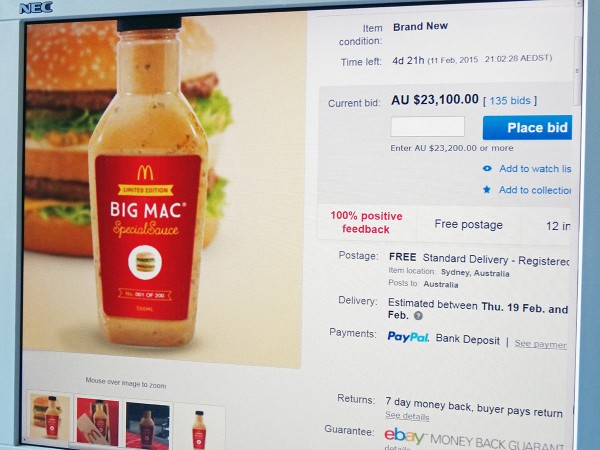
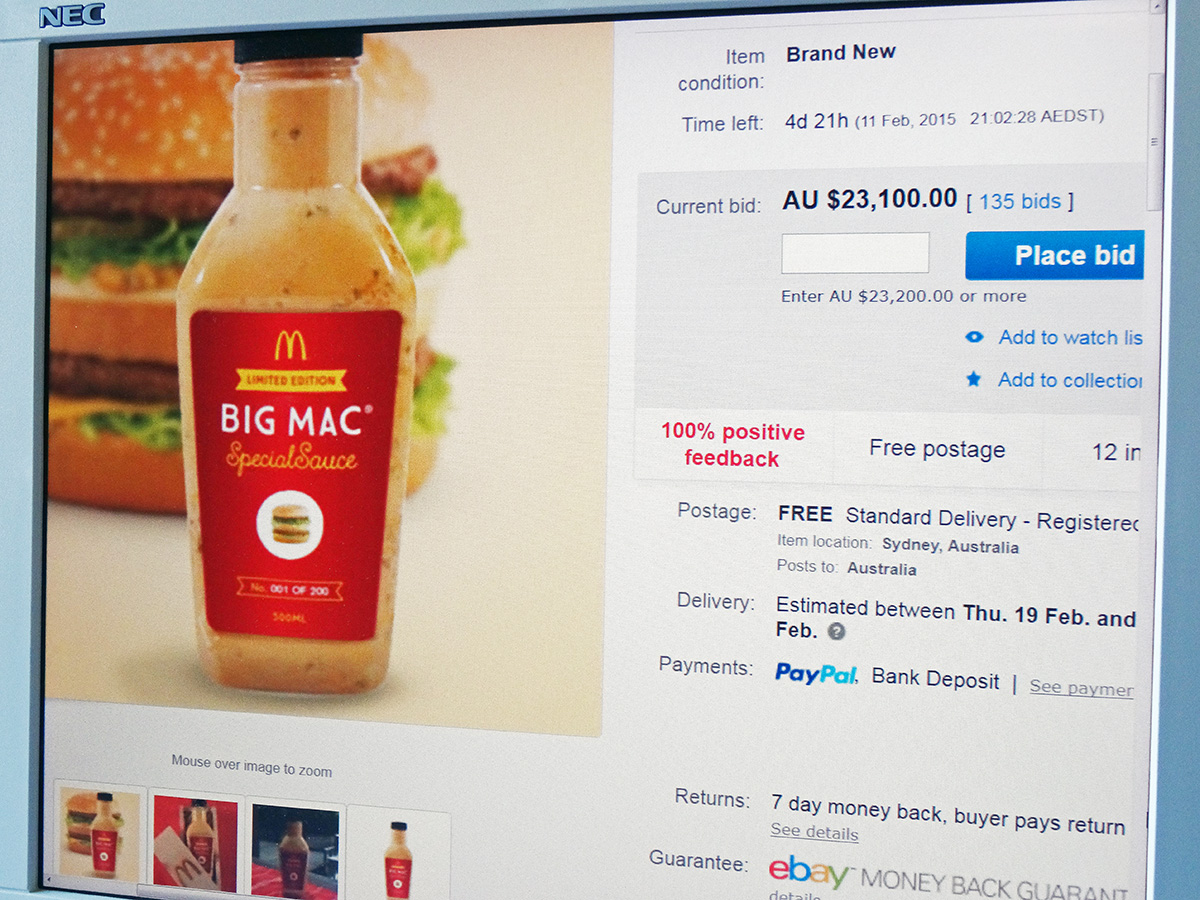
 McDonalds is one of the most recognised names in the world and its iconic product, the Big Mac, is an obsession for many people – though I have to confess that I have never had one. McDonalds is taking advantage of this fact by auctioning off a bottle of its secret Big Mac sauce. The proceeds will go to charity.
McDonalds has around 36 000 stores around the world, located in over 100 countries. The Big Mac is sold in all of these stores and the famous sauce is available there for a pretty small price. However, on eBay, this bottle of sauce has already reached a bid of AU$23 100 (£11 800)! The 500m bottle is only being auctioned in Australia and with a few days before the auction finishes, the price may get still higher.
So, why are people prepared to pay such a high price for a bottle of sauce that is readily available on a Big Mac and which, in Australia, will be sold in small tubs throughout this month?
The advert on eBay suggests that the bottle is being set free and is ‘rarer than a spot on Bondi beach on New Years Day’. As we know, when products become scarce their price tends to rise. This auction will be the first time that this sauce is available, as normally the sauce is dispensed straight onto the burger. The ingredients of this famous sauce are known, but the recipe for making it is not. Perhaps it represents an opportunity for someone to try to re-create it!
An auction is an interesting mechanism to receive the highest price for any product. Most people have a maximum willingness to pay for something and if they pay less than that, they will receive some consumer surplus. However, with an auction, it can be a good way for the seller to force consumers to bid their maximum price and hence this can reduce the consumer surplus.
Of course, in this auction only the highest bidder will actually pay and so it will only be their consumer surplus that is affected. However, other auction designs, such as an ‘All-pay’ auction can extract the full consumer surplus from bidders. Mr Lollback, the Chief Marketing Officer said:
‘We’re excited to be auctioning off the first-ever bottle of Big Mac sauce for a cause we are passionate about… It’s going to be interesting to see just how much people are prepared to pay for such a sought after commodity.’
The final price will certainly be interesting and, with other bottles of this sauce available, we will have to wait and see whether or not further auctions take place or if other mechanisms of delivering the sauce to the public appear. The following articles consider the Big Mac sauce auction.
McDonald’s Big Mac sauce auction attracts $18,000 bid BBC News (3/2/15)
Liquid Gold! Macca’s auction off the only bottle of its trademark Big Mac special sauce in Australia … and bids have already reached $23,000 Mail Online, Leesa Smith (3/2/15)
 Bottle of McDonald’s secret Big Mac sauce up for auction USA Today, Jessica Durando (3/2/15)
McDonald’s Big Mac special sauce yours to own from today The Telegraph, Richard Noone (29/1/15)
Questions
- Why does the price of a product rise when it is scarce? Use a diagram to explain this.
- What is consumer surplus and how can a firm aim to extract as much of this as possible? Why would a firm want to do this? Use a diagram to illustrate the concept of consumer surplus and how it can change.
- Why can an auction push up the market price of a product?/li>
- Given that the Big Mac sauce is available on all Big Macs, which can be purchased for a very low price, what explanation can be given for people being prepared to pay over £10,000?
- When are auctions a good mechanism to sell a product?
- What are the different types of auctions that can occur? How do they vary in terms of the price that can be achieved?
 One of the key prices in any economy is that of oil. Whenever oil prices change, it can have a knock-on effect on a range of other markets, as oil, or some variation, is used as an input into the production of countless products. The main products that consumers will see affected are energy prices and petrol prices..
Although on the supply-side, we see a large cartel in the form of OPEC, it is still the case that the forces of demand and supply directly affect the market price. Key things such as the demand for heating, economic growth, fears of war and disruption will change the demand and supply of oil. The possibility of militant strikes in oil producers, such as Syria, would normally reduce supply and push up the market price. However, we have actually seen oil prices drop much faster than we have in two years, dropping below $100 per barrel since September 5th. The slowdown of economic growth in Asia, together with the return of Libyan production at a level greater than expected have helped to push prices down and have offset the fears of global production.
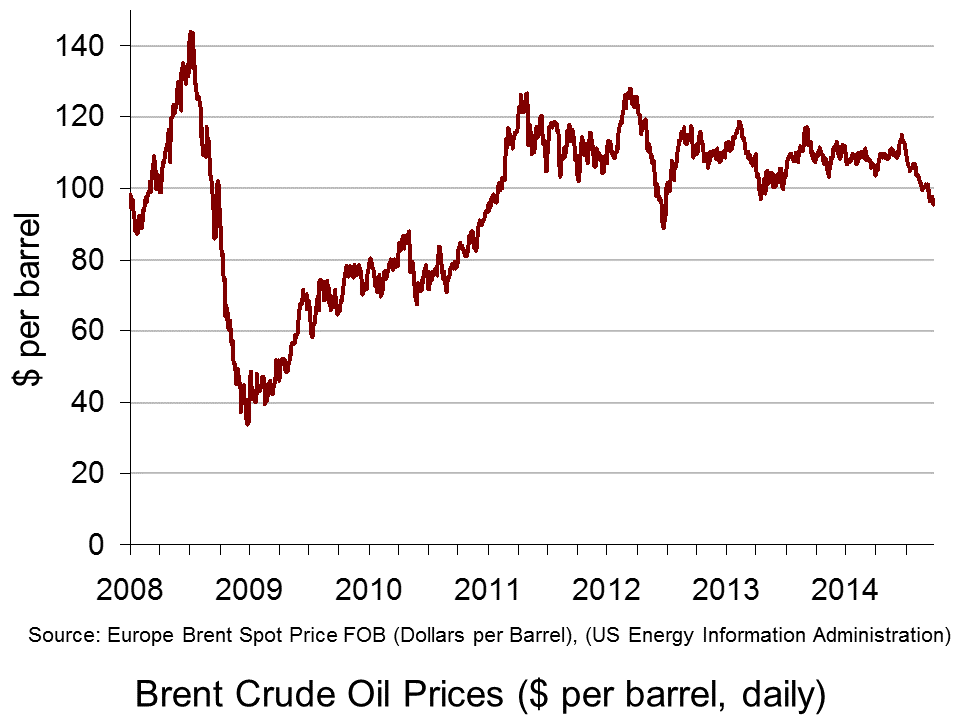 The market forces pushing prices down, while good for consumers and firms that use crude oil or one of its by-products, are clearly bad for oil producers. (Click here for a PowerPoint of the chart.) Countries are urging OPEC to halt its production and thereby shift supply upwards to the left putting a stop to the downward oil price trend. Several countries are concerned about the impact of lower prices, and one country that may be significantly affected is Russia. Some are suggesting that the impact could be as big as 4% of Russia’s GDP, taking into account the ongoing political crisis with Ukraine.
The market for oil is highly susceptible to changes in both demand and supply-side factors. Microeconomic changes will have an impact, but at the same time any global macroeconomic factors can have significant effects on the global price. Expectations are crucial and as countries release information about the size of the oil stocks and inventories, it is adding to the downward pressure on prices. Some oil experts have predicted that prices could get as low as $80 per barrel before OPEC takes significant action, influenced heavily by countries like Saudi Arabia. The following articles consider this global market.
Articles
Iran urges OPEC to halt oil price slide Financial Times, Anjli Raval (26/9/14)
Oil overflow: as prices slump, producers grapple with a new reality The Globe and Mail, Shawn McCarthy and Jeff Lewis (27/9/14)
Weak demand, plentiful supply drive decline in oil prices International Distribution (26/9/14)
Oil prices plunging despite ISIS CNN Money, Paul R La Monica (25/9/14)
Oil prices fall on EIA report of big U.S. crude stocks build Reuters, Robert Gibbons (17/9/14)
Sanctions and weaker oil prices could cost Russia 4% of GDP – official RT (25/9/14)
Data
Spot oil prices Energy Information Administration
Weekly European Brent Spot Price Energy Information Administration (Note: you can also select daily, monthly or annual.)
Annual Statistical Bulletin OPEC
Questions
- What are the key factors on the microeconomic side that affect (a) demand and (b) supply of oil?
- Explain the key macroeconomic factors that are likely to have an impact on global demand and supply of oil.
- Militant action in some key oil producing countries has caused fears of oil disruption. Why is that oil prices don’t reflect these very big concerns?
- Use a demand and supply diagram to explain the answer you gave to question 3.
- What type of intervention could OPEC take to stabilise oil prices?
- Why is the Russian economy likely to be adversely affected by the trend in oil prices?
- Changes in the global macroeconomy will directly affect oil prices. Is there a way that changes in oil prices can also affect the state of the global economy?
 Every year thousands of entrepreneurs will have another great idea that is sure to take off and bring in millions of customers. However, most of these great ideas will turn into another business failure. But, in the case of Dropbox, it is multiple business failures that eventually created a huge success, giving hope to millions of budding entrepreneurs.
With 300 million users, the file sharing ‘Dropbox’ is certainly a success, estimated at a value of $10bn. But it didn’t happen immediately and was preceded by a few failures. So, what is the secret to success in this case? The co-founder of Dropbox, Drew Houston, said that it is all about providing something that customers want. In the case of Dropbox, customers are crucial: the more people use it, the easier it becomes for others to use it too, as it allows file sharing on a much larger scale. Perhaps here we have a case of network externalities.
With Dropbox people would tell their friends about it and collaborate. So when you go into work and work on a project with colleagues you recruit them in essence to become Dropbox users because you’re all working on a project together.
No doubt there are many other examples of businesses that have proved a success after several failed attempts. Providing customers with what they want, at the time when they need it is clearly a key ingredient, but so, it appears, is business failure. The following article from BBC News considers the rise of Dropbox.
Dropbox and the failures behind it BBC News, Richard Taylor (1/7/14)
Questions
- Customers are clearly crucial for any business to succeed. How can a new entrepreneur find out if there is a demand?
- Why was timing so important in the case of Dropbox?
- Given that customers can actually use Dropbox for free, how does this company make so much money?
- What are network externalities? Explain them in the context of Dropbox.
- Drew Houston says that ‘distribution’ is another key ingredient to success. What do you think is meant by this and how will it help create success?
 Calls for an independent Scotland have focused on a variety of economic issues. These have included taxation, government spending, currency, fiscal policy and monetary policy. However, the BBC News article below looks at another factor which may be affected by a ‘yes’ vote – the price of stamps.
Having just returned from 10 days in the Highlands, I certainly agree with the BBC article that it would be an expensive business to deliver to the remotest parts of Scotland and would definitely require ‘trains, planes, ferries, Land Rovers and vans’ and, in an extreme case, a fishing boat.
So is the price we pay for postage to less rural areas of the UK used to subsidise the higher costs of delivery to the remotest parts of Scotland and, in particular, to the small islands off the Scottish coastline? What would a ‘yes’ vote mean for the cost of stamps in Scotland and in the remainder of the UK? The following articles consider this rather odd question.
Why postage should be cheaper in UK if Scots vote ‘Yes’ BBC News, Brian Milligan (19/4/14)
Tories warn over post service costs The Courier (6/4/14)
Questions
- What happened when the Royal Mail was privatised?
- What are the benefits and costs of privatisation?
- Using a cost and revenue diagram, explain how the different costs of delivery between urban parts of the UK and the remotest parts of Scotland should be reflected in different prices of postage.
- If the price of postage is the same for delivery everywhere in the UK, use your diagram to explain how this happens.
- What does your diagram suggest will happen to the price of postage stamps if a ‘subsidy’ is no longer available?
 Globalisation has led to an increasingly interdependent world, with companies based in one country often dependent on a market abroad. In recent years, it is the rapid growth of countries like China that has led to growth in the size of the markets for many products. With incomes rising in emerging countries, demand for many products has been growing, but in the past year, the trend for Prada has ended and seems to be reversing.
As the market in China matures and growth of demand in Europe slows, Prada has seen its shares fall by the largest margin since June last year.
Prada is a well-known luxury brand. The products it sells are relatively expensive and hence its products are likely to have an income elasticity of demand well above +1. With changes in China and Europe, Prada expects its growth in sales to January 2015 will be ‘low single-digit’ – less than the 7% figure recorded for the last financial year.
 This lower growth in same-store sales is likely to continue the following year as well. Add on to this the lower-than-expected profits, which missed analysts’ forecasts, and you have a prime example of a brand that is suffering because of its customer base and the economic times.
Prada isn’t alone in suffering from economic conditions and, relative to its European counterparts, is expected to have higher growth in sales and profits in the next 12 months – at 11.5% and 14.8% respectively. This is according to a survey by Thomson Reuters.
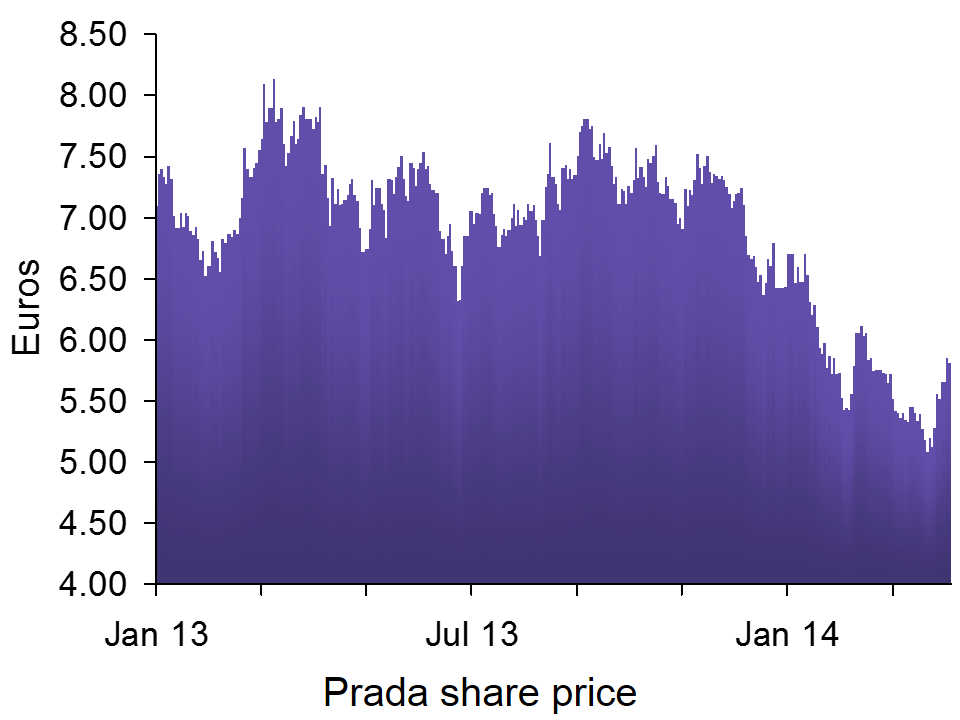 Prada has exploited high demand by Chinese consumers, but has recently been affected by the strength of the euro. A strong euro means that the Italian-based Prada is struggling with exports, which only adds to its problems. As economic growth picks up in China and as other emerging economies begin to experience more rapid economic growth, the fortunes of this luxury-retailer may change once more. However, with volatile economic times still around in many countries, the future of many retailers selling high-end products to higher income customers will remain uncertain. The following articles consider the fortunes of Prada.
Prada shares fall sharply after China luxury warning BBC News (3/4/14)
Prada falls after forecasting slowing luxury sales growth Bloomberg, Andrew Roberts and Vinicy Chan (3/4/14)
Prada profits squeezed by weakness in Europe and crackdown in China The Guardian (2/4/14)
Prada bets on men to accelerate sales growth Reuters, Isla Binnie (2/4/14)
Prada misses full year profit forecast Independent, Laura Chesters (2/4/14)
Questions
- How can we define a luxury product?
- Explain the main factors which have led to a decline in the demand for Prada products over the past 12 months.
- Using a diagram, illustrate what is meant by a strong euro and how this affects export demand.
- What business strategies are Prada expected to adopt to reverse their fortunes?
- Using a diagram, explain the factors that have caused Prada share prices to decline.
 McDonalds is one of the most recognised names in the world and its iconic product, the Big Mac, is an obsession for many people – though I have to confess that I have never had one. McDonalds is taking advantage of this fact by auctioning off a bottle of its secret Big Mac sauce. The proceeds will go to charity.