 House prices have been rising strongly in London. According to the Halifax House Price index, house prices in London in the first quarter of 2014 were 15.5% higher than a year ago. This compares with 8.7% for the UK as a whole, 1.3% for the North of England and –1.5% for Scotland. CPI inflation was just 1.6% for the same 12-month period.
The London housing market has been stoked by rising incomes in the capital, by speculation that house prices will rise further and by easy access to mortgages, fuelled by the government’s Help to Buy scheme, which allows people to put down a deposit of as little as 5%. House prices in London in the first quarter of 2014 were 5.3 times the average income of new mortgage holders, up from 3.5 times in the last quarter of 2007, just before the financial crisis.
Concerns have been growing about increasing levels of indebtedness, which could leave people in severe financial difficulties if interest rates were to rise significantly. There are also concerns that an increasing proportion of people are being priced out of the housing market and are being forced to remain in the rental sector, where rents are also rising strongly.
But how can the housing market in London be dampened without dampening the housing market in other parts of the country where prices are barely rising, and without putting a break on the still relatively fragile recovery in the economy generally?
The Governor of the Bank of England has just announced two new measures specific to the housing market and which would apply particularly in London.
The first is to require banks to impose stricter affordability tests to new borrowers. Customers should be able demonstrate their ability to continue making their mortgage payments if interest rates were 3 percentage points higher than now.
The second is that mortgage lenders should restrict their lending to 4½ times people’s income for at least 85% of their lending.
Critics are claiming that these measures are likely to be insufficient. Indeed, Vince Cable, the Business Secretary, has argued for a limit of 3½ times people’s income. Also banks are already typically applying a ‘stress test’ that requires people to be able to afford mortgage payments if interest rates rose to 7% (not dissimilar to the Bank of England’s new affordability test).
The videos and articles look at the measures and consider their adequacy in dealing with what is becoming for many living in London a serious problem of being able to afford a place to live. They also look at other measures that could have been taken.
Webcasts and Podcasts
 The Bank of England announces plans for a new affordability test BBC News (26/6/14)
Bank of England moves to avert housing boom BBC News, Simon Jack (26/6/14)
Bank of England to act on house prices in south-east BBC News, Robert Peston (25/6/14)
Bank of England measures ‘insure against housing boom’ BBC News, Robert Peston (26/6/14)
Carney: There is a ‘new normal’ for interest rates BBC Today Programme, Mark Carney (27/6/14)
Articles
Bank of England imposes first limits on size of UK mortgages Reuters, Ana Nicolaci da Costa and Huw Jones (26/6/14)
Stability Report – Mark Carney caps mortgages to cool housing market: as it happened June 26, 2014 The Telegraph, Martin Strydom (26/6/14)
Bank of England cracks down on mortgages The Telegraph, Szu Ping Chan (26/6/14)
Mortgage cap ‘insures against housing boom’ BBC News (26/6/14)
Viewpoints: Is the UK housing market broken? BBC News (26/6/14)
How can UK regulators cool house prices? Reuters (25/6/14)
Bank will not act on house prices yet, says Carney The Guardian, Jill Treanor and Larry Elliott (26/6/14)
Mark Carney’s housing pill needs time to let economy digest it The Guardian, Larry Elliott (26/6/14)
Bank Of England Admits Plans To Cool Housing Market Will Have ‘Minimal’ Impact Huffington Post, Asa Bennett (26/6/14)
Carney Surprises Are Confounding Markets as U.K. Central Bank Manages Guidance Bloomberg, Scott Hamilton and Emma Charlton (26/6/14)
House prices: stop meddling, Mark Carney, and bite the bullet on interest rates The Telegraph, Jeremy Warner (27/6/14)
Mark Carney’s Central Bank Mission Creep Bloomberg, Mark Gilbert (26/6/14)
Consultation paper
Implementing the Financial Policy Committee’s Recommendation on loan to income ratios in mortgage lending Bank of England (26/6/14)
Bank of England consults on implementation of loan-to-income ratio limit for mortgage lending Bank of England News Release (26/6/14)
Data
Links to sites with data on UK house prices Economic Data freely available online, The Economics Network
Questions
- Identify the main factors on the demand and supply sides that could cause a rise in the price of houses. How does the price elasticity of demand and supply affect the magnitude of the rise?
- What other measures could have been taken by the Bank of England? What effect would they have had on the economy generally?
- What suggests that the Bank of England is not worried about the current situation but rather is taking the measures as insurance against greater-than-anticipated house price inflation in the future?
- Why are UK households currently in a ‘vulnerable position’?
- What factors are likely to determine the future trend of house prices in London?
- Is house price inflation in London likely to stay significantly above that in other parts of the UK, or is the difference likely to narrow or even disappear?
- Should the Bank of England be given the benefit of the doubt in being rather cautious in its approach to dampening the London housing market?
 The spectre of deflation haunts the eurozone economy. Inflation in the 12 months to May 2014 was 0.5%, down from 0.7% to April and well below the target of 2% (see). Price deflation can result in deflation of the whole economy. With the prospect of falling prices, many consumers put off spending, hoping to buy things later at a lower price. This delay in spending deflates aggregate demand and can result in a decline in growth or even negative growth: hardly a welcome prospect as the eurozone still struggles to recover from the long period of recession or sluggish growth that followed the 2007–8 financial crisis.
The ECB is well aware of the problem. Its President, Mario Draghi, has stated on several occasions that the central bank will do whatever it takes to ward off deflation and stimulate recovery. At its monthly meeting on 5 June, the ECB Council acted. It took the following measures (see Mario Draghi’s press conference and the press release):
• The main refinancing rate it charges banks on reverse repos (when using open-market operations) was cut from 0.25% to 0.15%.
• The rate it pays banks for depositing money in the ECB was cut from 0% to –0.1%. In other words, banks would be charged for ‘parking’ money with the ECB rather than lending it.
• It will provide targeted lending to banks (targeted longer-term refinancing operations (TLTROs)), initially of 7% of the total amount of each banks’ loans to the non-financial private sector within the eurozone. This will be provided in two equal amounts, in September and December 2014. These extra loans will be for bank lending to businesses and households (other than for house purchase). The total amount will be some €400 billion. Substantial additional lending will be made available quarterly from March 2016 to June 2016.
• It will make preparations for an asset purchase scheme. Unlike that in the UK, which involves the purchase of government bonds, this will involve the purchase of assets which involve claims on private-sector (non-financial) institutions. Depending on financing arrangements, this could amount to quantitative easing.
 • It will suspend sterilising the extra liquidity that has been injected under the Securities Markets Programme (operated from May 2010 to September 2012), which involved purchasing eurozone countries’ existing bonds on the secondary market. In other words it will stop preventing the securities that have been purchased from increasing money supply. This therefore, for the first time, represents a genuine form of quantitative easing.
The question is whether the measures will be enough to stimulate the eurozone economy, prevent deflation and bring inflation back to around 2%. The measures are potentially significant, especially the prospect of quantitative easing – a policy pursued by other main central banks, such as the Fed, the Bank of England and the Bank of Japan. A lot depends on what the ECB does over the coming months.
The following articles consider the ECB’s policy. The first ones were published before the announcement and look at alternatives open to the ECB. The others look at the actual decisions and assess how successful they are likely to be.
Articles published before the announcement
Mario Draghi faces moment of truth as man with power to steady eurozone The Observer, Larry Elliott (1/6/14)
What the ECB will do in June? Draghi spells it out The Economist (26/5/14)
Draghi as Committed as a Central Banker Gets, as Economists Await ECB Stimulus Bloomberg, Alessandro Speciale and Andre Tartar (19/5/14)
ECB’s credit and credibility test BBC News, Robert Peston (2/6/14)
90 ECB decamps to debate monetary fixes Financial Times, Claire Jones (25/5/14)
Speech
Monetary policy in a prolonged period of low inflation ECB, Mario Draghi (26/5/14)
Articles published after the announcement
ECB launches €400bn scheme, seeks to force bank lending Irish Independent (5/6/14)
The ECB’s toolbox BBC News, Linda Yueh (5/6/14)
ECB’s justified action will help but is no panacea for eurozone deflationary ills The Guardian, Larry Elliott (5/6/14)
Why Negative Rates Won’t Work In The Eurozone Forbes, Frances Coppola (4/6/14)
Germany’s fear of QE is what’s stopping us from cracking open the Cava The Telegraph, Roger Bootle (8/6/14)
Data
Euro area economic and financial data ECB
Questions
- Why has the eurozone experienced falling inflation and a growing prospect of negative inflation?
- Explain how the Securities Markets Programme (SMP) worked (check it out on the ECB site). What countries’ bonds were purchased and why?
- What is meant by sterilisation? Why did the ECB sterilise the effects of the assets purchased under the SMP?
- If it is practical for the ECB to set a negative interest rate on the deposit facility for banks, would it be practical to set a negative interest rate for the main refinancing operations or the marginal lending facility? Explain.
- Why has the ECB, up to now, been unwilling to engage in quantitative easing? What has changed?
- Why may the introduction of a negative interest rate on bank deposits in the ECB have only a very small effect on bank lending?
- How much is broad money supply growing in the eurozone? Is this enough or too much? Explain.
- What else could the ECB have done to ward off deflation? Should the ECB have adopted these measures?
 At the end of January 2014, we looked at the problem of deflation and in particular at the fortunes of Japan, as its CPI was rising. As the blog explained, the Japanese economy, rather than being plagued by high inflation has been plagued by deflation and many suggest this is even worse.
In December 2013, Japan’s core consumer prices were growing faster than expected. The data gave the economy a much needed boost, following increases in government spending aimed at stimulating aggregate demand. This in turn pushed up prices, such that they achieved their fastest rate of growth in 5 years. Now, more recent date from May 2014 shows that the trend has continued. Prices in Japan have now increase at their fastest rate in 23 years, rising 3.2% and beating the forecasts of 3.1%. This means that prices have no risen in Japan for 11 consecutive months. Numerous policies have contributed towards this impressive trend for an economy plagued by deflation for 2 decades. Boosts in the money supply, increases in government spending, a rise in sales tax are just some of the contributing factors.
 Although the economy is certainly over the problem of deflation, some are now concerned that such price rises may reduce consumer spending. An ironic twist, given that barely a year ago the concern about low consumer spending was due to deflation. The next 12 months will be a key indicator of how consumers will respond to this unusual inflation data – after all inflation and high prices have been pretty uncommon. The following articles consider the update on the Japanese economy.
Japan inflation rate hits 23 year high (including video) BBC News (30/5/14)
Japan April core CPI rises to 23-year high after sales tax rise Reuters (29/5/14)
Japan inflation accelerates Wall Street Journal, Takashi Nakamichi (30/5/14)
Japan’s consumer inflation set to reach five year high The Guardian (18/4/14)
Japan’s inflation at highest rate for 23 years The Telegraph, Rebecca Clancy (30/5/14)
Japan inflation quickens to fastest since 1991 Bloomberg, Toru Fujioka (30/5/14)
Japaense inflation rises at fastest pace in over five years at 1.3% in December 2013 Independent, Russel Lynch (31/1/14)
Questions
- Why is deflation a problem?
- Using an AD/AS diagram, illustrate the problem of expectations and how this contributes to stagnant growth.
- Japanese policies have helped create a rise in the CPI. Which policies have been effective in creating rising prices?
- Explain how the sales tax has contributed towards higher prices.
- With prices rising, there are now concerned that consumer spending may decline. Using a diagram, explain why this may be the case.
- In the previous blog, we analysed the Indian economy and said that high inflation was something that was contributing towards lower growth. How is that low inflation or deflation can also contribute towards low growth?
 The expansion of the BRIC economies has both advantages and disadvantages for Western countries. Their consistently high growth rates have created a much wider market place for Western firms and a much needed additional source of consumer demand, especially in times of recession. Countries such as China have had double digit growth rates, with others like India experiencing growth rates of just under 10%. But are these impressive growth rates now beginning to fall?
For the last 2 years, the growth rate in the Indian economy has been sub-5%, with growth in the 2013-14 financial year at 4.7%. Though some sectors, including agriculture have experienced buoyant growth, it is other sectors that have been holding this economy back. Manufacturing contracted at an annualised rate of 1.4% over the quarter, while mining contracted by 0.4%. With a growth rate of just under 5%, one might think that this was good – after all many Western economies have only recently entered positive growth. However, the Indian economy has a rapidly growing population and it is estimated that 10 million additional jobs each year must be created. It is this figure that requires such a high growth rate – estimated at around 8%. Thus, the sub-5% growth recorded for 2 years is insufficient to sustain the required job creation.

There are many factors that appear to be holding growth back. High inflation has been a problem for some years and the Indian currency has been relatively weak and volatile. Together, these issues have created an environment of uncertainty and if there’s one thing that investors don’t like, it’s uncertainty. This has therefore led to a lack of investment in the economy, which is a key component of aggregate demand and hence a key source of economic growth. Furthermore, interest rates rose last year, thereby pushing up the cost of borrowing and the rate of credit growth has also slowed. These factors collectively have led to lower foreign investment, domestic investment and spending, which have all contributed towards more subdued growth than in the past. Glenn Levine, a senior economist at Moody’s said:
India’s economy continues to grow well below potential as a combination of supply‐side constraints and the adverse effects of an underperforming government weigh on capital expenditure and hiring … It will be a while before the Indian economy is expanding above 6% again.
However, many economists remain optimistic about the prospects of Asia’s third-largest economy. Inflation appears to be under control and the currency has gained strength. Many believe that more investment supporting government policies will be the kick start the economy needs and this will in turn encourage firms to begin investment. It may be the new leader of this country, Narendra Modo, that will jump start the economy. The Prime Minister is expected to back policies to stimulate growth, who will direct more spending at infrastructure, simplify taxes and introduce policies to attract foreign investment. Adi Godrej, Chairman of the Godrej group said:
As soon as investors see the first signals of growth-supportive policies, you will see a definite turnaround on the ground.
The coming months will be crucial in determining how quickly the Indian economy is likely to see a return to near double digit growth. The new government has indeed promised policies to boost the economy, but the annual budget will confirm whether this promise is likely to be kept. Given the dependence of Indian jobs on a fast growth rate and the dependence of the Western world on the continued growth of the BRICs in creating a wider market for our exports, the fortunes of India are extremely important. The following articles consider this economy.
Indian economy grew at 4.7% in 2013-14 The Times of India (30/5/14)
India’s economic growth disappoints BBC News (30/5/14)
India’s GDP grows 4.7% in fiscal year, missing government forecast Wall Street Journal, Anant Vijay Kala (30/5/14)
India’s economy expands 4.7pct in fiscal year 2013/14 Reuters (30/5/14)
India’s economy still underwhelms CNN Money, Charles Riley, Alanna Petroff (30/5/14)
FY14 GDP growth at 4.7%; India sees worst slowdown in 25 years The Economic Times (30/5/14)
India growth below 5% adds pressure on Modi to spur investment Bloomberg, Unni Krishnan (30/5/14)
Jim Armitage: ‘Modinomics’ in India has helped growth, but not for all Independent, Jim Armitage (17/5/14)
Questions
- Using a diagram, explain how economic growth can be created through (a) demand-side measures and (b) supply-side measures.
- Why would higher interest rates reduce growth?
- Why does high inflation create uncertainty and what impact does this have on business investment?
- India has experienced a weak and volatile currency and this has contributed towards a lack of foreign investment and low growth. Using a diagram, explain why this could be the case.
- What sort of government policies would you recommend for the Indian economy if you had become the new Prime Minister and your primary objective was to boost economic growth?
- Why is the expansion of the BRIC economies, of which India is one, so important for Western economies?
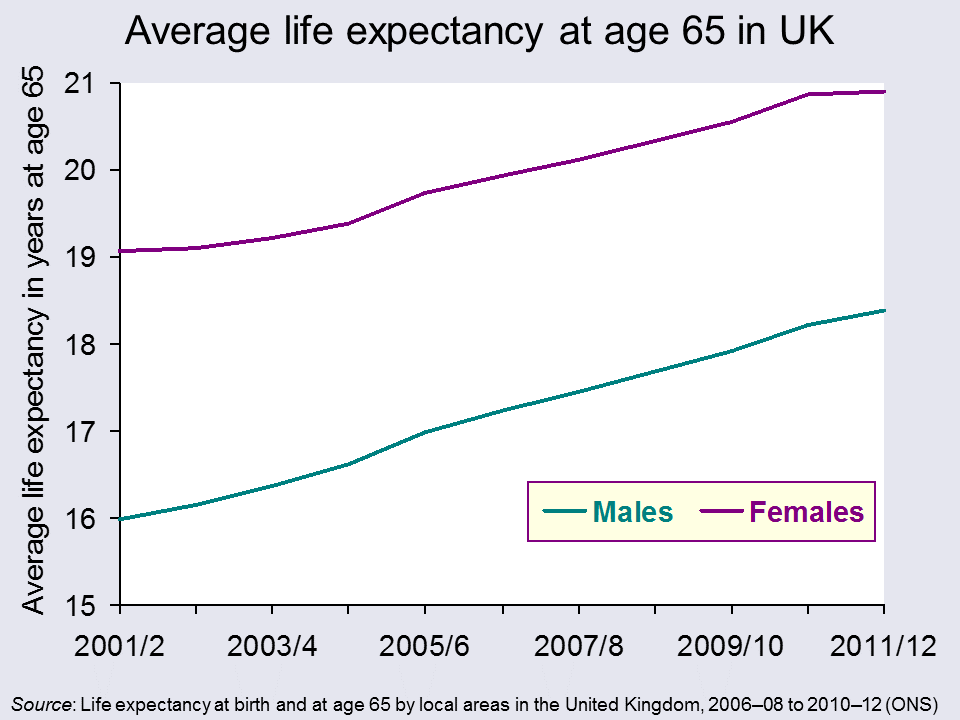
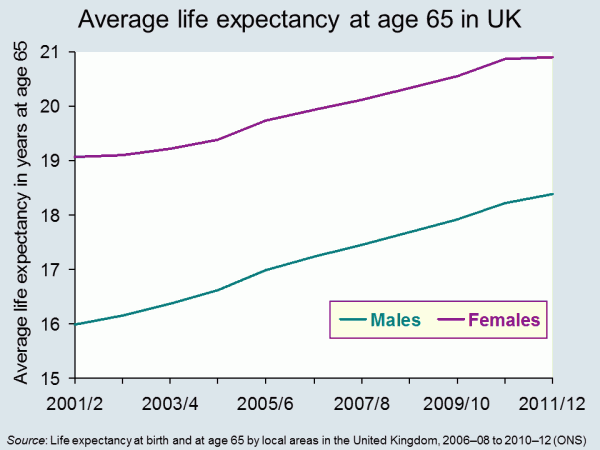 Life expectancy is increasing across the world and the latest set of figures from the Office for National Statistics show that in the UK it has passed 79 for boys born in 2010–12, and 82 for girls born then. In fact the prediction is that over a third of babies born in 2013 will live to more than 100. The data throws up some interesting questions. How well prepared are we for lives that last this long? And how evenly distributed is this increase in life expectancy? Pensions’ minister, Steve Webb, has called for better information on life expectancy to be shared. How would this impact on our decision making?
It seems reasonable to think that increasing life expectancy must be good news. And of course, for individuals it can be. In 1951 the average man retiring at 65, in England and Wales, could expect to live and draw a pension for another 12.1 years. By 2014 this had risen to 22 years.
 But while we can look forward to longer life, for the government, it presents some challenges The first is that we just don’t save enough for our old age. This seems to be partly because we find it hard to make decisions that will have an impact so far in the future. There are a number of measures that have been put in place to encourage us to save more, including auto-enrolment into company pension schemes. This is being rolled out across businesses over the next three years. In the 2014 Budget, the Chancellor announced that people reaching retirement age will be able to draw all their pension as a cash lump sum, rather than having to take it as a regular income.
Another concern for government is the variations that we find in life expectancy across the UK. The 2014 ONS data identified that life expectancy for men born in Glasgow in 2012 is 72.6, in East Dorset it is 82.9. 25% of those in Glasgow are not expected to live to 65. The gap in years of good health is even greater. This presents governments with a long-term problem. How do they achieve greater equality in this instance? Do they focus resources on the areas that need it most? Do they legislate to address behaviour? Or do they rely on the provision of good advice – on diet, exercise and other factors?
Information has a role to play in both areas identified above. In April 2014, Steve Webb, suggested that in order to make good decisions at the point of retirement, people need to understand more about what lies ahead. He said:
People tend to underestimate how long they’re likely to live, so we’re talking about averages, something very broad-brush. Based on your gender, based on your age, perhaps asking one or two basic questions, like whether you’ve smoked or not, you can tell somebody that they might, on average, live for another 20 years or so.
This suggestion has led to some concerns being expressed at what appears to be an over-simplistic approach. Estimates can only be based on a mix of averages modified by individual information. Would the projections be shared with pension providers? What would you do if you exceeded your forecast life expectancy – by a long way – and had spent all your money? Could you sue someone?
Will your pension pot last as long as you will? The Telegraph, Dan Hyde and Richard Dyson (23/4/2014)
Scientists invent death test that will tell us how long we have to live Metro (11/8/13)
Games host Glasgow has worst life expectancy in the UK The Guardian, Caroline Davies (16/4/2014)
Pensioners could get life expectancy guidance BBC News Politics (17/4/14)
ONS reveals gaps in life expectancy across the UK FT Adviser Pensions, Kevin White (23/4/14)
Health care aid for developing countries boosts life expectancy Health Canal, Ruth Ann Richter (22/4/14)
A third of babies born this year will live to 100 This is Money.co.uk, Adam Uren (11/12/13)
Questions
- Thinking about the UK, what are the factors that might explain variations in life expectancy across different regions? How might the government address these differences? Why would they want to do so?
- Do the same factors explain variations between countries? Who can address these differences? Who would want to do so?
- If you could have a reasonable prediction of your life expectancy at 65, would you want it? How would your behaviour change if you were predicted a longer than average life expectancy? How would it change if you were predicted a shorter than average life expectancy?
- If you could have an accurate prediction of your life expectancy at 18, how would your answers differ? If this were possible, would it present any problems?
 House prices have been rising strongly in London. According to the Halifax House Price index, house prices in London in the first quarter of 2014 were 15.5% higher than a year ago. This compares with 8.7% for the UK as a whole, 1.3% for the North of England and –1.5% for Scotland. CPI inflation was just 1.6% for the same 12-month period.