 A recent article on this blog discussed the likelihood that we will soon move to a cashless society. It is therefore interesting to consider the implications that this might have for consumer behaviour. We might expect the form of payment to make no difference to a rational consumer. However, there is considerable evidence to suggest that this is not the case.
One reason why people appear to spend more freely on credit cards is payment decoupling – you get utility from the item purchased before you pay the cost. However, more recent evidence suggests that this is not the only relevant factor. It appears that the degree of transparency of the payment method also has an effect. Psychologists quoted in the above article conclude from their experimental evidence that:
Payment modes differ in the transparency with which individuals can feel the outflow of money. ….with cash being the most transparent payment mode.
This effect also appears to make people spend cash less freely.
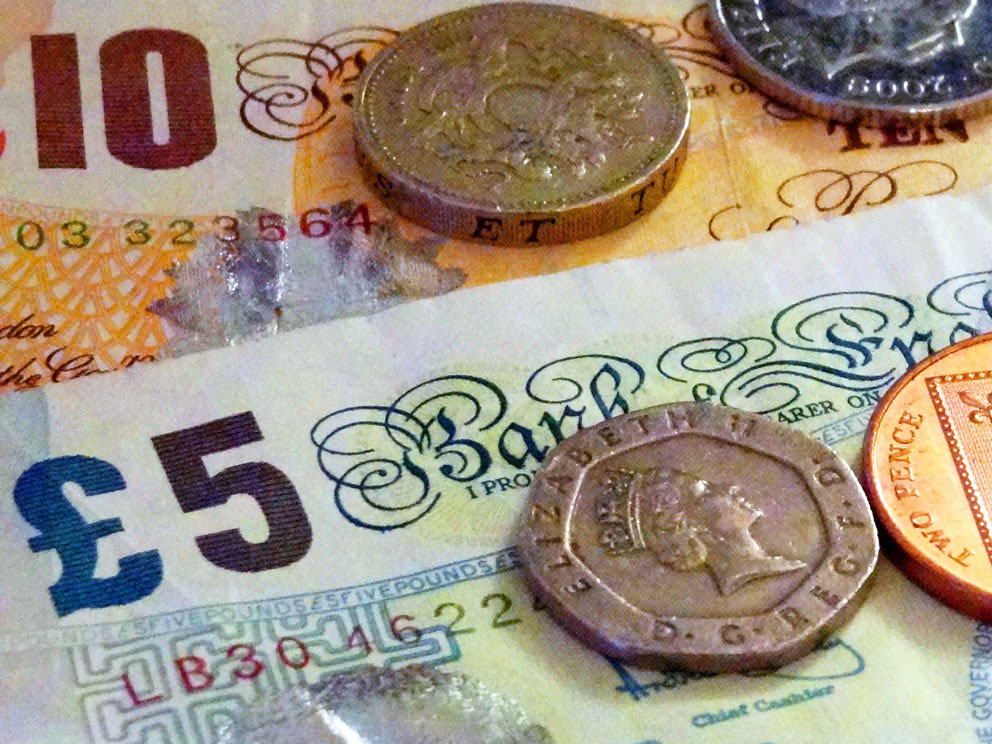 The author of the above article spent some time experimenting with trying to make all his purchases using cash. He found that by doing so, he was able to reduce his spending by about 10%. However, this seems likely to become harder to do in the future and, as the article concludes, it is already difficult to purchase some items with cash.
Article
Why does foreign money seem like play money? Science Codex (04/06/07)
Questions
- What type of products is it already difficult to purchase with cash?
- How did the psychologists test the transparency of payment methods?
- Do you think the consumer behaviour described above is likely to persist in the long-run?
- Might firms be able to take advantage of the consumers behave described above?
- Do you think the transparency of foreign currencies is the main reason why people spend more when they are abroad?
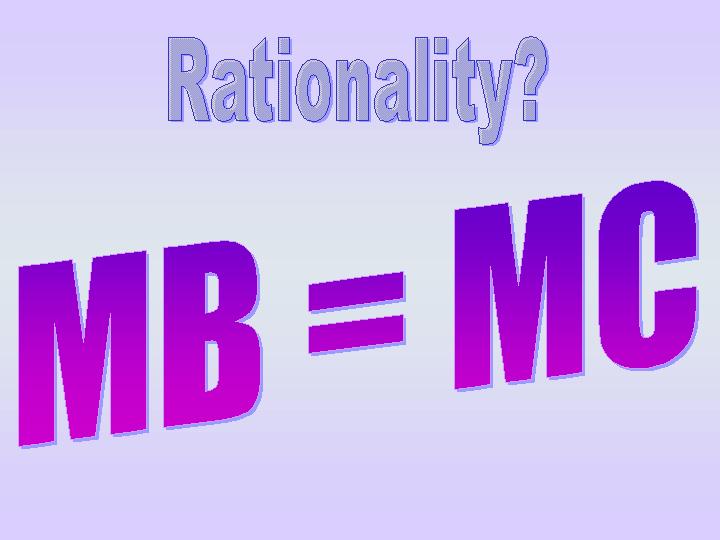
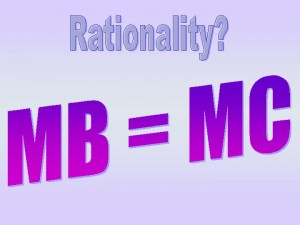 A key economic principle is that rational decision making requires thinking at the margin. This involves a comparison of the additional (or marginal) benefits and costs of an activity.
An example of such rational behaviour would be deciding to drink one more beer or spending one more hour studying only if the additional benefits were greater than the additional costs. The optimum is where marginal benefit equals marginal cost.
And this applies to firms too. A firm maximises its profits by producing the output at which marginal revenue is equal to marginal cost.
 However, a recent book by the American business guru Clayton Christensen argues that thinking in this way can be a problem. A recent article in the Guardian describes a story he tells of the time he refused to play for his university basketball team in a national final which took place on a Sunday and therefore conflicted with his religious beliefs. His decision involved sticking to his principles rather than thinking at the margin. For him, whilst the marginal cost of sacrificing these principles just once may well have been small compared to the resulting benefits, the eventual cost would be much higher.
Christensen also suggests that similar arguments can apply to firm decision making. The above article provides an example he uses of decisions made by executives at the Blockbuster video chain. When smaller rivals started offering movies by mail, Blockbuster instead continued to invest in its existing video store business model. This eventually proved disastrous for the company. The explanation given for this is that building on previous investments made more sense than setting up a mail-order arm which would cannibalise their existing business. On the other hand, an alternative explanation may be that executives at Blockbuster were irrationally allowing sunk costs to affect their decision making.
Articles
Clayton Christensen’s “How Will You Measure Your Life?” Harvard Business School, Clayton Christensen (9/5/12)
Clay Christensen’s life lessons BloombergBusinessweek, Bradford Wieners (3/5/12)
Bust Blockbuster goes on the block Guardian, Ben Child (4/4/11)
Questions
- Can you think of a situation where you have decided to stick to your principles rather than think at the margin?
- Why does a firm maximise profit by producing the output at which marginal revenue is equal to marginal cost?
- What do you think are the main costs of setting up a mail-order business?
- Are these costs mainly fixed or variable costs?
- Why is it irrational to take sunk costs into account when making a decision?
- Can you think of a situation where you have been influenced by sunk costs?
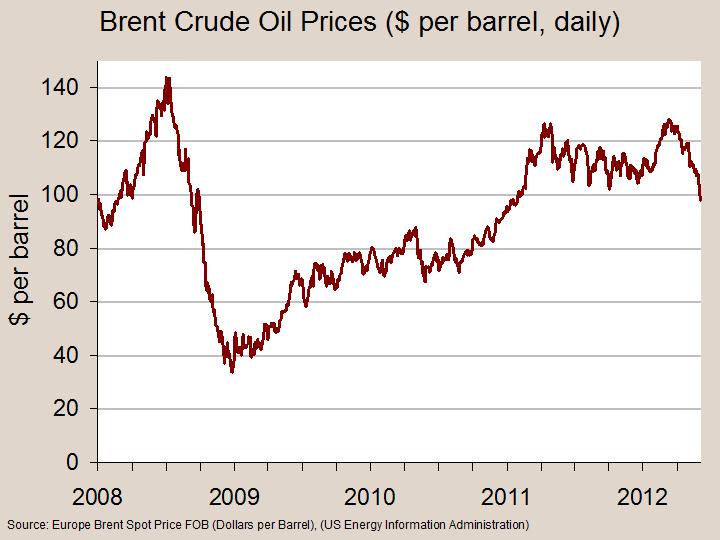
 Oil prices have been falling in recent months. By early June they had reached a 17-month low. The benchmark US crude price (the West Texas Intermediate price) fell to $83.2 at the beginning of the month, and Brent Crude (the North Sea reference price for refining into petrol) fell to $97.7 (see chart). (For a PowerPoint of the chart below, click here.)
At the same time various commodity prices have also been falling. The IMF all commodities price index has fallen by 7.2% over the past 12 months and by 6.2% in May alone. Some commodities have fallen much faster. In the 12 months to May 2012, natural gas fell by 44%, wheat by 25%, lamb by 37%, Arabica coffee by 36%, coconut oil by 45%, cotton by 47%, iron ore by 23% and tin by 29%.
Although part of the reason for the fall in the price of some commodities is increased supply, the main reason is weak world demand. And with continuing problems in the eurozone and a slowdown in China and the USA, commodity price weakness is likely to continue.
 So is this good news? To the extent that commodity prices feed through into consumer prices and impact on the rate of inflation, then this is good news. As inflation falls, so central banks will be encouraged to make further cuts in interest rates (in the cases where they are not already at a minimum). For example, the Reserve Bank of Australia cut its cash rate last week from 3.75% to 3.5%. This follows on from a cut from 4.25% on 1 May. In cases where there is no further scope for interest rate cuts (e.g. the US Federal Reserve Bank, whose interest rate is between 0% and 0.25%), then the fall in inflation may encourage a further round of quantitative easing.
But falling commodity prices are also a reflection of bad news, namely the low economic growth of the world economy and fears of turmoil from a possible Greek exit from the euro.
Update
A day after this was written (9/6/12), a deal was agreed between eurozone ministers to provide support of up to €100 billion for Spanish banks. This helped to reduce pessimism about the world economy, at least temporarily. Stock markets rose and so too did oil prices, by around 1%. But if pessimism increases again, then the fall is likely to resume.
Articles
Oil prices hit a 17-month low on China slowdown fears BBC News (8/6/12)
Oil gives up gains without signs of Fed move BloombergBusinessweek, Sandy Shore (7/6/12)
Oil Heads for Longest Run of Weekly Losses in More Than 13 Years BloombergBusinessweek, (8/6/12)
Gold plunges as Bernanke gives no hint of stimulus Live5News(7/6/12)
Oil Price Tumbles Below $83 on Weak Economy Money News(8/6/12)
World food price index expected to fall for May Reuters(6/6/12)
Oil price losing streak continues Guardian, Julia Kollewe (8/6/12)
Data
Spot fuel prices US Energy Information Administration
Commodity Prices Index Mundi
Crude Oil Price Index Index Mundi
Questions
- Why have crude oil prices fallen to their lowest level for 17 months?
- How can the concepts of income elasticity of demand, price elasticity of supply and price elasticity of demand help to explain the magnitude of the fall in crude oil prices?
- Would a fall in inflation linked to a fall in commodity prices be a fall in cost-push or demand-pull inflation? Explain.
- What are the macroeconomic implications of the fall in crude oil prices?
- What factors are likely to have significant impact on crude oil prices in the coming months
- Why is it difficult to predict crude oil prices over the coming months?
 Here’s a question that goes to the heart of economics and the social sciences generally: how desirable is the market system?
Our lives are dominated by markets. Whether in working or consuming, we operate in a market economy in which money is exchanged for goods or services. But also financial and product markets determine much of the structure of society, where most things seem to have a price.
But whilst, as a positive statement, we can say that money and markets are all around us, does that make them desirable? Markets provide signals and incentives; but are the signals the right ones? What are the incentives and how do we respond to them? And are these responses optimal?
 You will probably have studied various ways in which markets fail to provide the optimal allocation of resources. But what are the limits of markets as a mechanism for social choices? And is there some more fundamental issue about the morality of a society that is organised around markets?
These are questions considered in the following podcast. It is an episode from BBC Radio 4’s Start the Week programme, hosted by Andrew Marr, with guests Michael Sandel, Diane Coyle and Grigory Yavlinksy. Here are the programme details:
Andrew Marr discusses the relationship between markets and morals with the political philosopher Michael Sandel. In his latest book, What Money Can’t Buy, Sandel questions the dominance of the financial markets in our daily lives, in which everything has a price. But the economist Diane Coyle stands up for her much maligned profession, and points to the many benefits of a market economy. The Russian economist Grigory Yavlinksy argues against viewing the world of money as separate from culture and society: he believes the financial crisis was merely a symptom of a wider moral collapse, and that it is time to examine the way we live.
(Links to the three contributors: Michael Sandel, Diane Coyle (see also), Grigory Yavlinsky.)
Podcast
Michael Sandel on Money and Morality BBC Start the Week programme (21/5/12)
Videos and articles
For a range of videos and articles on the morality of capitalism, see the previous post at:
We need to talk about Capitalism (28/1/12)
Questions
- What crises are there in current capitalism?
- What, according to Michael Sandel, is the difference between a market economy and a market society?
- Is the market society a relatively new phenomenon, or does it go back hundreds of years?
- To what extent is the greed expressed through markets and encouraged by markets affecting/infecting society and human relationships generally?
- What is the role of morality and trust in determining the desirability of market relationships?
- To what extent does a market economy allow people, rich and poor, to live separately from each other and not interact as joint members of society?
- What are the value systems promoted by marketisation? Should certain aspects of human life be outside these value systems?
- To what extent is the crisis of capitalism a crisis of economics?
- What policy alternatives are there for rebalancing society?
- What is the role of economists in advising on policy alternatives?
 How much value do you place on that wonderful long weekend that a Bank holiday brings? The extra lie in; the ensuing 4 day week; the time you spend with your family. Some would say it’s invaluable – you can’t put a price on it. But those some people would not be economists! Each Bank holiday is worth about £2bn – at least that’s how much it costs the economy.
According to the Centre for Economics and Business Research, if the UK got rid of its Bank holidays, GDP would increase by approximately £18bn.
Some businesses will do well out the Bank holidays, but according to the research, the sectors of the economy that suffer are far greater, causing losses in productivity and hence in GDP. Indeed, the extra Bank Holiday we had last year for the Royal Wedding is thought to have been part of the cause for the slow down in growth to 0.1% during the second quarter of 2011.
Based on this data, there are unsurprisingly concerns that the extra Bank holiday this year for the Queen’s Diamond Jubilee could also cost the economy. Not particularly good news, considering how vulnerable the economy currently is. Although the Queen’s Diamond Jubilee will undoubtedly generate huge amounts of spending, it is thought that this will be more than offset by the sectors that are expected to lose out because of the loss in working hours and hence productivity.
Given the cost of Bank holidays to the economy, the CEBR says that they should be spread more evenly throughout the year. Is this the solution &ndash if one is needed – or should they be abolished altogether! The following articles consider the issue.
Do we really need bank holidays? Asks CEBR Telegraph, Emily Gosden (30/10/11)
Bank holidays ‘cost economy £18bn’ Independent, John Fahey (9/4/12)
Bank holiday costs UK economy £2.3bn Sky News, Tadhg Enright (9/4/12)
Bank holidays ‘cost economy £19bn’ BBC News (9/4/12)
Bank holidays cost UK economy £18bn and ‘should be spread out’ Mail Online (9/4/12)
Questions
- How could we use marginal utility theory to measure the ‘value’ of a Bank holiday?
- Which sectors will generally benefit from Bank holidays?
- Which areas of the economy are likely to contribute towards lost output because of a Bank holiday?
- Why does CEBR suggest that spreading out Bank holidays more evenly across the year would be less costly for economic growth?
- How can the value of lost output during one day be calculated?
- Does a Bank holiday add to somebody’s well-being? How could we measure this?