Calls for a simplified tax and benefit system have been ongoing and many see the Coalition’s plans for a Universal Credit as a step in the right direction. However, a second suggestion set out in a report by lobbying groups is to introduce a single rate of income tax at 30%. The argument is that it will simplify the system, help lower income earners and boost growth.
As well as the introduction of a single rate of income tax, The 2020 Tax Commission’s Report also suggests an increase in the personal allowance to £10,000; scrapping National Insurance Contributions, stamp duty, inheritance tax and air passenger duty, as well as cutting fuel duty by 5p. For the typical tax payer, it may sound great – the difference between your gross and your net pay would narrow, but the wider consequences must be considered. Although a single rate of income tax would undoubtedly simplify the system, the impact on government finances must be considered. The commission predicts that overall borrowing would fall by £35bn after 15 years, but that the national deficit would increase by £49.1bn in the first year. Perhaps not an ideal solution given the current state of the national deficit!
The report does contain some radical change, but the idea of simplification is well-recognised as a necessary principle of any tax system. As the Chairman of the Commission, Allister Heath said:
It is time for Britain to make a vital choice between tweaking the status quo and letting our economy continue to be crippled by complex and punitive taxes, and drastically changing course with a radical but realistic plan for a tax system fit for the 21st century.
The 2020 Tax Commission has set out that plan and would ensure that income is taxed once at a single, much more reasonable rate. It could create the conditions to establish the UK as a global trading hub, generating renewed prosperity for all those who live and work here.
The current system is complex and many people end up paying an extremely high rate of tax, once everything has been paid. The Guardian article below gives a nice illustration. “If you earn income from shares, first corporation tax is taken out of the profits. Then you pay taxes on the dividends. Then because those profits drive up the share price you pay capital gains tax as well.” With a simpler and fairer tax system, the Commission argues that it will boost the competitiveness of the UK economy and help boost its struggling growth rate. How many, if any, of these proposals will be incorporated into the government’s plans is anybody’s guess, but it definitely presents an interesting solution and problem.
Report
The Single Income Tax The 2020 Tax Commission (May 2012)
Articles
Why it’s time for a single income tax Guardian, Matthew Elliott (21/5/12)
Business backs income tax rate of 30% Financial Times, Martin Sandbu (21/5/12)
Calls for single 30% income tax rate BBC News (21/5/12)
Single 30% tax rate ‘essential’ for growth Sky News (21/5/12)
Osborne urged to introduce 30pc income tax for all The Telegraph, Tim Ross (20/5/12)
Tax shake-up urged to empower consumers and kickstart growth Independent, Russell Lynch (21/5/12)
The Tax Reform Britain needs Wall Street Journal, Matthew Sinclair (20/5/12)
Questions
- What are the key principles of a tax system?
- Explain why simplicity is so important when reforming a tax system. How can it affect the incentive to work?
- Would a 30% single rate of income tax be equitable?
- If the reforms set out in the report were to go ahead, what do you think would be the impact on goods and services provided by the government, such as the NHS, education, roads?
- Using indifference analysis, illustrate the effect of a cut in the basic rate of income tax. How does it affect the decision to work more or less? You should consider the income and substitution effects in your answer.
- Why does the report argue that the reforms they suggest would help boost growth?
- How might the proposals affect government finances in both the short and long term?
 The Office for Budget Responsibility has said that the UK Treasury will face a shortfall of £13bn in motoring taxes within a decade. Although car usage continues to rise putting increasing pressure on the road infrastructure, the greener and more fuel efficient cars being produced are driving down the tax revenues generated from motoring.
A report by the IFS has put forward the case for replacing the existing system of taxes on cars and fuel by a new road charging system. If no such change occurs, the IFS has forecast that with more electric cars and hence lower revenues raised from fuel and vehicle excise duties, the shortfall facing the Treasury would require an increase in fuel duty of some 50%. Instead of this, the solution could be to charge individuals for every mile of road they use, with the ‘price’ varying depending on the degree of congestion. For example, at peak times the price would be higher, where as for those in the countryside where roads are traditionally much quieter, charges would be lower. The IFS said:
 ‘Such a move would generate substantial economic efficiency gains from reduced congestion, reduce the tax levied on the majority of miles driven, leave many (particularly rural) motorists better off, and provide a stable long-term footing for motoring taxes without necessarily raising net additional revenue from drivers.’
Government policy across the world has been increasingly focused on climate change, with targets for emissions reductions being somewhat ambitious. However, many car manufactures who were told to reduce emissions significantly are on the way to meeting these targets and this success is a key factor contributing towards this new road ‘crisis’ that could soon be facing the government. The following articles consider the possibility of a road charging scheme.
Report
The road ahead for motoring taxes? Institute of Fiscal Studies (link to full report at the bottom of the page) (May 2012)
Articles
Compelling case for UK road charging, IFS study says BBC News (15/5/12)
Fears tax shortfall may lead to road tolls Sky News (15/5/12)
Who’s going to pay to update Britain’s infrastructure? Guardian Business Blog (15/5/12)
Motoring taxes: a future headache for the Chancellor Channel 4 News (15/5/12)
For whom the toll bills – less traffic hurts M6 toll road owner Guardian, Ian Griffiths and Dan Milmo (14/5/12)
Charge motorists per mile, says IFS Independent, Nigel Morris (15/5/12)
Green cars to drive down tax receipts Financial Times, Mark Odell and John Reed (15/5/12)
Questions
- Illustrate the effect of a tax being imposed on petrol. What happens to the equilibrium price and quantity?
- Despite fuel duty pushing up the price of petrol, why has there been such a small decline in the quantity of petrol individuals use?
- Evaluate the case for and against a road charging scheme.
- Why are tax revenues from motoring expected to decline over the next decade?
- Climate change has become an increasingly important focus of government policy. To what extent is the current road ‘crisis’ a positive sign that policies to tackle climate change are working?
- If a road charging scheme went ahead and prices were varied depending on traffic, time etc, what name would you give to this strategy?
- Why would it be possible to charge a higher price at peak times and a lower price for cars using country roads?
- Is there an argument for privatising the road network? Is it even possible?
 John Von Neumann was a mathematician and one of his many accolades was applying mathematics and his observations of traditional games to create a new discipline – Game Theory. This involves a mathematical approach to decision making whereby different strategies can be assessed. It a tool that not only can be used in Economics, but also can be applied to a broad range of areas and fields of study.
Just as I arrived at work, I was listening to Radio 4 and heard the introduction to the programme In our Time. This one in particular caught my attention because of the name mentioned – Von Neumann, and after arriving in my office I then listened to the discussions surrounding game theory.
The main link is to the discussion from BBC Radio 4, led by Melvyn Bragg, with guests: Ian Stewart, a Professor of Mathematics from the University of Warwick; Andrew Colman, a Professor of Psychology at the University of Leicester and Richard Bradley, a Professor of Philosophy from the LSE. I’ll keep it brief and simply say enjoy!
Podcast
 Game Theory (also at) BBC Radio 4, In our Time, Melvyn Bragg (10/5/12) (Programme details)
Articles
Game Theory cannot predict broadcasting future Financial Times, Andrew Edgecliffe-Johnson (4/5/12)
Game Theory, in the real world Phys Org (2/5/12)
Questions
- What is game theory? How is mathematics relevant here?
- The discussion talks about co-operative and non co-operative games. What is the difference between them?
- In the game – walking down the street – draw out the matrix and show whether a Nash equilibrium exists.
- Draw out the matrix for the game ‘Rock, Paper, Scissors’. How can game theory be applied to this game? What is the best strategy to win this game? Can there be a winner?
- Draw out the matrix for the problem of littering when it is non co-operative. Is there a Nash equilibrium?
- What is the Prisoner’s Dilemma? Give some examples of it. Explain why it is an example of a dominant strategy game.
- How is game theory relevant to broadcasting? Think about the role of auctions and also the information given in the Financial Times article.
- Explain how game theory is relevant to the Cold War.
 Weather has already been partly blamed for poor economic growth, in particular in December 2010 and January 2011. April 2012 is no different – the wettest April on record is said to have caused the worst performance in sales since March 2011.
Like-for-like sales fell by 3.3%, mainly through lower demand for clothes and shoes. Supermarkets saw an increased demand for warmer food items with the colder weather and demand for home products also increased, with analysts suggesting that people decided to re-decorate their houses rather than venture outside! This was further supported by sales of gardening equipment, which also fell. However, the weather is not always bad – in March, sales were higher than expected, with the unusually warm weather, but unfortunately for growth statistics, the boost in sales in March has been more than offset by the decline in sales in April. Furthermore, there are concerns that the March ‘heat-wave’ may have encouraged consumers to do their summer shopping already and hence summer sales may suffer.
The retail data for April 2012 must be considered carefully, as comparing this month’s sales with the same period last year will be very misleading. Last April, the UK was hit with the Royal Wedding, which did boost sales of many products – underlying sales growth was recorded at 5.2% for the month. However, whilst April sales for 2012 could hardly hope to compete with April sales for 2011, the downward trend is undoubtedly going to cause concern for the government. Helen Dickinson, Head of Retail at KPMG said:
“While May will certainly be brighter than April, the health of the retail sector continues on a downward trajectory.”
Whether or not sales do continue their downward trend depends on many factors, including government policy measures to boost growth and cut unemployment. However, one other variable that may influence the trend is the weather. Here’s hoping that the sun shines and people begin to spend!
Weaker retail sales, job surveys raise risk of longer slump Reuters, Olesya Dmitracova (9/5/12)
Wettest April ‘hits retail sales’ BBC News (9/5/12)
Retail sales slide in wettest April on record Telegraph (9/5/12)
April showers wash out retail sales Financial Times, Sarah O’Connor (9/5/12)
Retail sales slip back 1 per cent as fashion stores weather April showers Independent, James Thompson (9/5/12)
Questions
- Use a demand and supply diagram to illustrate the effects of the weather on equilibrium price and output.
- What other factors besides the weather affect retail sales?
- What government policy measures could be implemented to try to boost the retail sector?
- From the information you are told are there any sectors that surprise you in terms of whether sales have risen or fallen? Explain your answer in each case.
- With sales in April falling, what is the implication for a firm’s profits? What steps might a firm take in a bid to boost sales?
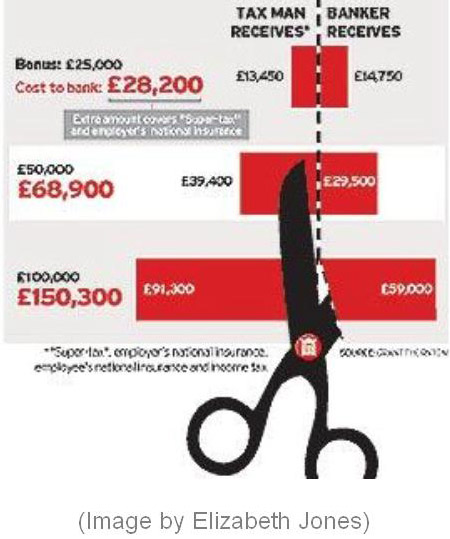 Executive pay has been a contentious issue in recent years, with bankers’ bonuses stealing many headlines. Shareholders have been voicing their opinions on bonuses paid to top executives and the management teams at the banks in question are unlikely to be too pleased with the turn of events.
Nearly one third of shareholders from Credit Suisse opposed the bonuses that were set out to be paid to their executives; more than 50% of shareholders from Citigroup rejected the plan to pay their Chief Executive £9.2m for 2011 and, at the end of April, almost a third of shareholders at Barclays refused to support the bank’s pay awards. Barclay’s Chief Executive was to be paid £17.7m, but this revolt is just another indication of how the tide is turning against having to pay big bonuses to retain the best staff.
Bonuses are essentially there to reward good performance. For example, if a company or bank achieves higher than expected profits, you may support a bonus for the key individuals who achieved this. However, in the case of Barclays, the £17.7m package for the Chief Executive was to be paid, despite him saying that his bank’s performance in 2011 was ‘unacceptable’. I wonder what bonus might have been suggested had the performance been ‘acceptable’?
Revolts over big bonuses are not a new thing for 2012. Over the past few years, more and more resentment has been growing for the huge pay increases received by top managers. Many big companies around the world have seen shareholder revolts and this could mean the tide is beginning to turn on big bonuses. The following articles consider this contentious issue.
Credit Suisse and Barclays investors revolt over pay Reuters, Matt Scuffham and Katharina Bart (27/4/12)
Aviva rocked by shareholder rebellion over pay Guardian, Jill Treanor and Julia Kollewe (3/5/12)
Tide turns on bank bonuses as revolt hits UK Scotsman, Bill Jamieson and Tom Peterkin (28/4/12)
Barclays AGM: ‘We can’t pay zero bonuses, the consequences would be dire’ Telegraph, Harry Wilson (27/4/12)
Barclays shareholders have spoken. The overpaid must listen Guardian, Chuka Umunna (27/4/12)
Barclays suffers executive pay backlash Financial Times, Patrick Jenkins (27/4/12)
Aviva to review pay policy amid investor concerns Wall Street Journal, Jessica Hodgson and Vladimir Guevarra (30/4/12)
UBS faces shareholder opposition over executive pay New York Times, Julia Werdigier (3/5/12)
Low returns stir Europe-wide revolt on bankers’ pay Reuters, Steve Slater and Sinead Cruise (25/4/12)
Barclays targeted over bonuses Telegraph, Louise Peacock (9/4/12)
UBS gets stinging rebuke from shareholders on pay Reuters, Katharina Bart (3/5/12)
Vince Cable urges investors to keep up the pressure on executive pay Guardian, Jill Treanor (4/5/12)
Questions
- To what extent do you think high bonuses are the most important variable to a company in retaining the best staff?
- In The Telegraph article by Harry Wilson, Barclays’ Chairman is quoted as saying: ‘We can’t pay zero bonuses, the consequences would be dire’. What would be the consequences if Barclays did pay zero bonuses?
- What would be the consequence if all UK firms paid zero bonuses?
- How would smaller bonuses affect shareholder dividends?
- The Guardian article by Chuka Umunna says that ‘excessive pay and rewards for failure are bad for shareholders, the economy and society.’ Why is this?
- Should those receiving big bonuses be forced to give them up, if their company has under-performed?
- What are the main arguments for and against paying out big bonuses?