 The housing market is often a good indicator of the level of confidence in an economy. Prior to the credit crunch, there had been a house price bubble and as the financial crisis began and economies plunged into recession, house prices began to fall significantly. In the last few months, the housing market has begun its recovery and data from the ONS shows average property prices up by 5.4% across the UK in November, compared with a year earlier.
When we analyse the housing market, or any market, we have to give attention to both demand-side and supply-side factors. It is the combination of these factors that yields the equilibrium price. For most people, buying a house will represent their single biggest expenditure and so there are many factors that need to be considered.
The demand for housing is affected by incomes, by the availability of mortgages, the rate of interest and hence the cost of mortgages. Speculation also tends to be a key factor that influences the demand for houses, as people may buy houses if they believe that prices will soon rise. Of course, simply by responding to expectations about future price changes causes the price changes to happen – a classic case of self-fulfilling speculation.
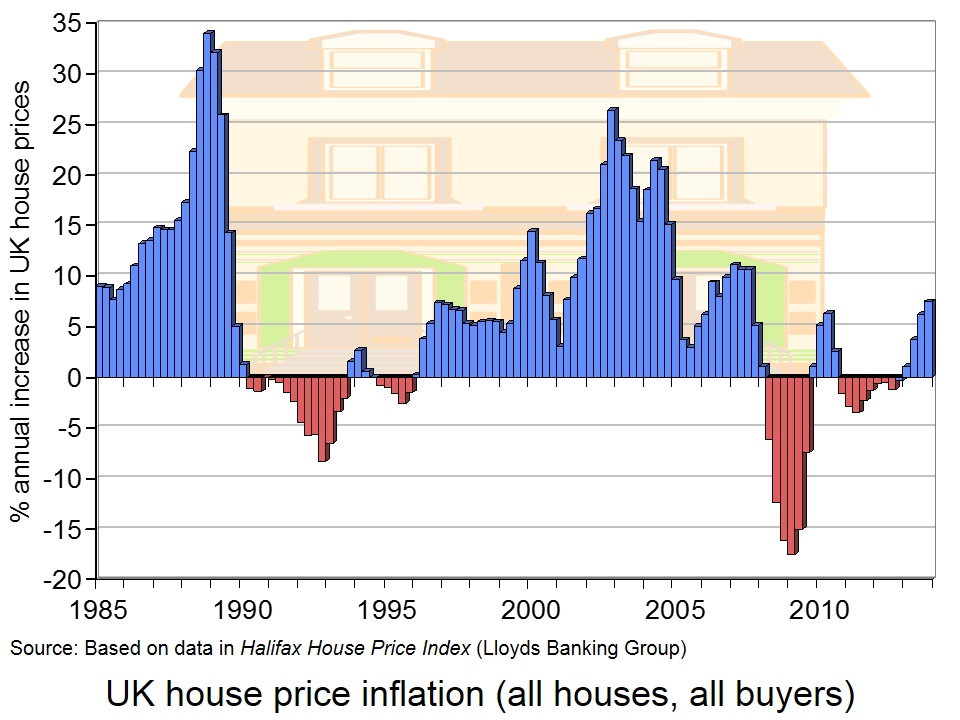 The availability of mortgages has been one of the biggest factors increasing the demand for and hence price of houses in recent months. More individuals have been able to get onto the property ladder and, with confidence returning to the market, these factors have caused a rightward shift in the demand for owner-occupied houses.
Another key factor has been the growth in the demand for housing as an investment opportunity, in particular from the global super rich. This has been of particular concern in London, where there are fears of a housing bubble developing and of lower-income households being priced out of the market.
At the same time, there has been a growth in the supply or housing and thus a rightward shift of the supply curve. Ceteris paribus, this would push down average prices. However, the data suggest that house prices, especially in London, have increased, implying that the impact on price of the increase in demand has more than offset the downward force in prices from the increase in supply. Part of this can be explained by the demand-side factor of an increase in demand for top-end properties, which ‘has been distracting developers from the need for more affordable accommodation.’ When asked about the changes observed in the London housing market, Civitas said:
London is one of the most – if not the most – attractive property markets for international investors all over the world. It is also at the centre of an affordability crisis in the UK which is having serious consequences for younger people and the less well-off…For too many it [investment at the top end of the market] is providing financial shelter rather than human shelter.
With the upward pressure on house prices, many are now warning of another bubble developing in London. When comparing house prices in London with a Londoner’s income, Ernst and Young found that house prices were 11 times average annual income. Data like this were last seen prior to the financial crisis and it is this which has led to concerns of a post-crisis bubble.
There are suggestions that more action is needed to combat this bubble, such as imposing a limit in income multiples in relation to how much of a mortgage you are able to borrow. Another criticism levelled at the market is the government’s Help to Buy scheme, which critics argue is raising demand and pushing up prices, because there is no matched increase in supply.
So, with the rest of the market returning to some semblance of normality, it is currently just London showing signs of a bubble and we are all well aware of what the consequences might be if a bubble is allowed to grow and then eventually burst. The following articles consider the housing market.
Housing bubble forming in London, warns Ernst and Young BBC News (3/2/14)
London housing market shows new bubble sign – report Reuters, Andrew Winning (3/2/14)
Expert calls for stronger action to tame London housing bubble risks Independent (21/5/12)
London shows signs of house price ‘bubble’, experts warn The Telegraph, Scott Campbell (3/2/14)
Economic forecasters call for measures to cool down London’s property market The Guardian, Rupert Neate (3/2/14)
Think-tank calls for a ban on rich foreigners buying homes in London to puncture property bubble Mail Online, Lizzie Edmonds (2/2/14)
London property bubble to last until 2018 Sky News (3/2/14)
Questions
- What are the key factors that will affect (a) the demand for and (b) the supply of housing?
- Which factors explain why house prices in London have increased relative to prices across the country? Identify which factors are demand-side and which are supply-side.
- How has Help to Buy affected the housing market?
- What government policies could be implemented to ‘puncture’ the bubble?
- Why is a housing bubble a problem?
- Why has a house price bubble not emerged in the rest of the UK?
 It is rising inflation that typically causes problems for countries, whether it is demand-pull or cost-push. However, one country that has not been subject to problems of rising prices is Japan. Instead, this economy has been suffering from the gloom of deflation for many years and many argue that this is worse than high inflation.
Falling prices are popular among consumers. If you see a product whose price has fallen from one day to the next, you can use your income to buy more goods. What’s the problem with this? The Japanese economy has experienced largely stagnant growth for two decades and a key cause has been falling prices. When the prices of goods begin to fall over and over again, people start to form expectations about the future direction of prices. If I expect the price of a good to fall next week, then why would I buy now, if I can buy the same good next week at a lower price?  But, when next week arrives and the price has fallen as expected, why would I purchase the product, if I think that the price fall is set to continue? The problem of deflation is that with continuously falling prices, consumers stop spending. Aggregate demand therefore declines and economic growth all but disappears. This is the problem that the Japanese economy has been faced with for more than 20 years.
However, the latest data from Japan shows core consumer prices growing faster than expected in December 2013, compared to the previous year. This figure was above market forecasts and was the fastest rate of growth in the past 5 years. These data, together with those on unemployment have given the economy a much needed boost.
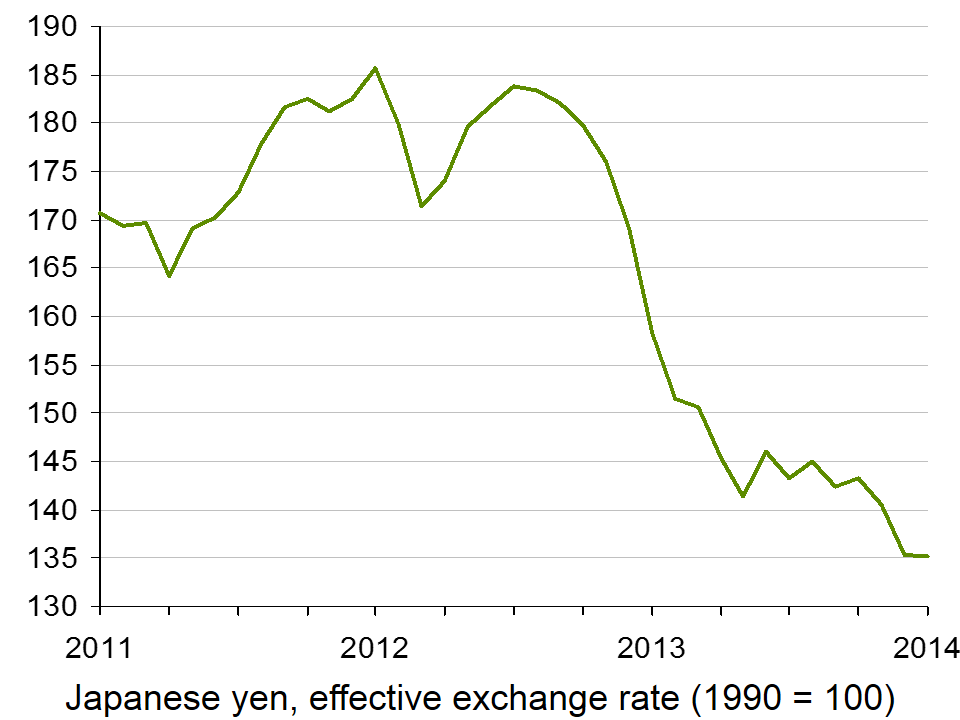 Recent government policy has been focused on boosts in government spending, with an aim of reducing the value of the currency (click here for a PowerPoint of the chart). Such policies will directly target aggregate demand and this in turn should help to generate an increase in national output and push up prices. If the price trend does begin to reverse, consumers will start to spend and again aggregate demand will be stimulated.
The future of the economy remains uncertain, though the same can be said of many Western economies. However, the signs are good for Japan and if the recovery of other economies continues and gathers pace, Japan’s export market will be a big contributor to recovery. The following articles consider the Japanese economy.
Japan inflation rises at fastest pace in over five years BBC News (31/1/14)
Benchmark Japan inflation rate hits 1.3% Financial Times, Jonathan Soble (31/1/14)
Japan’s inflation accelerates as Abe seeks wage gains Bloomberg, Chikako Mogi, Masahiro Hidaka and James Mayger (31/1/14)
Japan inflation quickens to over 5-year high, output rebounds Reuters, Leika Kihara and Stanley White (31/1/14)
Japaense inflation rises at fastest pace in over five years at 1.3% in December 2013 Independent, Russel Lynch (31/1/14)
 Why Abenomics holds lessons for the West BBC News, Linda Yueh (18/12/13)
Questions
- Why is deflation a problem?
- Using an AD/AS diagram, illustrate the problem of expectations and how this contributes to stagnant growth.
- How will a lower currency help Japan?
- What is the likely effect of a sales tax being imposed?
- Does the fact that unemployment has declined support the fact that consumer prices are beginning to rise?
- What government policies would you recommend to a government faced with stagnant growth and falling prices?
- How important are expectations in creating the problem of deflation?
 I am an avid tennis fan and have spent many nights and in the last 10 days had many early mornings (3am), where I have been glued to the television, watching in particular Rafael Nadal in the Australian Open. Tennis is one of the biggest sports worldwide and generates huge amounts of revenue through ticket sales, clothing and other accessories, sponsorship, television rights and many other avenues. When I came across the BBC article linked below, I thought it would make an excellent blog!
There are many aspects of tennis (and of every other sport) that can be analysed from a Business and Economics stance. With the cost of living having increased faster than wages, real disposable income for many households is at an all-time low. Furthermore, we have so many choices today in terms of what we do – the entertainment industry has never been so diverse. This means that every form of entertainment, be it sport, music, cinema, books or computer games, is in competition. And then within each of these categories, there’s further competition: do you go to the football or the tennis? Do you save up for one big event and go to nothing else, or watch the big event on TV and instead go to several other smaller events? Tennis is therefore competing in a highly competitive sporting market and a wider entertainment market. The ATP Executive Chairman and President said:
We’ve all got to understand the demands on people’s discretionary income are huge, they are being pulled in loads of different avenues – entertainment options of film, music, sport – so we just need to make sure that our market share remains and hopefully grows as well.
As we know from economic analysis, product differentiation and advertising are key and tennis is currently in a particularly great era when it comes to drawing in the fans, with four global superstars.
However, tennis and all sports are about more than just bringing in the fans to the live events. Sponsorship deals are highly lucrative for players and, in this case, for the ATP and WTA tennis tours. It is lucrative sponsorship deals which create prize money worth fighting for, which help to draw in the best players and this, in turn, helps to draw in the fans and the TV companies.
 With technological development, all sports are accessible by wider audiences and tennis is making the most of the fast growth in digital media. Looking at the packaging of tour events and how best to generate revenues through TV rights is a key part of strategic development for the ATP. It goes a long way to showing how even one of the world’s most successful sporting tours is always looking at ways to innovate and adapt to changing economic and social times. Tennis is certainly a sport that has exploited all the opportunities it has had and, through successful advertising, well-organised events and fantastic players, it has created a formidable product, which can compete with any other entertainment product out there. As evidence, the following fact was observed in the Telegraph article:
A 1400 megawatt spike – equivalent to 550,000 kettles being boiled – was recorded at around 9.20pm on that day [6/7/08] as Nadal lifted the trophy. The surge is seen as an indicator of millions viewing the final and then rushing to the kitchen after it is over. The national grid felt a bigger surge after the Nadal victory even than at half time during the same year’s Champions League final between Manchester United and Chelsea.
Tennis top guns driving ATP revenues BBC News, Bill Wilson (20/1/14)
The top 20 sporting moments of the noughties: The 2008 Wimbledon Final The Telegraph, Mark Hodgkinson (14/12/09)
The global tennis industry in numbers BBC News (22/1/14)
Questions
- How does tennis generate its revenue?
- In which market structure would you place the sport of tennis?
- What are the key features of the ATP tour which have allowed it to become so successful? Can other sports benefit from exploiting similar things?
- How has technological development created more opportunities for tennis to generate increased revenues?
- Can game theory be applied to tennis and, if so, in what ways?
- Why does sponsorship of the ATP tour play such an important role in the business of tennis?
- How important is (a) product differentiation and (b) advertising in sport?
 A recession is typically characterised by high unemployment, low or negative growth and low inflation, due to a lack of aggregate demand. However, since 2009, inflation levels in the UK have only added to the pressures facing the government and the Bank of England. Not only had there been a problem of lack of demand, but the inflation target was no longer being met.
Inflation had increased to above 5% – a figure we had not been accustomed to for many years. With interest rates at record lows with the aim of boosting aggregate demand, demand-pull inflation only added to cost-push pressures. However, data released by the ONS shows that inflation, as measured by the CPI, has now fallen back to its 2% target. Having been at 2.1% in November 2013, the figure for December 2013 fell by 0.1 percentage points.
 The data for December include some of the energy price rises from the big six, but do not include the full extent of price decreases and discounting initiated by retailers in the lead up to Christmas. The key factors that have helped to keep prices down include some of the discounting throughout December and falling food prices, in particular bananas, grapes and meat.
With inflation back on target, pressures have been removed from the Bank of England to push up interest rates. Mark Carney has said that interest rates will remain at 0.5% until unemployment falls to 7%. 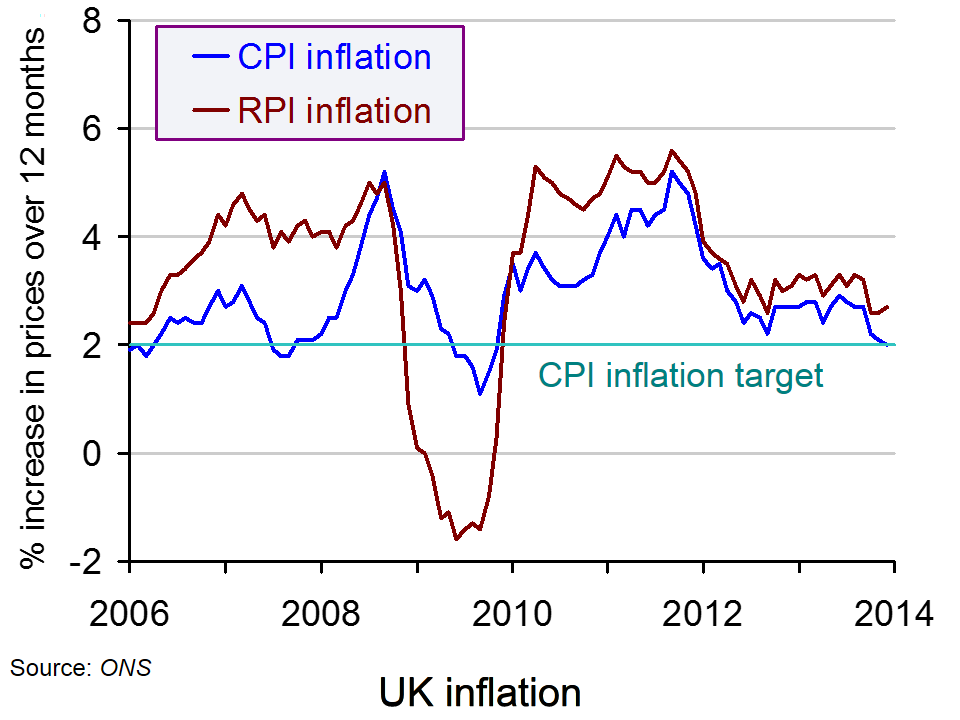 With unemployment fast approaching this target, there has been speculation that interest rates would rise, but with inflation falling back on target, these pressures have been reduced. (Click here for a PowerPoint of the chart.) Referring to this, Jeremy Cook, the chief economist at World First said:
The lack of inflation will help stay their hand especially if the pace of job creation seen in the second half of last year also shows.
These thoughts were echoed by Rob Wood, the chief UK economist at Berenberg Bank:
Inflation is the BoE’s ‘get out of jail free’ card for this year … The lack of inflation pressure gives them room to delay a first hike until next year.
Many economists now believe that the CPI rate of inflation is likely to remain at or below the target, in particular if productivity growth improves. This belief is further enhanced by the fact that tax rates are stable, the pound is relatively strong and the previous upward pressure on commodity prices from China is now declining. Some economists believe that CPI inflation could fall to 1.5% this year and the Treasury has said that it is ‘another sign that the Government’s long-term economic plan is working’. The following articles consider this latest macroeconomic data.
UK inflation falls to Bank of England’s 2pc target in December The Telegraph, Szu Ping Chan (14/1/14)
UK inflation falls to 2% target rate in December BBC News (14/1/14)
Carney’s lucky streak continues as UK inflation slows to 2% Financial Times, Claire Jones (14/1/14)
UK inflation fall gives Bank of England a lift Wall Street Journal, Richard Barley(14/1/14)
Inflation falls to Bank of England target Reuters, William Schomberg and Ana Nicolaci da Costa (14/1/14)
Inflation hits Bank of England’s target of 2% in December Independent, John Paul Ford Rojas (14/1/14)
Questions
- What is the relationship between interest rates and aggregate demand?
- Which factors have led to the reduction in the rate of inflation?
- Why have the latest data on inflation rates reduced the pressure on the Bank of England to increase interest rates?
- Why do stable tax rates, a strong pound and reduced pressure from China on commodity prices suggest that the CPI measures of inflation is likely to remain at similarly low levels?
- Why has the RPI increased while the CPI has fallen?
 There’s been much talk about the UK’s economic recovery and whether or not it has begun and whether consumer spending is actually the cause. The latest sector to post positive figures is the car industry, which has seen 2013 bring in the highest level of car sales since the onset of the credit crunch.
According to the Society of Motor Manufacturers and Traders (SMMT), vehicle registrations in 2013 were 2.26 million, which represented a 10.8% increase from 2012. That’s not to say that we have returned to the heights seen pre-crisis levels, as sales still remain some way below their 2007 figure, but the data is certainly moving in the right direction. The key questions are: What’s the cause of this growth and what does it mean for the UK economy?
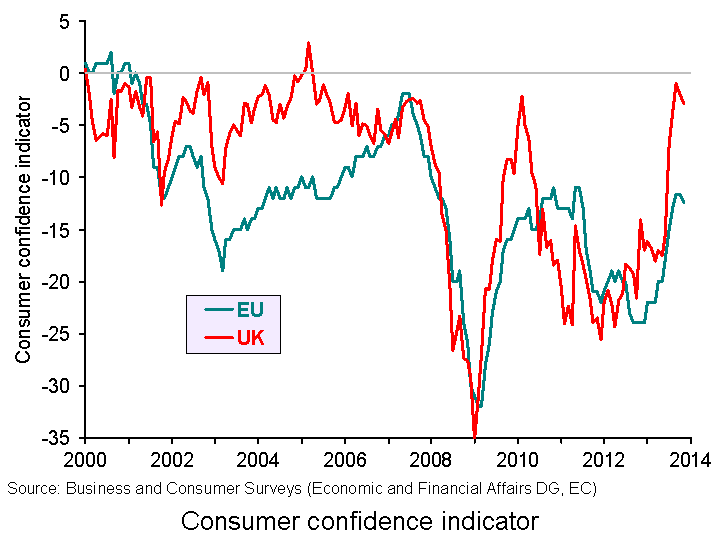 The economy has certainly turned a corner and perhaps consumer confidence is improving to reflect this. With consumes more optimistic about future economic prospects, more luxury items may well be purchased. During the height of the recession, many families may well have said ‘it will last’ or ‘we’ll make do’, referring to their old cars. However, this improved confidence, together with attractive finance deals may have been instrumental in convincing consumers to splash out. This is reflected in the data, which indicates that some 75% of car sales involve a finance package. One further explanation that has been offered by industry analysts is that the refunds individuals are receiving through mis-sold payment protection insurance are providing a nice contribution towards the deposit.
PPI payments will certainly dry up, but as long as attractive finance packages remain, car sales should continue. A key factor affecting affordability may be interest rates. When they increase, any variable rate loans will become more expensive to service and this may act to deter consumers. However, if the car industry helps to stimulate other sectors and wages begin to increase, the overall effect may be to sustain and even further the growth of this key economic sector. The following articles consider the car industry.
UK car sales hit five-year high The Guardian, Angela Monaghan (7/1/14)
UK new car sales highest since 2007, SMTT says BBC News (7/1/14)
Car sales increased by almost 11% in 2013 Sky News (7/1/14)
UK new car sales rise to highest level since 2007 Reuters, David Milliken (7/1/14)
UK car sales up 11% in 2013, topping pre-crisis levels Wall Street Journal, Matthew Curtin and Ian Walker (7/1/14)
New car sales in UK at highest since before recession Independent, Sean O’Grady (7/1/14)
UK car sales top pre-recession levels Financial Times, Henry Foy (6/1/14)
Questions
- How important is the car industry in the context of the UK economy?
- How is the UK car industry performing relative to its Western rivals?
- Would a 30% single rate of income tax be equitable?
- Explain the way in which car sales have been affected by consumer confidence.
- How have finance packages helped to stimulate car sales?
- What are the key macroeconomic variables that are likely to affect the future performance of this key sector?
 The housing market is often a good indicator of the level of confidence in an economy. Prior to the credit crunch, there had been a house price bubble and as the financial crisis began and economies plunged into recession, house prices began to fall significantly. In the last few months, the housing market has begun its recovery and data from the ONS shows average property prices up by 5.4% across the UK in November, compared with a year earlier.