 ‘Employment has been strong, but productivity and real wages have been flat.’ This is one of the key observations in a new OECD report on the state of the UK economy. If real incomes for the majority of people are to be raised, then labour productivity must rise.
For many years, the UK has had a lower productivity (in terms of output per hour worked) than most other developed countries, with the exception of Japan. But from 1980 to the mid 2000s, the gap was gradually narrowing. Since then, however, the gap has been widening again. This is illustrated in Chart 1, which shows countries’ productivity relative to the UK’s (with the UK set at 100). (Click here for a PowerPoint.)
Compared with the UK, GDP per hour worked in 2013 (the latest data available) was 28% higher in France, 29% higher in Germany and 30% higher in the USA. What is more, GDP per hour worked 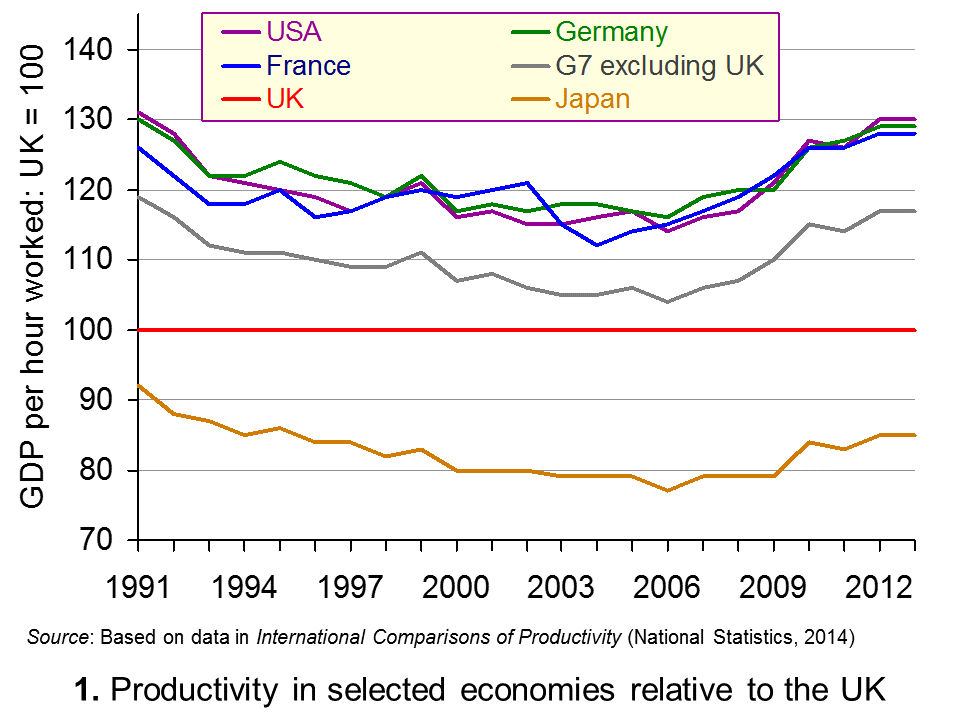 and GDP per capita in the UK fell by 3.8% and 6.1% respectively after the financial crisis of 2007/8 (see the green and grey lines in Chart 2). And while both indicators began rising after 2009, they were still both below their 2007 levels in 2013. Average real wages also fell after 2007 but, unlike the other two indicators, kept on falling and by 2013 were 4% below their 2007 levels, as the red line in Chart 2 shows. (Click here for a PowerPoint.)
Although productivity and even real wages are rising again, the rate of increase is slow. If productivity is to rise, there must be investment. 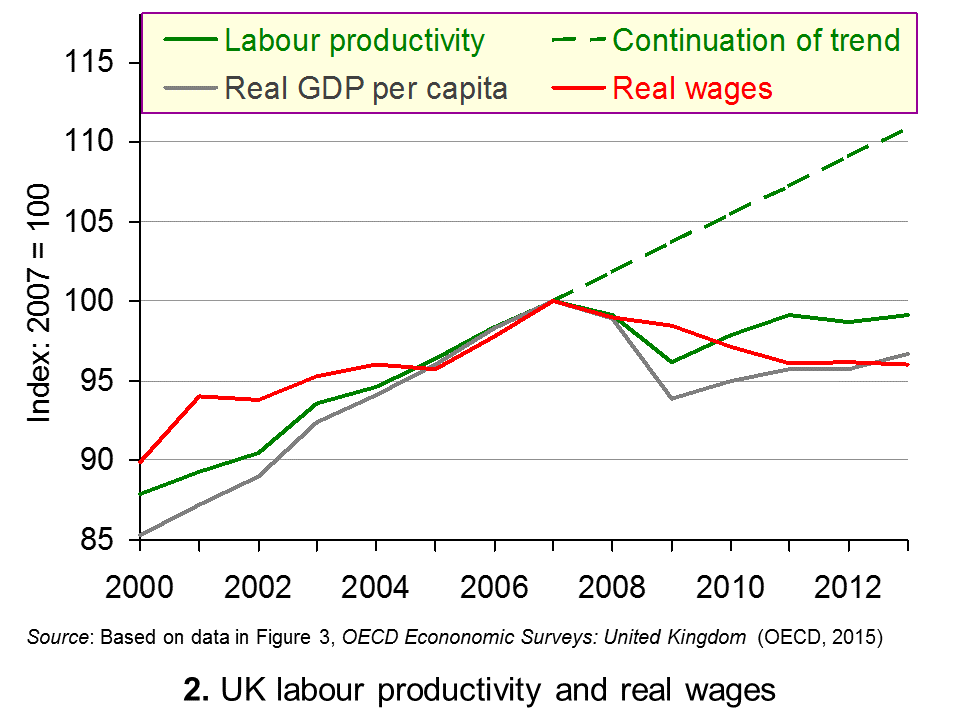 This could be in physical capital, human capital or, preferably, both. But for many years the UK has had a lower rate of investment than other countries, as Chart 3 shows. (Click here for a PowerPoint.) This chart measures investment in fixed capital as a percentage of GDP.
So how can investment be encouraged? Faster growth will encourage greater investment through the accelerator effect, but such an effect could well be short-lived as firms seek to re-equip but may be cautious about committing to increasing capacity. What is crucial here is maintaining 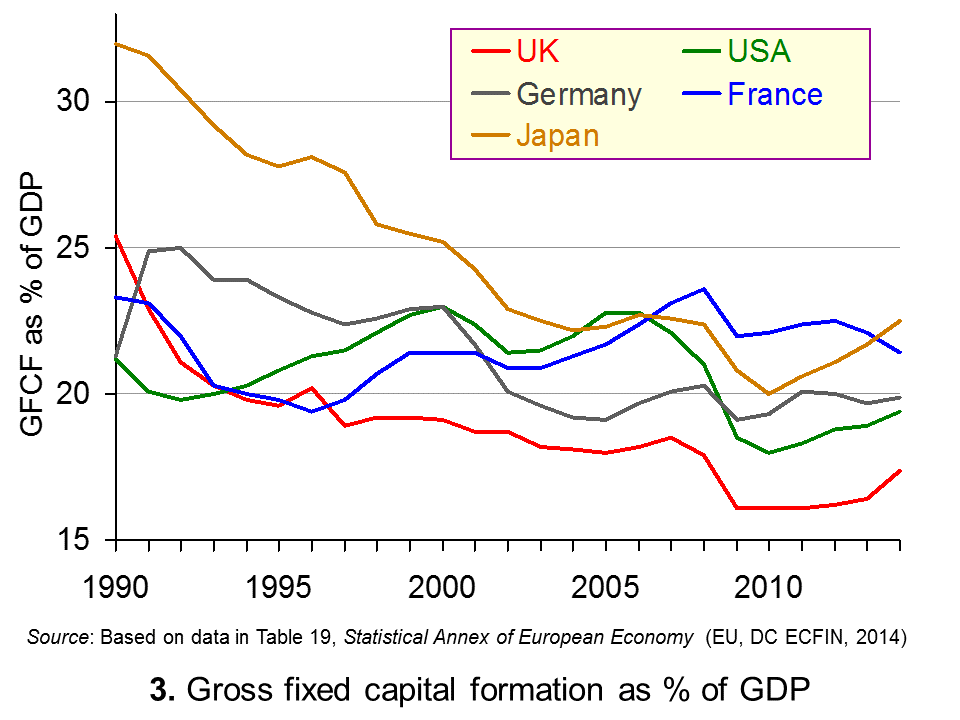 high degrees of business confidence over an extended period of time.
More fundamentally, there are structural problems that need tackling. One is the poor state of infrastructure. This is a problem not just in the UK, but in many developed countries, which cut back on public and private investment in transport, communications and energy infrastructure in an attempt to reduce government deficits after the financial crisis. Another is the low level of skills of many workers. Greater investment in training and apprenticeships would help here.
Then there is the question of access to finance. Although interest rates are very low, banks are cautious about granting long-term loans to business. Since the financial crisis banks have become much more risk averse and long-term loans, by their nature, are relatively risky. Government initiatives to provide finance to private companies may help here. For example the government has just announced a Help to Grow scheme which will provide support for 500 small firms each year through the new British Business Bank, which will provide investment loans and also grants on a match funding basis for new investment.
Articles
OECD: UK must fix productivity Economia, Oliver Griffin (25/2/15)
The UK’s productivity puzzle BBC News, Lina Yueh (24/2/15)
OECD warns UK must fix productivity problem to raise living standards The Guardian, Katie Allen (24/2/15)
Britain must boost productivity to complete post-crisis recovery, says OECD International Business Times, Ian Silvera (24/2/15)
OECD urges UK to loosen immigration controls on skilled workers Financial Times, Emily Cadman and Helen Warrell (24/2/15)
Report
OECD Economic Surveys, United Kingdom: Overview OECD (February 2015)
OECD Economic Surveys, United Kingdom: Full report OECD (February 2015)
Questions
- In what ways can productivity be measured? What are the relative merits of using the different measures?
- Why has the UK’s productivity lagged behind other industrialised countries?
- What is the relationship between income inequality and labour productivity?
- Why has UK investment been lower than in other industrialised countries?
- What are zombie firms? How does the problem of zombie firms in the UK compare with that in other countries? Explain the differences.
- What policies can be pursued to increased labour productivity?
- What difficulties are there in introducing effective policies to tackle low productivity?
- Should immigration controls be lifted to tackle the problem of a shortage of skilled workers?
 What is the relationship between the degree of inequality in a country and the rate of economic growth? The traditional answer is that there is a trade off between the two. Increasing the rewards to those who are more productive or who invest encourages a growth in productivity and capital investment, which, in turn, leads to faster economic growth. Redistribution from the rich to the poor, by contrast, is argued to reduce incentives by reducing the rewards from harder work, education, training and investment. Risk taking, it is claimed, is discouraged.
Recent evidence from the OECD and the IMF, however, suggests that when income inequality rises, economic growth falls. Inequality has grown massively in many countries, with average incomes at the top of the distribution seeing particular gains, while many at the bottom have experienced actual declines in real incomes or, at best, little or no growth. 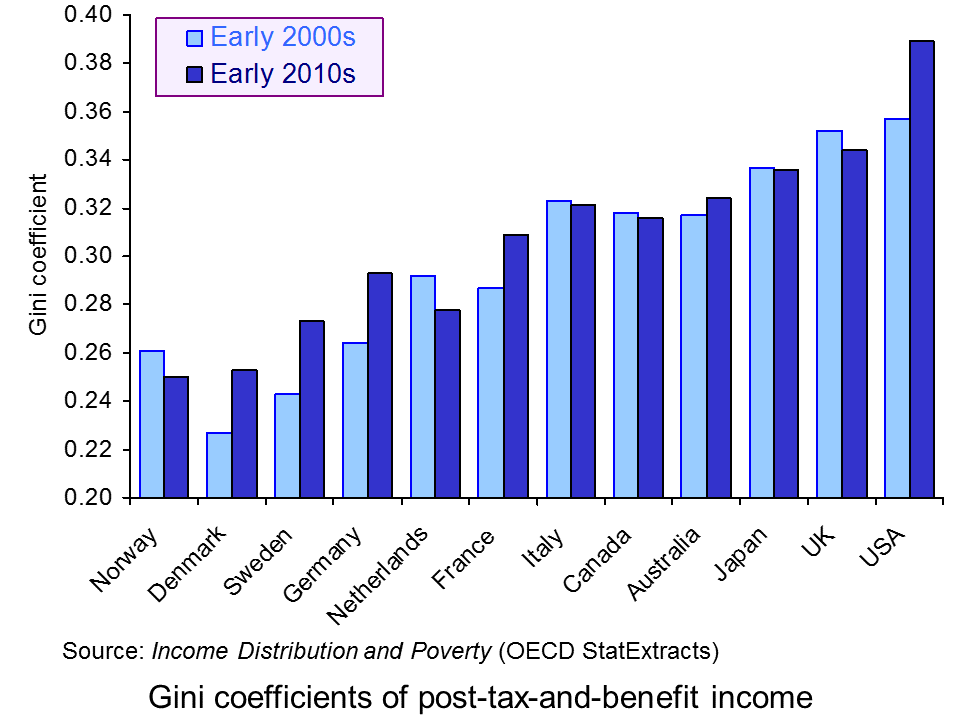 This growth in inequality can be seen in a rise in countries’ Gini coefficients. The OECD average Gini coefficient rose from 0.29 in the mid-1980s to 0.32 in 2011/12. This, claims the OECD, has led to a loss in economic growth of around 0.35 percentage points per year.
But why should a rise in inequality lead to lower economic growth? According to the OECD, the main reason is that inequality reduces the development of skills of the lower income groups and reduces social mobility.
By hindering human capital accumulation, income inequality undermines education opportunities for disadvantaged individuals, lowering social mobility and hampering skills development.
The lower educational attainment applies both to the length and quality of education: people from poorer backgrounds on average leave school or college earlier and with lower qualifications.
But if greater inequality generally results in lower economic growth, will a redistribution from rich to poor necessarily result in faster economic growth? According to the OECD:
Anti-poverty programmes will not be enough. Not only cash transfers but also increasing access to public services, such as high-quality education, training and healthcare, constitute long-term social investment to create greater equality of opportunities in the long run.
Thus redistribution policies need to be well designed and implemented and focus on raising incomes of the poor through increased opportunities to increase their productivity. Simple transfers from rich to poor via the tax and benefits system may, in fact, undermine economic growth. According to the IMF:
That equality seems to drive higher and more sustainable growth does not in itself support efforts to redistribute. In particular, inequality may impede growth at least in part because it calls forth efforts to redistribute that themselves undercut growth. In such a situation, even if inequality is bad for growth, taxes and transfers may be precisely the wrong remedy.
Articles
Inequality ‘significantly’ curbs economic growth – OECD BBC News (9/12/14)
Is inequality the enemy of growth? BBC News, Robert Peston (6/10/14)
Income inequality damages growth, OECD warns Financial Times, Chris Giles (8/10/14)
OECD finds increasing inequality lowers growth Deutsche Welle, Jasper Sky (10/12/14)
Revealed: how the wealth gap holds back economic growth The Guardian, Larry Elliott (9/12/14)
Inequality Seriously Damages Growth, IMF Seminar Hears IMF Survey Magazine (12/4/14)
Warning! Inequality May Be Hazardous to Your Growth iMFdirect, Andrew G. Berg and Jonathan D. Ostry (8/4/11)
Economic growth more likely when wealth distributed to poor instead of rich The Guardian, Stephen Koukoulas (4/6/15)
So much for trickle down: only bold reforms will tackle inequality The Guardian, Larry Elliott (21/6/15)
Videos
Record inequality between rich and poor OECD on YouTube (5/12/11)
The Price of Inequality The News School on YouTube, Joseph Stiglitz (5/10/12)
Reports and papers
FOCUS on Inequality and Growth OECD, Directorate for Employment, Labour and Social Affairs (December 2014)
Trends in Income Inequality and its Impact on Economic Growth OECD Social, Employment and Migration Working Papers, Federico Cingano (9/12/14)
An Overview of Growing Income Inequalities in OECD Countries: Main Findings OCED (2011)
Redistribution, Inequality, and Growth IMF Staff Discussion Note, Jonathan D. Ostry, Andrew Berg, and Charalambos G. Tsangarides (February 2014)
Measure to Measure Finance and Development, IMF, Jonathan D. Ostry and Andrew G. Berg (Vol. 51, No. 3, September 2014)
Data
OECD Income Distribution Database: Gini, poverty, income, Methods and Concepts OECD
The effects of taxes and benefits on household income ONS
Questions
- Explain what are meant by a Lorenz curve and a Gini coefficient? What is the relationship between the two?
- The Gini coefficient is one way of measuring inequality. What other methods are there? How suitable are they?
- Assume that the government raises taxes to finance higher benefits to the poor. Identify the income and substitution effects of the tax increases and whether the effects are to encourage or discourage work (or investment).
- Distinguish between (a) progressive, (b) regressive and (c) proportional taxes?
- How will the balance of income and substitution effects vary in each of the following cases: (a) a cut in the tax-free allowance; (b) a rise in the basic rate of income tax; (c) a rise in the top rate of income tax? How does the relative size of the two effects depend, in each case, on a person’s current income?
- Identify policy measures that would increase both equality and economic growth.
- Would a shift from direct to indirect taxes tend to increase or decrease inequality? Explain.
- By examining Tables 3, 26 and 27 in The Effects of Taxes and Benefits on Household Income, 2012/13, (a) explain the difference between original income, gross income, disposable income and post-tax income; (b) explain the differences between the Gini coefficients for each of these four categories of income in the UK.
 Many people are attracted to work in the private sector, with expectations of greater opportunities for promotion, more variation in work and higher salaries. However, according to the Office for National Statistics, it may be that the oft-talked-of pay differential is actually in the opposite direction. Data from the ONS suggests that public sector workers are paid 14.5% more on average than those working in the private sector.
As is the case with the price of a good, the price of labour (that is, the wage rate) is determined by the forces of demand and supply. Many factors influence the wages that individuals are paid and traditional theory leads us to expect higher wages in sectors where there are many firms competing for labour. With the government acting as a monopsony employer, it has the power to force down wages below what we would expect to see in a perfectly competitive labour market. However, the ONS data suggests the opposite. What factors can explain this wage differential?
Jobs in the public sector, on average, require a higher degree of skills. There tend to be entry qualifications, such as possessing a university degree. While this is the case for many private-sector jobs as well, on average it is a greater requirement in the public sector. The skills required therefore help to push up the wages that public-sector workers can demand. Another explanation could be the size of public-sector employers, which allows them to offer higher wages. When the skills, location, job specifications etc. were taken into account, the 14.5% average hourly earnings differential declined to between just 2.2% and 3.1%, still in favour of public-sector workers. It then reversed to give private-sector workers the pay edge, once the size of the employer was taken out.
Further analysis of the data also showed that, while it may pay to be in the public sector when you’re starting out on your career, it pays to be in the private sector as you move up the career ladder. Workers in the bottom 5% of earners will do better in the public sector, while those in the top 5% of earners benefit from private-sector employment. The ONS said:
Looking at the top 5%, in the public sector earnings are greater than £31.49 per hour, while in the private sector, the top 5% earn more than £33.63 per hour… The top 1% of earners in the private sector, at more than £60.21 per hour, earns considerably more than the top 1% of earners in the public sector, at more than £49.65 per hour.
The data from the ONS thus suggest a reversal in the trend of average public-sector pay being higher than private sector pay, once all the relevant factors are taken into account.
This will naturally add to debates about living standards, which are likely to take on a stronger political slant as the next election approaches. It is obviously partly down to the public-sector pay freeze that we saw in 2010 and also to a reversal, at least in part, of the previous trend from 2008, where public-sector pay  had been growing faster than private-sector pay. However, depending on the paper you read or the person you listen to, they will offer very different views as to who gets paid more. All you need to do in this case is look at the titles of the newspaper articles written by the Independent and The Telegraph! Whatever the explanation, these new data provide a wealth of information about relative prospects for pay for everyone.
Data
Public and Private Sector Earnings Office for National Statistics (March 2014)
Annual Survey of Hours and Earnings, 2013 Provisional Results Office for National Statistics (December 2013)
Articles
Austerity bites as private sector pay rises above the public sector for the first time since 2010 Independent, Ben Chu (10/3/14)
Public sector workers still better paid despite the cuts The Telegraph, John Bingham (10/3/14)
Public sector hourly pay outstrips private sector pay BBC News (10/3/14)
Public sector workers are biggest losers in UK’s post-recession earnings squeeze The Guardian, Larry Elliott (11/3/14)
New figures go against right-wing claims that public sector workers are grossly overpaid Independent, Ben Chu (10/3/14)
Public sector pay sees biggest shrink on 2010, figures suggest LocalGov, Thomas Bridge (11/3/14)
Public sector staff £2.12 an hour better off The Scotsman, David Maddox (11/3/14)
Questions
- Illustrate the way in which wages are determined in a perfectly competitive labour market.
- Why does monopsony power tend to push wages down?
- Why does working for a large company suggest that you will earn a higher wage on average?
- Using the concept of marginal revenue product of labour, explain the way in which higher skills help to push up wages.
- How significant are public-sector pay freezes in explaining the differential between public- and private-sector pay?
- Why is there a difference between the bottom and top 5% of earners? How does this impact on whether it is more profitable to work in the public or private sector?
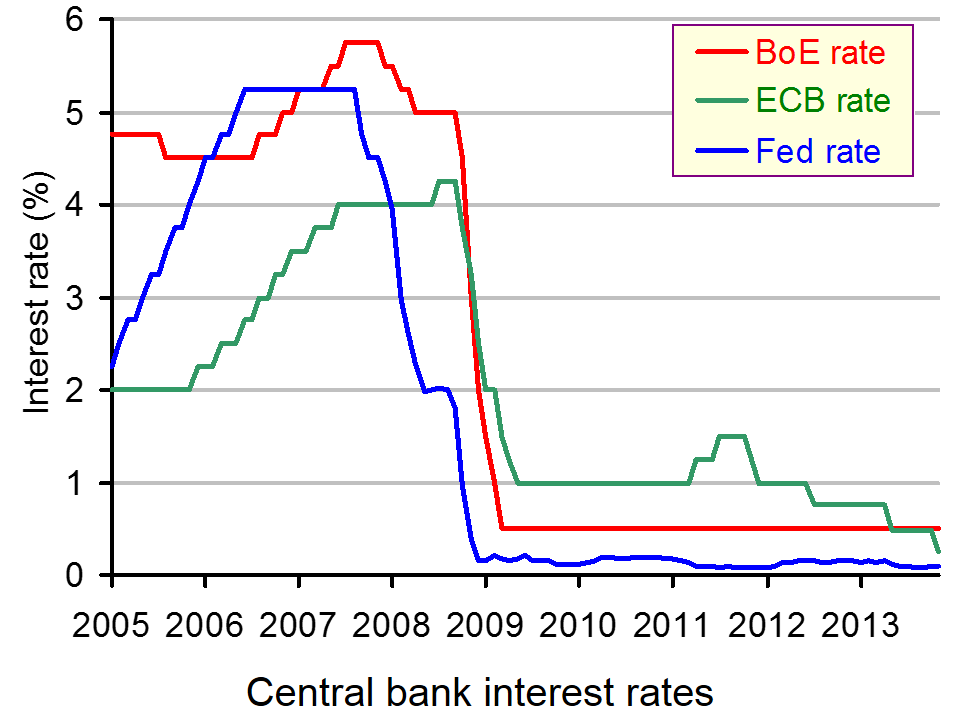 A constant feature of the UK economy (and of many other Western economies) has been record low interest rates. Since March 2009, Bank Rate has stood at 0.5%. Interest rates have traditionally been used to keep inflation on target, but more recently their objective has been to stimulate growth. However, have these low interest rates had a negative effect on the business environment?
Interest rates are a powerful tool of monetary policy and by affecting many of the components of aggregate demand, economic growth can be stimulated. This low-interest rate environment is an effective tool to stimulate consumer spending, as it keeps borrowing costs low and in particular can keep mortgage repayments down. However, this policy has been criticised for the harm it has been doing to savers – after all, money in the bank will not earn an individual any money with interest rates at 0.5%! Furthermore, there is now a concern that such low interest rates have led to ‘zombie companies’ and they are restricting the growth potential and recovery of the economy.
A report by the Adam Smith Institute suggests that these ‘zombie companies’ have emerged in part by the low-interest environment and are continuing to absorb resources, which could otherwise be re-allocated to companies with more potential, productivity and a greater contribution to the economic recovery. During a recession, there will undoubtedly be many business closures, as aggregate demand falls, sales and profits decline until eventually the business becomes unviable and loans cannot be repaid. Given the depth and duration of the recent recessionary period, the number of business closures should have been very large. However, the total number appears to be relatively low – around 2% or 100,000 and the report suggests that the low interest rates have helped to ‘protect’ them.
Low interest rates have enabled businesses to meet their debt repayments more easily and with some banks being unwilling to admit to ‘bad loans’, businesses have benefited from loans being extended or ‘rolled over’. This has enabled them to survive for longer and as the report suggests, may be preventing a full recovery. The report’s author, Tom Papworth said:
Low interest rates and bank forbearance represent a vast and badly targeted attempt to avoid dealing with the recession. Rather than solving our current crisis, they risk dooming the UK to a decade of stagnation … We tend to see zombies as slow-moving and faintly laughable works of fiction. Economically, zombies are quite real and hugely damaging, and governments and entrepreneurs cannot simply walk away.
The problem they create is that resources are invested into these companies – labour, capital, innovation. This creates an opportunity cost – the resources may be more productive if invested into new companies, with greater productive potential. The criticism is that the competitiveness of the economy is being undermined by the continued presence of such companies and that this in turn is holding the UK economy back. Perhaps the interest rate rise that may happen this time next year may be what is needed to encourage the re-allocation of capital. However, a 0.5 percentage point rise in interest rates would hardly be the end of the world for some of these companies. Perhaps a more focused approach looking at restructuring is the key to their survival and the allocation of resources to their most productive use. The following articles and the report itself consider the case of the trading dead.
Report
The Trading Dead The Adam Smith Institute, Tom Papworth November 2013
Articles
Zombie firms threaten UK’s economic recovery, says thinktank The Guardian, Gyyn Topam (18/11/13)
 Zombie companies ‘probably have no long term future’ BBC News (18/11/13)
Rate rise set to put stake through heart of zombie companies Financial Times, Brian Groom (14/11/13)
Why we can still save the zombie firms hindering the UK economic rival City A.M., Henry Jackson (18/11/13)
Breathing new life into zombies The Telegraph, Rachel Bridge (9/11/13)
Questions
- Which components of aggregate demand are affected (and how) by low interest rates?
- Why do low interest rates offer ‘protection’ to vulnerable businesses?
- How is the reallocation of resources relevant in the case of zombie companies?
- If interest rates were to increase, how would this affect the debts of vulnerable businesses? Would a small rate irse be sufficient and effective?
- What suggestions does the report give for zombie companies to survive and become more productive?
- Is there evidence of zombie companies in other parts of the world?
 Each year in November, the Living Wage Foundation publishes figures for the hourly living wage that is necessary for people to meet basic bills. The rate for London is calculated by the Greater London Authority and for the rest of the UK by the Centre for Research in Social Policy at Loughborough University.
The 2013 update was published on 4 November. The Living Wage was estimated to be £8.80 in London and £7.65 in the rest of the UK.
Two things need to be noted about the Living Wage rate. The first is that the figure is an average and thus does not take into account the circumstances of an individual household. Clearly households differ in terms of their size, the number of wage earners and dependants, the local costs of living, etc. Second, the figures have been reduced from what is regarded as the ‘reference’ living wage, which is estimated to be £9.08 outside London. The reason for this is that people earning higher incomes have seen their living standards squeezed since 2009, with prices rising faster than average post-tax-and-benefit wages. Thus, the Living Wage is capped to reflect the overall decline in living standards. As the Working Paper on rates outside London explains:
From 2012 onwards, two kinds of limit have been put on the amount that the Living Wage as applied can rise in any one year. The first limits the increase in the net income (after taxes and benefits) requirement for each household on which the living wage calculation is based, relative to the rise in net income that would be achieved by someone on average earnings. The second limits the increase in the living wage itself (representing gross income) relative to the increase in average earnings.
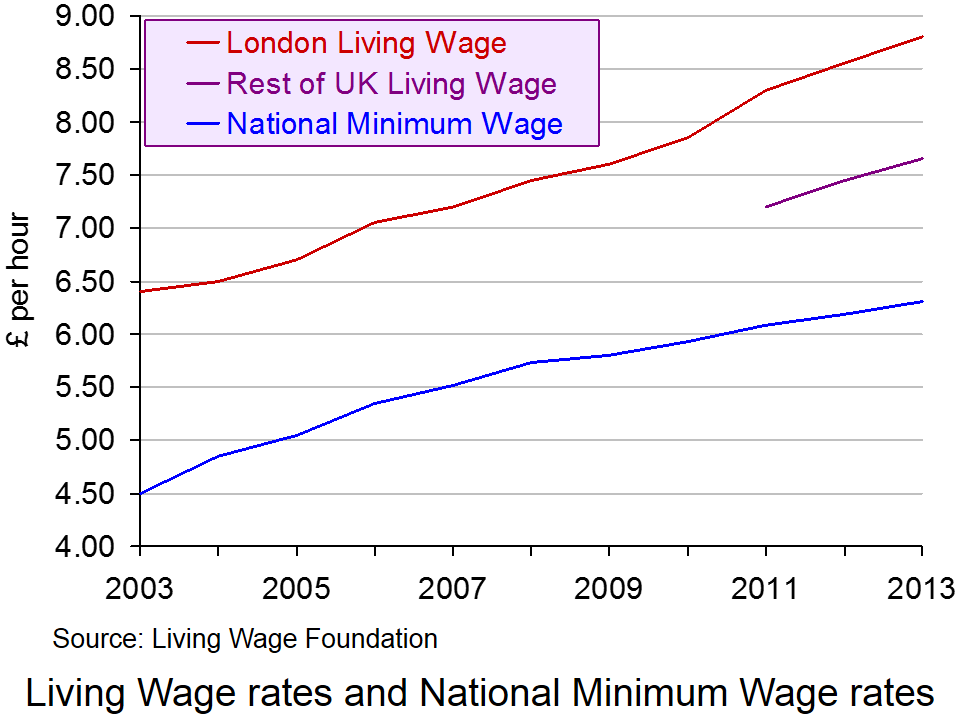 Nevertheless, despite this capping of the living wage, it is still significantly higher than the UK National Minimum Wage, which currently stands at £6.31 for those aged 21 and over. This can be seen from the chart (click here for a PowerPoint).
Paying the Living Wage is voluntary for employers, but as The Guardian reports:
A total of 432 employers are now signed up to the campaign, up from 78 this time last year, including Legal & General, KPMG, Barclays, Oxfam, Pearson, the National Portrait Gallery and First Transpennine Express, as well as many smaller businesses, charities and town halls. Together they employ more than 250,000 workers and also commit to roll out the living wage in their supply chain.
But as The Observer reports:
The number of people who are paid less than a ‘living wage’ has leapt by more than 400,000 in a year to over 5.2 million, amid mounting evidence that the economic recovery is failing to help millions of working families.
A report for the international tax and auditing firm KPMG also shows that nearly three-quarters of 18-to-21-year-olds now earn below this level – a voluntary rate of pay regarded as the minimum to meet the cost of living in the UK. The KPMG findings highlight difficulties for ministers as they try to beat back Labour’s claims of a “cost of living crisis”.
According to the report, women are disproportionately stuck on pay below the living wage rate, currently £8.55 in London and £7.45 elsewhere. Some 27% of women are not paid the living wage, compared with 16% of men. Part-time workers are also far more likely to receive low pay than full-time workers, with 43% paid below living-wage rates compared with 12% of full-timers.
But although paying a living wage may be desirable in terms of equity, many firms, especially in the leisure and retailing sectors, claim that they simply cannot afford to pay the living wage and, if they were forced to, would have to lay off workers.
The point they are making is that it is not economical to pay workers more than their marginal revenue product. But this raises the question of whether a higher wage would encourage people to work more efficiently. If it did, an efficiency wage may be above current rates for many firms. It also raises the question of whether productivity gains could be negotiated in exchange for paying workers a living wage
These arguments are discussed in the following podcast.
Podcast
Higher ‘productivity’ will increase living wage BBC Today Programme, Priya Kothari and Steve Davies (4/11/13)
Articles
UK living wage rises to £7.65 an hour The Guardian (4/11/13)
More than 5 million people in the UK are paid less than the living wage The Observer, Toby Helm (2/11/13)
Increasing numbers of Scots are paid less than living wage Herald Scotland (2/11/13)
Labour would give tax rebates to firms that pay living wage Independent, Jane Merrick (3/11/13)
Employers praise Ed Miliband’s living wage proposal Independent, Andy McSmith (3/11/13)
Miliband’s living wage tax break will raise prices, warns CBI chief The Telegraph, Tim Ross (3/11/13)
Living Wage rise provides a boost for low paid workers BBC News (4/11/13)
Information and Reports
What is the Living Wage? Living Wage Foundation
The Living Wage Centre for Research in Social Policy, Loughborough University
Living wage Mayor of London
One in five UK workers paid less than the Living Wage KPMG News Release (3/11/13)
Number of workers paid less than the Living Wage passes 5 million KPMG News Release (3/11/13)
Living Wage Research for KPMG Markit (October 2012)
Questions
- How is the Living Wage calculated?
- What are the reasons for announcing a Living Wage figure that is lower than a reference living wage? Assess these reasons.
- If there are two separate figures for the Living Wage for London and the rest of the UK, would it be better to work out a living wage for each part, or even location, of the UK?
- Why might it be in employers’ interests to pay at least the Living Wage? Does this explain why more and more employers are volunteering to pay it?
- Assess the Labour Party’s pledge, if they win the next election, that ‘firms which sign up to the living wage will receive a tax rebate of up to £1000 for every low-paid worker who gets a pay rise, funded by tax and national insurance revenue from the higher wages’.
- Which is fairer: to pay everyone at least the Living Wage or to use tax credits to redistribute incomes to low-income households?