 First the good news. Employment is rising and unemployment is falling. Both claimant count rates and Labour Force Survey rates are down. Compared with a year ago, employment is up 279,092 to 29,869,489; LFS unemployment is down from 7.87% to 7.69%; and the claimant count rate is down from 4.7% to 4.0%.
Now the bad news. Even though more people are in employment, real wages have fallen. In other words, nominal wages have risen less fast than prices. Since 2009, real wages have fallen by 7.6% and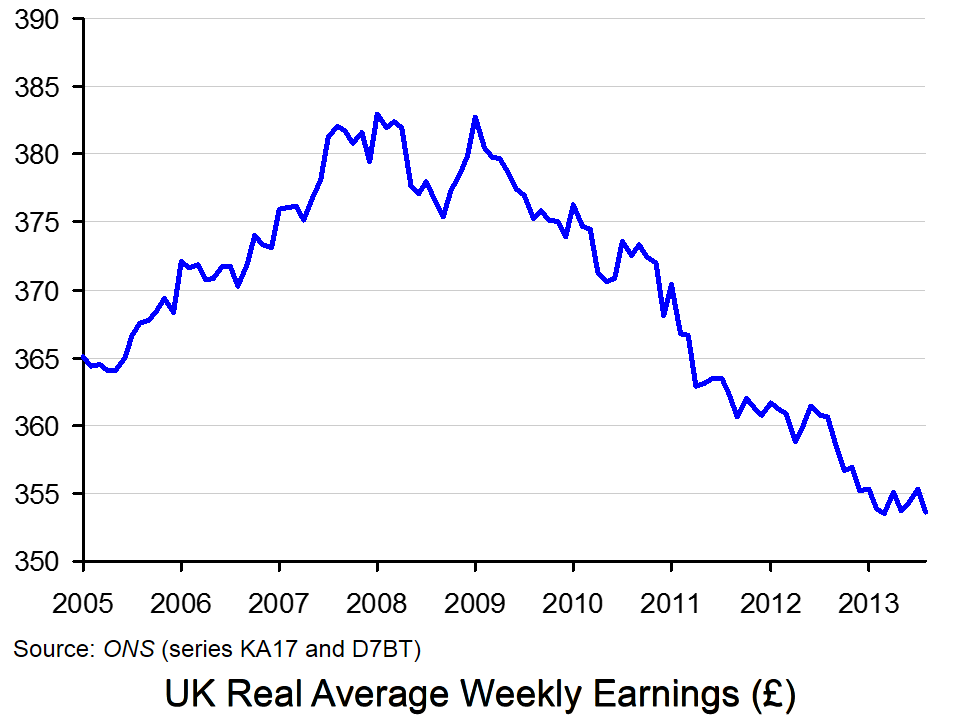 have continued to fall throughout this period. The first chart illustrates this. It shows average weekly wage rates in 2005 prices. (Click here for a PowerPoint of the chart.)
The fall in real wages is an average for the whole country. Many people, especially those on low incomes, have seen their real wages fall much faster than the average. For many there is a real ‘cost of living’ crisis.
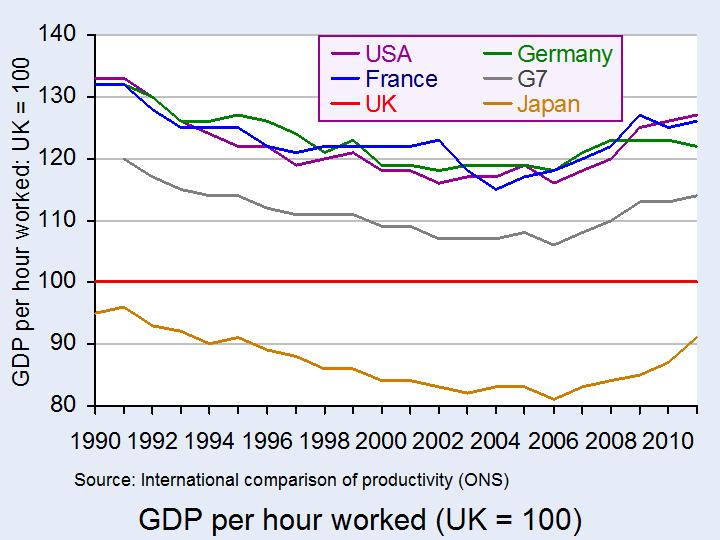
But why have real wages fallen despite the rise in employment? The answer is that output per hour worked has declined. This is illustrated in the second chart, which compares UK output per worker with that of other G7 countries. UK productivity has fallen both absolutely and relative to other G7 countries, most of which have had higher rates of investment.
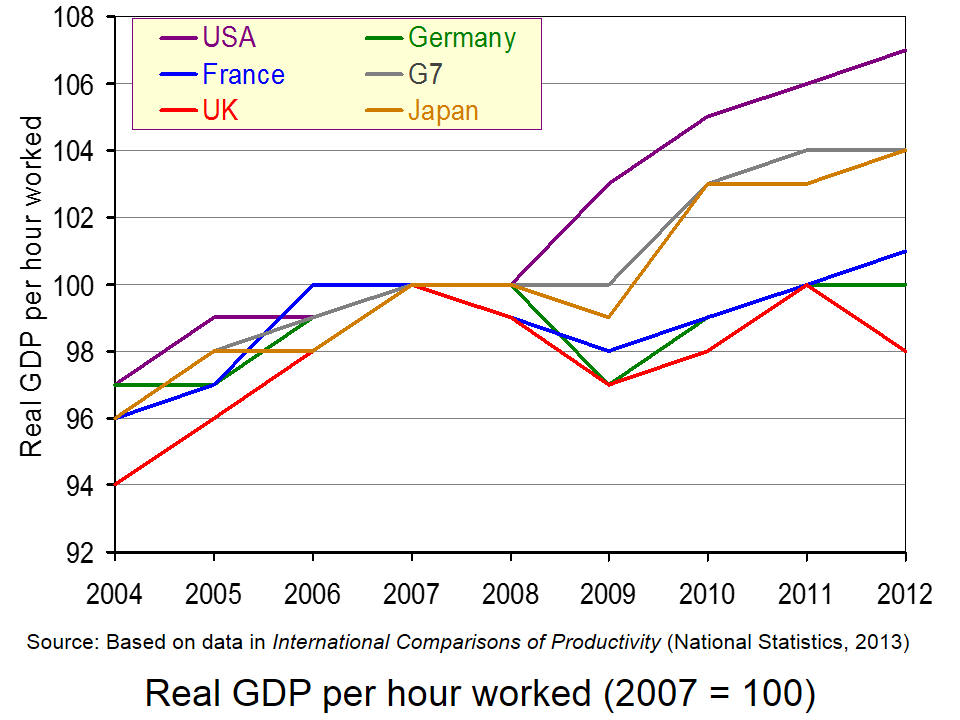 The falling productivity in the UK requires more people to be employed to produce the same level of output. Part of what seems to be happening is that many employers have been prepared to keep workers on in return for lower real wages, even if demand from their customers is falling. And many workers have been prepared to accept real wage cuts in return for keeping their jobs.
Another part of the explanation is that the jobs that have been created have been largely in low-skilled, low-wage sectors of the economy, such as retailing and other parts of the service sector.
But falling productivity is only part of the reason for falling real wages. The other part is rising prices. A number of factors have contributed to this. These include a depreciation of the exchange rate back in 2008, the effects of which took some time to filter through into higher prices in the shops; a large rise in various commodity prices; and a rise in VAT and various other administered prices.
So what is the answer to falling real wages? The articles below consider the problem and some of the possible policy alternatives.
Articles
Inflation, unemployment and UK ‘misery’ BBC News, Linda Yueh (16/10/13)
Employment is growing, but so are the wage slaves The Guardian, Larry Elliott (16/10/13)
Living standards – going down and, er, up BBC News, Nick Robinson (26/7/13)
Revealed: The cost of living is rising faster in the UK than anywhere in Europe, with soaring food and energy bills blamed Mail Online, Matt Chorley (16/10/13)
Cutting prices to raise living standards is just a waste of energy The Telegraph, Roger Bootle (6/10/13)
Downturn sees average real wages collapse to a record low Independent, Ben Chu (17/10/13)
Why living standards and public finances matter Financial Times, Gavin Kelly (29/9/13)
Social Mobility Tsar Alan Milburn Calls on Government to Boost Wages to End UK Child Poverty International Business Times, Ian Silvera (17/10/13)
Do incorrect employment growth figures explain low UK productivity? The Guardian, Katie Allen (23/10/13)
Data
Unemployment data ONS
Average Weekly Earnings dataset ONS
Consumer Prices Index ONS
International Comparison of Productivity ONS
Questions
- How are real wages measured?
- Why have real wage rates fallen in the UK since 2009?
- What factors should be included when measuring living standards?
- Why has employment risen and unemployment fallen over the past two years?
- What factors could lead to a rise in real wages in the future?
- What government policies could be adopted to raise real wages?
- Assess these policies in terms of their likely short-term success and long-term sustainability.
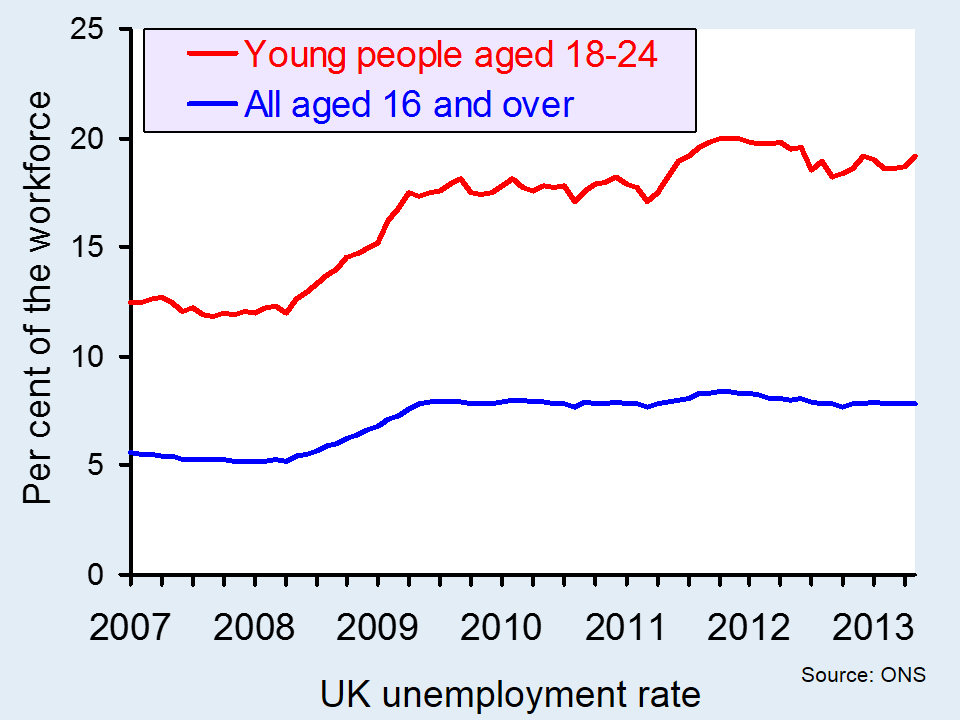
 UK unemployment fell by 4000 to 2.51 million in second quarter of this year. But this was too small to have any significant effect on the unemployment rate, which remained at 7.8%.
According to the forward guidance issued by the Bank of England, Bank Rate will stay at 0.5%, barring serious unforeseen circumstances, until unemployment reaches 7%. So will this be soon?
There are good reasons to suggest that the answer is no. Reasons include the following:
(a) Many firms may choose to employ their part-time workers for more hours, rather than taking on extra staff, if the economy picks up.
 (b) The recovery is being fuelled by a rise in consumption, which, in turn, is being financed by people drawing on savings or borrowing more. The household saving ratio fell from 7.4% in 2012 Q1 to 4.2% in 2013 Q1. This trend will be unsustainable over the long run, especially as the Bank of England may see a rapid rise in borrowing/decline in saving as serious enough to raise interest rates before the unemployment rate has fallen to 7%.
(c) Despite the modest recovery, people’s average real incomes are well below the levels prior to the deep recession of 2008/9.
The articles consider the outlook for the economy and unemployment
Articles
UK unemployment holds steady at 7.8pc The Telegraph, Rebecca Clancy (14/8/13)
Unemployment rate is unlikely to fall sharply The Guardian, Larry Elliott (14/8/13)
UK unemployment falls by 4,000 to 2.51 million BBC News (14/8/13)
UK wages decline among worst in Europe BBC News (11/8/13)
Squeezing the hourglass The Economist (10/8/13)
 More people in work than ever before as unemployment falls Channel 4 News, Faisal Islam (14/8/13)
Data
Labour Market Statistics, August 2013 ONS
United Kingdom National Accounts, The Blue Book, 2013: Chapter 06: Households and Non-profit Institutions Serving Households (NPISH) ONS
Questions
- What factors determine the rate of unemployment?
- With reference to the ONS data in Labour Market Statistics, August 2013 above, what has happened to (a) the long-term unemployment rate; (b) the unemployment rate for 18–24 year olds?
- How would you define ‘living standards’?
- How is labour productivity relevant to the question of whether unemployment is likely to fall?
- How much have living standards fallen since 2008?
- Under what circumstances might the Bank of England raise interest rates before the rate of unemployment has fallen to 7%?
- Property prices are beginning to rise. Consider the effects of this and whether, on balance, a rise in property prices is beneficial.
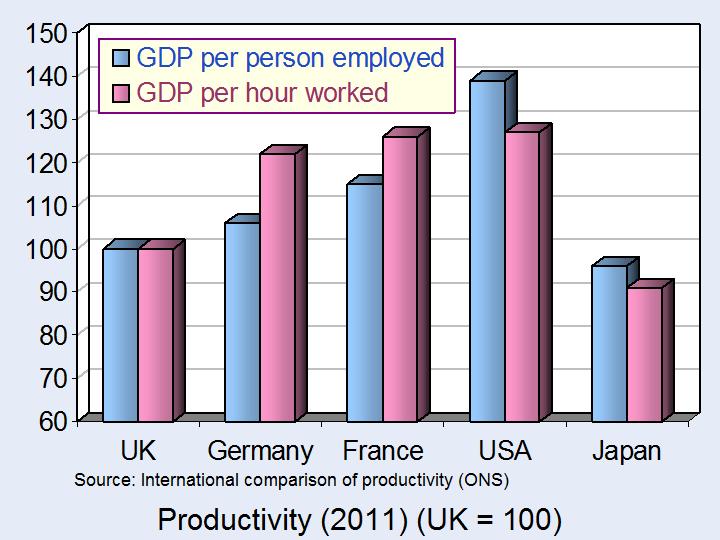 Recent figures from the ONS suggest that the UK lags well behind its competitors in terms of labour productivity. In terms of output per hour worked, Germany produces 22% more than the UK, France produces 26% more, the USA produces 27% more, the Netherlands 31% more and Ireland 43% more. The first chart illustrates some of these figures.
(Click here for a PowerPoint of this chart.)
And in the past few years the problem has been getting worse. This is shown in the second chart. This, however, is a relatively recent phenomenon. Until 2006, the gap was narrowing, but since then it has widened. (Click here for a PowerPoint of the second chart.)
 What has caused this widening of the gap? Part of the problem is a historical lack of investment in the UK. Between 2005 and 2012, the UK invested on average 15.7% of GDP. The USA invested 16.5%, Germany 17.9% and France 20.1%. And part of the problem has been the cut back in private-sector investment in response to the recession (which has been deeper in the UK) and in public-sector investment as part of the government’s austerity measures.
Part of the problem has been lower levels of inward investment. Inward direct investment to the UK in 2011 was only 24 per cent of that in 2007. In France, Germany, Italy and the USA, the figures were 43, 50, 66 and 105 per cent respectively.
Part of the problem has been the size of the financial sector in the UK. This is considerably larger as a proportion of the economy than in most the UK’s major competitors. And it was this sector most hard hit by the crisis of 2007/8.
 With this poor productivity performance, you might expect unemployment to have soared. In fact, the UK has one of the lowest unemployment rates of the developed countries and in recent months it has been falling while other countries have seen their unemployment rates rise.
In fact, low productivity and high employment are compatible. If people produce less than their counterparts abroad, then more people will be needed to produce the same level of output. The problem, of course, is that this only works if wages are kept down. Indeed, wages have fallen in real terms and now stand at the level of 10 years ago.
The problem of falling real wages is that this translates into a lack of demand – especially when people are trying to reduce their debts. Not only does this result in a lack of economic growth, it discourages firms from investing – and investment is one of the prime drivers of future productivity growth!
The following articles explore the problem of low productivity and its relationship with employment and with both short-term and long-term economic growth.
Articles
UK has widest productivity gap since 1993 City A.M., Ben Southwood (14/2/13)
Productivity ‘key to UK’s economic future’ SnowdropKCS (7/2/13)
Low wages and lack of investment – why UK’s productivity has slumped Wales Online, David Williamson (2/3/13)
Recovery in jobs gives a fillip before the news on growth Independent, Russell Lynch (23/1/13)
U.K. Triple-Dipping as Productivity Falls Slate, Matthew Yglesias (25/1/13)
UK productivity puzzle baffles economists BBC News, By Andrew Walker (18/10/12)
Is low productivity a structural problem in the UK? BBC Today Programme, Bridget Rosewell and Andrew Sentance (4/1/13)
We Need to Talk About the Middle Huffington Post, Stewart Wood (14/2/13)
UK Wages Slump to Lowest Level in a Decade – ONS International Business Times, Shane Croucher (13/2/13)
Britain’s low-wage economy serves as a bind on the country The Guardian, Philip Inman (13/2/13)
Real wages fall back to 2003 levels in UK The Guardian, Hilary Osborne (13/2/13)
Data
International Comparisons of Productivity – Final Estimates for 2011 ONS (13/2/13)
International Comparisons of Productivity, datasets ONS (13/2/13)
Changes in real earnings in the UK and London, 2002 to 2012 ONS (13/2/13)
Questions
- Which is a better measure of productivity – output per worker or output per hour worked? Why, do you think, does the USA produce 39% more per worker, but only 27% more per hour worked?
- What policies should the government adopt in order to encourage a growth in productivity?
- If productivity growth increased, what would be the likely effect on employment? Explain.
- Why has unemployment not risen in recent months?
 Pressure has been growing in the UK for people to be paid no less than a living wage. The Living Wage Foundation claims that this should be £8.55 per hour in London and £7.45 in the rest of the UK. The current minimum wage is £6.19.
There has been considerable support for a living wage across the political spectrum. Ed Miliband, the Labour leader, has stated that a Labour government would ensure that government employees were paid at least the living wage and that government contracts would go only to firms paying living wages. Other firms that paid less could be ‘named and shamed’. The living wage has also been supported by Boris Johnson, Conservative Mayor of London. The Prime Minister said that a living wage is ‘an idea whose time has come’, although many Conservatives oppose the idea.
The hourly living wage rate is calculated annually by the Centre for Research in Social Policy and is based on the basic cost of living. The London rate is calculated by the Greater London Authority.
Advocates of people being paid at least the living wage argue that not only would this help to reduce poverty, it would also help to reduce absenteeism and increase productivity by improving motivation and the quality of people’s work.
 It would also bring in additional revenue to the government. According to a report by the Institute for Public Policy Research and the Resolution Foundation, if everyone were paid at least a living wage, this would increase the earnings of the low paid by some £6.5bn per year. Of this, some £3.6bn would go to the government in the form of higher income tax and national insurance payments and reduced spending on benefits and tax credits. Of this £6.5bn, an extra £1.3 billion would be paid to public-sector workers, leaving the Treasury with a net gain of £2.3bn.
But what would be the effect on employment? Would some firms be forced to reduce their workforce and by how much? Or would the boost to aggregate demand from extra consumer spending more than offset this and lead to a rise in employment?. The following articles look at the possible effects.
Articles
Living wage for all workers would boost taxes and GDP Independent, Nigel Morris (28/12/12)
Living wage could save £2bn – think tank research BBC News (28/12/12)
‘Living wage’ would save money, says study Financial Times, Helen Warrell (28/12/12)
Why the Resolution Foundation and IPPR can go boil their heads Adam Smith Institute, Tim Worstall (30/12/12)
Living wage for public servants moves a step closer The Observer,
Yvonne Roberts and Toby Helm (15/12/12/)
Living wage: Ed Miliband pledge over government contracts BBC News (5/11/12)
‘London Living Wage’ increased to £8.55 by mayor BBC News (5/11/12)
Q&A: The living wage BBC News (5/11/12)
Scrooges in UK firms must pay a Living Wage This is Money, John Sentamu (23/12/12)
Report
What price a living wage? IPPR and The Resolution Foundation, Matthew Pennycook (May 2012)
Questions
- How would you set about determining what the living wage rate should be?
- Distinguish between absolute and relative poverty. Would people being paid below a living wage be best described as absolute or relative poverty (or both or neither)?
- What do you understand by the term ‘efficiency wage’? How is this concept relevant to the debate about the effects of firms paying a living wage?
- Under what circumstances would raising the statutory minimum wage rate to the living wage rate result in increased unemployment? How is the wage elasticity of demand for labour relevant to your answer and how would this elasticity be affected by all firms having to pay at least the living wage rate?
- What would be the macroeconomic effects of all workers being paid at least the living wage rate? What would determine the magnitude of these effects?
 Many developing Asian countries have experienced rapid and yet relatively stable economic growth over a number of years. In other words, this has not been a short-term unsustainable boom associated with the expansionary phase of the business cycle – with aggregate demand expanding more rapidly than aggregate supply. Rather it is the result of a rapid growth in aggregate supply.
Over the period from 2000 to 2011, several Asian countries experienced average annual growth rates of over 4% and some, such as China and India, much more than that, as the following table shows. The table also shows forecasts for the period from 2012 to 2017. The high forecast growth rates are based on a continuing rapid growth in aggregate supply as the countries invest in infrastructure and adopt technologies, many of which have already been developed elsewhere.
Average annual economic growth rates
|
2000–11 |
2012–17 |
| China |
10.2 |
8.4 |
| India |
7.2 |
6.3 |
| Lao |
7.1 |
7.9 |
| Vietnam |
7.1 |
6.5 |
| Indonesia |
5.2 |
6.5 |
| Malaysia |
5.0 |
4.9 |
| Philippines |
4.7 |
4.9 |
| Thailand |
4.0 |
5.1 |
 First the good news. Employment is rising and unemployment is falling. Both claimant count rates and Labour Force Survey rates are down. Compared with a year ago, employment is up 279,092 to 29,869,489; LFS unemployment is down from 7.87% to 7.69%; and the claimant count rate is down from 4.7% to 4.0%.