 On 2 November, the Bank of England raised Bank rate from 0.25% to 0.5% – the first rise since July 2007. But was now the right time to raise interest rates? Seven of the nine-person Monetary Policy Committee voted to do so; two voted to keep Bank Rate at 0.25%.
Raising the rate, on first sight, may seem a surprising decision as growth remains sluggish. Indeed, the two MPC members who voted against the rise argued that wage growth was too weak to justify the rise. Also, inflation is likely to fall as the effects of the Brexit-vote-induced depreciation of sterling on prices feeds through the economy. In other words, prices are likely to settle at the new higher levels but will not carry on rising – at least not at the same rate.
So why did the other seven members vote to raise Bank Rate. There are three main arguments:
|
|
| • |
Inflation, at 3%, is above the target of 2% and is likely to stay above the target if interest rates are not raised. |
| • |
There is little spare capacity in the economy, with low unemployment. There is no shortage of aggregate demand relative to output. |
| • |
With productivity growth being negligible and persistently below that before the financial crisis, aggregate demand, although growing slower than in the past, is growing excessively relative to the growth in aggregate supply. |
As the Governor stated at the press conference:
In many respects, the decision today is straightforward: with inflation high, slack disappearing, and the economy growing at rates above its speed limit, inflation is unlikely to return to the 2% target without some increase in interest rates.
But, of course, the MPC’s forecasts may turn out to be incorrect. Many things are hard to predict. These include: the outcomes of the Brexit negotiations; consumer and business confidence and their effects on consumption and investment; levels of growth in other countries and their effects on UK exports; and the effects of the higher interest rates on saving and borrowing and hence on aggregate demand.
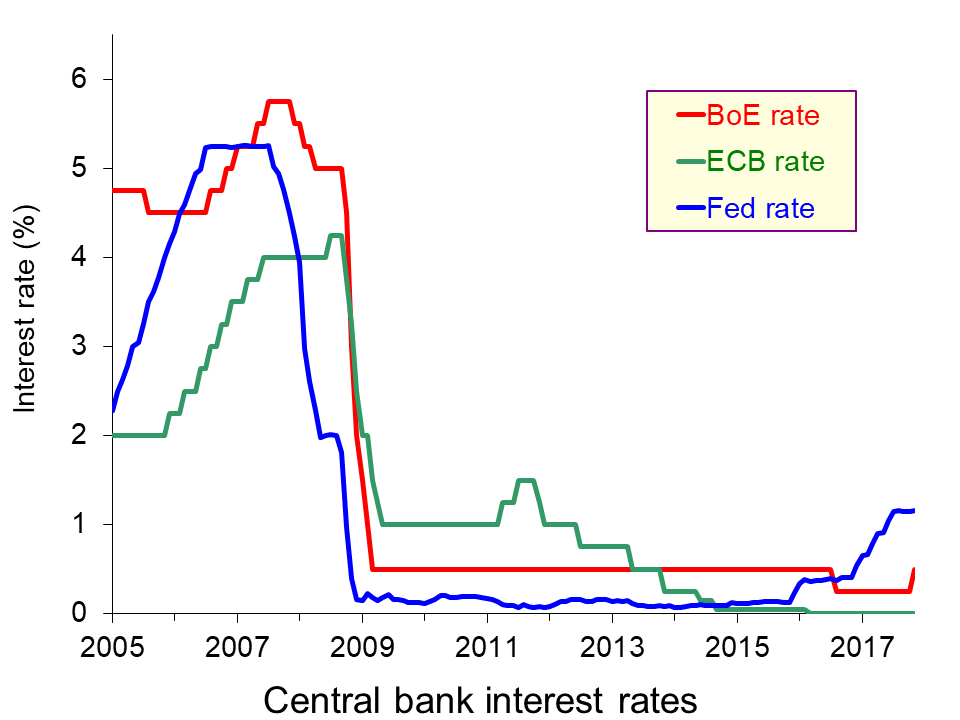 The Bank of England is well aware of these uncertainties. Although it plans two more rises in the coming months and then Bank Rate remaining at 1% for some time, this is based on its current assessment of the outlook for the economy. If circumstances change, the Bank will adjust the timing and total amount of future interest rate changes.
There are, however, dangers in the rise in interest rates. Household debt is at very high levels and, although the cost of servicing these debts is relatively low, even a rise in interest rates of just 0.25 percentage points can represent a large percentage increase. For example, a rise in a typical variable mortgage interest rate from 4.25% to 4.5% represents a 5.9% increase. Any resulting decline in consumer spending could dent business confidence and reduce investment.
Nevertheless, the Bank estimates that the effect of higher mortgage rates is likely to be small, given that some 60% of mortgages are at fixed rates. However, people need to refinance such rates every two or three years and may also worry about the rises to come promised by the Bank.
Articles
Bank of England deputy says interest rate rise means pain for households and more hikes could be in store Independent, Ben Chapman (3/11/17)
UK interest rates: Bank of England shrugs off Brexit nerves to launch first hike in over a decade Independent, Ben Chu (2/11/17)
 Bank of England takes slow lane after first rate hike since Reuters, David Milliken, William Schomberg and Julian Satterthwaite (2/11/17)
First UK rate rise in a decade will be a slow burn Financial Times, Gemma Tetlow (2/11/17)
The Bank of England’s Rate Rise Could Spook Britain’s Economy Bloomberg, Fergal O’Brien and Brian Swint (3/11/17)
Bank of England hikes rates for the first time in a decade CNBC, Sam Meredith (2/11/17)
Interest rates rise in Britain for the first time in a decade The Economist (2/11/17)
Bank of England publications
Bank of England Inflation Report Press Conference, Opening Remarks Financial Times on YouTube, Mark Carney (2/11/17)
Bank of England Inflation Report Press Conference, Opening Remarks Bank of England, Mark Carney (2/11/17)
Inflation Report Press Conference (full) Bank of England on YouTube (2/11/17)
Inflation Report Bank of England (November 2017)
Monetary Policy Summary and minutes of the Monetary Policy Committee meeting ending on 1 November 2017 Bank of England (2/11/17)
Questions
- Why did the majority of MPC members feel that now was the right time to raise interest rates whereas a month ago was the wrong time?
- Why did the exchange rate fall when the announcement was made?
- How does a monetary policy of targeting the rate of inflation affect the balance between aggregate demand and aggregate supply?
- Can monetary policy affect potential output, or only actual output?
- If recent forecasts have downgraded productivity growth and hence long-term economic growth, does this support the argument for raising interest rates or does it suggest that monetary policy should be more expansionary?
- Why does the MPC effectively target inflation in the future (typically in 24 months’ time) rather than inflation today? Note that Mark Carney at the press conference said, “… it isn’t so much where inflation is now, but where it’s going that concerns us.”
- To what extent can the Bank of England’s monetary policy be described as ‘discretionary’?
 In various blogs, we’ve looked at the UK’s low productivity growth, both relative to other countries and relative to the pre-1998 financial crisis (see, for example, The UK productivity puzzle and Productivity should we be optimistic?). Productivity is what drives long-term economic growth as it determines potential GDP. If long-term growth is seen as desirable, then a fall in productivity represents a serious economic problem.
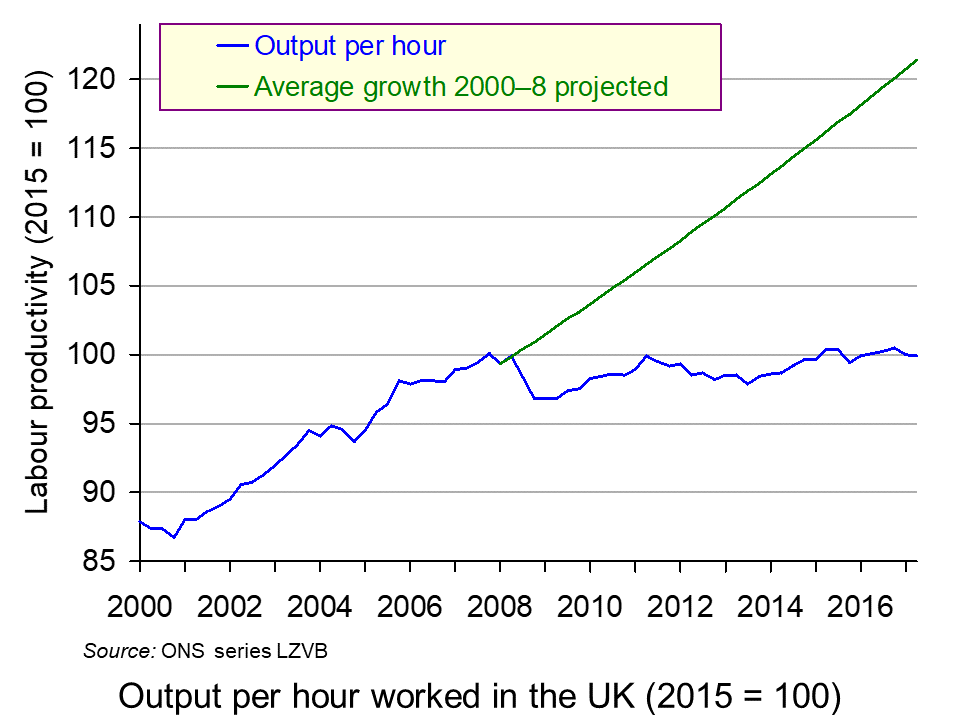
Recent data suggest that the problem, if anything, is worse than previously thought and does not seem to be getting better. Productivity is now some 21% below what it would have been had productivity growth continued at the rate experienced in the years before the financial crisis (see second chart below).
In its latest productivity statistics, the ONS reports that labour productivity (in terms of output per hour worked) fell by 0.1% in the second quarter of 2017. This follows a fall of 0.5% in quarter 1. Over the whole year to 2017 Q2, productivity fell by 0.3%.
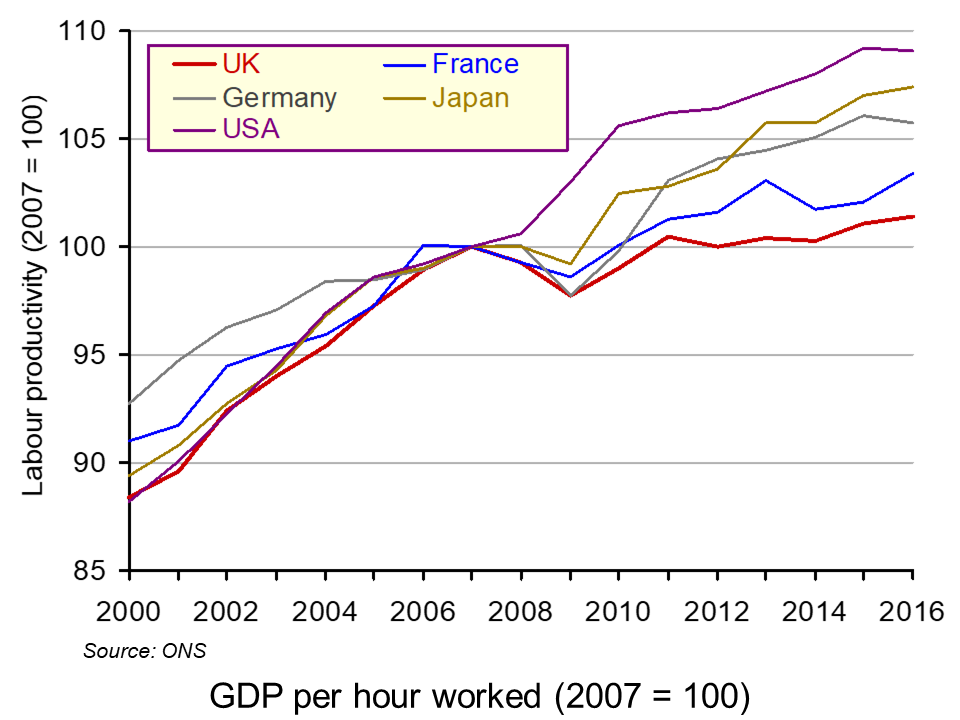 Most other major developed countries have much higher productivity than the UK. In 2016, Italy’s productivity was 9.9% higher than the UK’s; the USA’s was 27.9%, France’s was 28.7% and Germany’s was 34.5% higher. What is more, their productivity has grown faster (see chart).
But what of the future? The Office for Budget responsibility publishes forecasts for productivity growth, but has consistently overestimated it. After predicting several times in the past that UK productivity growth would rise towards its pre-financial crisis trend of around 2% per year, in its October 2017 Forecast evaluation Report it recognises that this was too optimisitic and revises downwards its forecasts for productivity growth for 2017 and beyond.
As the period of historically weak productivity growth lengthens, it seems less plausible to assume that potential and actual productivity growth will recover over the medium term to the extent assumed in our most recent forecasts. Over the past five years, growth in output per hour has averaged 0.2 per cent. This looks set to be a better guide to productivity growth in 2017 than our March forecast of 1.6 per cent.
Looking further ahead, it no longer seems central to assume that productivity growth will recover to the 1.8 per cent we assumed in March 2017 within five years.
 But why has productivity growth not returned to pre-crisis levels? There are five possible explanations.
The first is that there has been labour hoarding. But with companies hiring more workers, this is unlikely still to be true for most employers.
The second is that very low interest rates have allowed some low-productivity companies to survive, which might otherwise have been driven out of business.
The third is a reluctance of banks to lend for investment. After the financial crisis this was driven by the need for them to repair their balance sheets. Today, it may simply be greater risk aversion than before the financial crisis, especially with the uncertainties surrounding Brexit.
The fourth is a fall in firms’ desire to invest. Although investment has recovered somewhat from the years directly following the financial crisis, it is still lower than might be expected in an economy that is no longer is recession. Indeed, there has been a much slower investment recovery than occurred after previous recessions.
The fifth is greater flexibility in the labour market, which has subdued wages and has allowed firms to respond to higher demand by taking on more relatively low-productivity workers rather than having to invest in human capital or technology.
Whatever the explanation, the solution is for more investment in both technology and in physical and human capital, whether by the private or the public sector. The question is how to stimulate such investment.
Articles
UK productivity lagging well behind G7 peers – ONS Financial Times, Katie Martin (6/10/17)
UK productivity sees further fall BBC News (6/10/17)
UK resigned to endless productivity gloom The Telegraph, Tim Wallace (10/10/17)
UK productivity estimates must be ‘significantly’ lowered, admits OBR The Guardian, Richard Partington and Phillip Inman (10/10/17)
UK productivity growth to remain sluggish, says OBR BBC News (10/10/17)
Official Treasury forecaster slashes UK productivity growth forecast, signalling hole in public finances for November Budget Independent, Ben Chu (10/10/17)
The Guardian view on Britain’s productive forces: they are not working The Guardian, Editorial (10/10/17)
Mind the productivity gap: the story behind sluggish earnings The Telegraph, Anna Isaac (26/10/17)
Data and statistical analysis
Labour productivity: April to June 2017 ONS Statistical Bulletin (6/10/17)
International comparisons of productivity ONS Dataset (6/10/17)
Forecast evaluation report OBR (October 2017)
Questions
- Explain the relationship between labour productivity and potential GDP.
- What is the relationship between actual growth in GDP and labour productivity?
- Why does the UK lag France and Germany more in output per hour than in output per worker, but the USA more in output per worker than in output per hour?
- Is there anything about the UK system of financing investment that results in lower investment than in other developed countries?
- Why are firms reluctant to invest?
- In what ways could public investment increase productivity?
- What measures would you recommend to encourage greater investment and why?
- How do expectations affect the growth in labour productivity?
 According to a new report, Time for Change published by the Institute for Public Policy Research (IPPR), ‘The British economic model needs fundamental reform.’
It is no longer generating rising earnings for a majority of the population, and young people today are set to be poorer than their parents. Beneath its headlines figures, the economy is suffering from deep and longstanding weaknesses, which make it unfit to face the challenges of the 2020s.
The report by the IPPR’s Commission on Economic Justice is an interim one, with the final report due in the latter part of next year. The commission was set up in 2016 and includes business leaders, such as the heads of John Lewis and Siemens, the TUC General Secretary, the Archbishop of Canterbury and other leading figures.
Commenting on the interim report, Justin Welby, the Archbishop of Canterbury said
Our economic model is broken. Britain stands at a watershed moment where we need to make fundamental choices about the sort of economy we need. We are failing those who will grow up into a world where the gap between the richest and poorest parts of the country is significant and destabilising
The report found that wages have stagnated for the majority of the population since the financial crisis of 2007/8. Wage income has fallen as a proportion of national income, while the proportions going to income from profits and property have risen. Young people are poorer than previous generations of young people.
Despite low unemployment, many people are on zero-hour contracts, part-time contracts or employed on a casual basis. For many, their jobs are insecure and they have no bargaining power.
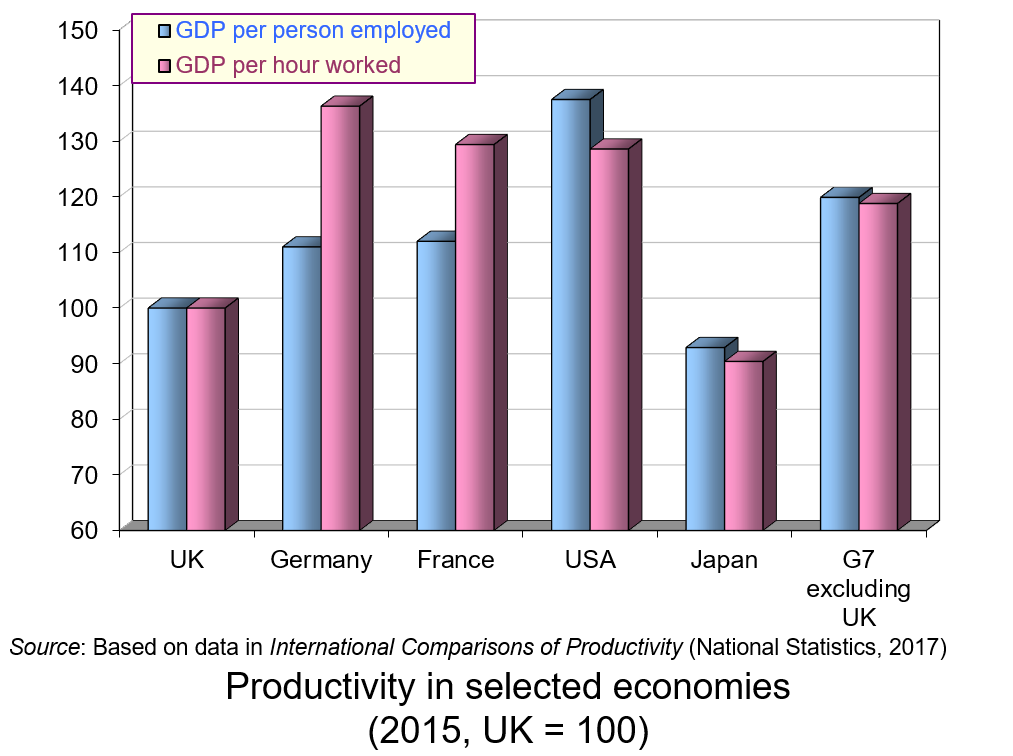 The UK for many years has had a lower rate of investment that other developed economies and productivity, in terms of output per hour, is the lowest of its major competitors. Productivity in Germany is 36% higher than in the UK; in France and the USA it is 29% higher. Although there are some internationally competitive UK firms with high productivity, the country has:
a longer ‘tail’ of low-productivity businesses, in which weak management and poor use of skills leads to ‘bad jobs’ and low wages.
There are many other challenges, including an ageing population, uncertainties from Brexit, a large current account deficit, increased competition from abroad and growth once more in private-sector debt, which means that consumption may cease to be the main driver of economic growth as people seek to curb their borrowing.
The report is also critical of fiscal policy, which with record low interest rates could have been used to finance infrastructure projects as well as supporting public services.
The report recommends three approaches:
The first is institutional reform to support investment.
The second is making the economy more competitive through a coherent industrial strategy, reform of the financial sector to support long-term investment, reform of corporate governance to promote business success and tackling the market dominance of companies such as Amazon and Google.
The third is to bring greater social justice and equality through encouraging more secure and better-paid jobs, strengthening trades unions and reforming the tax system to make it fairer and smarter.
Not surprisingly the government has defended its record of reducing debt, presiding over falling unemployment and reduced inequality as measured by a reduced Gini coefficient. However, there has only been a modest fall in the Gini coefficient, from 0.333 in 2009/10 to 0.315 in 2016/7, and this has largely been the result of the very rich seeing a decline in income from assets.
Articles
Britain’s economy is broken and failing to tackle inequality, says major new report Independent, Ben Chu (6/9/17)
UK’s economic model is broken, says Archbishop of Canterbury The Guardian, Phillip Inman (5/9/17)
Tax wealth or see the UK tear itself apart, Cable will warn Bloomberg, Alex Morales and Thomas Penny (6/9/17)
Archbishop of Canterbury calls for radical economic reform BBC News (5/9/17)
Archbishop warns economy is “broken” as report reveals longest period of wage stagnation for 150 years Huffington Post, Rachel Wearmouth (6/9/17)
Britain’s economy is broken. We desperately need new ideas The Guardian, Tom Kibasi (4/6/17)
Carney: Britain is in the ‘first lost decade since the 1860s’, Business Insider, Oscar Williams-Grut (6/12/16)
Our broken economy, in one simple chart New York Times, David Leonhardt (7/8/16)
Report
Time for Change: A new Vision for the British Economy IPPR Commission on Economic Justice (6/9/17)
Questions
- Why have wages for the majority of the UK population stagnated for the past 10 years?
- Why is productivity in the UK lower than in most other developed economies?
- Is it possible for poor people to become poorer and yet for the Gini coefficient to fall?
- What institutional reforms would you suggest to encourage greater investment?
- Explain the possible advantages and disadvantages of abandoning ‘austerity policy’ and adopting a more expansionist fiscal stance?
- Does it matter that Amazon and Google are dominant players in their respective markets? Explain.
 In the last blog post, As UK inflation rises, so real wages begin to fall, we showed how the rise in inflation following the Brexit vote is causing real wages in the UK to fall once more, after a few months of modest rises, which were largely due to very low price inflation. But how does this compare with other OECD countries?
In an article by Rui Costa and Stephen Machin from the LSE, the authors show how, from the start of the financial crisis in 2007 to 2015 (the latest year for which figures are available), real hourly wages fell further in the UK than in all the other 27 OECD countries, except Greece (see the chart below, which is Figure 5 from their article). 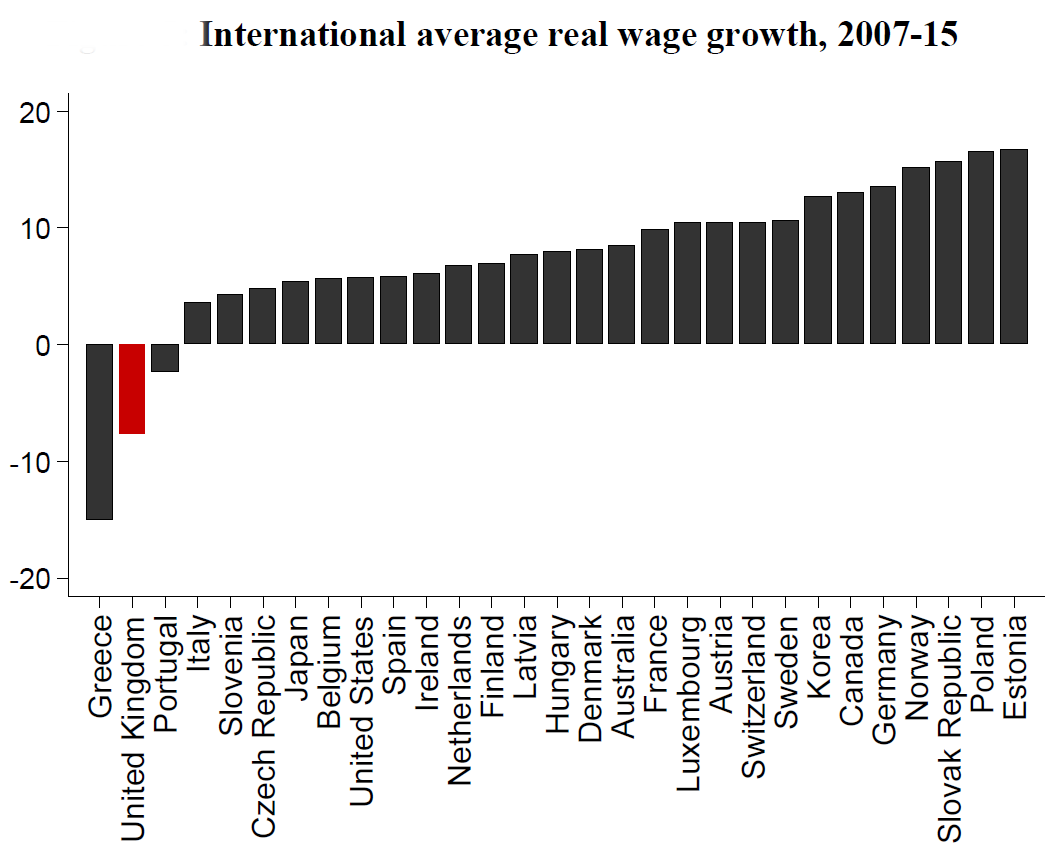 Indeed, only in Greece, the UK and Portugal were real wages lower in 2015 than in 2007.
The authors examine a number of aspects of real wages in the UK, including the rise in self employment, differences by age and sex, and for different percentiles in the income distribution. They also look at how family incomes have suffered less than real wages, thanks to the tax and benefit system.
The authors also look at what the different political parties have been saying about the issues during their election campaigns and what they plan to do to address the problem of falling, or only slowly rising, real wages.
Articles
Real Wages and Living Standards in the UK LSE – Centre for Economic Performance, Rui Costa and Stephen Machin (May 2017)
The Return of Falling Real Wages LSE – Centre for Economic Performance, David Blanchflower, Rui Costa and Stephen Machin (May 2017)
The chart that shows UK workers have had the worst wage performance in the OECD except Greece Independent, Ben Chu (5/6/17)
Data
Earnings and working hours ONS
OECD.Stat OECD
International comparisons of productivity ONS
Questions
- Why have real wages fallen more in the UK than in all OECD countries except Greece?
- Which groups have seen the biggest fall in real wages? Explain why.
- What policies are proposed by the different parties for raising real wages (a) generally; (b) for the poorest workers?
- How has UK productivity growth compared with that in other developed countries? What explanations can you offer?
- What is the relationship between productivity growth and the growth in real wages?
 According to Christine Lagarde, Managing Director of the IMF, the slow growth in global productivity is acting as a brake on the growth in potential income and is thus holding back the growth in living standards. In a recent speech in Washington she said that:
Over the past decade, there have been sharp slowdowns in measured output per worker and total factor productivity – which can be seen as a measure of innovation. In advanced economies, for example, productivity growth has dropped to 0.3 per cent, down from a pre-crisis average of about 1 per cent. This trend has also affected many emerging and developing countries, including China.
We estimate that, if total factor productivity growth had followed its pre-crisis trend, overall GDP in advanced economies would be about 5 percent higher today. That would be the equivalent of adding another Japan – and more – to the global economy.
So why has productivity growth slowed to well below pre-crisis rates? One reason is an ageing working population, with older workers acquiring new skills less quickly. A second is the slowdown in world trade and, with it, the competitive pressure for firms to invest in the latest technologies.
 A third is the continuing effect of the financial crisis, with many highly indebted firms forced to make deep cuts in investment and many others being cautious about innovating. The crisis has dampened risk taking – a key component of innovation.
What is clear, said Lagarde, is that more innovation is needed to restore productivity growth. But markets alone cannot achieve this, as the benefits of invention and innovation are, to some extent, public goods. They have considerable positive externalities.
She thus called on governments to give high priority to stimulating productivity growth and unleashing entrepreneurial energy. There are several things governments can do. These include market-orientated supply-side policies, such as removing unnecessary barriers to competition, driving forward international free trade and cutting red tape. They also include direct intervention through greater investment in  education and training, infrastructure and public-sector R&D. They also include giving subsidies and/or tax relief for private-sector R&D.
Banks too have a role in chanelling finance away from low-productivity firms and towards ‘young and vibrant companies’.
It is important to recognise, she concluded, that innovation and structural change can lead to some people losing out, with job losses, low wages and social deprivation. Support should be given to such people through better education, retraining and employment incentives.
Articles
IMF chief warns slowing productivity risks living standards drop Reuters, David Lawder (3/4/17)
Global productivity slowdown risks social turmoil, IMF warns Financial Times, Shawn Donnan (3/4/17)
Global productivity slowdown risks creating instability, warns IMF The Guardian, Katie Allen (3/4/17)
The Guardian view on productivity: Britain must solve the puzzle The Guardian (9/4/17)
Speech
Reinvigorating Productivity Growth IMF Speeches, Christine Lagarde, Managing Director, IMF(3/4/17)
Paper
Gone with the Headwinds: Global Productivity IMF Staff Discussion Note, Gustavo Adler, Romain Duval, Davide Furceri, Sinem Kiliç Çelik, Ksenia Koloskova and Marcos Poplawski-Ribeiro (April 2017)
Questions
- What is the relationship between actual and potential economic growth?
- Distinguish between labour productivity and total factor productivity.
- Why has total factor productivity growth been considerably slower since the financial crisis than before?
- Is sustained productivity growth (a) a necessary and/or (b) a sufficient condition for a sustained growth in living standards?
- Give some examples of technological developments that could feed through into significant growth in productivity.
- What is the relationship between immigration and productivity growth?
- What policies would you advocate for increasing productivity? Explain why.
 On 2 November, the Bank of England raised Bank rate from 0.25% to 0.5% – the first rise since July 2007. But was now the right time to raise interest rates? Seven of the nine-person Monetary Policy Committee voted to do so; two voted to keep Bank Rate at 0.25%.