 Over the past three months oil prices have been falling. From the beginning of September to the end of November Brent Crude has fallen by 30.8%: from $101.2 to a four-year low of $70.0 per barrel (see chart below: click here for a PowerPoint). The fall in price has been the result of changes in demand and supply.
As the eurozone, Japan, South America and other parts of the world have struggled to recover, so the demand for oil has been depressed. But supply has continued to expand as the USA and Canada have increased shale oil production through fracking. 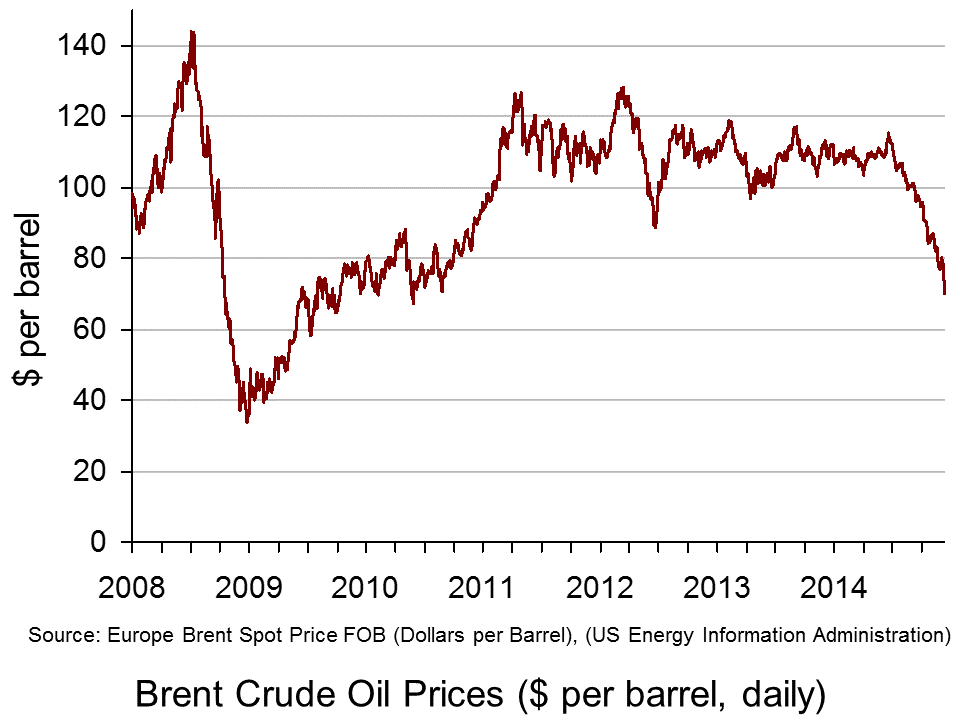 As far as OPEC is concerned, rather than cutting production, it decided at a meeting on 27 November to maintain the current target of 30 million barrels a day.
The videos and articles linked below look at these demand and supply factors and what is likely to happen to oil prices over the coming months.
They also look at the winners and losers. Although falling prices are likely in general to benefit oil importing countries and harm oil exporting ones, it is not as simple as that. The lower prices could help boost recovery and that could help to halt the oil price fall and be of benefit to the oil exporting countries. But if prices stay low for long enough, this could lower inflation and even cause deflation (in the sense of falling prices) in many countries. This, in turn, could dampen demand (see the blog post, Deflation danger). This is a particular problem in Japan and the eurozone. Major oil importing developing countries, such as China and India, however, should see a boost to growth from the lower oil prices.
Some oil exporting countries will be harder hit than others. Russia, in particular, has been badly affected, especially as it is also suffering from the economic sanctions imposed by Western governments in response to the situation in Ukraine. The rouble has fallen by some 32% this year against the US dollar and nearly 23% in the past three months alone.
Then there are the environmental effects. Cheaper oil puts less pressure on companies and governments to invest in renewable sources of energy. And then there are the direct effects on the environment of fracking itself – something increasingly being debated in the UK as well as in the USA and Canada.
Videos
 Oil price at four-year low as Opec meets BBC News, Mark Lobel (27/11/14)
Opec losing control of oil prices due to US fracking BBC News, Nigel Cassidy (4/12/13)
How the price of oil is set – video explainer The Telegraph, Oliver Duggan (28/11/14)
How Oil’s Price Plunge Impacts Wall Street Bloomberg TV, Richard Mallinson (28/11/14)
Oil Prices Plummet: The Impact on Russia’s Economy Bloomberg TV, Martin Lindstrom (28/11/14)
Articles
Oil prices plunge after Opec meeting BBC News (28/11/14)
Crude oil prices extend losses Financial Times, Dave Shellock (28/11/14)
Oil price plunges after Opec split keeps output steady The Guardian, Terry Macalister and Graeme Wearden (27/11/14)
Falling oil prices: Who are the winners and losers? BBC News, Tim Bowler (17/10/14)Hooray for cheap oil BBC News, Robert Peston (1/12/14)
Russian Recession Risk at Record as Oil Price Saps Economy Bloomberg, Andre Tartar and Anna Andrianova (28/11/14)
Rouble falls as oil price hits five-year low BBC News (1/12/14)
Data
Brent Spot Price US Energy Information Administration (select daily, weekly, monthly or annual: can be downloaded to Excel)
Spot exchange rate of Russian rouble against the dollar Bank of England
Questions
- Use a diagram to illustrate the effects of changes in the demand and supply of oil on oil prices.
- How does the price elasticity of demand and supply of oil affect the magnitude of these price changes?
- Explain whether (a) the demand for and (b) the supply of oil are likely to be relatively elastic or relatively inelastic? How are these elasticities likely to change over time?
- Distinguish between the spot price and forward prices of oil? If the three-month forward price is below the spot price, what are the implications of this?
- Analyse who gains and who loses from the recent price falls.
- What are the effects of a falling rouble on the Russian economy?
- What are likely to be the effects of further falls in oil prices on the eurozone economy?
 In December 2013, Uruguay passed a law permitting the growing, distribution and consumption of marijuana. The legislation comes into effect in April 2014. The state will regulate the industry to ensure good quality strains of the crop are grown and sold. It will also tax the industry.
Uruguay is the first country to legalise cannabis, but in July 2012, Colorado and Washington states in the USA passed laws permitting the sale and possession of small amounts of the drug for recreational use. (It was already legal to possess the drug for medical use.) The laws took effect a few months later. It is heavily taxed, however, especially in Washington, where it is taxed at a rate of 25% three times over: when it is sold to the processor; when the processor sells it to the retailer; and when the retailer sells it to the consumer. In Massachusetts, Nevada and Oregon, medical cannabis shops will be permitted to open this year. In the Netherlands, although the sale of cannabis is still illegal, ‘coffee shops’ are permitted to sell people up to 5 grams per day.
So should cannabis be legalised? People have very strong views on the subject and this can make a calm assessment of the issue more difficult. The economist’s approach to legalising cannabis involves seeking to identify and measure the costs and benefits of doing so. If the benefits exceed the costs, then it should be legalised; if not, it should remain illegal (or made illegal). The problem is that the size of the costs and benefits are not easy calculate as they involve estimates of things such as consumption levels, tax revenues, crime reduction, the effects on the consumption of other drugs, including legal drugs such as alcohol and tobacco.
Nevertheless, various estimates of these costs and benefits have been made and provide a basis for discussion.
Possible benefits of cannabis legalisation include: increased tax revenues for the government; reduction in crime, and hence reduction in law enforcement and prison costs; encouraging people with addiction problems to seek help, as they would not fear arrest; reduction in the price, benefiting users; regulating quality of the drug; reducing the consumption of alcohol and more dangerous drugs if these are substitutes for cannabis; moral arguments concerning freedom of individuals to choose their lifestyle.
Possible costs include: increased consumption of cannabis, with attendant health and social side effects; increased consumption of other drugs if they are complements, or if cannabis is an ‘entry level’ drug to harder drugs; moral objections to drug taking.
Clearly some of these costs and benefits are easier to measure than others. Moral arguments are almost impossible to assess quantitatively, even when various underlying moral standpoints are agreed.
The following articles look at recent events and at the arguments, both economic and non-economic.
Articles
As Uruguay moves to legalise cannabis, is the ‘war on drugs’ finished? Metro (20/1/14)
Regulating the sale of marijuana: Global perspective Journalist’s Resource, John Wihbey (17/1/14)
Next Step in Uruguay: Competitive, Quality Marijuana Independent European Daily Express (IEDE) (12/1/14)
U.S. support for legalization of marijuana at an all-time HIGH Mail Online, Anna Edwards (7/1/14)
14 Ways Marijuana Legalization Could Boost The Economy Huffington Post, Harry Bradford (7/11/12)
Colorado pot legalization: 30 questions (and answers) The Denver Post, John Ingold (13/12/12)
Economists Predict Marijuana Legalization Will Produce ‘Public-Health Benefits’ Forbes, Jacob Sullum (1/11/13)
Papers
Economics of Cannabis Legalization Hemp Today, Dale Gieringer (10/10/93)
Pros & Cons of Legalizing Marijuana About.com: US Liberal Politics, Deborah White
Would Marijuana Legalization Increase the Demand for Marijuana? About.com: Economics, Mike Moffatt
Time to Legalize Marijuana? – 500+ Economists Endorse Marijuana Legalization About.com: Economics, Mike Moffatt
A cost benefit analysis of cannabis legalisation Institute for Social and Economic Research, University of Essex
Licensing and regulation of the cannabis market in England and Wales: Towards a cost–benefit analysis Institute for Social and Economic Research, University of Essex, Mark Bryan, Emilia Del Bono and Stephen Pudney (9/13)
What Can We Learn from the Dutch Cannabis Coffeeshop Experience? Rand Drug Policy Research Center, Robert J. MacCoun (7/10)
Podcast
Licensing and regulating the cannabis market in England and Wales Institute for Social and Economic Research, University of Essex, Stephen Pudney (15/9/13)
Questions
- If a country legalises cannabis, what is likely to happen to the price of cannabis? Use a demand and supply diagram to illustrate your argument, considering the effects on both demand and supply. How are the price elasticities of demand and supply relevant to your answer?
- What externalities are there from drug use?
- What externalities are there from making cannabis illegal?
- Distinguish between complementary and substitute goods for cannabis? How is the demand for these likely to be affected by legalising cannabis?
- Go through each of the benefits and costs of legalising cannabis and identify difficulties that might be experienced in quantifying these costs and benefits?
- If cannabis were legalised, how would you set about determining the optimum rate of tax on cannabis production, processing, distribution and sale?
- Consider the arguments for and against legalising cannabis from the perspective of (a) a free-market liberal and (b) a social democrat who sees government intervention as an important means of achieving various social goals.
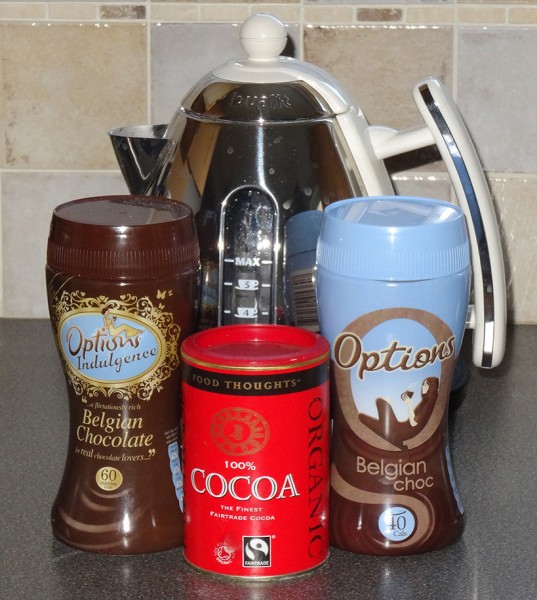 Your favourite chocolate bar or your drink of hot chocolate could soon be much dearer. Since March, the price of cocoa has risen by 34% and much of this increase remains to be passed on to the consumer. The price of cocoa butter is up 70% since the beginning of the year.
On the demand side, sales of luxury cocoa-rich chocolate and hot chocolate have been rising and chocolate manufacturers, with relatively low forward purchases of cocoa, are likely to have to buy more in spot markets. What is more, there is growing speculative demand as traders anticipate higher prices to come.
On the supply side, dry weather in West Africa, where 70% of cocoa beans are produced, has led to a fall in output. Estimates suggest that cocoa production in the 12 months to end-September 2013 will be 2.7% down on the previous 12 months. Supply is expected to be 60,000 tonnes less than demand, resulting in a fall in stocks from 1,833,000 to 1,773,000.
The following articles look at the ‘crisis’ for chocoholics and at the market conditions that lie behind it.
Articles
Craving for a chocolate fix? Prepare to pay more Reuters, Lewa Pardomuan and Marcy Nicholson (15/9/13)
Hot chocolate demand sends cocoa prices soaring Financial Times, Emiko Terazono (15/10/13)
Price of chocolate ‘to triple’ The Telegraph (8/10/13)
Paying more for chocolate? You will be CNN Money, Alanna Petroff (14/10/13)
Chocolate Prices Soar in Dark Turn The Wall Street Journal, Leslie Josephs and Neena Rai (22/9/13)
Chocolate prices could increase as cocoa costs soar BBC News, Nigel Cassidy (21/10/13)
… and on a lighter note: Rising Prices Signal A ‘Devastating’ Global Chocolate Crisis: Should Government Act To Save Us? Forbes, Doug Bandow (14/10/13)
Data
Cocoa beans: monthly price Index Mundi
ICCO daily prices of cocoa beans International Cocoa Organization (click on calendar to select month)
Production of cocoa beans International Cocoa Organization (click on Statistical Data links in right hand panel
Monthly review of the market International Cocoa Organization
Questions
- What happened to cocoa prices from January 2009 to March 2013? Explain this movement in prices.
- Why have cocoa prices risen so much since March 2013? Illustrate your analysis with a supply and demand diagram.
- If the demand for luxury chocolate fluctuates considerably with the state of the business cycle, what does this suggest about the income elasticity of demand for luxury chocolate?
- How would you establish whether or not cheap chocolate is an inferior good?
- If cocoa prices rise by 34%, what determines the percentage by which a bar of chocolate will rise?
- What determines the difference between cocoa futures and spot prices?
- How realistically could government intervention improve the lot of chocoholics?
 Over the past few years lobster prices in Maine have tumbled. Eight years ago the price paid to fishermen was around $4.60 per pound. Today it’s around $2.20. The problem is one of booming lobster populations and the dominance of lobster in catches. Last year’s haul was double that of a decade ago and, in some waters, six times higher.
You would think that larger catches would be good news for fishermen. But prices now are so low that they barely cover variable costs. Individual fishermen fish harder and longer to bring in even bigger catches to make up for the lower price. This, of course, compounds the problem and pushes the price even lower.
So what are the answers for the fishermen of Maine? One solution is to diversify their catch, but with lobster so plentiful and other fish stocks depleted, this is not easy.
Another solution is to cooperate. The Reuters article below quotes John Jordan, a lobsterman and president of Calendar Islands Maine Lobster Co.:
‘If you had an industry that actually cooperated, you wouldn’t be bringing in more product if you couldn’t sell what you already had, right?’
Restricting the catch would require lobster distributors to cooperate and set quotas for what the fishermen would be permitted to sell. But with over 5000 fishermen, this is not easy.
Another solution is to expand the market. One way is for the distributors or other agencies to market lobster and lobster products more aggressively. For example, 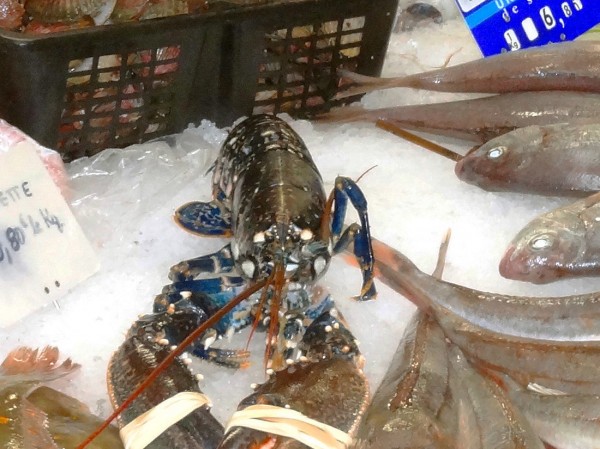 this year the State of Maine has established a $2 million marketing collaborative. Another solution is to find new markets.
Jordan’s company and others are frantically seeking new ways to sneak lobster into unexpected corners of the food market, from gazpacho to puff pastries and quiche.
In the meantime, for consumers the question is whether the low prices paid to the fishermen of Maine will feed through into low prices in the fishmonger, supermarket and restaurant. So far that does not seem to be happening, as the final two articles below explain.
Webcasts
US lobster fishermen’s ‘problem of plenty’ BBC News, Jonny Dymond (5/10/13)
Maine lobstermen in a pinch over low prices, record catch: Part 1, Part 2, Part 3 Aljazeera America, Adam May (11/10/13)
Articles
Something fishy is going on in the nation’s lobster capital CNBC, Heesun Wee (1/9/13)
Booming lobster population pinches profits for Maine’s fishery Reuters, Dave Sherwood (25/8/13)
Lobster’s worth shelling out for The Observer,
Rachel Cooke (21/9/13)
Clawback The New Yorker, James Surowiecki (26/8/13)
Why The Glut Of Cheap Lobster Won’t Lower Price Of Lobster Rolls Gothamist, John Del Signore (20/7/12)
Questions
- Why have lobster prices paid to fishermen fallen? Illustrate your argument with a demand and supply diagram
- What has determined the size of the fall in prices? What is the relevance of price elasticity of demand and price elasticity of supply to your answer?
- How is the fallacy of composition relevant to the effects on profits of an increase in the catch by (a) just one fisherman and (b) all fishermen? What incentive does this create for individual fishermen in a competitive market?
- What can lobster fishermen do to restore profit margins through collaborative action?
- In what ways is there a conflict between economics and ecology in the lobster fishing industry?
- How does stored lobster affect (a) the price elasticity of supply and (b) the price volatility of lobster?
- How could cooperation between lobster fishermen and lobster processors and distributors benefit all those involved in the cooperation?
- Why may restaurants choose to maintain high prices for lobster dishes for ‘psychological reasons’? Are there any other reasons?
 Why are 43 companies in the pub and restaurant sector in the UK donating over a £1 million to an 86 year old Frenchman who claims to work a 70 hour week? Jacques Borel has led an interesting and varied life which has included activities such as helping the French resistance in the 2nd world war and opening the first take-away hamburger restaurant in France in 1961. In 2001 he started a campaign to get the European Union to allow member states to reduce the rate of VAT applied to food and drink sold in the pub, hotel and restaurant industry. Organisations such as JD Wetherspoon, Heineken and Pizza Hut are backing his attempts to persuade the UK government of the benefits of this policy.
VAT is paid when goods and services are purchased and is normally included in the price advertised by the seller. It generates a significant amount of money for the UK government and it is estimated that it will raise £102 billion in 2012-13 – the third biggest source of revenue after income tax and national insurance contributions. It is applied at three different rates in the UK – a standard rate of 20%, a reduced rate of 5% and a zero rate i.e. 0%. This may sound straightforward but in reality the tax is extremely complicated as previously discussed in articles on this website . For example most basic or staple items of food sold in shops are zero rated. However there are some rather bizarre exceptions. For example a packet of potato crisps is subject to the standard rate of VAT whereas tortilla chips are not. The standard rate is applied to a packet of Wotsits whereas a zero rate is applied to a packet of Skips!
The campaign headed by Mr Borel focuses on the discrepancy between the zero-rate applied to most food items purchased from a shop and the standard rate applied to food purchased in restaurants or cafes. For example, if you buy a Pizza from a supermarket then you don’t pay any tax on this purchase, whereas if you eat a pizza in a restaurant the standard 20% rate of VAT is applied. Mr Borel is lobbying the UK government to reduce the rate of VAT paid in pubs and restaurants from the standard rate of 20% to the reduced rate of 5%. One reason why so many UK companies are willing to offer him financial support is because of his success in getting governments in other countries such as Germany, Belgium, Finland and France to adopt this policy.
In a recent radio interview Mr Borel was asked to make his case for the proposed reduction of VAT in the UK. He claimed:
I have a commitment from 125 chains of hotels, restaurants and independents to use 60% of the reduction in VAT to lower prices so that would be a 7.5% decrease in price. When you decrease price by that magnitude you will see an increase in customers of 10-12% and you will be forced to hire new staff. In our best case scenario, we plan to create 670,000 jobs in three years.
When asked in another interview why the hospitality sector should be favoured more than others he replied that:
It would create more jobs in a minimal amount of time…you cannot do that with any other industry.
One obvious drawback of the policy would be the loss of revenue for the UK government. Some estimates have suggested that the loss of VAT receipts would be between £5.5 and £7.8 billion. However it has been claimed that over time the impact of the change on government finances would be zero. In response to the proposed tax cut a Treasury spokesman commented:
Any reduced rates would make a significant impact on revenue and, as a significant proportion of spending in these areas is by UK residents, any increase in activity in these areas would largely be at the expense of other consumer spending.
Webcast
Jacques Borel: VAT cut for pubs Morning Advertiser on YouTube (18/5/11)
Articles
Industry VAT campaigner Jacques Borel appears on Radio Four’s Today and Radio Five Propelinfo (24/4/13)
French veteran in fight to cut pub VAT Financial Times, Christopher Thompson (5/6/12)
The fiscal impact of reduced VAT rates VAT Club Jobs (22/4/13)
Pub and restaurant groups pay 86-year-old Frenchman £1m to convince UK government to cut VAT The Mail on Sunday, Sarah Bridge (20/4/13)
French veteran seeks British jobs boost with VAT Reuters (17/1/13)
Questions
- In his radio interview Jacques Borel claims that if firms pass on 60% of the cut in VAT this would cause a 7.5% reduction in prices. Explain why this is the case. Clearly outline any assumptions you have made in the analysis
- If 60% of the reduction was passed on by firms through lower prices, what do you think would happen to the money generated from the other 40% of the reduction?
- Using a demand and supply diagram illustrate the proposed reduction in the rate of VAT on the hospitality industry. Make sure your diagram is drawn in such a way that it clearly illustrates producers passing on 60% of the tax reduction in the form of lower prices.
- Assuming that the hospitality industry was very competitive, what impact would a reduction in VAT have on consumer surplus, producer surplus and deadweight welfare loss?
- Explain any assumptions you have in your answer to question 3 about the price elasticity of demand and supply.
- Using the figures provided in the radio interview is it possible to calculate the price elasticity of demand. Try making the calculation and clearly explain any assumptions you have made.
- Explain why the reduction in VAT might have no net effect on government finances in the long run?
- What factors determine the price elasticity of supply? What assumption is Mr Borel making about the price elasticity of supply in the hospitality industry compared to other industries when he makes the claim that jobs would be created quickly?
- Outline some of the arguments against cutting the rate of VAT.
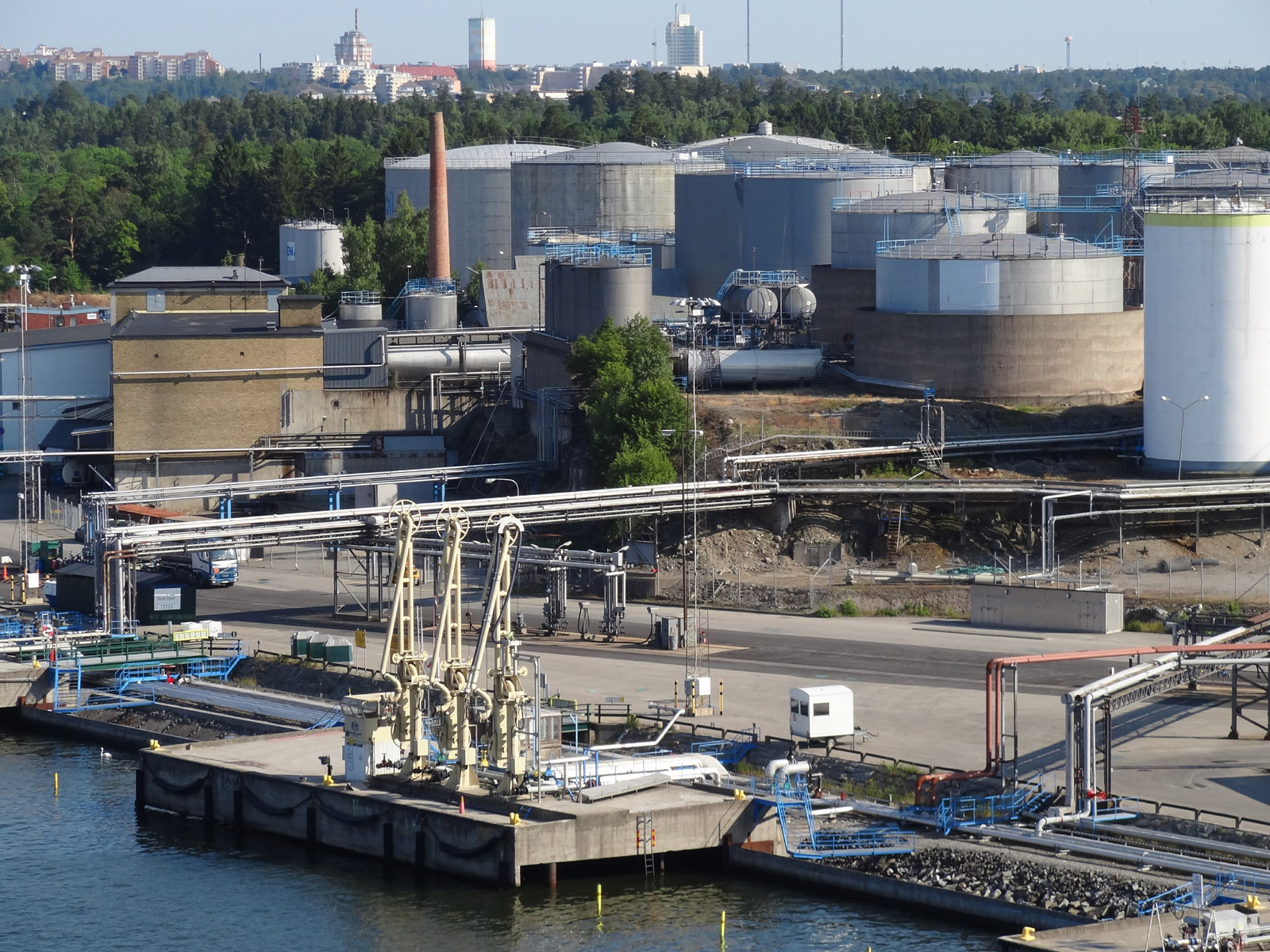 Over the past three months oil prices have been falling. From the beginning of September to the end of November Brent Crude has fallen by 30.8%: from $101.2 to a four-year low of $70.0 per barrel (see chart below: click here for a PowerPoint). The fall in price has been the result of changes in demand and supply.
  Major oil importing developing countries, such as China and India, however, should see a boost to growth from the lower oil prices.