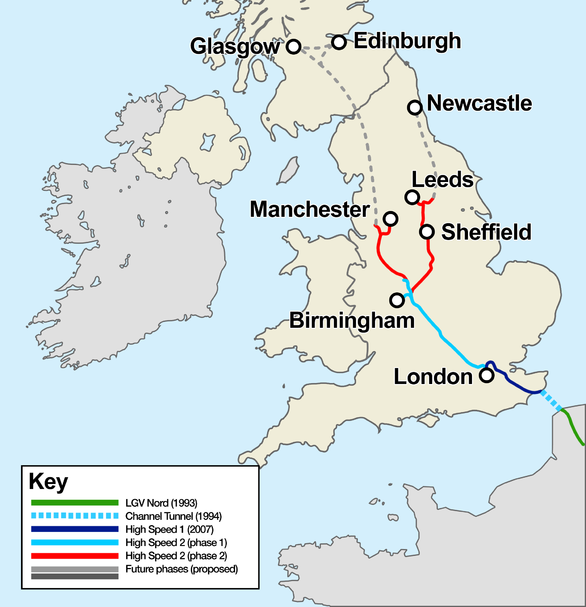
 HS2 has been a controversial topic for some time now. Between the disruption it would cause to countless neighbourhoods and the protests that have emerged and the debate about the cost effectiveness of the project, it’s been in the news a fair amount. The transport network in the UK needs improving, not only for businesses located here, but also to encourage more investment into the country. HS2 is one of the solutions offered.
The latest estimate for the cost of HS2 is over £40 billion. However, many suggest that the benefits HS2 will bring do not cover the full costs. Furthermore, as noted above, other concerns include the disruption that it will bring to countless households who will be living along the proposed routes. Cost benefit analysis have been carried out to determine the viability of the project, but they are invariably difficult to do. As they involve determining all of the private and social costs and benefits and putting a monetary estimate onto them, there will inevitably be factors that are over-looked, under-estimated or over-estimated. The suggestions here are that the costs have been under-estimated and the benefits over-estimated.
 In September, KPMG produced a report that estimated the overall benefit to the UK economy would be a boost to growth of 0.8%, which would benefit many businesses and communities. The British Chambers of Commerce said:
Business communities in dozens of cities and towns, from many parts of the UK, remain strongly supportive of HS2.
The railway network is also approaching full capacity and this is one of the reasons why HS2 has been proposed. A government source said:
We need to do something because our railways are nearly full, but the alternative to HS2 is a patch and mend job that would cause 14 years of gridlock, hellish journeys and rail replacement buses … The three main routes to the north would be crippled and the economy would be damaged.
However, this report has faced criticism, in particular because it ignored a variety of supply-side constraints and because they argue it would be more effective to simply update the existing network.  However, a new government-commissioned report has suggested that this alternative to HS2 would involve 14 years of weekend route closures and much longer journey times. However, those in favour of updating existing routes have said that this new report commissioned by the government is ‘a complete fabrication’. Hilary Wharf of the HS2 Action Alliance commented:
This government-funded report is a complete fabrication. The main alternative to HS2 involves longer trains and reduced first-class capacity to provide more standard class seats…No work is required at Euston to deliver the necessary capacity increase. Work is only required at three locations on the WCML [West Coast Main Line], and this is comparable to the work being carried out on the route at present.
The debate regarding HS2 will continue for the time being and it is just another area that is fuelling the political playing field. Whatever is done, the rail network certainly requires investment, whether it is through HS2 or upgrades to the existing routes. The following reports and articles consider the latest developments and controversy regarding HS2.
Reports
HS2 Cost and Risk model Report: A report to Government by HS2 ltd HS2 Ltd March 2012
High Speed 2 (HS2) Limited: HS2 Regional Economic Impacts KPMG September 2013
Draft Environmental Statement: Phase One: Engine for Growth HS2 May 2013
Updated Economic Case for HS2 HS2 August 2012
Articles
HS2 alternative ‘would mean years of rail disruption’ BBC News (28/10/13)
Alternative to HS2 would see Britain suffer 14 years of rail misery, says Coalition Independent, Nigel Morris (28/10/13)
HS2 alternatives could require 14 years of weekend rail closures The Guardian, Rajeev Syal (28/10/13)
Passengers ‘face 14 years of chaos if HS2 is derailed’: ‘Unattractive’ package of closures would be needed to expand capacity if Labour withdraws support Mail Online, Jason Groves (28/10/13)
HS2: Labour to examine cheaper rival plan The Telegraph, Tim Ross and Andrew Gilligan (27/10/13)
Britain’s railways have become mere outposts of other nations’ empires The Guardian, John Harris (28/10/13)
’Years of delays’ if government backs down on HS2 rail project Financial Times, Kiran Stacey and Brian Gloom (28/10/13)
Questions
- What is a cost-benefit analysis? Explain the steps that are involved in any cost-benefit analysis.
- Conduct a cost-benefit analysis for HS2. Ensure that you differentiate between costs and benefits and between private and social concepts.
- How can we measure the costs and benefits of HS2?
- Explain how HS2 is expected to boost economic growth. Use the AD/AS model to illustrate this.
- To what extent is there likely to be a multiplier effect from HS2? Is it likely to benefit the whole economy or just those areas where the route lies?
- Conduct a cost-benefit analysis for the alternative suggestion. Which do you think is likely to be more feasible? Explain your answer.
- How will improvements to the rail network or the investment of HS2 benefit businesses in the UK economy?
 In a News Item of 1 October, Over the Cliff, we looked at the passing of the deadline that same day for Congress to agree a budget. We also looked at the looming deadline for Congress to agree a new higher ceiling for Federal Government debt, currently standing at $16.699 trillion. Without an agreement to raise the limit, the government will start becoming unable to pay some of its bills from around 17 October.
One week on and no agreement has been reached on either a budget or a higher debt ceiling.
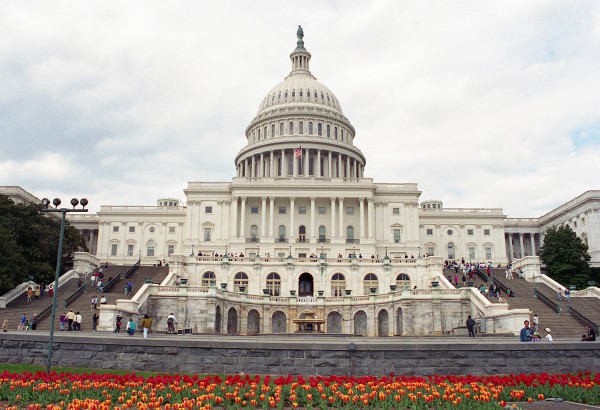 Failure to agree on a budget has led to the ‘shut-down’ of government. Only essential services are being maintained; the rest are no longer functioning and workers have been sent home on ‘unpaid leave’. This has led to considerable hardship for many in the USA. It has had little effect, however, on the rest of the world, except for tourists to the USA being unable to visit various national parks and monuments.
Failure to raise the debt ceiling, however, could have profound consequences for the rest of the world. It could have large and adverse effects of global growth, global trade, global investment and global financial markets. The articles below explore some of these consequences.
U.S. Congress enters crucial week in budget, debt limit battles Reuters, Richard Cowan (7/10/13)
Debt ceiling: Understanding what’s at stake CBS Moneywatch, Alain Sherter (7/10/13)
Q&A: What is the US debt ceiling? BBC News, Ben Morris (3/10/13)
Five Reasons to Fear the Debt Ceiling Bloomberg (6/10/13)
A U.S. Default Seen as Catastrophe Dwarfing Lehma Bloomberg Businessweek, Yalman Onaran (6/10/13)
China tells US to avoid debt crisis for sake of global economy BBC News (7/10/13)
US shutdown is starting to hit business, says Commerce Secretary BBC News (6/10/13)
Why Australia should fear a US government default The Guardian, Greg Jericho (7/10/13)
Could the US default over just $6bn? BBC News, Linda Yueh (11/10/13)
IMF piles pressure on US to reconcile differences and prevent debt default The Guardian, Larry Elliott and Jill Treanor (10/10/13)
Republicans offer to raise US debt ceiling for six weeks The Telegraph, Peter Foster and Raf Sanchez (11/10/13)
Questions
- If a debt ceiling is reached, what does this imply for the budget deficit?
- How serious are the two current fiscal cliffs?
- How would a continuation of the partial government shut-down impact on the US private sector?
- What multiplier effects on the rest of the world are likely to arise from a cut in US government expenditure or a rise in taxes? What determines the size of these multiplier effects?
- Explain the likely effect of the current crisis on the exchange rate of the dollar into other currencies.
- Why might the looming problem of reaching the debt ceiling drive up long-term interest rates in the USA and beyond?
For the second time in nine months, the USA has approached a fiscal cliff. This is where the federal government is forced to make government expenditure cuts and/or impose tax rises. There are two types of cliff face. The first is a legal limit on the size of the federal government debt and hence deficit. The second is failure to agree on a budget.
On January 1st this year, a fiscal cliff was narrowly averted by a last-minute agreement to raise the size of the permitted debt. On the 1st October (the beginning of the financial year), however, the US economy ‘fell over the cliff’. This time is was a failure by Congress to reach agreement over the federal budget. The sticking point was an unwillingness of the Republican majority in the House of Representatives to agree to a budget without the government making concessions on its healthcare reform. The government was unwilling to do that and so no budget was passed.
With no budget, much of government has to shut down! In practice, this means that all non-essential workers will cease to be paid. 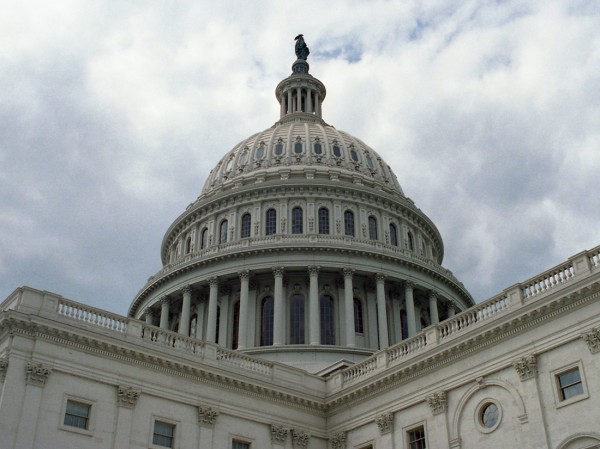 That includes workers in housing, parts of healthcare, the civil law part of the justice system, immigration, regulatory agencies, the passport service, parks and museums. Even workers in essential areas, such as civilian workers in the military, police and social services, are likely to see their pay delayed until the problem is resolved. The articles below look at some of the implications of this partial shut-down.
It is hoped that, within a few days, agreement on a budget will be reached. But that will not be the end of the story because a second fiscal cliff looms. And that is of the first type. There is currently a legal limit to Federal Government debt of $16.699 trillion. Because that limit was reached earlier this year, from May 18 the government has been able to use various ‘extraordinary measures‘ to carry on borrowing. These measures will run out, however, around 17 October. From then, if a new higher debt ceiling has not been agreed by Congress, the government will be unable to pay some of its bills. For example, on 1 November it will get a bill of $67billion for social security, medicare and veterans benefits. As the second Independent article below explains:
In a government shutdown, the federal government is not allowed to make any new spending commitments. By contrast, if we hit the debt-ceiling then the Treasury Department won’t be able to borrow money to pay for spending that Congress has already approved. In that case, either Congress will have to lift the debt ceiling or the federal government will have to default on some of its bills, possibly including payments to bondholders or Social Security payouts. That could trigger big disruptions in the financial markets — or a long-term rise in borrowing costs.
Not surprisingly, financial markets are nervous. Although the direct effect of lost output will be relatively small, provided agreements on the budget and the debt are reached fairly soon, the impact on confidence in the US system of government could be more damaging. Not only could this curb recovery in the USA, it could have a significant effect on global recovery, given the size and importance of the US economy to the rest of the world.
Webcasts
 What does the shutdown mean for normal Americans? BBC News, Keith Doyle (1/10/13)
How the government shut down is being reported in the US BBC News (1/10/13)
Shutdown could slam frail U.S. economy Reuters, Bobbi Rebell (1/10/13)
Shutdown Will Cost U.S. Economy $300 Million a Day, IHS Says Bloomberg, Jeanna Smialek & Ian Katz (1/10/13)
How will the US government shutdown affect the global economy? The Guardian, Larry Elliott and Guy Grandjean (1/10/13)
How would a government shutdown affect the rebounding economy? Aljazeera, Duarte Geraldino (30/9/13)
How will the US government shutdown affect the economy? BBC News, Richard Lister (1/10/13)
Shutdown continues as Obama and Republicans fail to agree BBC News, Rajini Vaidynathan (2/10/13)
Former US Secretary of Labor Robert Reich on shutdown BBC News, Robert Reich (2/10/13)
Government shutdown: What’s the cost? CBS News, Rebecca Kaplan (1/10/13)
US shutdown will have ‘minimal impact’ on global economy One News (New Zealand), Dan Zirker (2/10/13)
What is the US debt ceiling? BBC News, Hugh Pym (14/10/13)
Articles
US wakes up to government shutdown as Congress fails to strike budget deal Independent, Nikhil Kumar (1/10/13)
US begins government shutdown as budget deadline passes BBC News (1/10/13)
David Cameron warns on world growth as US government shuts down The Telegraph, Damien McElroy (1/10/13)
Shutdown showdown: A glossary Aljazeera, Ben Piven (30/9/13)
Everything you need to know about how the partial shutdown will work in US Independent, Brad Plumer (1/10/13)
What’s the economic impact of a US government shutdown? BBC News, Kim Gittleson (1/10/13) (follow links at top of screen for further articles)
US government shutdown isn’t the worst of it BBC News, Linda Yueh (30/9/13)
Onset of the storm BBC News, Robert Peston (1/10/13)
The gathering storm? BBC News, Robert Peston (30/9/13)
Government shutdown: what’s really going on – and who’s to blame? The Guardian, Dan Roberts (30/9/13)
Government shutdown threat is getting very old, very fast CNN, Julian Zelizer (30/9/13)
US fiscal cliff fears rattle the markets The Australian, Adam Creighton (1/10/13)
U.S. Government Shutdown Sinks Dollar Forbes, Dean Popplewell (1/10/13)
US Government Shutdown: European Markets Not Fretting Over Temporary Closure International Business Times, Ishaq Siddiqi (1/10/13)
The States to plunge into abyss of debt, off fiscal cliff Pravda, Irina Sabinina (1/10/13)
Shutting down the United States government nothing new The Vancouver Sun, Andrew Coyne (1/10/13)
Christine Lagarde urges US that debt crisis threatens world economy The Guardian, Larry Elliott (3/10/13)
U.S. failure to lift debt ceiling could damage world – IMF Reuters (3/10/13)
Data
US government shutdown: in numbers The Guardian (see also)
US Budget: Historical Tables White House Office of Management and Budget (includes estimates to 2018 as well as historical data)
Questions
- If a debt ceiling is reached, what does this imply for the budget deficit?
- How serious are the two current fiscal cliffs?
- How would a continuation of the partial government shut-down impact on the US private sector?
- What multiplier effects on the rest of the world are likely to arise from a cut in US government expenditure or a rise in taxes? What determines the size of these multiplier effects?
- Explain the likely effect of the current crisis on the exchange rate of the dollar into other currencies.
- Why might the looming problem of reaching the debt ceiling drive up long-term interest rates in the USA and beyond?
 There’s some good news and some bad news about the UK economy. The good news is that there are signs that the recovery is gathering momentum; the ‘green shoots’ are growing bigger. The bad news is that it’s the ‘wrong type of growth’!
One of the main underlying problems of the 2008 financial crisis was that household debt had been increasing to unsustainable levels, egged on by banks only too willing to lend, whether as personal loans, on credit cards or through mortgages. When the recession hit, many people sought to reduce their debts by cutting back on spending. This further fuelled the recession.
What the government and most economists hoped was that there would be some rebalancing of the economy, with less reliance on consumer spending to drive economic growth. Instead it was hoped that growth would be driven by a rise in investment and exports. Indeed, the 25% depreciation of sterling exchange between 2007 and 2009 was seen as a major advantage as this would boost the demand for exports and encourage firms to invest in the export sector.
But things haven’t turned out the way people hoped. The recession (or lack of growth) has been much deeper and more prolonged than previous downturns in the economy. Today, real GDP per head is more than 7% below the level in 2007 and many people have seen much bigger declines in their living standards.
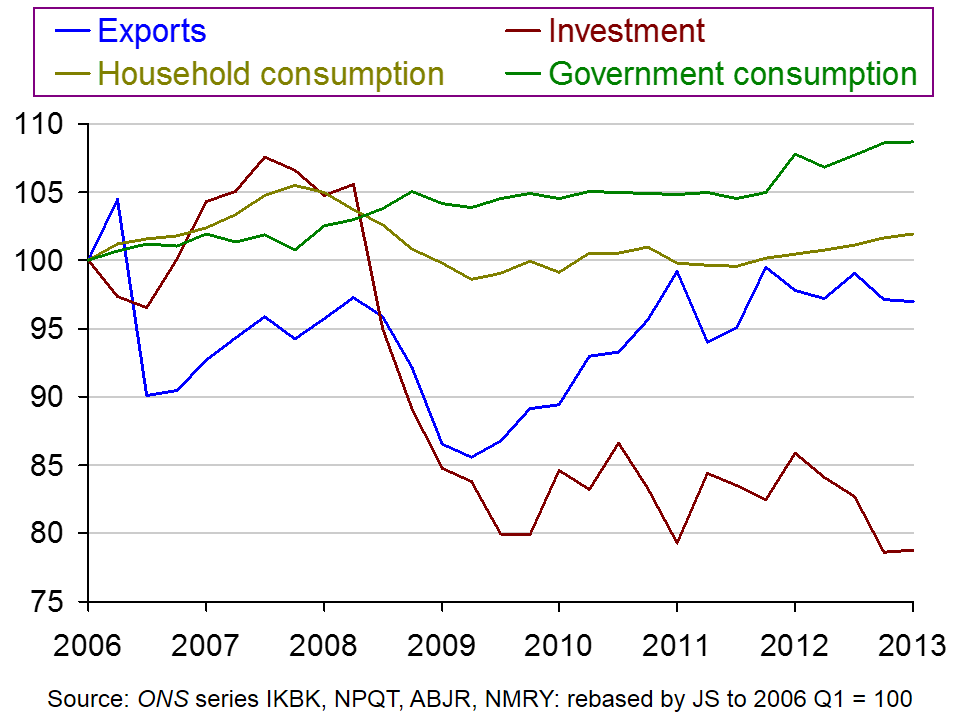 But also, despite the austerity policies, the economy has not been ‘rebalanced’ towards exports and investment. Exports are 3% lower than in 2006 (although they did grow between 2009 Q2 and 2011 Q1, but have since stagnated). And investment is 27% lower than in 2006. Household consumption, however, has grown by about 2% and general government consumption by around 9% since 2006. The chart shows the figures, based on 2006 Q1 = 100.
(Click here for a PowerPoint of the chart.)
And recent evidence is that consumption is beginning to grow faster – not because of rising household incomes, but because of falling saving rates. In 2008, the household saving ratio had fallen to nearly 0% (i.e. households were on average saving about the same as they were borrowing). Then the saving ratio rose dramatically as people reined in their spending. Between 2009 and 2012, the ratio hovered around 7%. But in the first quarter of 2013, it had fallen to 4.2%
So the good news is that aggregate demand is rising, boosting economic growth. But the bad news is that, at least for the time being, this growth is being driven by a rise in household borrowing and a fall in household saving. The videos and articles consider whether this is, however, still good news on balance.
Webcasts
Britain’s imbalanced economy The Economist, Zanny Minton Beddoes and Richard Davies (4/7/13)
Britain’s Export Drought: an enduring disappointment The Economist, Andrew Palmer and Richard Davies (9/2/13)
‘Green shoots’ of economic recovery in Rugby BBC News, Paul Mason (12/6/13)
Articles
Is the UK economy seeing the ‘wrong kind’ of green shoots? BBC News, Stephanie Flanders (3/7/13)
The export drought: Better out than in The Economist (9/2/13)
Exports and the economy: Made in Britain The Economist (21/1/12)
The economy: On a wing and a credit card The Economist (6/7/13)
Unbalanced and unsustainable – this is the wrong kind of growth The Telegraph, Jeremy Warner (8/7/13)
The UK economy’s looking up – but no one’s told manufacturers The Guardian, Heather Stewart (10/7/13)
Data
Quarterly National Accounts, Q1 2013 (27/6/13)
Forecasts for the UK economy: a comparison of independent forecasts HM Treasury (June 2013)
ISM Manufacturing Report on Business® PMI History Institute for Supply Management
Questions
- What are forecasters expecting to happen to economic growth in the coming months? Why?
- What factors determine investment? Why has it fallen so substantially in the UK?
- Explain what is meant by the ‘accelerator’. Is the rise in consumption likely to lead to an accelerator effect and, if so, what will determine the size of this effect?
- Why have exports not grown more rapidly despite the depreciation of sterling after 2007?
- What will determine the rate of potential economic growth in the UK economy? How will a rise in real GDP driven by a rise in consumption impact on potential GDP and potential economic growth?
- What supply-side policies would you recommend, and why, in order to increase potential economic growth?
 Unemployment is a key macroeconomic objective for governments across the world. The unemployment rate for the UK now stands at 7.9% according to the ONS, which recorded 2.56 million people out of work. But why is unemployment of such importance? What are the costs?
The economy is already in a vulnerable state and with unemployment rising by 70,000 people between December and February 2013, the state of the economic recovery has been questioned. Indeed, following the news of the worsening unemployment data, the pound fell significantly against the dollar, suggesting a lack of confidence in the British economy.
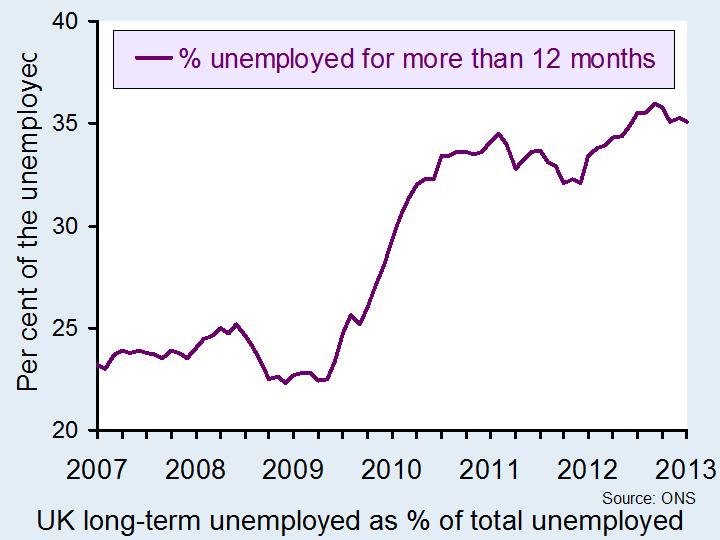 Although the increase in the number of people out of work is concerning, perhaps of more concern should be the number of long-term unemployed. The ONS suggests that more than 900,000 have now been out of work for more than a year. Not only does this pose costs for the individual in terms of lost earnings and skills, but it also imposes costs on friends and family and the wider economy. (Click here for a PowerPoint of the first chart, which shows the percentage of unemployed people out for work longer than 12 months.)
The chief executive of the Prince’s Trust focused on the costs of youth unemployment in particular, saying:
Thousands of these young people are long-term unemployed, often facing further challenges such as poverty and homelessness. We must act now to support these young people into work and give them the chance of a better future.
(Click here for a PowerPoint of the second chart, which shows how much higher the unemployment rate is for young people aged 18 to 24 than it is for the working age population as a whole.)
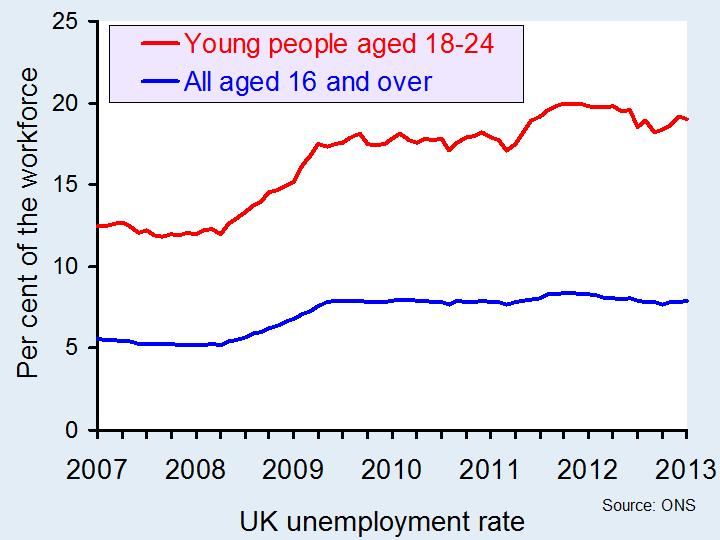 Furthermore, with so many people unemployed, we are operating below full-employment and thus below our potential output. Furthermore, the longer people are out of work, the more likely it is that they will lose their skills and thus require re-training in the future or find that there are now fewer jobs available to them based on their lower skill level.
In addition to this there are monetary costs for the government through lower tax receipts, in terms of income tax, national insurance contributions and even VAT receipts. With more people unemployed, the numbers claiming various unemployment-related benefits will rise, thus imposing a further cost on the government and the taxpayer. Another cost to the government of this latest data is likely to be the expectations of the future course of the economy. Numerous factors affect business confidence and unemployment data is certainly one of them. The concern is that business confidence affects many other variables as well and until we receive more positive data, the economy recovery is likely to remain uncertain. The following articles consider this topic.
UK unemployment rise adds to pressure on Osborne’s austerity strategy The Guardian, Phillip Inman (18/4/13)
Unemployment figures are ‘worrying’, David Cameron’s spokesman says The Telegraph, Peter Dominiczak (17/4/13)
UK unemployment rises to 2.56 million BBC News (17/4/13)
Unemployment jumps to 7.9% as rise in the number of young people out of work takes figure ‘dangerously’ close to a million Mail Online, Leon Watson (17/4/13)
Unemployment up as stay-at-home mothers head back to the job-centre Independent, Ben Chu (17/4/13)
Jobs data points to finely balanced market Financial Times, Brian Groom (18/4/13)
Hugh’s review: making sense of the stats BBC News (19/4/13)
Questions
- How is unemployment measured?
- What are the costs to the individual of being unemployed?
- What are the wider non-monetary costs to society?
- Explain the main financial costs to the wider economy of a rising unemployment rate.
- Illustrate the problem of unemployment by using a production possibility frontier.
- Could there be a negative multiplier effect from a rise in unemployment?
 However, a new government-commissioned report has suggested that this alternative to HS2 would involve 14 years of weekend route closures and much longer journey times. However, those in favour of updating existing routes have said that this new report commissioned by the government is ‘a complete fabrication’. Hilary Wharf of the HS2 Action Alliance commented: