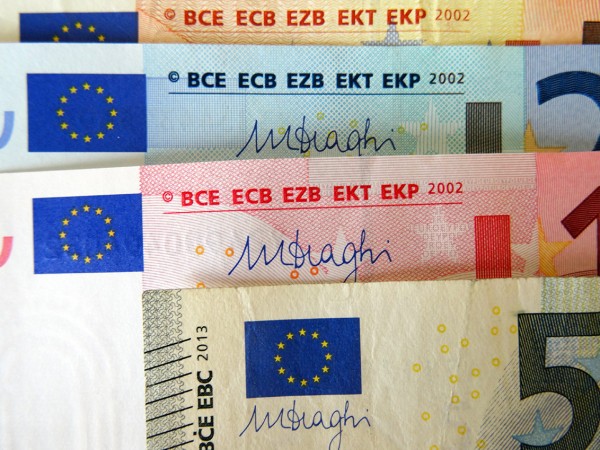
 Mario Draghi, the ECB President, has indicated that the ECB is prepared to engage in further monetary stimulus. This is because of continuing weaknesses in the global economy and in particular in emerging markets.
Although the ECB at its meeting in Malta on 22 October decided to keep both interest rates and asset purchases (€60 billion per month) at current levels, Mario Draghi stated at the press conference that, at its next meeting on December 3rd, the ECB would be prepared to cut interest rates and re-examine the size, composition and duration of its quantitative easing programme. He stopped short, however, of saying that interest rates would definitely be cut or quantitative easing definitely increased. He said the following:
“The Governing Council has been closely monitoring incoming information since our meeting in early September. While euro area domestic demand remains resilient, concerns over growth prospects in emerging markets and possible repercussions for the economy from developments in financial and commodity markets continue to signal downside risks to the outlook for growth and inflation. Most notably, the strength and persistence of the factors that are currently  slowing the return of inflation to levels below, but close to, 2% in the medium term require thorough analysis.
In this context, the degree of monetary policy accommodation will need to be re-examined at our December monetary policy meeting, when the new Eurosystem staff macroeconomic projections will be available. The Governing Council is willing and able to act by using all the instruments available within its mandate if warranted in order to maintain an appropriate degree of monetary accommodation.”
Mario Draghi also argued that monetary policy should be supported by fiscal policy and structural policies (mirroring Japan’s three arrows). Structural policies should include actions to improve the business environment, including the provision of an adequate public infrastructure. This is vital to “increase productive investment, boost job creation and raise productivity”.
As far as fiscal policies are concerned, these “should support the economic recovery, while remaining in compliance with the EU’s fiscal rules”. In other words, fiscal policy should be expansionary, while staying within the limits set by the Stability and Growth Pact.
His words had immediate effects in markets. Eurozone government bond yields dropped to record lows and the euro depreciated 3% against the US dollar over the following 24 hours.
Webcasts
 ECB Press Conference on YouTube, Mario Draghi (22/10/15)
Draghi reloads bazooka FT Markets, Ferdinando Guigliano (22/10/15)
Articles
Mario Draghi: ECB prepared to cut interest rates and expand QE The Guardian, Heather Stewart (22/10/15)
Draghi signals ECB ready to extend QE Financial Times, Claire Jones and Elaine Moore (22/10/15)
Dovish Mario Draghi sends bond yields to new lows Financial Times, Katie Martin (23/10/15)
What Draghi Said on QE, Policy Outlook, Global Risks and Inflation Bloomberg, Deborah Hyde (22/10/15)
ECB set to ‘re-examine’ stimulus policy at next meeting BBC News (22/10/15)
The global economy warrants a big dose of caution The Guardian, Larry Elliott (25/10/15)
ECB Press Conference
Introductory statement to the press conference (with Q&A) ECB, Mario Draghi (President of the ECB), Vítor Constâncio (Vice-President of the ECB) (22/10/15)
Questions
- Why is the ECB considering further expansionary monetary policy?
- What monetary measures can a central bank use to stimulate aggregate demand?
- Explain the effects of Mario Draghi’s announcement on bond and foreign exchange markets.
- What are the objectives of ECB monetary policy according to the its mandate?
- Should the ECB consider using quantitative easing to provide direct funding for infrastructure projects?
- What constraints does the EU’s Stability and Growth Pact impose on eurozone countries?
- What are the arguments for and against (a) the Bank of England and (b) the US Federal Reserve engaging in further QE?
- If the ECB does engage in an expanded QE programme, what will determine its effectiveness?
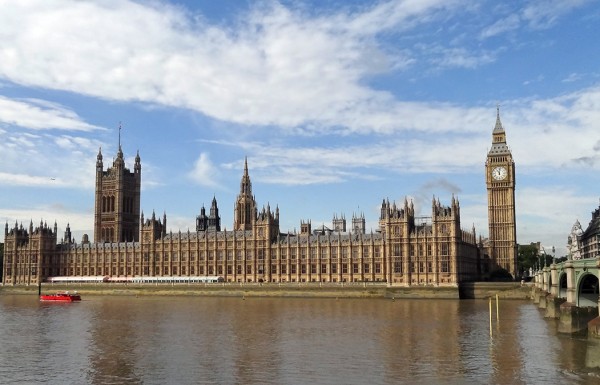 In his annual Mansion House speech to business leaders on 10 June 2015, George Osborne announced a new fiscal framework. This would require governments in ‘normal times’ to run a budget surplus. Details of the new framework would be spelt out in the extraordinary Budget, due on 8 July.
If by ‘normal times’ is meant years when the economy is growing, then this new fiscal rule would mean that in most years governments would be require to run a surplus. This would reduce general government debt.
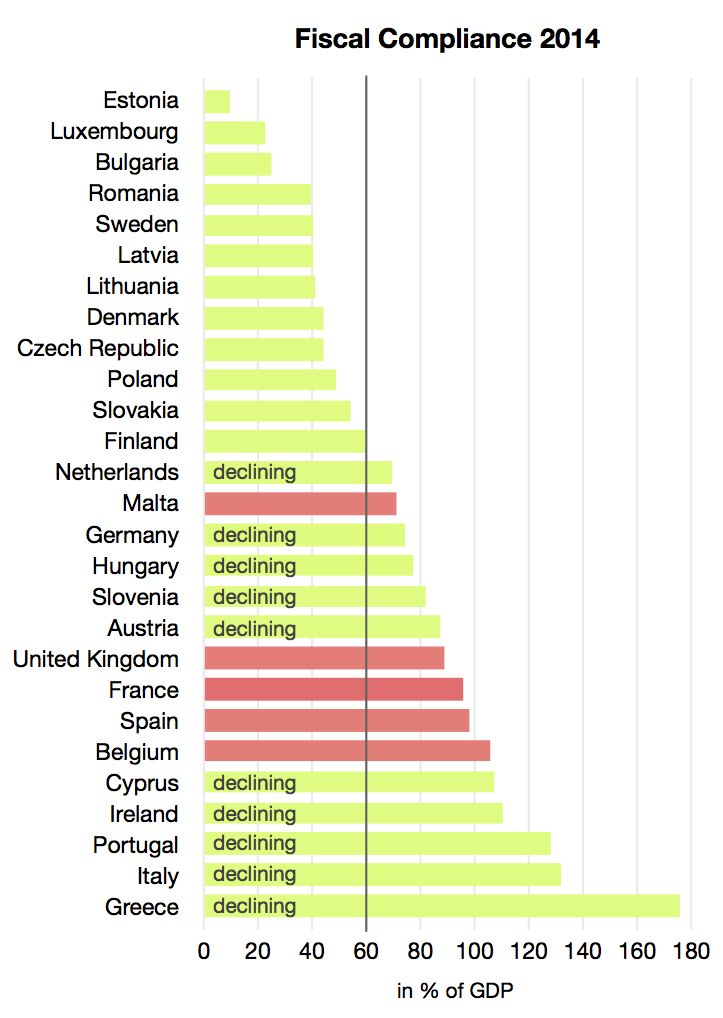
And it would eventually reduce the debt from the forecast ratio of 89% of GDP for 2015 to the target of no more than 60% set for member states under the EU’s Stability and Growth Pact. Currently, many countries are in breach of this target, although the Pact permits countries to have a ratio above 60% provided it is falling towards 60% at an acceptable rate. The chart shows in pink those countries that were in breach in 2014. They include the UK.
 Sweden and Canada have similar rules to that proposed by George Osborne, and he sees them as having been more able to use expansionary fiscal policy in emergency times, such as in the aftermath of the financial crisis of 2007/8, without running excessive deficits.
Critics have argued, however, that running a surplus whenever there is economic growth would dampen recovery if growth is sluggish. This makes the rule very different from merely requiring that, over the course of the business cycle, there is a budget balance. Under that rule, years of deficit are counterbalanced by years of surplus, making fiscal policy neutral over the cycle. With a requirement for a surplus in most years, however, fiscal policy would have a net dampening effect over the cycle. The chancellor hopes that this would be countered by increased demand in the private sector and from exports.
The rule is even more different from the Coalition government’s previous ‘fiscal mandate‘, which was for a ‘a forward-looking target to achieve cyclically-adjusted current balance by the end of the rolling, five-year forecast period’. The current budget excludes investment expenditure on items such as transport infrastructure, hospitals and schools. The fiscal mandate was very similar to the former Labour government’s ‘Golden rule’, which was to achieve a current budget balance over the course of the cycle.
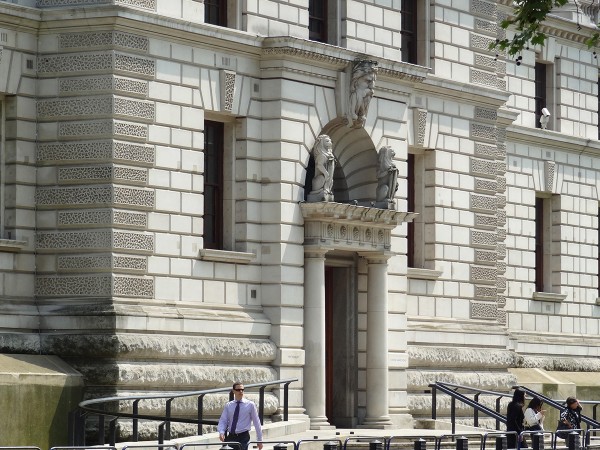 By excluding public-sector investment from the target, as was previously done, it can allow borrowing to continue for such investment, even when there is a substantial deficit. This, in turn, can help to increase aggregate supply by improving infrastructure and has less of a dampening effect on aggregate demand. A worry about the new rule is that it could lead to further erosion of public-sector investment, which can be seen as vital to long-term growth and development of the economy. Indeed, Sweden decided in March this year to abandon its surplus rule to allow government borrowing to fund investment.
The podcasts and articles below consider the implications of the new rule for both aggregate demand and aggregate supply and whether adherence to the rule will help to increase or decrease economic growth over the longer term.
Video and audio podcasts
George Osborne confirms budget surplus law Channel 4 News, Gary Gibbon (10/6/15)
Osborne To Push Through Budget Surplus Rules Sky News (10/6/15)
OECD On Osborne’s Fiscal Plans Sky News, Catherine Mann (10/6/15)
‘Outright fiscal madness’ Osborne’s Mansion House Speech RT UK on YouTube, Harry Fear (11/6/15)
A “straightjacket” [sic] on future government spending? BBC Today Programme, Robert Peston; Nigel Lawson (11/6/15)
Thursday’s business with Simon Jack BBC Today Programme, Gerard Lyons (12/6/15)
Articles
Osborne seeks to bind successors to budget surplus goal Reuters, David Milliken (10/6/15)
George Osborne to push ahead with budget surplus law The Telegraph, Peter Dominiczak (10/6/15)
Osborne Wants U.K. to Build Treasure Chest During Good Times Bloomberg, Svenja O’Donnell (10/6/15)
Questions over Osborne’s Victorian-era budget plans BBC News (10/6/15)
Years more spending cuts to come, says OBR BBC News (11/6/15)
Is Chancellor right to want surplus in normal times? BBC News, Robert Peston (10/6/15)
George Osborne Unveils New Budget Surplus Law, But Critics Warn It Means Needless Cuts Huffington Post, Paul Waugh (10/6/15)
George Osborne’s fiscal handcuffs are political, but he does have a point Independent, Hamish McRae (11/6/15)
Osborne’s budget surplus law follows UK tradition of moving goalposts Financial Times, Chris Giles (10/6/15)
George Osborne’s budget surplus rule is nonsense and it could haunt Britain for decades Business Insider, Malaysia, Mike Bird (10/6/15)
To cut a way out of recession we need growth, not austerity economics Herald Scotland, Iain Macwhirter (11/6/15)
George Osborne moves to peg public finances to Victorian values The Guardian, Larry Elliott and Frances Perraudin (10/6/15)
The Guardian view on George Osborne’s fiscal surplus law: the Micawber delusion The Guardian, Editorial (10/6/15)
Academics attack George Osborne budget surplus proposal The Guardian, Phillip Inman (12/6/15)
Osborne plan has no basis in economics Guardian letters, multiple signatories (12/6/15)
Is there an optimal debt-to-GDP ratio? Vox EU, Anis Chowdhury and Iyanatul Islam
No basis in economics Mainly Macro, Simon Wren-Lewis (16/6/15)
Questions
- Explain what is meant by a ‘cyclically adjusted current budget balance’.
- How does the speed with which the government reduces the public-sector debt affect aggregate demand and aggregate supply?
- What are the arguments for and against running a budget surplus: (a) when there is currently a large budget deficit; (b) when there is already a budget surplus? How do the arguments depend on the stage of the business cycle?
- Do you agree with the statement that ‘the biggest issue with the UK economy right now is not the government deficit’. If so, what bigger issues are there?
- How could public-sector debt as a proportion of GDP decline without the government running a budget surplus?
- How might the term ‘normal times’ be defined? How does the definition used by the Chancellor affect the rate at which the public-sector debt is reduced?
- How sustainable is the current level of public-sector debt? How does its sustainability relate to the interest rate on long-term government bonds?
- If there is a budget surplus, such that G – T is negative, what can we say about the balance betwen (I + X) and (S + M)? What good and adverse consequences could follow?
- Why do George Osborne’s plans for budget surpluses ‘risk a liquidity crisis that could also trigger banking problems, a fall in GDP, a crash, or all three’?
 Let’s say that the world slides back into recession, or at least, the eurozone, the USA and other major economies. This is not unthinkable, given the determination of many countries to reduce public-sector deficits and debt, concerns about slowing growth in China and other major developing countries, and worries about various geo-political developments, such as conflict in the Middle East and the possible exit of Greece from the euro and the shock waves this might send. If it happened, what could governments and central banks do to stimulate aggregate demand? The problem is, according to the linked articles below, the world has largely run out of policy instruments.
In normal times, the main policy instruments for stimulating aggregate demand are cuts in interest rates (monetary policy) and increases in government expenditure and/or tax cuts (fiscal policy). But with interest rates currently at virtually zero, there is little scope for further cuts. And with governments attempting to ‘repair’ their balance sheets by cutting deficits, there is little appetite for increasing deficits again.
 It is possible that central banks could engage in further quantitative easing. Indeed, the ECB is only just starting its large QE programme, involving monthly bond purchases of €60bn until at least September 2016 (totalling €1.14tr at that point). But QE leads to market distortions, such as increased asset prices (e.g. share and house prices), made higher and more unstable by speculation. By providing ‘cheap money’, it also encourages potentially risky investments.
The articles below considers the dilemma and looks at six possible options for policy makers suggested by Stephen King, chief economist at HSBC. But are they realistic? Read the articles and then consider the questions.
Financial crisis fixes leave policymakers short of ammo for next recession The Guardian, Larry Elliott (31/5/15)
How to get the economy working for us Guardian Letters, Mary Mellor; Colin Hines; Martin London; William Dixon and David Wilson (2/6/15)
HSBC’s Stephen King Outlines “Economic Nightmare” ValueWalk (14/5/15)
HSBC: Central Banks Are Running Low on Ammunition Bloomberg, Julie Verhage (13/5/15)
If the US economy is signalling an iceberg, bad news: we’re out of lifeboats The Guardian, Nils Pratley (13/5/15)
Policy makers lack the firepower to fight another US recession Financial Times, Stephen King (18/5/15)
The new surrealism Global Economics Quarterly, Stephen King (Q2, 2015)
Questions
- What are the risks to global recovery?
- Why has recovery from the 2008/9 recession been slower than that from previous recessions?
- What are the traditional instruments for combatting a recession?
- Why might central banks be wary of engaging in further rounds of quantitative easing?
- What is meant by ‘helicopter money’? Would this be a better solution to a recession than quantitative easing?
- Go through the other five policy options identified by Stephen King and discuss the suitability of each one.
 In their manifestos, the parties standing for the UK general election on May 7th state their plans for fiscal policy and, more specifically, for reducing public-sector net borrowing and public-sector net debt. The degree of detail in the plans varies, especially with regards to where cuts will be made, but there are nevertheless some very clear differences between the parties.
The Institute for Fiscal Studies has examined the public finance plans of the Conservatives, Labour, Liberal Democrats and SNP and has published a briefing note (see link below) and an accompanying press release. It accuses all four parties’ plans of being short on detail over specific cuts (especially the Conservatives), and over borrowing requirements (especially Labour):
None of these parties has provided anything like full details of their fiscal plans for each year of the coming parliament, leaving the electorate somewhat in the dark as to both the scale and composition of likely spending cuts and tax increases. In our analysis we have used the information provided in each manifesto, plus in some cases some necessary assumptions, to shed light on the four parties’ plans.
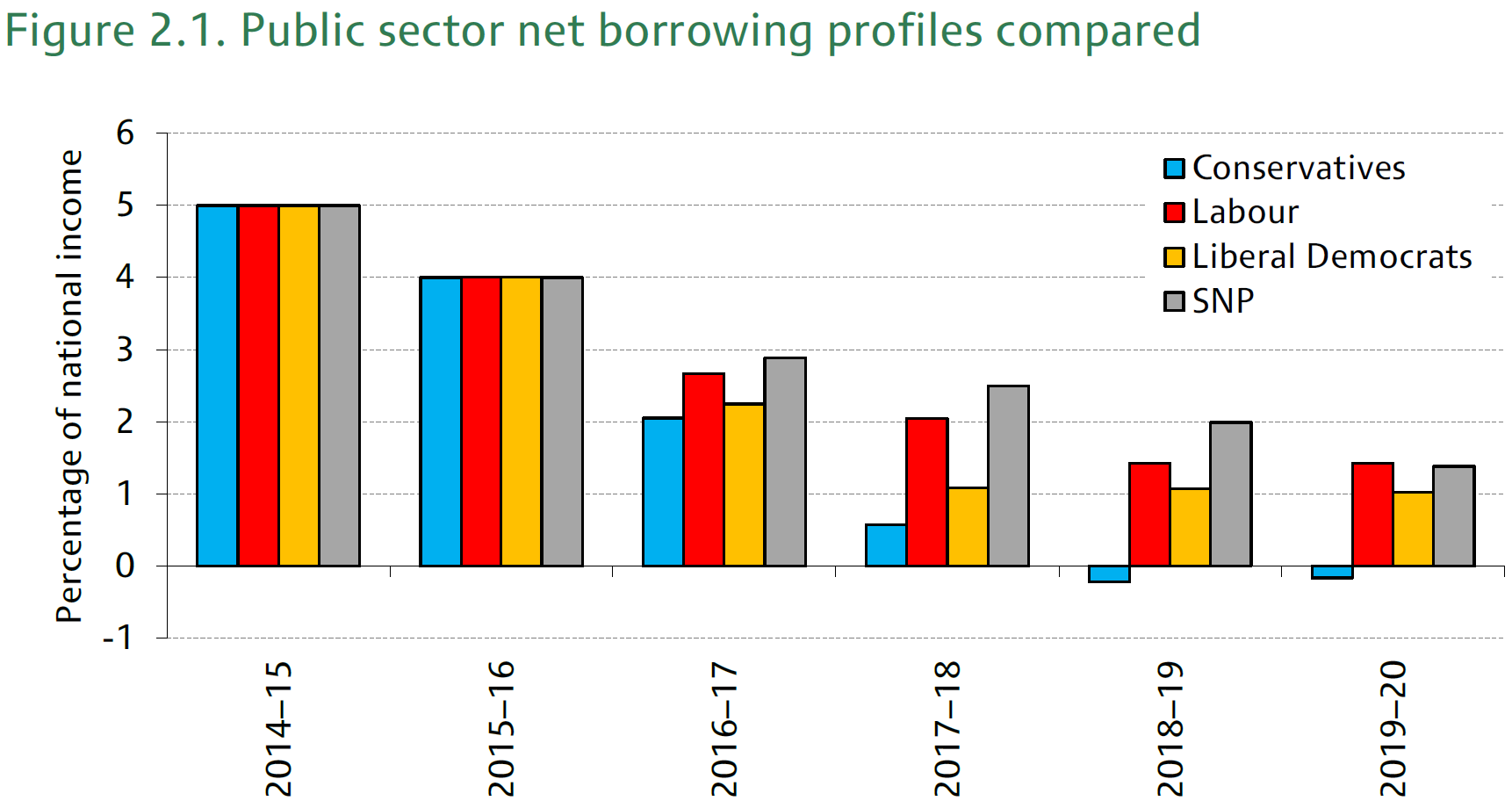
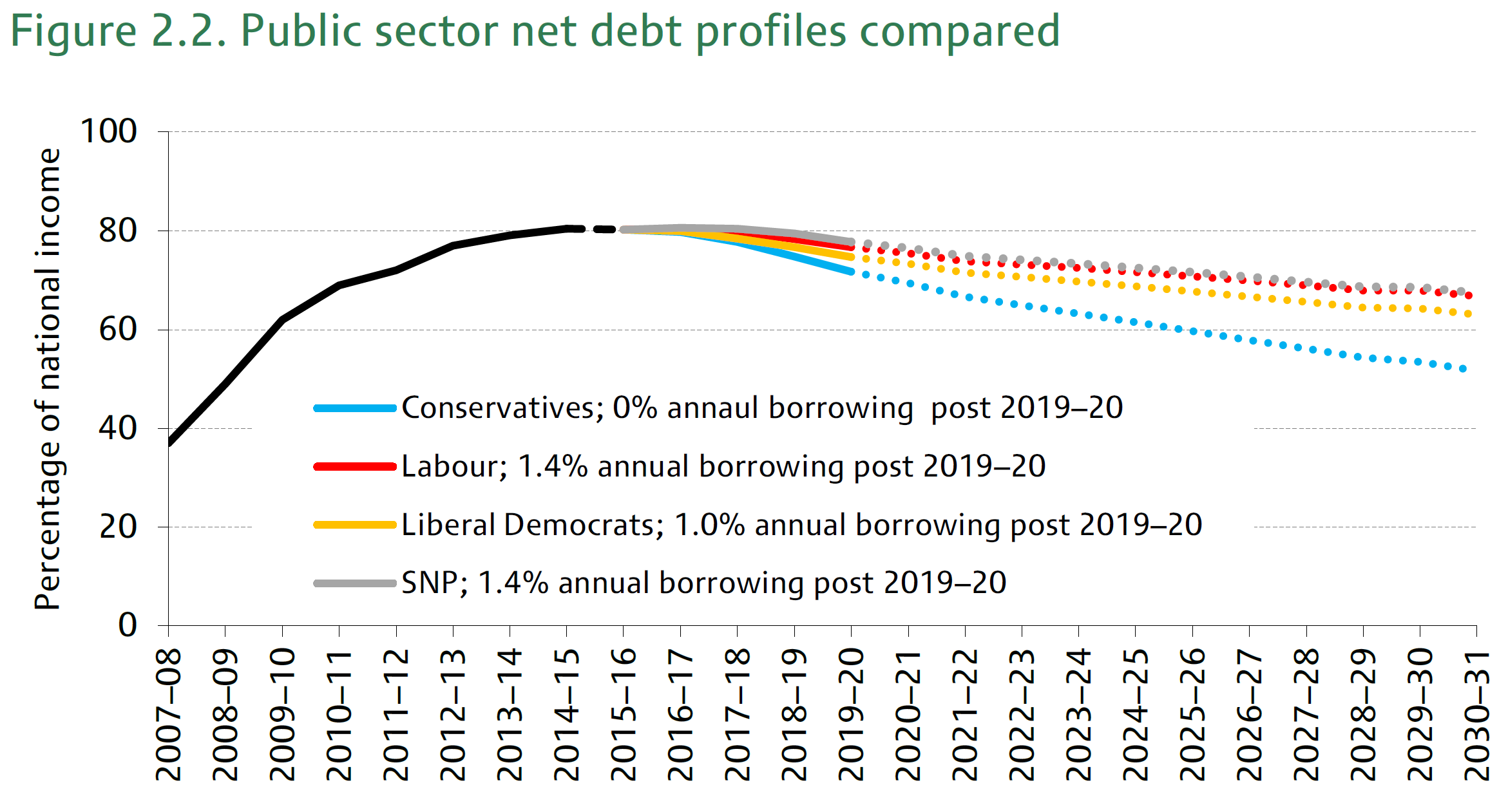
But despite the lack of detail, the IFS claims that there are big differences in the parties’ plans. These are illustrated in the following three charts from the IFS Briefing Note.
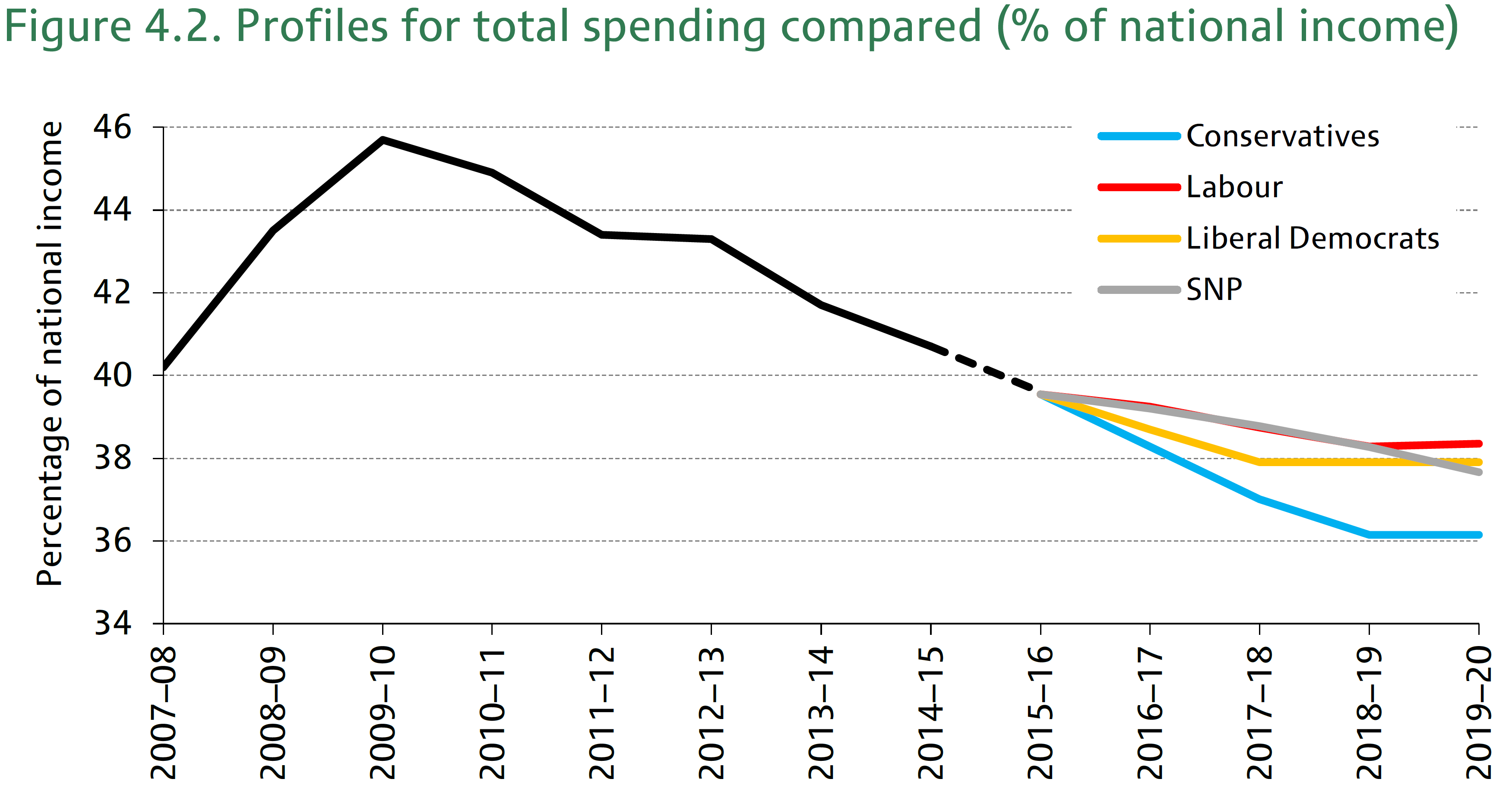
According to Carl Emmerson, IFS deputy director:
“There are genuinely big differences between the main parties’ fiscal plans. The electorate has a real choice, although it can at best see only the broad outlines of that choice. Conservative plans involve a significantly larger reduction in borrowing and debt than Labour plans. But they are predicated on substantial and almost entirely unspecified spending cuts and tax increases. While Labour has been considerably less clear about its overall fiscal ambitions its stated position appears to be consistent with little in the way of further spending cuts after this year”.
So what would be the implications of the plans of the various parties for fiscal policy and what, in turn, would be the implications for economic growth and investment? The various videos and articles look at the briefing note and at what is missing from the parties’ plans.
Videos
Voters ‘in the dark’ over budgets BBC News, Robert Peston (23/4/15)
Election 2015: Main parties respond to IFS deficit claims BBC News, James Landale (23/4/15)
Election 2015: ‘Not enough detail’ on deficit cut plans, says IFS BBC News, Paul Johnson (23/4/15)
IFS: Electorate ‘left in the dark’ by political parties ITV News, Chris Ship (23/4/15)
Voters Left In Dark Over Spending Cuts, Says IFS Sky News (23/4/15)
Post-election austerity: parties’ plans compared Institute for Fiscal Studies, Press Briefing (23/5/15)
Articles
IFS: election choice is stark Economia, Oliver Griffin (23/4/15)
Election 2015: Voters ‘left in the dark’, says IFS BBC News (23/4/15)
The huge choice for voters BBC News, Robert Peston (23/4/15)
IFS manifesto analysis: fantasy island of Tory deficit reduction plan The Guardian, Larry Elliott (23/4/15)
Tories have £30bn black hole in spending plans, says IFS The Guardian, Heather Stewart (23/4/15)
Ed Miliband will leave Britain an extra £90bn in debt, IFS finds The Telegraph, Steven Swinford (23/4/15)
IFS despairs as it finds no party’s imaginary numbers add up The Guardian, John Crace (23/4/15)
Reality Check: Why should we trust the IFS? BBC News, Sebastian Chrispin (23/4/15)
IFS: Households can expect lower incomes, whoever wins the election BBC News, Brian Milligan (28/4/15)
Briefing Notes
Post-election Austerity: Parties’ Plans Compared Institute for Fiscal Studies, Briefing Note BN170, Rowena Crawford, Carl Emmerson, Soumaya Keynes and Gemma Tetlow (April 15)
Taxes and Benefits: The Parties’ Plans Institute for Fiscal Studies, Briefing Notw BN 172, Stuart Adam, James Browne, Carl Emmerson, Andrew Hood, Paul Johnson, Robert Joyce, Helen Miller, David Phillips, Thomas Pope and Barra Roantree (April 2015)
Questions
- What detail is missing about cuts in the Conservative plans?
- What detail is missing in the Labour plans on borrowing requirements?
- How do (a) the Liberal Democrat plans and (b) the SNP plans differ from Conservative and Labour plans?
- Find out the public finances plans of (a) the Green Party; (b) UKIP; and (c) Plaid Cymru. How different are these plans from those of other parties?
- Define ‘austerity’.
- How would a tightening of fiscal policy affect economic growth (a) in the short term; (b) in the long term?
- How would an expansion of the economy affect the budget balance through automatic fiscal stabilisers?
- What is meant by the structural deficit? How could this be reduced?
- Would the structural deficit be affected by austerity policies and the resulting size of the output gap, or is it independent of such policies? Explain.
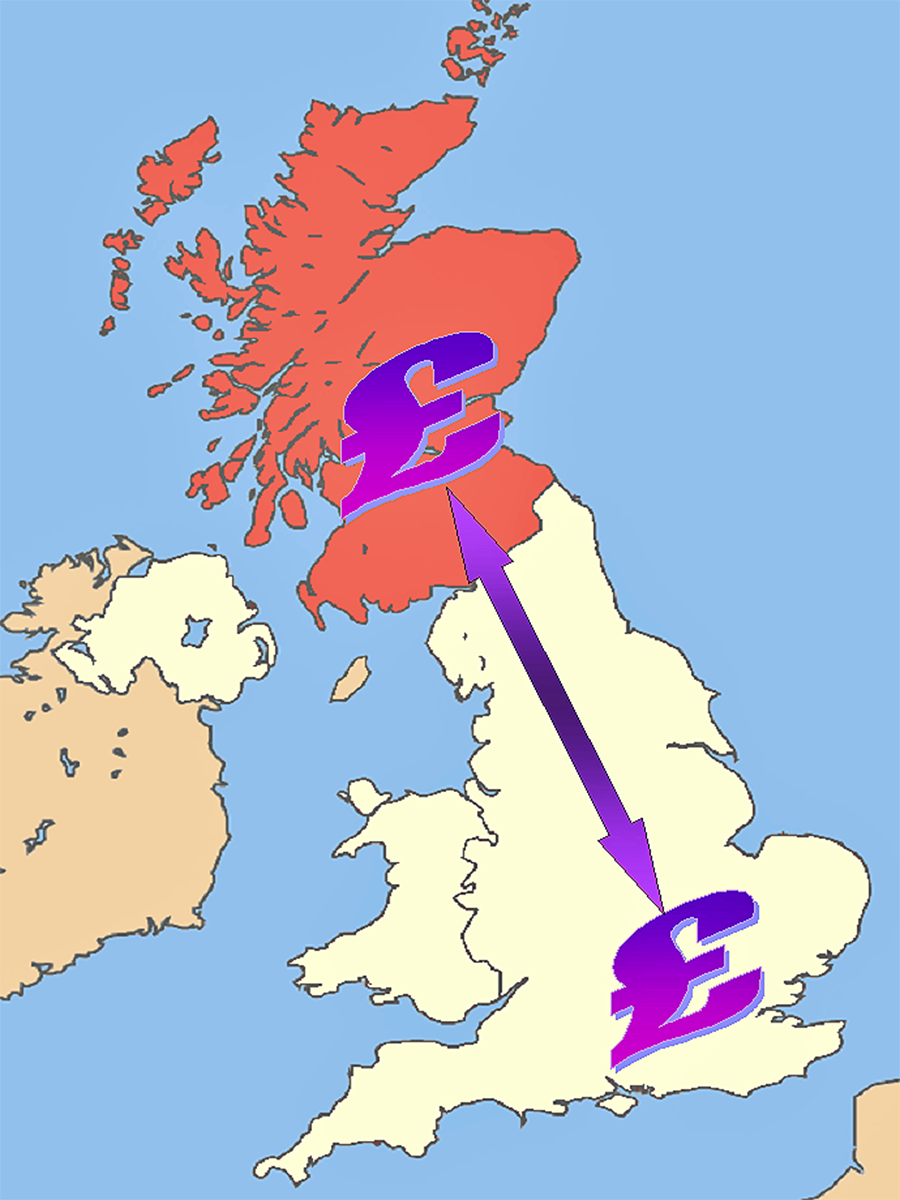 Scottish voters will be crucial in the upcoming election, with the SNP poised to take many of Labour’s seats north of the border. The future of Scotland will depend on which party comes to power and what decisions are made with regards to its finances.
Nicola Sturgeon wants government spending and taxation powers transferred to the Scottish Parliament, but would this mean spending cuts and tax rises for the Scottish people? Ed Miliband, Labour’s leader has been vocal in pointing out what this might mean, with cuts to pensions or raising taxes. However, given that it is Labour that is facing the biggest threat from the SNP, it is perhaps hardly surprising.
However, as the first video below shows, there would be an estimated £7.6bn deficit in Scotland, according to the IFS if spending and taxing was to be transferred here. This is because the tax revenues raised in Scotland are lower per person and spending per person is higher than across the whole of the UK. Oil prices are extremely low at present and hence this is reducing tax revenues. When the oil price does rise, revenues will increase and so if the split in finances was to occur this would reduce that deficit somewhat, but it would still leave a rather large hole in Scotland’s finances. The following videos and articles consider the SNP’s plans.
Videos
SNP fiscal autonomy plan: What would it do to Scotland’s finances? BBC News, Robert Peston (10/4/15)
Labour attacks SNP’s ‘devastating’ economic plans BBC News (10/4/15)
Articles
Ed Miliband attacks SNP plan for Scottish fiscal autonomy The Guardian, Severin Carrell (10/4/15)
Ed Miliband wars pensions will be cut under SNP plans The Telegraph, Auslan Cramb (10/4/15)
SNP fails to account for billions in welfare and pensions pledge, says IFS The Guardian, Severin Carrell (10/4/15)
Questions
- What is a budget deficit?
- What does fiscal autonomy for Scotland actually mean?
- The IFS suggests that there will be a large deficit in Scottish finances if they gain autonomy. How could this gap be reduced?
- Why has Labour claimed that tax rises would occur under the SNP’s plans? What could this mean for Scottish growth?
- Why do lower oil prices reduce tax revenues for Scotland?
- If Scotland had control over its finances, it could influence where government spending goes. Which industries would you invest in if you were in charge?
 Mario Draghi, the ECB President, has indicated that the ECB is prepared to engage in further monetary stimulus. This is because of continuing weaknesses in the global economy and in particular in emerging markets.