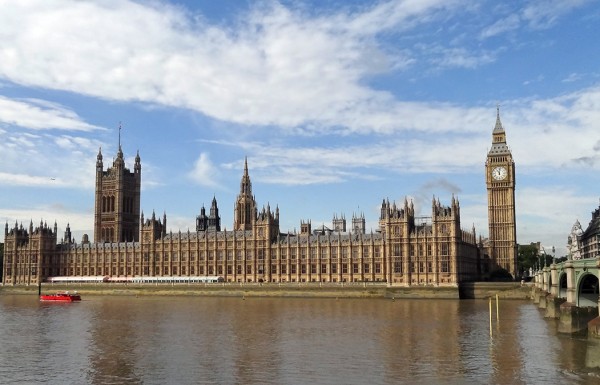
 In his annual Mansion House speech to business leaders on 10 June 2015, George Osborne announced a new fiscal framework. This would require governments in ‘normal times’ to run a budget surplus. Details of the new framework would be spelt out in the extraordinary Budget, due on 8 July.
If by ‘normal times’ is meant years when the economy is growing, then this new fiscal rule would mean that in most years governments would be require to run a surplus. This would reduce general government debt.
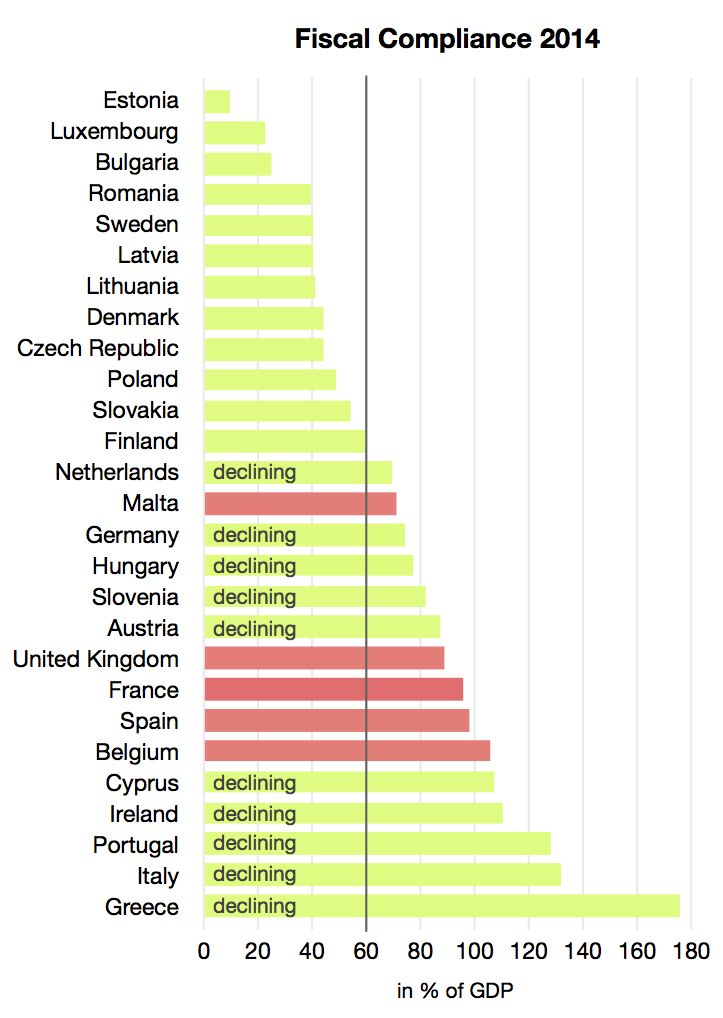
And it would eventually reduce the debt from the forecast ratio of 89% of GDP for 2015 to the target of no more than 60% set for member states under the EU’s Stability and Growth Pact. Currently, many countries are in breach of this target, although the Pact permits countries to have a ratio above 60% provided it is falling towards 60% at an acceptable rate. The chart shows in pink those countries that were in breach in 2014. They include the UK.
 Sweden and Canada have similar rules to that proposed by George Osborne, and he sees them as having been more able to use expansionary fiscal policy in emergency times, such as in the aftermath of the financial crisis of 2007/8, without running excessive deficits.
Critics have argued, however, that running a surplus whenever there is economic growth would dampen recovery if growth is sluggish. This makes the rule very different from merely requiring that, over the course of the business cycle, there is a budget balance. Under that rule, years of deficit are counterbalanced by years of surplus, making fiscal policy neutral over the cycle. With a requirement for a surplus in most years, however, fiscal policy would have a net dampening effect over the cycle. The chancellor hopes that this would be countered by increased demand in the private sector and from exports.
The rule is even more different from the Coalition government’s previous ‘fiscal mandate‘, which was for a ‘a forward-looking target to achieve cyclically-adjusted current balance by the end of the rolling, five-year forecast period’. The current budget excludes investment expenditure on items such as transport infrastructure, hospitals and schools. The fiscal mandate was very similar to the former Labour government’s ‘Golden rule’, which was to achieve a current budget balance over the course of the cycle.
 By excluding public-sector investment from the target, as was previously done, it can allow borrowing to continue for such investment, even when there is a substantial deficit. This, in turn, can help to increase aggregate supply by improving infrastructure and has less of a dampening effect on aggregate demand. A worry about the new rule is that it could lead to further erosion of public-sector investment, which can be seen as vital to long-term growth and development of the economy. Indeed, Sweden decided in March this year to abandon its surplus rule to allow government borrowing to fund investment.
The podcasts and articles below consider the implications of the new rule for both aggregate demand and aggregate supply and whether adherence to the rule will help to increase or decrease economic growth over the longer term.
Video and audio podcasts
 George Osborne confirms budget surplus law Channel 4 News, Gary Gibbon (10/6/15)
Osborne To Push Through Budget Surplus Rules Sky News (10/6/15)
OECD On Osborne’s Fiscal Plans Sky News, Catherine Mann (10/6/15)
‘Outright fiscal madness’ Osborne’s Mansion House Speech RT UK on YouTube, Harry Fear (11/6/15)
A “straightjacket” [sic] on future government spending? BBC Today Programme, Robert Peston; Nigel Lawson (11/6/15)
Thursday’s business with Simon Jack BBC Today Programme, Gerard Lyons (12/6/15)
Articles
Osborne seeks to bind successors to budget surplus goal Reuters, David Milliken (10/6/15)
George Osborne to push ahead with budget surplus law The Telegraph, Peter Dominiczak (10/6/15)
Osborne Wants U.K. to Build Treasure Chest During Good Times Bloomberg, Svenja O’Donnell (10/6/15)
Questions over Osborne’s Victorian-era budget plans BBC News (10/6/15)
Years more spending cuts to come, says OBR BBC News (11/6/15)
Is Chancellor right to want surplus in normal times? BBC News, Robert Peston (10/6/15)
George Osborne Unveils New Budget Surplus Law, But Critics Warn It Means Needless Cuts Huffington Post, Paul Waugh (10/6/15)
George Osborne’s fiscal handcuffs are political, but he does have a point Independent, Hamish McRae (11/6/15)
Osborne’s budget surplus law follows UK tradition of moving goalposts Financial Times, Chris Giles (10/6/15)
George Osborne’s budget surplus rule is nonsense and it could haunt Britain for decades Business Insider, Malaysia, Mike Bird (10/6/15)
To cut a way out of recession we need growth, not austerity economics Herald Scotland, Iain Macwhirter (11/6/15)
George Osborne moves to peg public finances to Victorian values The Guardian, Larry Elliott and Frances Perraudin (10/6/15)
The Guardian view on George Osborne’s fiscal surplus law: the Micawber delusion The Guardian, Editorial (10/6/15)
Academics attack George Osborne budget surplus proposal The Guardian, Phillip Inman (12/6/15)
Osborne plan has no basis in economics Guardian letters, multiple signatories (12/6/15)
Is there an optimal debt-to-GDP ratio? Vox EU, Anis Chowdhury and Iyanatul Islam
No basis in economics Mainly Macro, Simon Wren-Lewis (16/6/15)
Questions
- Explain what is meant by a ‘cyclically adjusted current budget balance’.
- How does the speed with which the government reduces the public-sector debt affect aggregate demand and aggregate supply?
- What are the arguments for and against running a budget surplus: (a) when there is currently a large budget deficit; (b) when there is already a budget surplus? How do the arguments depend on the stage of the business cycle?
- Do you agree with the statement that ‘the biggest issue with the UK economy right now is not the government deficit’. If so, what bigger issues are there?
- How could public-sector debt as a proportion of GDP decline without the government running a budget surplus?
- How might the term ‘normal times’ be defined? How does the definition used by the Chancellor affect the rate at which the public-sector debt is reduced?
- How sustainable is the current level of public-sector debt? How does its sustainability relate to the interest rate on long-term government bonds?
- If there is a budget surplus, such that G – T is negative, what can we say about the balance betwen (I + X) and (S + M)? What good and adverse consequences could follow?
- Why do George Osborne’s plans for budget surpluses ‘risk a liquidity crisis that could also trigger banking problems, a fall in GDP, a crash, or all three’?
 A deal has just been signed between 26 African nations to form a new free trade area, the Tripartite Free Trade Area (TFTA). The countries have a population of 625 million (56% of Africa’s total) and a GDP of $1.6 trillion (63% of Africa’s total). The deal effectively combines three existing free trade areas: the Common Market for Eastern and Southern Africa, the Southern African Development Community and the East African Community.
Although the deal has been signed by the nations’ leaders, it still needs parliamentary approval from each of the countries. It is hoped that this will be achieved by 2017. If it is, it will mark a major step forward in encouraging intra-African trade.
The deal will involve the removal of trade barriers on most goods and lead to a reduction in overall tariffs by more than 50%. The expectation of the leaders is that this will generate $1 trillion worth of economic activity across the 26 countries through a process of trade creation, investment, increased competition and the encouragement of infrastructure development.  But given the current poor state of infrastructure and the lack of manufacturing capacity in many of the countries, the agreement will also encourage co-operation to promote co-ordinated industrial and infrastructure development.
Up to now, the development of intra-African trade has been relatively slow because of poor road and rail networks and a high average protection rate – 8.7% on exports to other African countries compared with 2.5% on exports to non-African countries. As a result, intra-African trade currently accounts for just 12% of total African trade. It is hoped that the development of TFTA will result in this rising to over 30%.
Much of the gains will come from economies of scale. As Kenyan academic Calestous Juma says:
“By having larger markets, it signals the possibility of being able to manufacture products at a scale that is cost-effective. For example, where you need large-scale investments like $200m to create a pharmaceutical factory, you couldn’t do that if you were only selling the products in one country.”
The question is whether the agreement signed on the 10 June will lead to the member countries fully taking advantage of the opportunities for trade creation. Agreeing on a deal is one thing; having genuinely free trade and investing in infrastructure and new efficient industries is another.
Videos and audio
African leaders ink trade deal Deutsche Welle (11/6/15)
African leaders sign pact to create ‘Cape to Cairo’ free trade bloc euronews (10/6/15)
Africa Free Trade Analysis BBC Africa, Calestous Juma (9/6/15)
Articles
African Leaders To Sign Free Trade Agreement To Create Common Market International Business Times, Aditya Tejas (10.6.15)
EAC, COMESA and SADC Blocs Ink ‘Historic’ Trade Deal allAfrica, James Karuhanga (11/6/15)
Tripartite Free Trade Area an Opportunity Not a Threat allAfrica, Sindiso Ngwenya (9/6/15)
Africa a step closer to free trade area Business Report (South Africa), Rob Davies (11/6/15)
The Cape to Cairo trade ‘super bloc’ is here; 15 surprising – and shocking – facts on trade within Africa Mail & Guardian (Kenya), Christine Mungai (8/6/15)
The tripartite free trade area agreement in Africa is bound to disappoint Quartz Africa, Hilary Matfess (10/6/15)
Africa creates TFTA – Cape to Cairo free-trade zone BBC News Africa (10/6/15)
Will the Cape to Cairo free-trade zone work? BBC News Africa, Lerato Mbele (10/6/15)
African free trade still some way off BBC News, Matthew Davies (10/6/15)
Zambia not to benefit from Africa’s TFTA Medafrica, Geraldine Boechat (10/6/15)
Questions
- Distinguish between a free trade area, a customs union and a common market.
- What does the law of comparative advantage imply about the gains from forming a free trade area?
- Distinguish between trade creation and trade diversion.
- Why is it likely that there will be considerable trade creation from TFTA? Would there be any trade diversion?
- Why are small countries with a relatively low level of economic development likely to experience more trade creation than larger, richer ones?
- What barriers might remain in trade between the TFTA countries?
- Why might smaller, less developed members of TFTA be worried about the removal of trade barriers?
- Why might concentrating on developing local capacity, rather than just lowering tariffs, be a more effective way of developing intra-African trade
- What ‘informal’ barriers to trade exist in many African countries?
- Why is it that ‘Ordinary Africans are most probably not holding their breath’ about the gains from TFTA?
 With talks ongoing about resolving the Greek debt crisis, it is clear that there is no agreement that will satisfy both sides – the Greek government and the troika of lenders (the IMF, the ECB and the European Commission). Their current negotiating positions are irreconcilable. What is needed is something more fundamental to provide a long-term solution. What is needed is a ‘deus ex machina‘.
A deus ex machina, which is Latin for ‘god from a machine’, was a device used in Greek tragedy to solve an impossible situation. A god would appear from above, lowered by a crane, or from below through a trap door, and would put everything right. The tragedy would then be given a happy ending.
So what possible happy ending could be brought to the current Greek tragedy and who could be the deus ex machina?
 The negotiations between Greece and the troika currently centre on extending credit by €7.2bn when existing debts come up for repayment. There are repayments currently due to the IMF, or by the end of June, of €1.5bn and more in July, September and December (another €3.2bn). There are also €6.7bn of Greek bonds held by the ECB, as part of the 2010 bailout programme, that are due for repayment in July and August. Without the €7.2 billion bailout, Greece will be unable to meet these debt repayments, which also include Treasury bills.
But the troika will only release the funds in return for harsh austerity measures, which involve further cuts to pensions and public expenditure. Greece would be required to run a substantial budget surplus for many years.
Greece could refuse, but then it would end up defaulting on debt and be forced out of the euro. The result would probably be a substantial depreciation of a newly restored drachma, rising inflation and many Greeks suffering even greater hardship – at least for a period of time.
 So what is the possible deus ex machina? If you’re looking for a ‘god’ then it is best, perhaps, to look beyond the current actors. Perhaps the Americans could play the role in finding a solution to the impasse. Perhaps a small group of independent experts or politicians, or both, could find one. In either case, the politics of the situation would have to be addressed as well as the economics and finance.
And what would be the ‘fix’ to satisfy both sides? Ultimately, this has to allow Greek debt to be sustainable without further depressing demand and undermining the fabric of Greek society.  This would almost certainly have to involve a large measure of debt forgiveness (i.e. debts being written off). It also has to avoid creating a moral hazard, whereby if the Greeks are seen as being ‘let off lightly’, this might encourage other indebted eurozone countries to be less willing to reduce their debts and make demands for forgiveness too.
Ultimately, the issue is a political one, not an economic one. This will require clever negotiation and, if there is a deus ex machina, clever mediation too.
Videos
Greek PM Tsipras warns lenders bailout plans ‘not realistic’ BBC News, Jim Reynolds (5/6/25)
Greece defers IMF payment until end of June BBC News, Chris Morris (5/6/15)
Greek debt talks: Empty shops and divided societies BBC News, Chris Morris (10/6/15)
Potential Grexit effects Deutsche Welle (13/6/15)
Articles
It’s time to end the pretence: Greece will never fully repay its bailout loan The Guardian, Andrew Farlow (9/6/15)
Greek exit would trigger eurozone collapse, says Alexis Tsipras The Guardian, Phillip Inman, Helena Smith and Graeme Wearden (9/6/15)
The eurozone was a dream of unity. Now Europe has turned upon itself The Guardian, Business leader (14/6/15)
Greece bailout talks: an intractable crisis with three possible outcomes The Guardian, Larry Elliott (2/6/15)
Greece needs an economic defibrillator and a debt write-off Financial Times letters, Ray Kinsella (25/3/15)
Greece’s new debt restructuring plan Times of Change, Peter Spiegel (5/6/15)
Eurozone still in denial about Greece BBC News, Robert Peston (3/6/15)
Greece bailout talks – the main actors in a modern-day epic The Guardian, Phillip Inman, Ian Traynor and Helena Smith (9/6/15)
Greece isn’t any old troubled debtor BBC News, Robert Peston (15/6/15)
Greece in default if debt deadline missed, says Lagarde BBC News (18/6/15)
Burden of debt to IMF and European neighbours proves too much for Greece The Guardian, Heather Stewart (17/6/15)
Paper
Ending the Greek Crisis: Debt Management and Investment led Growth Greek government
Questions
- To which organisations is Greece indebted? What form to the debts take?
- To what extent is Greece’s current debt burden the result of design faults of the euro?
- Would it be possible to restructure debts in ways that make it easier for Greece to service them?
- Should Greece be treated by the IMF the same way it treated the highly indebted poor countries (HIPCs) and granted substantial debt relief?
- What would be the effects of Greek exit from the euro (a) for Greece; (b) for other eurozone countries?
- What bargaining chips can Greece deploy in the negotiations?
- Explain what is meant by ‘moral hazard’. Where in possible outcomes to the negotiations may there be moral hazard?
- What has been the impact of Greek austerity measures on the distribution of income and wealth in Greece?
- What are the practicalities of pursuing supply-side policies in Greece without further dampening aggregate demand?
 You may be used to these types of blogs by now … On my commute to work on the 18th May, I listened to Start the Week on BBC radio 4 and happened upon a fascinating discussion on inequality.
Of those discussing the issue, one certainly needs no introduction: Joseph Stiglitz, a prominent economist, author and commentator on economics, in particular on inequality. He was joined by Steve Hilton, who has worked for David Cameron for many years in providing advice on a range of issues, including inequality and strategy and has written on existing institutions and their effectiveness. The final panellist was Masha Gessen, who has written extensively on Russia and in particular on the journey of the infamous Boston Bomber.
Though the discussion covers a variety of areas relevant to economics, one key area that is addressed is inequality and the policies that are being used to address the causes and the symptoms. You can access the 45-minute discussion at the link below.
Joseph Stiglitz and Steve Hilton on inequality BBC Radio 4 (18/5/15)
Questions
- How would you measure inequality?
- Why is it important to distinguish between the causes and symptoms of poverty when designing government policy?
- To what extent do you believe that education is an essential requirement for growth and development?
- Why has inequality grown in some of the most developed nations?
- How is it possible that inequality in the developed world has grown, while global inequality has fallen?
- Why does the report argue that the reforms they suggest would help boost growth?
- Do you agree that existing institutions are not suitable for society today?
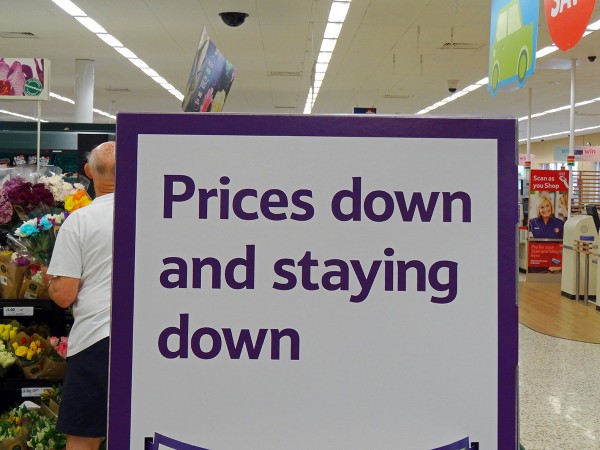 The CPI index fell by 0.1% in the 12 months to April 2015. This is partly the result of lower air and sea fares, as the upward ‘blip’ in these fares at Easter last year was not present in mid-April this year as Easter fell outside the period when the statistics are collected. What is more significant is that fuel, commodity and retail food prices have fallen over the past 12 months, and the exchange rate has risen, especially against the euro.
But how do we define what’s happened and how significant is it? It might seem highly significant as it’s the first time in 55 years that the CPI has fallen over a 12-month period. In fact, the effect is likely to be temporary, as fuel prices are now rising again and commodity prices generally are beginning to rise too. What is more, the pound seems to have peaked against the euro. Thus although aggregate demand remains relatively dampened, the main causes of falling prices and potential rises in the coming months are largely to be found on the cost side. This then brings us on to the definition of a falling CPI.
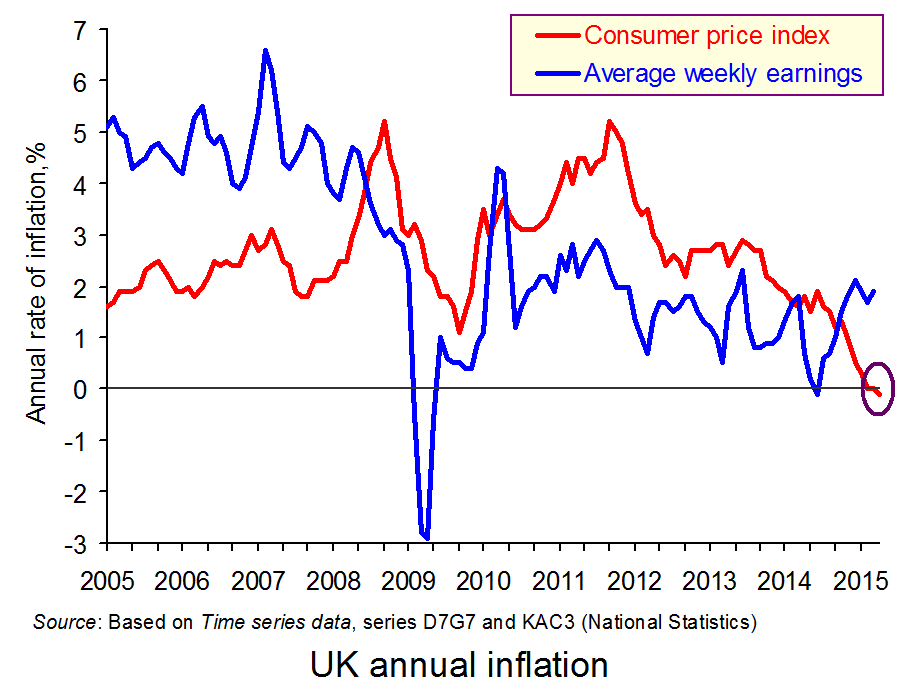 A falling CPI over a 12-month period can be defined as negative inflation. This is unambiguous. But is this ‘deflation’? The problem with the term ‘deflation’ is that it is ambiguous. On the one hand it can be defined simply as negative inflation. In that case, by definition, the UK has experienced deflation. But on the other, it is used to describe a situation of persistent falling prices as a result of declining aggregate demand.
If an economy suffers from deflation in this second sense, the problem can be very serious. Persistent falling prices are likely to discourage consumers from spending on durables (such as fridges, TVs, cars and furniture) and firms from buying capital equipment. After all, why buy an item now if, by waiting, you can get it cheaper later on? This mentality of waiting to spend leads to falling aggregate demand and hence falling output. It also leads to even lower prices. In other words deflation can get worse: a deflationary spiral.
If we define deflation in this second, much more serious sense, then the UK is not suffering deflation – merely temporary negative inflation. In fact, with prices now falling (slightly) and wages rising at around 2% per year, there should be an increase in aggregate demand, which will help to drive the recovery.
Videos
Should Britain Panic Over Negative Inflation? Sky News, Ed Conway (20/5/15)
UK inflation negative for first time since 1960; BoE says temporary Reuters, Andy Bruce and William Schomberg (19/5/15)
UK inflation negative for the first time since 1960 CNBC, Dhara Ranasinghe (19/5/15)
Articles
UK inflation rate turns negative BBC News (19/5/15)
Why there’s little to fear as the spectre of deflation descends on UK The Telegraph, Szu Ping Chan (19/5/15)
UK inflation turns negative The Guardian, Katie Allen (19/5/15)
Is the UK in the early stages of deflation? The Guardian, Larry Elliott (19/5/15)
Is the UK in deflation or negative inflation? Q&A The Guardian, Katie Allen and Patrick Collinson (19/5/15)
Market View: Economists unconcerned on temporary deflation FT Adviser, Peter Walker (19/5/15)
Questions
- Is negative inflation ever a ‘bad thing’?
- Explain the movement in UK inflation rates over the past five years.
- How do changes in exchange rates impact on (a) inflation; (b) aggregate demand? Does it depend on what caused the changes in exchange rates in the first place?
- Why is the current period of negative inflation likely to be short-lived?
- Would you describe the negative inflation as negative cost-push inflation?
- What factors could change that might make negative inflation more persistent and raise the spectre of deflation (in its bad sense)?
- If inflation remains persistently below 2%, what can the Bank of England do, given current interest rates, to bring inflation back to the 2% target?
- What is meant by ‘core inflation’ and what has been happening to it in recent months?
- What global factors are likely to have (a) an upward; (b) a downward effect on UK inflation?
 In his annual Mansion House speech to business leaders on 10 June 2015, George Osborne announced a new fiscal framework. This would require governments in ‘normal times’ to run a budget surplus. Details of the new framework would be spelt out in the extraordinary Budget, due on 8 July.
 By excluding public-sector investment from the target, as was previously done, it can allow borrowing to continue for such investment, even when there is a substantial deficit. This, in turn, can help to increase aggregate supply by improving infrastructure and has less of a dampening effect on aggregate demand. A worry about the new rule is that it could lead to further erosion of public-sector investment, which can be seen as vital to long-term growth and development of the economy. Indeed, Sweden decided in March this year to abandon its surplus rule to allow government borrowing to fund investment.