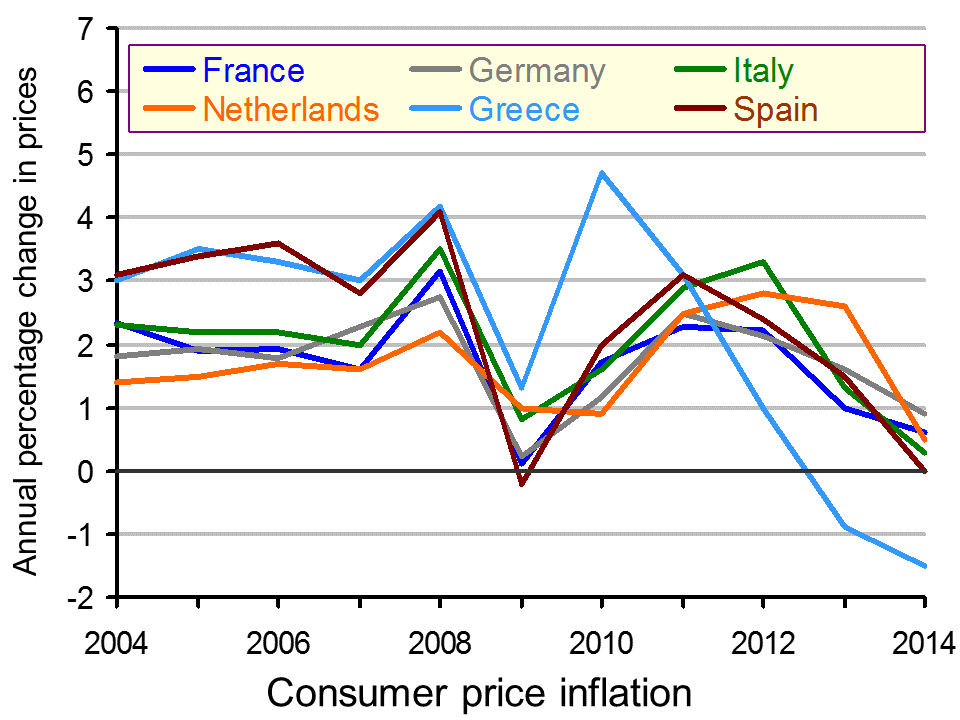
 The eurozone is made up of 18 countries (19 in January) and, besides sharing a common currency, they also seem to be sharing the trait of weak economic performance. The key macroeconomic variables across the eurozone nations have all seemingly been moving in the wrong direction and this is causing a lot of concern for policy-makers.
Some of the biggest players in the eurozone have seen economic growth on the down-turn, unemployment rising and consumer and business confidence falling once again. Germany’s economic growth has been revised down and in Italy, unemployment rose to a record of 13.2% in September and around 25% of the workforce remains out of work in Spain and Greece. A significant consequence of the sluggish growth across this 18-nation bloc of countries is the growing risk of deflation.
 Whilst low and stable inflation is a macroeconomic objective across nations, there is such a thing as inflation that is too low. When inflation approaches 0%, the spectre of deflation looms large (see the blog post Deflation danger). The problem of deflation is that when people expect prices to fall, they stop spending. As such, consumption falls and this puts downward pressure on aggregate demand. After all, if you think prices will be lower next week, then you are likely to wait until next week. This decision by consumers will cause aggregate demand to shift to the left, thus pushing national income down, creating higher unemployment. If this expectation continues, then so will the inward shifts in AD. This is the problem facing the eurozone. In November, the inflation rate fell to 0.3%. One of the key causes is falling energy prices – normally good news, but not if inflation is already too low.
 Jonathan Loynes, Chief European Economist at Capital Economics said:
“[the inflation and jobless data] gives the ECB yet another nudge to take urgent further action to revive the recovery and tackle the threat of deflation…We now expect the headline inflation rate to drop below zero at least briefly over the next six months and there is a clear danger of a more prolonged bout of falling prices.”
Some may see the lower prices as a positive change, with less household income being needed to buy the same basket of goods. However, the key question will be whether such low prices are seen as a temporary change or an indication of a longer-term trend. The answer to the question will have a significant effect on business decisions about investment and on the next steps to be taken by the ECB. It also has big consequences for other countries, in particular the UK. The data over the coming months across a range of macroeconomic variables may tell us a lot about what is to come throughout 2015. The following articles consider the eurozone data.
Euro area annual inflation down to 0.3% EuroStat News Release (28/11/14)
Eurozone inflation weakens again, adding pressure on ECB Nasdaq, Brian Blackstone (28/11/14)
Eurozone inflation rate falls in October BBC News (28/11/14)
Eurozone recovery fears weigh on UK plc, says report Financial Times, Alison Smith (30/11/14)
€300bn Jean-Claude Juncker Eurozone kickstarter sounds too good to be true The Guardian, Larry Elliott (26/11/14)
Eurozone area may be in ‘persistent stagnation trap’ says OECD BBC News (25/11/14)
Euro area ‘major risk to world growth’: OECD CNBC, Katy Barnato (25/11/14)
OECD sees gradual world recovery, urges ECB to do more Reuters, Ingrid Melander (25/11/14)
Questions
- What is deflation and why is it such a concern?
- Illustrate the impact of falling consumer demand in an AD/AS diagram.
- What policies are available to the ECB to tackle the problem of deflation? How successful are they likely to be and which factors will determine this?
- To what extent is the economic stagnation in the Eurozone a cause for concern to countries such as the UK and US? Explain your answer.
- How effective would quantitative easing be in combating the problem of deflation?
 Figures for employment and unemployment give an incomplete picture of the state of the labour market. Just because a person is employed, that does not mean that they are working the number of hours they would like.
Some people would like to work more hours, either by working more hours in their current job, or by switching to an alternative job with more hours or by taking on an additional part-time job. Such people are classed as ‘underemployed’. On average, underemployed workers wanted to work an additional 11.3 hours per week in 2014 Q2. Underemployment is a measure of slack in the labour market, but it is not picked up in the unemployment statistics.
Other people would like to work fewer hours (at the same hourly rate), but feel they have no choice – usually because their employer demands that they work long hours. Some, however, would like to change to another job with fewer hours even if it involved less pay. People willing to sacrifice pay in order to work fewer hours are classed as ‘overemployed’.
Statistics released by the Office for National Statistics show that, in April to June 2014, 9.9%, or 3.0 million, workers in the UK were underemployed; and 9.7%, or 2.9 million, were overemployed.
The figures for underemployment vary between different groups:
|
|
| • |
11.0% of female workers |
8.9% of male workers |
| • |
19.6% of 16-24 year olds |
9.9% of all workers |
| • |
21.1% of people in elementary occupations (e.g. cleaners, shop assistants and security guards) |
5.4% of people in professional occupations (e.g. doctors, teachers and accountants) |
| • |
11.5% of people in the North East of England (in 2013) |
9.2% of people in the East of England (in 2013) |
| • |
22.1% of part-time workers |
5.4% of full-time workers |
As far as the overemployed are concerned, professional people and older people are more likely want shorter hours
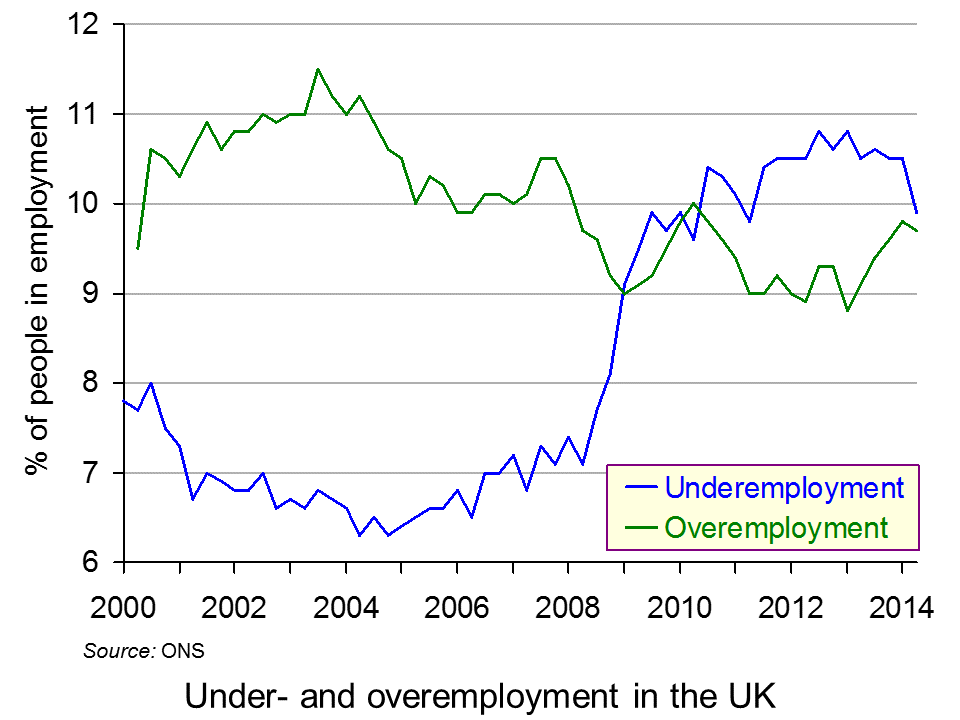 The ONS data also show how under- and overemployment have changed over time: see chart (click here for a PowerPoint). Before the financial crisis and recession, overemployment exceeded underemployment. After the crisis, the position reversed: underemployment rose from 6.8% in 2007 to a peak of 10.8% in mid-2012; while overemployment fell from 10.5% in 2007 to a trough of 8.8% in early 2013.
More recently, as the economy has grown more strongly, underemployment has fallen back to 9.9% (in 2014 Q2) and overemployment has risen to 9.7%, virtually closing the gap between the two.
The fact that there is still significant underemployment suggests that there is still considerable slack in the labour market and that this may be acting as a brake on wage increases. On the other hand, the large numbers of people who consider themselves overemployed, especially among the professions and older workers, suggests that many people feel that they have not got the right work–life balance and many may be suffering consequent high levels of stress.
Articles
Rise in number of UK workers who want to cut back hours, ONS says The Guardian, Phillip Inman (25/11/14)
Data reveal slack and stretch in UK workforce Financial Times, Sarah O’Connor (25/11/14)
Will you graduate into underemployment? The Guardian, Jade Grassby (30/9/14)
Three million people would take pay cut to work shorter hours: Number who say they feel overworked rises by 10 per cent in one year Mail Online, Louise Eccles (26/11/14)
ONS: Rate of under-employment in Scotland lower than UK average Daily Record, Scott McCulloch (25/11/14)
ONS Release
Underemployment and Overemployment in the UK, 2014 ONS (25/11/14)
Questions
- Distinguish between unemployment (labour force survey (LFS) measure), unemployment (claimant count measure), underemployment (UK measure), underemployment (Eurostat measure) and disguised unemployment.
- Why is underemployment much higher amongst part-time workers than full-time workers?
- How do (a) underemployment and (b) overemployment vary according to the type of occupation? What explanations are there for the differences?
- Is the percentage of underemployment a good indicator of the degree of slack in the economy? Explain.
- How is the rise in zero hours contracts likely to have affected underemployment?
- How could the problem of overemployment be tackled? Would it be a good idea to pass a law setting a maximum number of hours per week that people can be required to do in a job?
- Would flexible working rights be a good idea?
 Lloyds Banking Group has announced that it plans to reduce its labour force by 9000. Some of this reduction may be achieved by not replacing staff that leave, but some may have to be achieved through redundancies.
The reasons given for the reduction in jobs are technological change and changes in customer practice. More banking services are available online and customers are making more use of these services and less use of branch banking. Also, the increasingly widespread availability of cash machines (ATMs) means that fewer people withdraw cash from branches.
And it’s not just outside branches that technological change is impacting on bank jobs. Much of the work previously done by humans is now done by software programs.
One result is that many bank branches have closed. Lloyds says that the latest planned changes will see 150 fewer branches – 6.7% of its network of 2250.
What’s happening in banking is happening much more widely across modern economies. Online shopping is reducing the need for physical shops. Computers in offices are reducing the need, in many cases, for office staff. More sophisticated machines, often controlled by increasingly sophisticated computers, are replacing jobs in manufacturing.
So is this bad news for employees? It is if you are in one of those industries cutting employment. But new jobs are being created as the economy expands. So if you have a good set of skills and are willing to retrain and possibly move home, it might be relatively easy to find a new, albeit different, job.
As far as total unemployment is concerned, more rapid changes in technology create a rise in frictional and structural unemployment. This can be minimised, however, or even reduced, if there is greater labour mobility. This can be achieved by better training, education and the development of transferable skills in a more adaptive labour force, where people see changing jobs as a ‘normal’ part of a career.
Webcasts
 Lloyds Bank cuts 9,000 jobs – but what of the tech future? Channel 4 News, Symeon Brown (28/10/14)
Lloyds Bank confirms 9,000 job losses and branch closures BBC News, Kamal Ahmed (28/10/14)
Article
Lloyds job cuts show the technology axe still swings for white collar workers The Guardian, Phillip Inman (28/10/14)
Reports
Unleashing Aspiration: The Final Report of the Panel on Fair Access to the Professions Cabinet Office (July 2009)
Fair access to professional careers: a progress report Cabinet Office (30/5/12)
Questions
- Is a reduction in banking jobs inevitable? Explain.
- What could banks do to reduce the hardship to employees from a reduction in employment?
- What other industries are likely to see significant job losses resulting from technological progress?
- Distinguish between demand-deficient, real-wage, structural and frictional unemployment. Which of these are an example, or examples, of equilibrium unemployment?
- What policies could the government pursue to reduce (a) frictional unemployment; (b) structural unemployment?
- What types of industry are likely to see an increase in employment and in what areas of these industries?
 Europe’s largest economy is Germany and the prospects and growth figures of this country are crucial to the growth of the Eurozone as a whole. The EU is a key trading partner for the UK and hence the growth data of Germany and in turn of the Eurozone is also essential in creating buoyant economic conditions within our borders. The bad news is that the economic growth forecast for Germany has been cut by the German government.
The German government had previously estimated that the growth rate for this year would be 1.8%, but the estimate has now been revised down to 1.2% and next year’s growth rate has also been revised downwards from 2% to 1.3%. Clearly the expectation is that low growth is set to continue.
Whenever there are changes in macroeconomic variables, a key question is always about the cause of such change, for example is inflation caused by demand-pull or cost-push factors. The German government has been quick to state that the lower growth rates are not due to internal factors, but have been affected by external factors, in particular the state of the global economy. As such, there are no plans to make significant changes to domestic policy, as the domestic economy remains in a strong position. The economy Minister said:
“The German economy finds itself in difficult external waters … Domestic economic forces remain intact, with the robust labour market forming the foundation … As soon as the international environment improves, the competitiveness of German companies will bear fruit and the German economy will return to a path of solid growth … [for this reason there is] no reason to abandon or change our economic or fiscal policy.”
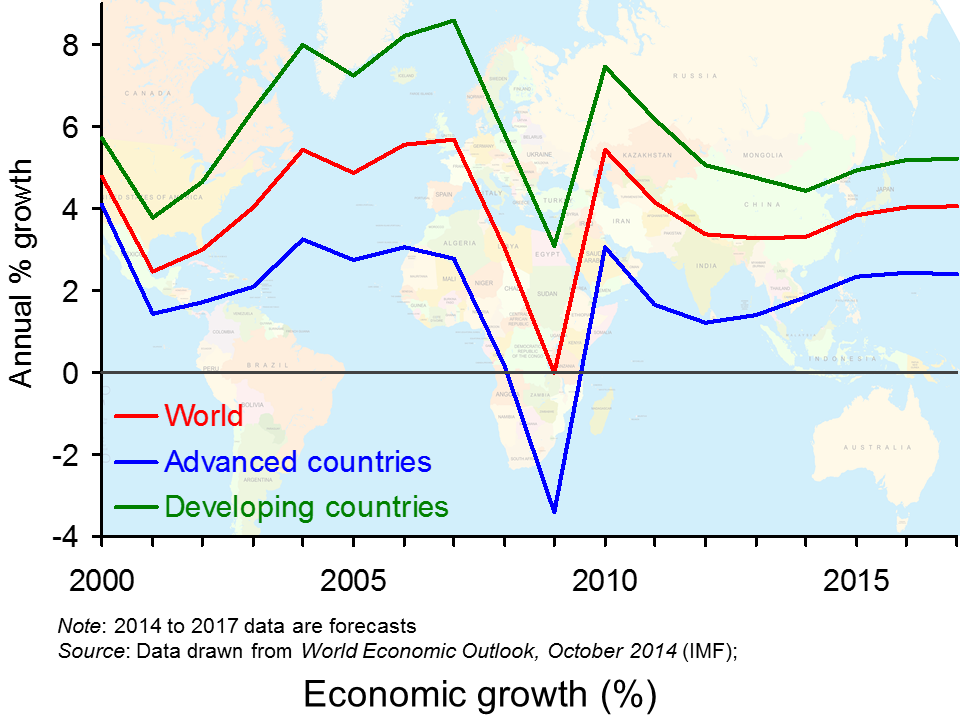 The global picture remains relatively weak and while some economies, including the UK, have seen growth pick up and unemployment fall, there are concerns that the economic recovery is beginning to slow. With an increasingly interdependent world, the slowing down of one economy can have a significant impact on the growth rate of others. If country A begins to slow, demand for imports will fall and this means a fall in the demand for exports of country B. For countries that are dependent on exports, such as Germany and China, a fall in the demand for exports can mean a big decline in aggregate demand and in August, Germany saw a 5.8% drop in exports.
Adding to the gloom is data on inflation, suggesting that some other key economies have seen falls in the rate of inflation, including China. The possibility of a triple-dip recession for the Eurozone has now been suggested and with its largest economy beginning to struggle, this suggestion may become more real. The following articles consider the macroeconomic picture.
Articles
Germany cuts growth forecasts amid recession fears, as Ireland unveils budget The Guardian, Graeme Wearden (14/10/14)
As cracks in its economy widen, is Germany’s miracle about to fade? The Observer, Philip Oltermann (19/10/14)
Why the German economy is in a rut The Economist (21/10/14)
Germany’s flagging economy: Build some bridges and roads, Mrs Merkel The Economist (18/10/14)
Germany cuts 2014 growth forecast from 1.8% to 1.2% BBC News (14/10/14)
IMF to cut growth forecast for Germany – der Spiegel Reuters (5/10/14)
Fears of triple-dip eurozone recession, as Germany cuts growth forecast The Guardian, Phillip Inman (15/10/14)
Germany slashes its economic forecasts Financial Times, Stefan Wagstyl (14/10/14)
Merkel vows austerity even as growth projection cut Bloomberg, Brian Parkin, Rainer Buergin and Patrick Donahue (14/10/14)
Is Europe’s economic motor finally stalling? BBC News, Damien McGuinness (17/10/14)
Why Germany won’t fight deflation BBC News, Robert Peston (16/10/14)
Data
World Economic Outlook Database IMF (15/10/14)
World Economic Outlook IMF (October 2014)
Questions
- How do we measure economic growth and is it a good indicator of the state of an economy?
- What are the key external factors identified by the Germany government as the reasons behind the decline in economic growth?
- Angela Merkel has said that austerity measures will continue to balance the budget. Is this a sensible strategy given the revised growth figures?
- Why is low inflation in other economies further bad news for those countries that have seen a decline or a slowdown in their growth figures?
- Why is interdependence between nations both a good and a bad thing?
- Using AS and AD analysis, illustrate the reasons behind the decline German growth. Based on your analysis, what might be expected to happen to some of the other key macroeconomic variables in Germany and in other Eurozone economies?
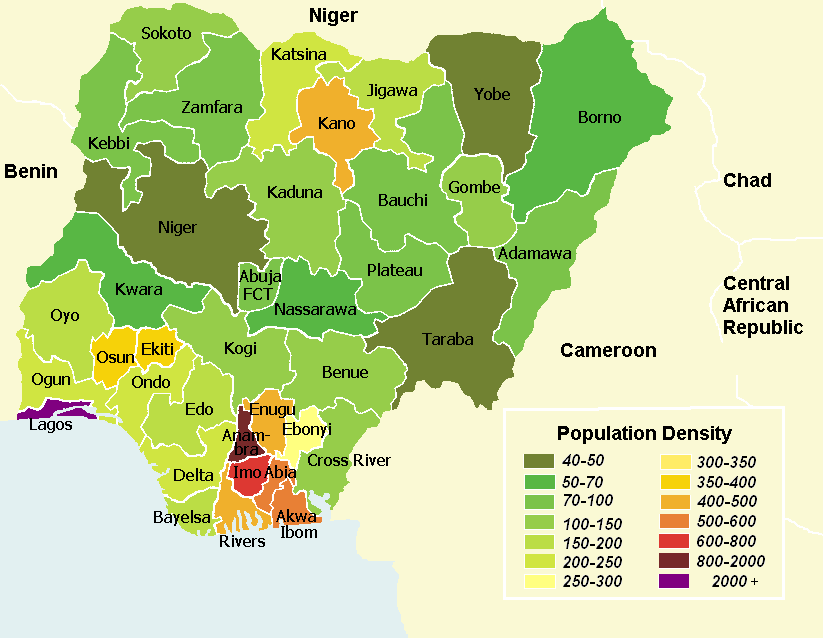
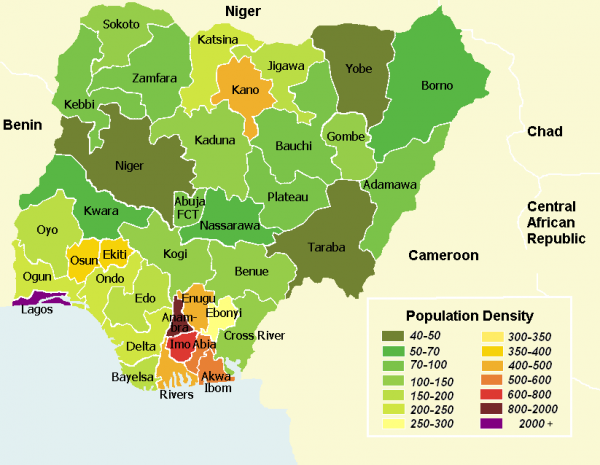 I found this interesting article on the BBC News website about three students in Nigeria who have created an online job search company. Only five years later, this company now is valued in the millions and employs over 100 people.
The article below contains some interesting insights into the Nigerian job market and the key to success for this company. In particular, they note the effect of the multiplier through job creation and how this has been used to benefit the wider economy. This is particularly pertinent given the severe unemployment problem that has affected this African economy. It has helped 35,000 people to find jobs in the past two years.
How three students created Nigeria’s online jobs giant BBC News, Jason Boswell (2/9/14)
Questions
- What are the main causes of the unemployment problem in Nigeria?
- The company itself employs hundreds of people, but indirect employment effects have also occurred. How has this happened?
- How important are entrepreneurs in African countries as a means of helping their development?
 Whilst low and stable inflation is a macroeconomic objective across nations, there is such a thing as inflation that is too low. When inflation approaches 0%, the spectre of deflation looms large (see the blog post Deflation danger). The problem of deflation is that when people expect prices to fall, they stop spending. As such, consumption falls and this puts downward pressure on aggregate demand. After all, if you think prices will be lower next week, then you are likely to wait until next week. This decision by consumers will cause aggregate demand to shift to the left, thus pushing national income down, creating higher unemployment. If this expectation continues, then so will the inward shifts in AD. This is the problem facing the eurozone. In November, the inflation rate fell to 0.3%. One of the key causes is falling energy prices – normally good news, but not if inflation is already too low.