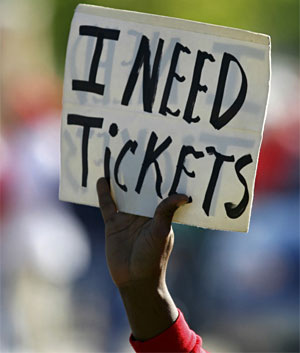
 Imagine that the team you support has made the final of a major competition or a your favourite band is playing a live concert this summer. You desperately want a ticket and are willing to pay the advertised price. They go on sale at 9.00am in the morning and you go on-line at 8.59am but unfortunately the webpage will not load. You keep pressing the refresh button but with no success. Eventually, annoyed and frustrated, you give up at 10.00am!
Tickets for sporting, musical or other live shows are initially sold by people who organise the events in two ways. They may choose to sell some or all of the tickets directly to the customer. For example you can buy tickets for a West End show from the box office in the theatre. With some football games it is still possible to buy tickets on the day at the stadium. Another approach is to sell some or all of the tickets via an authorised ticket agent. These businesses are usually members of STAR (The Society of Ticket Agents and Retailers) and the organisers of the sporting, musical or live show provide them with tickets to sell on their behalf. Some of the larger and well known agents such as Ticketmaster, Ticketline and Seetickets usually sell the tickets at face value although some booking fees are often added to the price. This initial sale of tickets by either the event organiser themselves or an agent acting on their behalf is referred to as the primary market.
For example, British Athletics sold all of its 130,000 tickets for its two day Anniversary Games on the 26th and 27th July via its authorised ticket agent in 75 minutes!! However an internet search for this event will quickly reveal that tickets are still available!! Unfortunately in most cases the advertised price will be far greater than the face value of the ticket. How is this possible? The answer is that the internet has helped a thriving secondary market for tickets to develop. The secondary market refers to situations where people who have already purchased tickets through the primary market re-sell them to other members of the public. Prior to the internet the main way of buying a ticket in the secondary market was to visit the venue on the day of the event and hunt for some-one willing to sell. However technology has dramatically reduced these transaction costs and made it much easier for potential buyers and sellers to make an exchange. For example companies such as Viagogo, Seatwave, GetMeIn and Stubhub have created websites that allow members of the public to buy and sell tickets. As Viagogo publish on their webpage:
You are buying tickets from a third party, Viagogo is not the ticket seller. Ticket prices are set by the seller and may be above or below face value.
Why does this secondary market exist? An economist would argue that it can only happen if the quantity of tickets demanded is greater than the quantity of tickets for sale at the price set by the event organiser. If this was not the case then customers would be able to buy tickets through the primary market on the day of the match, concert or show. The puzzle is to explain why prices do not rise in the primary market. If the quantity demanded of any product is greater than the quantity supplied then market forces should put upward pressure on prices. However it would appear that many of the event organisers appear to resist this incentive and consistently set prices below the level that would limit demand to the number of tickets available. This leaves an opportunity for sellers in the secondary market to sell tickets much closer to their market clearing rate. Navin Kekane, the business operations director of Stubhub, stated that
What we do is all about supply and demand, and you can sometimes find tickets at below face value.
Some of these companies in the secondary market have recently established formal partnerships with a number of English Premier League (EPL) football clubs and other major sporting bodies. For example Viagogo have signed deals with 10 EPL clubs while Stubhub have deals with 3 EPL clubs as well as Leicester Tigers and the Lawn Tennis Association.
However some observers have expressed grave reservations about the growth of the secondary market. For example Malcolm Clarke, chairman of the Football Supporters Federation, stated that
At the moment if you are fan trying to sell a spare ticket and are not authorised to do so then you face a criminal conviction, even if you sell at the face value.
But secondary ticketing exchanges, because they are authorised, are allowed to do so. Many clubs grant these agencies the right to allow the re-sale of tickets for their matches at above face value. I don’t think that can be right.
Joe Cohen, the founder of Seatwave counters that
Touts is an emotional, dehumanising word. The reality is that they are just speculators. No one likes speculators until you need something from them.
Some have called for more regulation of the secondary market. For example Sharon Hodgson, Labour MP for Washington and Sunderland West, unsuccessfully tried to get a Private Members Bill through Parliament which would have made it illegal to re-sell tickets for more than 10% above their face value.
Articles
Questions
- Give some potential advantages for a football club or sporting body of using an authorised ticket agent to sell tickets in the primary market.
- Using a demand and supply diagram explain what happens in a market if the price is continually set below its market clearing rate. Illustrate and explain how mutually beneficial trade can take place in the secondary market at prices above those in the primary market.
- Can you explain why it is less likely for a secondary market to exist for cinema tickets than a popular West End show?
- Can you think of any reasons why it might be in the interests of a profit maximising organiser of a sporting or music event to sell tickets below the market clearing rate.
- What non-price methods could be used to allocate tickets for popular events? Consider some of the advantages/disadvantages of using these non-price methods.
- Do you think it is in the interests of society to allow people to re-sell tickets at a price above their face value?
The total EU budget in 2010 was €123 billion. Just under half of this (€58 billion) was spent on supporting agriculture. The programme of support – the Common Agricultural Policy (CAP) – has changed over the years. For a start, despite its being a large proportion of the EU budget, this proportion has actually been falling. In 1980, the CAP accounted for 69% of the EU budget; in 1990 it was 60%; in 2000 it was 52%; in 2010 it was 47%.
The types of support have also changed. The main method in the past was effectively to set minimum prices for various foodstuffs and for Intervention Boards to buy up any surpluses that arose from such prices being above the market equilibrium. Massive food ‘mountains’ resulted. Sometimes these surpluses were dumped on the world market; sometimes they were thrown away; sometimes they were simply kept in storage. Export subsidies and import levies (taxes) were also used to reduce surpluses. This, of course, was highly damaging to farmers in many countries outside the EU, especially in various primary exporting developing countries.
Reforms have taken place in recent years. The most important has been to replace high intervention prices with direct payments to farmers unrelated to current output. Whilst such payments still provide a substantial outgoing from the EU budget, being unrelated to current output, they do not encourage farmers to produce more and thus do not generate surpluses. Prices in most cases are allowed to be determined by the market.
The EU has just announced further reforms. These include:
• Capping total CAP spending at current levels until 2020
• Capping the total payment to any one farm to €300,000
• Relating subsidies to acreage rather than previous output
• Making 30% of the direct payments dependent on farmers meeting environmental criteria.
The following videos and articles examine the proposals and assess their likely benefits, their likely drawbacks and their likelihood of being implemented.
Videos
 EU plans to reform Common Agricultural Policy for farmers BBC News, Jeremy Cooke (12/10/11)
EU unveils controversial agricultural reforms Euronews (12/10/11)
Towards a new Common Agricultural Policy Euronews (14/10/11)
Queen to lose out in shake up of Europe’s farm payments Channel 4 News (12/10/11)
Cautious welcome for EU agriculture policy shake-up STV News (12/10/11)
CAP reform proposals YouTube, Dacian Cioloş, European Commissioner for Agriculture and Rural Development (in French with English subtitles) (12/10/11)
Articles
EU farm chief: CAP plans represent profound reform Reuters, Charlie Dunmore (12/10/11)
UK to dismiss Common Agricultural Policy reforms as inadequate Guardian, David Gow (11/10/11)
EU Farm Policy Debate Pits Top Receiver France Against U.K. Bloomberg Businessweek, Rudy Ruitenberg (12/10/11)
EU plans CAP reforms for ‘greener’ farm subsidies BBC News (12/10/11)
Common Agriculture Policy farm subsidy plan unveiled BBC News (12/10/11)
Q&A: Reform of EU farm policy BBC News (12/10/11)
CAP reform: Shepherd and steward of the land BBC News, Jeremy Cooke (12/10/11)
EU agriculture policy ‘still hurting farmers in developing countries’ Guardian: Poverty Matters blog, Mark Tran (11/10/11)
EU aid to farmers to continue over next decade Financial Times, Joshua Chaffin (12/10/11)
EU publications
CAP Reform – an explanation of the main elements Europa Press Release (12/10/11)
The European Commission proposes a new partnership between Europe and the farmers European Commission Press Release (12/10/11)
EU farm policy after 2013: Commission proposals welcomed with reservations European Parliament Press Release (12/10/11)
Legal proposals for the CAP after 2013 European Commission: Agriculture and Rural Development (12/10/11)
Questions
- Explain why the old system of price support under the CAP led to food surpluses. Use a diagram to illustrate your analysis.
- What is the significance of price elasticity of demand and supply in determining the size of these surpluses?
- What reforms have been introduced to the CAP in recent years? What effects have these had?
- Explain the new proposals for the CAP after 2013.
- What are the likely benefits of these proposals?
- What are the likely drawbacks of the proposals?
The government has been under a lot of pressure to tackle the culture of binge drinking. Figures for 2006/7 show that the cost to the NHS of binge drinking was £2.7 billion per year. In response, MPs are calling for a change in government policy towards the alcohol industry, arguing that at present the drinks industry has more control over policy than health experts. So what can be done?
In a report published in early January 2010, the House of Commons Health Select Committee proposed a minimum price per unit of alcohol, tighter controls on advertising and mandatory labelling. A minimum price, the Committee argued, would reduce demand by heavy drinkers who are looking for cheap alcohol. At present, many supermarkets have promotions that involve selling cider and beer at below cost, allowing people to ‘pre-load’ cheaply at home before going out drinking. The report suggested that a minimum price of alcohol of 50p per unit would save more than 3000 lives per year and a minimum price of 40p per unit would save 1100 lives.
Dr. Richard Taylor, an independent MP and member of the Commons Health Select Committee, said:
“The evidence we took showed that minimum pricing was the most effective way forward and at the moment you can sometimes buy beer cheaper than water. Our message is that the price would be put up but only by a little for moderate drinkers. Surely that is a sacrifice to pay for the good health of young people.”
However, those opposed to setting a minimum price per unit of alcohol argue that it would be unfair on moderate drinkers, that it wouldn’t work and that it could even be illegal. Instead, they argue that that government intervention needs to be smarter. It should not target everyone, but solely those groups consuming the most alcohol. The British Beer and Pub Association suggests that 10% of the population consumes 44% of all alcohol.
It appears that the government won’t be following Scotland’s minimum price on alcohol, but will instead impose bans on all-you-can-drink deals and introduce compulsory identity checks. However, supermarket deals don’t appear to have been targeted. Successive governments have failed to tackle this problem sufficiently, but with an election approaching, will this be a proposal that is promoted?
Raise alcohol price to save lives, MPs argue Telegraph, Rebecca Smith (8/1/10)
Commons committee backs minimum alcohol pricing BBC News (8/1/10)
Campagain to tackle cut price alchol The Arran Banner (8/1/10)
Wyre Forest MP calls for alcohol minimum pricing The Shuttle (8/1/10)
Should 50p be minimum price for a unit of alcohol? Have your say BBC News (8/1/10)
BBPA: minimum price would be ineffective Morning Advertiser, Ewan Turney (8/1/10)
Cost of binge drinking doubles for the NHS rises to £2.7 billion Mirror, James Lyons (2/1/10)
Bring in 50p minimum price for alcohol, MPs urge Guardian, Toby Helm (3/1/10)
All-you-can-drink pub offers facing ban BBC News (19/1/10)
Too much of the hard stuff: what alcohol costs the NHS THE NHS Confederation, Issue 193 January 2010
Minimum pricing for alcohol essential, says Health Committee Marketing Week, David Burrows (8/1/10)
Minimum alcohol pricing ‘will affect the poor’ BBC News, Kevin Barron and Gavin Partington debate (8/1/10)
Questions
- How is the equilibrium price of alcohol determined?
- Illustrate and explain the effects of the imposition of a minimum price.
- To what extent is a minimum price likely to be effective? How is elasticity likely to play a role in the effectiveness of such a policy?
- Why could the introduction of a minimum price on alcohol be illegal and contravene European competition law?
- What are the arguments for and against a minimum price on alcohol? Explain how and why some people will gain and others will lose.
- How would a minimum price on alcohol affect government spending? Would more investment in prevention lead to a lower cost to the NHS? Explain your answer.
- Why might bans on all-you-can-drink deals be ineffective?
Price controls – limiting the price of goods through government intervention in a market – have fallen out of fashion to a great extent as an economic policy tool in the past couple of decades, but they may be making a comeback in Argentina, Russia and China according to the article below from Slate magazine.
Cry for me Argentina (and Russia and China) MSN Slate (30/10/07)
Questions
| 1. |
Using supply and demand diagrams as appropriate, illustrate the ways in which price controls have been used to influence prices in Argentina and Russia and China. |
| 2. |
Examine the reasons why the Argentinean government has chosen to implement price controls for energy. |
| 3. |
Discuss the likely effectiveness of price controls in combating inflation in Russia, China and Argentina. |
The national minimum wage will rise again in October 2007 by about 3% from £5.35 to £5.52. However, the Work Foundation has warned that the effectiveness of the minimum wage may be at its limits and that further rises in its level may not have the desired impact in terms of addressing inequality. The articles and press release below consider these issues.
Minimum wage up to £5.52 per year BBC News Online (7/3/07)
National minimum wage at the limits of its effectiveness The Work Foundation – press release (6/3/07)
Warning over minimum wage level BBC News Online (6/3/07)
Questions
| 1. |
Using diagrams as appropriate, illustrate the likely impact on the UK labour market of the proposed increase in the national minimum wage from October 2007. |
| 2. |
Assess the arguments given by the Work Foundation that the minimum wage is reaching the limits of its effectiveness. |
| 3. |
Evaluate two methods other than a national minimum wage for reducing levels of both relative and absolute poverty. |