 In a carefully argued article in the New Statesman, the UK Business Secretary, Vince Cable, considers the slow recovery in the economy and whether additional measures should be adopted. He sums up the current state of the economy as follows:
The British economy is still operating at levels around or below those before the 2008 financial crisis and roughly 15 per cent below an albeit unsustainable pre-crisis trend. There was next to no growth during 2012 and the prospect for 2013 is of very modest recovery.
Unsurprisingly there is vigorous debate as to what has gone wrong. And also what has gone right; unemployment has fallen as a result of a million (net) new jobs in the private sector and there is vigorous growth of new enterprises. Optimistic official growth forecasts and prophets of mass unemployment have both been confounded.
He argues that supply-side policies involving “a major and sustained commitment to skills, innovation and infrastructure investment” are essential if more rapid long-term growth is to be achieved. This is relatively uncontroversial.
 But he also considers the claim that austerity has kept the economy from recovering and whether policies to tackle the negative output gap should be adopted, even if this means a short-term increase in government borrowing.
But crude Keynesian policies of expanding aggregate demand are both difficult to implement and may not take into account the particular circumstance of the current extended recession – or depression – in the UK and in many eurozone countries. World aggregate demand, however, is not deficient. In fact it is expanding quite rapidly, and with the sterling exchange rate index some 20% lower than before the financial crisis, this should give plenty of opportunity for UK exporters.
Yet expanding UK aggregate demand is proving difficult to achieve. Consumers, worried about falling real wages and large debts accumulated in the years of expansion, are reluctant to increase consumption and take on more debts, despite low interest rates. In the light of dampened consumer demand, firms are reluctant to invest. This makes monetary policy particularly ineffective, especially when banks have become more risk averse and wish to hold higher reserves, and indeed are under pressure to do so.
 So what can be done? He argues that there is “some scope for more demand to boost output, particularly if the stimulus is targeted on supply bottlenecks such as infrastructure and skills.” In other words, he advocates policies that will simultaneously increase both aggregate demand and aggregate supply. Monetary policy, involving negative real interest rates and quantitative easing, has helped to prevent a larger fall in real aggregate demand and a deeper dive into recession, but the dampened demand for money and the desire by banks to build their reserves has meant a massive fall in the money multiplier. Perhaps monetary policy needs to be more aggressive still (see the blog post, Doves from above), but this may not be sufficient.
Which brings Dr Cable to the political dynamite! He advocates an increase in public investment on infrastructure (schools and colleges, hospitals, road and rail projects and housing, and considers whether this should be financed, not by switching government expenditure away from current spending, but by borrowing more.
Such a strategy does not undermine the central objective of reducing the structural deficit, and may assist it by reviving growth. It may complicate the secondary objective of reducing government debt relative to GDP because it entails more state borrowing; but in a weak economy, more public investment increases the numerator and the denominator.
 He raises the question of whether the balance of risks has changed: away from the risk of increased short-term borrowing causing a collapse of confidence to the risk of lack of growth causing a deterioration in public finances and this causing a fall in confidence. As we saw in the blog post Moody Blues, the lack of growth has already caused one ratings agency (Moody’s) to downgrade the UK’s credit rating. The other two major agencies, Standard & Poor’s and Fitch may well follow suit.
The day after Dr Cable’s article was published, David Cameron gave a speech saying that the government would stick to its plan of deficit reduction. Not surprisingly commentators interpreted this as a split in the Coalition. Carefully argued economics from Dr Cable it might have been, but political analysts have seen it as a hand grenade, as you will see from some of the articles below.
When the facts change, should I change my mind? New Statesman, Vince Cable (6/3/13)
Keynes would be on our side New Statesman, Vince Cable (12/1/11)
Exclusive: Vince Cable calls on Osborne to change direction New Statesman, George Eaton (67/3/13)
Vince Cable: Borrowing may not be as bad as slow growth BBC News (7/3/13)
Vince Cable makes direct challenge to Cameron over economic programme The Guardian, Nicholas Watt (7/3/13)
Vince Cable Says George Osborne Must Change Course And Borrow More To Revive Growth Huffington Post, Ned Simons (6/3/13)
David Cameron and Vince Cable at war over route to recovery Independent, Andrew Grice (6/3/13)
 Vince Cable: Borrowing may not be as bad as slow growth BBC News, James Landale (6/3/13)
David Cameron: We will hold firm on economy BBC News (7/3/13)
David Cameron: We will hold firm on economy BBC News (7/3/13)
Clegg Backs Cable Over Controversial Economy Comments LBC Radio, Nick Clegg (7/3/13)
It’s plain what George Osborne needs to do – so just get on and do it The Telegraph, Jeremy Warner (6/3/13)
Vince Cable’s plan B: a “matter of judgement” BBC News, Stephanie Flanders (7/3/13)
George Osborne needs to turn on the spending taps The Guardian, Phillip Inman (12/3/13)
Questions
- Why has monetary policy proved ineffective in achieving a rapid recovery from recession?
- Distinguish between discretionary fiscal policy and automatic fiscal stabilisers.
- Why has the existence of automatic fiscal stabilisers meant that the public-sector deficit has been difficult to bring down?
- In what ways has the balance of risks in using discretionary fiscal policy changed over the past three years?
- In what ways is the depression of the late 2000s/early 2010s (a) similar to and (b) different from the Great Depression of the early 1930s?
- In what ways is the structure of public-sector debt in the UK different from that in many countries in the eurozone? Why does this give the government more scope for expansionary fiscal policy?
- Why does the Office of Budget Responsibility’s estimates of the tax and government expenditure multipliers suggest that “if fiscal policy is to work in a Keynesian manner, it needs to be targeted carefully, concentrating on capital projects”?
- Why did Keynes argue that monetary policy is ineffective at the zero bound (to use Dr Cable’s terminology)? Are we currently at the zero bound? If so what can be done?
- Has fiscal tightening more than offset loose monetary policy?
 With many countries struggling to recover from the depression of the past few years, central banks are considering more and more doveish moves to kick-start lending. But with short-term interest rates in the USA, the UK and Japan close to zero, the scope for further cuts are limited. So what can central banks do?
The first thing that can be done is to adopt a higher inflation target or to accept inflation above target – at least for the time being. This could be accompanied by explicitly targeting GDP growth (real or nominal) or unemployment (see the blog from last December, Rethinking central bank targets).
 The second option is to increase quantitative easing. Although in a minority at the last MPC meeting, Mervyn King, the current Bank of England Governor, argued for a further £25 billion of asset purchases (bringing the total to £400bn) (see MPC minutes paragraph 39). It is highly likely that the MPC will agree to further QE at its next meeting in March. In Japan, the new governor of the Bank of Japan is expected to include asset purchases as part of the policy of monetary easing.
The third option is for the central bank to provide finance at below-market rates of interest directly to the banking sector specifically for lending: e.g. to small businesses or for house purchase. The Bank of England’s Funding for Lending Scheme is an example and the Bank is considering extending it to other financial institutions.
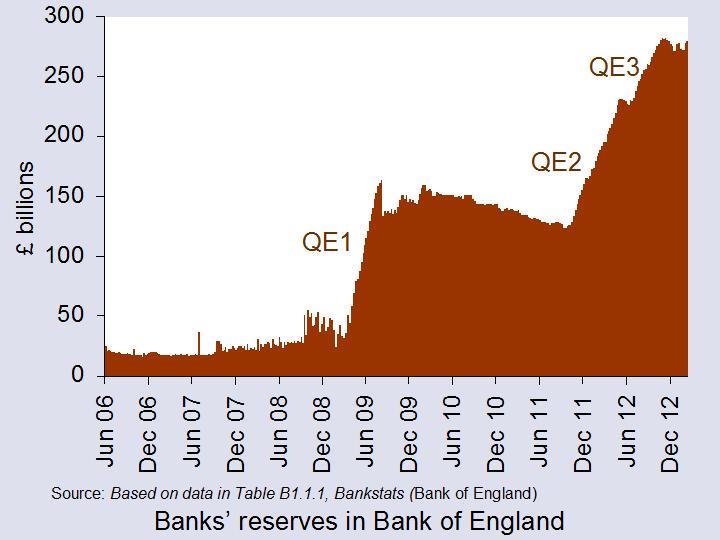 One other approach, mooted by the Bank of England’s Deputy Governor before the House of Commons Treasury Select Committee, is for negative interest rates paid on Banks’ reserves in the Bank of England. This would, in effect, be a fee levied on banks for keeping money on deposit. The idea would be to encourage banks to lend the money and not to keep excessive liquidity. As you can see from the chart, three rounds of quantitative easing have led to a huge increase in bank’s reserves at the Bank of England. (Click here for a PowerPoint of the chart.)
The following articles consider these various proposals and whether they will work to stimulate lending and thereby aggregate demand and economic recovery.
Central banks: Brave new words The Economist (23/2/13)
Phoney currency wars The Economist (16/2/13)
Analysis: Global central banks will keep taking it easy Reuters, Alan Wheatley (22/2/13)
Quantitative easing: the markets are struggling with a serious drug habi The Guardian, Larry Elliott (24/2/13)
Negative interest rates idea floated by Bank’s Paul Tucker BBC News (26/2/13)
Bank of England mulls negative interest rates Independent, Ben Chu (26/2/13)
BoE floats extending Funding for Lending to non-banks Mortgage Solutions, Adam Williams (26/2/13)
Funding for Lending Scheme failing to get banks lending Left Foot Forward, James Bloodworth (26/2/13)
Mortgage market boosted by lending schemes, says Redrow BBC News (26/2/13)
Widespread quantitative easing risks ‘QE wars’ and stagnation The Guardian, Nouriel Roubini (28/2/13)
Questions
- Consider each of the methods outlined above and their chances of success in stimulating aggregate demand.
- Go through each of the methods and consider the problems they are likely to create/have created.
- How important is it that monetary policy measures affect people’s expectations?
- What effects do the measures have on the distribution of income between borrowers and savers?
- What are annuities? How are these affected by policies of monetary easing?
- How has actual and anticipated Japanese monetary policy affected the exchange rate of the Japanese yen? How is this likely to affect the Japanese economy?
- Explain the sub-heading of the final article above, “When several major central banks pursue QE at the same time, it becomes a zero-sum game”. Do you agree?
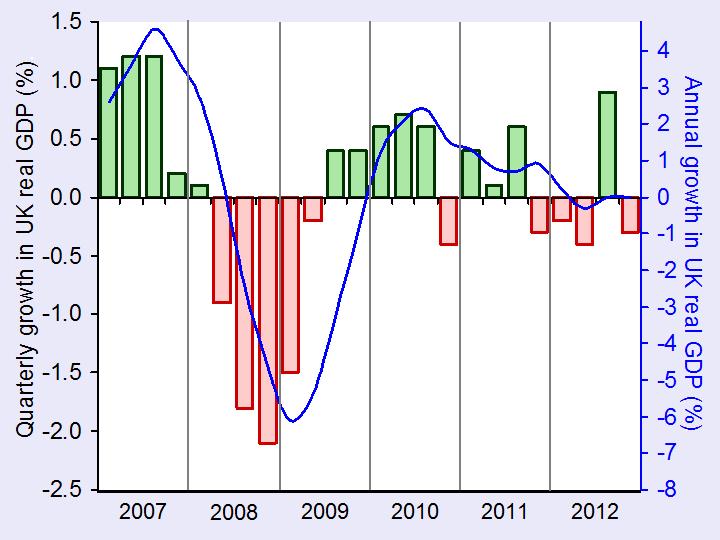
 According to the first estimate by the Office for National Statistics, the UK economy shrank by 0.3% in the final three months of 2012. This means that over the whole year growth was flat.
The biggest contributor to the fall in GDP in Q4 was the production industries, which include manufacturing. Output of the production sector fell by 1.8% in Q4. Construction sector output, by contrast, was estimated to have increased by 0.3%. Service sector output was flat. The chart below shows quarterly and annual growth in the UK from 2007 to 2012. (Click here for a PowerPoint.)
Latest estimates by the IMF are that the UK economy will grow by 1.0% in 2013 – well below the long-term growth in potential output (see also the last blog, High hopes in the Alps). But some forecasters are predicting that real GDP will continue to fall for at least one more quarter, which means that the economy would then be in a ‘triple-dip recession’.
 Not surprisingly politicians have interpreted the statistics very differently, as have economists. The government, while recognising that the UK faces a ‘very difficult economic situation’, argues that now is not the time to change course and that by continuing with policies to reduce the deficit the economy will be placed on a firmer footing for sustained long-term growth
The opposition claims that the latest figures prove that the government’s policies are not working and that continuing attempts to bear down on the deficit are depressing aggregate demand and thereby keeping the economy depressed.
The following webcasts, podcasts and articles expand on these arguments. Try to be dispassionate in using economic analysis and evidence to assess the arguments.
Webcasts and podcasts
Video Summary: Gross Domestic Product Preliminary Estimate, Q4 2012 Media Briefing (Click here for the following Q&A) ONS (25/1/13)
Triple dip on the menu? Channel 4 News, Siobhan Kennedy and Faisal Islam (25/1/13)
Getting and spending – the key to recovery Channel 4 News, Cathy Newman (25/1/13)
UK economy shrinks by 0.3% in the last three months of 2012 BBC News, Hugh Pym (25/1/13)
Danny Alexander on GDP figures and economic plans BBC Daily Politics (25/1/13)
Osborne defends government’s deficit reduction plan BBC News (25/1/13)
Ed Balls: UK economy urgently needs a ‘Plan B’ BBC News (25/1/13)
UK heads for triple dip as GDP contracts 0.3pc The Telegraph, Philip Aldrick (25/1/13)
Economist: Government may need to rethink its fiscal policy The Telegraph, Jim O’Neill (25/1/13)
Has austerity really been tried in Britain? BBC Today Programme, Jonathan Portes and Andrew Lilico (29/1/13)
Articles
UK GDP: Economy shrank at end of 2012 BBC News (25/1/13)
UK GDP shrinks by 0.3% in fourth quarter: what the economists say The Guardian (25/1/13)
New Bank of England head Mark Carney hints at big shift in policy The Guardian (26/1/13)
The Bank of England, the chancellor, and the target BBC News. Stephanie Flanders (29/1/13)
The Entire World Of Economics Is Secretly Thankful To The UK Right Now Business Insider, Joe Weisenthal (26/1/13)
Data
Gross Domestic Product: Preliminary Estimate, Q4 2012 ONS (25/1/13)
Video Summary: Gross Domestic Product Preliminary Estimate, Q4 2012 ONS (25/1/13)
Preliminary Estimate of GDP – Time Series Dataset 2012 Q4 ONS (25/1/13)
Business and Consumer Surveys DG ECFIN
Questions
- What are the reasons for the decline in GDP in 2012 Q4??
- Examine how likely it is that the UK will experience a triple-dip recession.
- What measures could be adopted to increase consumer and business confidence?
- If there is substantial spare capacity, is expansionary fiscal policy the best means of achieving economic growth?
- What additional monetary policy measures could be adopted to stimulate economic growth?
- Find out what has happened to the UK’s public-sector deficit and debt over the past three years. Explain what has happened.
 What lies ahead for economic growth in 2013 and beyond? And what policies should governments adopt to aid recovery? These are questions examined in four very different articles from The Guardian.
The first is by Nouriel Roubini, Professor of Economics at New York University’s Stern School of Business. He was one of the few economists to predict the collapse of the housing market in the USA in 2007 and the credit crunch and global recession that followed. He argues that continuing attempts by banks, governments and individuals to reduce debt and leverage will mean that the advanced economies will struggle to achieve an average rate of economic growth of 1%. He also identifies a number of other risks to the global economy.
 In contrast to Roubini, who predicts that ‘stagnation and outright recession – exacerbated by front-loaded fiscal austerity, a strong euro and an ongoing credit crunch – remain Europe’s norm’, Christine Lagarde, head of the IMF and former French Finance Minister, predicts that the eurozone will return to growth. ‘It’s clearly the case’, she says, ‘that investors are returning to the eurozone, and resuming confidence in that market.’ Her views are echoed by world leaders meeting at the World Economic Forum in Davos, Switzerland, who are generally optimistic about prospects for economic recovery in the eurozone.
The third article, by Aditya Chakrabortty, economics leader writer for The Guardian, looks at the policies advocated at the end of World War II by the Polish economist, Michael Kalecki and argues that such policies are relevant today. Rather than responding to high deficits and debt by adopting tough fiscal austerity measures, governments should adopt expansionary fiscal policy, targeted at expanding infrastructure and increasing capacity in the economy. That would have an expansionary effect on both aggregate demand and aggregate supply. Sticking with austerity will result in continuing recession and the ‘the transfer of wealth and power into ever fewer hands.’
 But while in the UK and the eurozone austerity policies are taking hold, the new government in Japan is adopting a sharply expansionary mix of fiscal and monetary policies – much as Kalecki would have advocated. The Bank of Japan will engage in large-scale quantitative easing, which will become an open-ended commitment in 2014, and is raising its inflation target from 1% to 2%. Meanwhile the Japanese government has decided to raise government spending on infrastructure and other government projects.
So – a range of analyses and policies for you to think about!
Risks lie ahead for the global economy The Guardian, Nouriel Roubini (21/1/13)
Eurozone showing signs of recovery, says IMF chief The Guardian, Graeme Wearden (14/1/13)
Austerity? Call it class war – and heed this 1944 warning from a Polish economist The Guardian, Aditya Chakrabortty (14/1/13)
Bank of Japan bows to pressure with ‘epoch-making’ financial stimulus The Guardian, Phillip Inman (22/1/13)
Questions
- What are the dangers facing the global economy in 2013?
- Make out a case for sticking with fiscal austerity measures.
- Make out a case for adopting expansionary fiscal policies alongside even more expansionary monetary policies.
- Is is possible for banks to increase their capital-asset and liquidity ratios, while at the same time increasing lending to business and individuals? Explain.
- What are the implications of attempts to reduce public-sector deficits and debt on the distribution of income? Would it be possible to devise austerity policies that did not have the effect you have identified?
- What will be the effect of the Japanese policies on the exchange rate of the yen with other currencies? Will this be beneficial for the Japanese economy?
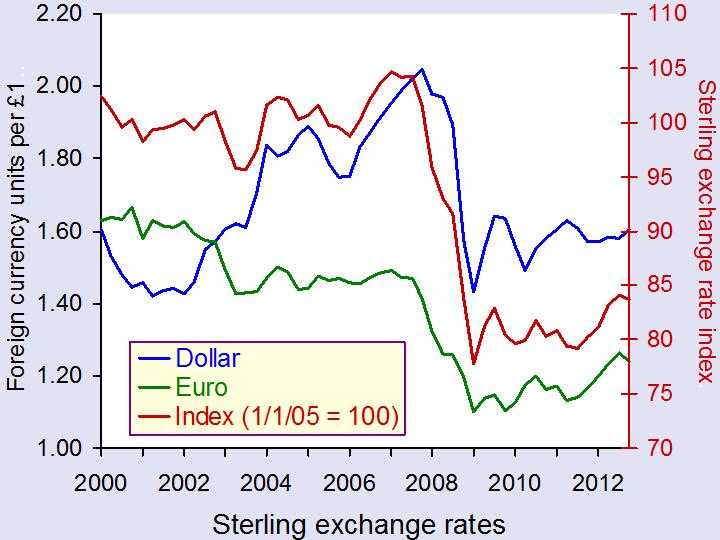 The exchange rate for sterling is determined in much the same way as the price of goods – by the interaction of demand and supply.
When factors change that cause residents abroad to want to hold more or fewer pounds, the demand curve for sterling will shift. If, instead, factors change that cause UK residents to want to buy more or less foreign currency, then the supply curve of sterling will shift. It is these two curves that determine the equilibrium exchange rate of sterling.
There are concerns at the moment that sterling is about to reach a peak, with expectations that the pound will weaken throughout 2013. But is a weakening exchange rate good or bad for the UK?
 With lower exchange rates, exports become relatively more competitive. This should lead to an increase in the demand for UK products from abroad. As exports are a component of aggregate demand, any increase in exports will lead to the AD curve shifting to the right and thus help to stimulate a growth in national output. Indeed, throughout the financial crisis, the value of the pound did fall (see chart above: click here for a PowerPoint) and this led to the total value of UK exports increasing significantly. However, the volume of UK exports actually fell. This suggests that whilst UK exporters gained in terms of profitability, they have not seen much of an increase in their overall sales and hence their market share.
Therefore, while UK exporters may gain from a low exchange rate, what does it mean for UK consumers? If a low exchange rate cuts the prices of UK goods abroad, it will do the opposite for the prices of imported goods in the UK. Many goods that UK consumers buy are from abroad and, with a weak pound, foreign prices become relatively higher. This means that the living standards of UK consumers will be adversely affected by a weak pound, as any imported goods buy will now cost more.
It’s not just the UK that is facing questions over its exchange rate. Jean-Claude Junker described the euro as being ‘dangerously high’ and suggested that the strength or over-valuation of the exchange rate was holding the eurozone back from economic recovery. So far the ECB hasn’t done anything to steer its currency, despite many other countries, including Japan and Norway having already taken action to bring their currencies down. Mario Draghi, the ECB’s president, however, said that ‘both the real and the effective exchange rate of the euro are at their long-term average’ and thus the current value of the euro is not a major cause for concern.
So, whatever your view about intervening in the market to steer your currency, there will be winners and losers. Now that countries are so interdependent, any changes in the exchange rate will have huge implications for countries across the world. Perhaps this is why forecasting currency fluctuations can be so challenging. The following articles consider changes in the exchange rate and the impact this might have.
A pounding for sterling in 2013? BBC News, Stephanomics, Stephanie Flanders (17/1/13)
UK drawn into global currency wars as slump deepens Telegraph, Ambrose Evans-Pritchard (16/1/13)
Foreign currency exchange rate predictions for GBP EUR, Forecasts for USD and NZD Currency News, Tim Boyer (15/1/13)
Euro still looking for inspiration, Yen firm Reuters (16/1/13)
Daily summary on USD, EUR, JPY, GBP, AUD, CAD and NZD International Business Times, Roger Baettig (16/1/13)
UK inflation bonds surge on Index as pound falls versus euro Bloomberg, Business News, Lucy Meakin (10/1/13)
Questions
- Which factors will cause an increase in the demand for sterling? Which factors will cause a fall in the supply of sterling?
- In the article by Stephanie Flanders from the BBC, loose monetary policy is mentioned as something which is likely to continue. What does this mean and how will this affect the exchange rate?
- Explain the interest- and exchange-rate transmission mechanisms, using diagrams to help your answer.
- If sterling continues to weaken, how might this affect economic growth in the UK? Will there be any multiplier effect?
- What is the difference between the volume and value of exports? How does this relate to profit margins?
- Why are there suggestions that the euro is over-valued? Should European Finance Ministers be concerned?
- Should governments or central banks intervene in foreign exchange markets?
- If all countries seek to weaken their currencies in order to make their exports more competitive, why is this a zero-sum game?