 UK Unemployment figures for the July to September period have just been published. Perhaps surprisingly, the rate has fallen to 7.8% from 8.0% in the previous 3-month period. What is more, there have been similar 0.2 percentage-point falls in each of the two 3-month periods prior to that (see chart below).
This would normally suggest that the economy has been growing strongly and faster than the growth in potential output. But, despite positive economic growth in quarter 3 (see A positive turn of events?), the economy has been experiencing a prolonged period of low or negative growth.
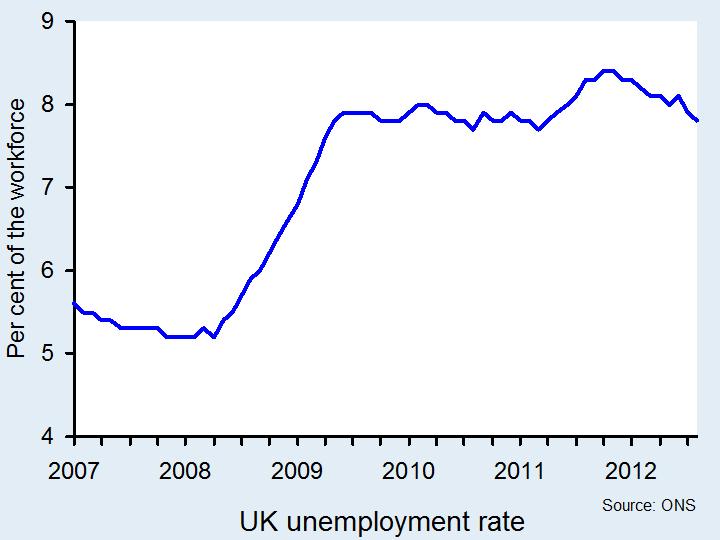
So what is the explanation for the fall in unemployment? (For a PowerPoint of the chart, click here)
One reason is a greater flexibility in the labour market than in previous recessions. People are more willing to accept below inflation wage increases, or even nominal wage cuts, in return for greater job security. Others are prepared to reduce their hours.
The other reason is a fall in productivity (i.e. output per hour worked). One explanation is that people are not working so hard because, with a lack of demand, there is less pressure on them to be productive; a similar explanation is that firms are ‘hoarding’ labour in the hope that the market will pick up again.
Another explanation is that employment growth has often occurred in the low productivity industries, such as labour-intensive service industries; another is that when people leave their jobs they are replace by less productive workers on lower wages; another is that workers are making do with ageing equipment, whose productivity is falling, because firms cannot afford to invest in new equipment. An range of possible explanations is given on page 33 of the Bank of England’s November 2012 Inflation Report.
But with many predicting that growth will be negative again in 2012 quarter 4, the fall in unemployment may not continue. Britain may join many other countries in Europe and experience rising unemployment as well as falling output.
Articles
Government hails fall in jobless total The Guardian, Hélène Mulholland (14/11/12)
UK unemployment figures: analysis The Guardian, Larry Elliott (14/11/12)
Jobless claims rise as Olympics effect wanes The Telegraph, Rachel Cooper and Louisa Peacock (14/11/12)
UK unemployment falls to 2.51 million, ONS says BBC News (14/11/12)
 Unemployment continuing to fall BBC News, Stephanie Flanders (14/11/12)
Britain’s recession: Harsh but fair? BBC News, Stephanie Flanders (17/10/12)
The UK productivity puzzle (cont’d) BBC News, Stephanie Flanders (20/9/12)
UK jobs: The plot thickens BBC News, Stephanie Flanders (15/8/12)
Data
Unemployment: the key UK data and benefit claimants for every constituency Guardian Data Blog
Labour Market Statistics, November 2012 ONS
Video Summary: Latest on the Labour Market, November 2012 ONS
Labour Productivity, Q2 2012 ONS
International Comparisons of Productivity, First estimates for 2011 ONS
Questions
- What possible explanation are there for the latest fall in unemployment?
- What has been happening to employment, both full time and part time?
- What are the different ways of measuring productivity? Why will they be affected differently by a fall in the average number of hours worked?
- Why might it be in firms’ interests to maintain the level of their workforce despite falling sales?
- Assume that there has been a fall in aggregate demand. Compare the resulting effect on consumption of (a) a fall in wages rates; (b) a rise in unemployment. How might the design of the benefit system affect the answer?
 With the winter fast approaching, consumers have already begun to stock up on warmer clothes. This has contributed towards consumer spending increasing faster in September than it has in the past 3 years. According to Visa Europe’s UK expenditure index, sales in August increased by 1.2pc, but in September they rose month-on-month by 3pc.
But whilst sales on the high-street increased, sales on-line and over the telephone declined. It seems that the recent decrease in temperature is just what the retail sector ordered, as people took to the high streets.
Furthermore, recent improvements in consumer income, together with lower inflation and rising employment have all contributed towards a growth in spending. However, as consumer confidence remains at a relatively low level, it is unlikely that the winter will bring much of a change to growth in the economy. The Chief Economist at Markit said:
However, consumer confidence remains historically low as uncertainty about the economy and job security persists, suggesting that the bounce in spending seen in the third quarter could be as good as it gets for the foreseeable future.
 Although the lower temperature has caused a boost in consumption, once people have made their ‘investment’ in warmer clothes, retail spending may once again decline. Hence the above comment by Markit, which suggests that further sustained increases in consumer spending may still be some way off.
The following few articles look at the latest data on retail spending.
UK consumer spending ‘rose in September’ BBC News (5/10/12)
Consumer spending increases by 3pc The Telegraph (5/10/12)
Consumer spending increases by 3% The Press Association (5/10/12)
UK retail sales: what the analysts say Guardian (20/9/12)
Online sales and wet weather boost John Lewis Scotsman, Peter Ranscombe (5/10/12)
Questions
- Which factors typically affect consumer spending?
- Using a diagram, illustrate the impact of this increase in consumption on national output and the price level.
- Is it possible that a multiplier effect may occur with the August and September rise in retail sales?
- Why is consumer confidence remaining low? Which components of aggregate demand does it affect?
- Explain why (a) lower inflation, (b) the colder weather and (c) rising employment have caused consumer spending to rise.
 Trade union action has been a feature of the British labour market over the past few years, as discussed in this first and second blog. With the government’s austerity measures still in place and ongoing issues over pension provision, there are many explosive issues that will undoubtedly be discussed at this year’s TUC Conference in Brighton.
We have already heard from numerous unions that strike action over the coming year is ‘inevitable’. With rising prices, static or even falling wages, reduced pension provision and increased contributions, the cost of living has become increasingly unaffordable for many members of the trade unions. Dave Prentis, the General Secretary of Unison said:
‘I think people have been pushed into a corner. They are moving into poverty … The threat is that if we can’t move forward in negotiations to find a way through it then we will move to industrial action. There is no doubt whatsoever that we can create disputes throughout next year.’
Although few would argue against the notion that the government’s finances are in a dire state and spending cuts together with tax rises are needed, the controversy seems to lie in exactly when these cuts should take place and how severe they should be. For many, cutting government spending and raising taxes whilst the economy is still in recession is asking for trouble. For others, it’s the right thing to do and everyone should play a part in helping to return government finances to a semblance of balance. The Labour government has traditionally supported trade unions, but even their leadership backed the government’s plan for pay restraint for public sector workers. This, together with the continuing debates over public sector pensions has clearly angered many public sector workers, thus creating this ‘inevitable’ industrial action over the coming year.
Unison and GMB have said that they will be working together in order to try to better pay and conditions for its members, by co-ordinating public-sector strikes around Spring next year. Co-ordinated strikes across a variety of sectors could create havoc for the economy. Not just disruption for the everyday person, but losses for businesses and the economy. A general strike has not taken place since 1926, but it is thought that TUC delegates will be voting on whether or not one should be planned. So, when faced with these inevitable strikes, should the government back down and cut back on austerity or stand up to them and suffer the disruption of a strike, whilst continuing on with bringing its budget back on track? The following articles look at the TUC Congress and the proposed strike action.
Public sector unions plan Spring strikes Guardian, Dan Milmo (9/9/12)
Trade union warns of further strikes Financial Times, Brian Groom (7/9/12)
Trade union officials gather for TUC Congress in Brighton BBC News, John Moylan (9/9/12)
Unite union leader warns of wave of public sector strikes Guardian, Dan Milmo (7/9/12)
Unison and GMB unions planning co-ordinated strikes over pay BBC News, Justin Parkinson (9/9/12)
TUC Conference 2012: a mixture of new and old Channel 4 News (9/9/12)
Government must stand up to these TUC bully tactics Express, Leo McKinstry (9/9/12)
Questions
- What is the purpose of a trade union?
- What is the difference between individual and collective bargaining? Why is collective bargaining likely to be more successful in achieving certain aims?
- If there is co-ordinated strike action, what are the likely costs for (a) the workers on strike (b) the non-striking workers (c) businesses and (d) the economy?
- What are the main issues being debated between unions and the government?
- Explain the economic reasoning behind Dave Prentis’ statement that people are being moved into poverty.
- Do you agree with strike action? Do you think it has any effect?
- When do you think is the right time to implement austerity measures? Has the government got it right? As always, make sure you explain your answer!!
 One problem for motorists at the moment is the cost of petrol, where prices have reached over 1.37p on average, as we considered in the blog It’s fuelling anger. However, another problem could soon materialise and that is no petrol. Back in 2000, there was massive disruption to the public with a fuel blockade and a similar thing could occur, following the ‘yes’ vote by fuel tank drivers in favour of strike action.
Over the past few years, strikes have occurred across a variety of industries and if this one did happen with no contingency plan in place, disruption would be significant to both private individuals and companies. Drivers from Unite (the trade union) supply over 90% of fuel to UK garages and so any strike could lead to the closure of up to 7,900 stations.
However, the government has begun to consider the worst case scenario, if talks do not work with plans to begin training army drivers. There are concerns that without these plans in place, disruption across the country may occur with supermarkets, garages and airports all facing fuel shortages. Those who have a job that relies on travel, or even those who simply use their cars or buses to get to work will also feel the effects. Other problems within the emergency services could also emerge, but the government has assured the public that their fuel would be prioritised. The following articles consider this issue.
Fuel strike drivers vote yes in row over conditions BBC News (26/3/12)
Plan for fuel strike, says Downing Street Financial Times, George Parker (27/3/12)
Talks urged to avert fuel tanker strike Independent, Andrew Woodcock and David Mercer (27/3/12)
Ed Miliband: Fuel strike must be avoided at all costs Telegraph, James Hall (27/3/12)
All striking tanker drivers want is responsible minimum standards Guardian, Len McCluskey (27/3/12)
Questions
- If a trade union bargains for higher wages, what is the likely effect on employment and unemployment?
- How might strike action by tankers affect businesses?
- Are there likely to be any adverse long term effects if strike action does occur over Easter?
- How could strike action affect a firm’s costs of production? Think in particular about those who rely on travel as part of the business.
- What other options are there to trade unions, besides striking? Assess the effectiveness of each of the options.
- If a shortage of petrol emerged, what would you expect to happen to its market price?
 Unemployment figures for the UK have been going in the wrong direction for some time. With consumer expenditure, investment and hence aggregate demand remaining low, job creation has been severely lacking. However, 2 pieces of news have emerged in the last couple of days, which as David Cameron said was ‘a massive confidence boost for the UK economy’. Tesco and Nissan have both announced the creation of thousands of new jobs.
Over the next 2 years, Tesco has said that it will create 20,000 new jobs through store improvement and the opening of new stores. Whilst it is not clear how many will be full-time, part-time or apprenticeship placements, it still represents net job creation. This huge investment represents what many are calling a ‘fight-back’ from Tesco, who issued its first profit warning in 20 years, following weak Christmas trading. That announcement slashed their shares by over £5bn and is perhaps partly responsible for this planned investment.
Despite this good news, criticisms have emerged that the major supermarkets are simply inflating the job creation figures and that the actual number of new jobs will be significantly less than the 20,000 suggested. This follows allegations made towards Asda, who claimed to have created 30,000 jobs. However, evidence from records at Companies House suggests that new job creation by the company was closer to 7,000. Whatever the true figure, it still means new jobs, which can only help UK unemployment data.
In addition to this, Nissan has also announced that it will be creating 2,000 new jobs, as it begins production on a new model at its Sunderland factory. The jobs will be created as part of a £125m investment, including a £9.3m grant from the government. This is especially good news, given the area where many of these jobs will emerge. The North East is a region that has been hit particularly hard by the recession and the grant from the government has come from its regional growth fund. Nissan has said that even in hard economic times, it is possible to sell cars, as long as they are competitively priced. Neither of the plans discussed above will create jobs immediately, but perhaps the key is that it creates confidence, which is a rarity in the UK with the current economic situation. The following articles consider these job creation plans and their wider implications.
Tesco plans to create 20,000 UK jobs over 2 years BBC News (5/3/12)
Tesco to create 20,000 jobs in UK fight-back Telegraph, Jamie Dunkley (6/3/12)
Tesco’s UK boss defends ‘new jobs’ claims Sky News (5/3/12)
Tesco to freshen up with 20,000 new staff Financial Times, Andrea Felsted (5/3/12)
Now Tesco creates 20,000 jobs – with pay Independent (9/5/11)
Nissan to build new car in Sunderland BBC News (6/3/12)
Nissan pledges 2,000 new jobs at North East plant Sky News, Gerard Tubb (6/3/12)
Nissan Invitation compact car set to create 2,000 jobs Telegraph, Roland Gribben and David Millward (6/3/12)
Nissan to create 2,000 new jobs by building compact car in Sunderland Guardian, Dan Milmo(6/3/12)
Questions
- Explain the process by which net job creation should provide a boost to the economy.
- Will these new jobs have any impact on the government’s budget deficit?
- Why is there concern that the supermarkets are inflating the employment creation figures?
- What type of unemployment has been created by the recession? Why have certain areas, such as the North East been affected so badly by the recession and austerity measures?
- Which factors could have led to Tesco’s weaker trading figures towards then end of 2011? Why did this lead to a £5bn loss in the value of the group’s shares?
- Nissan has said that cars can be sold as long as they are competitively priced. To what extent do you think price is the main competitive weapon in the market for cars and in the supermarket industry?
 UK Unemployment figures for the July to September period have just been published. Perhaps surprisingly, the rate has fallen to 7.8% from 8.0% in the previous 3-month period. What is more, there have been similar 0.2 percentage-point falls in each of the two 3-month periods prior to that (see chart below).