
The yen has been depreciating against the dollar and other currencies for several months. It fell from 100 yen = $0.97 in January 2021 to $0.61 by the end of July 2026 – a fall of 37%. This marked a 40-year low. But then, at the end of July it rallied and by 3 August the rate was 100 yen = $0.64 – a rise of nearly 5%. But why did this happen and what will be the implications for Japan and the wider world economy?
Why has the yen fallen so much since 2021?
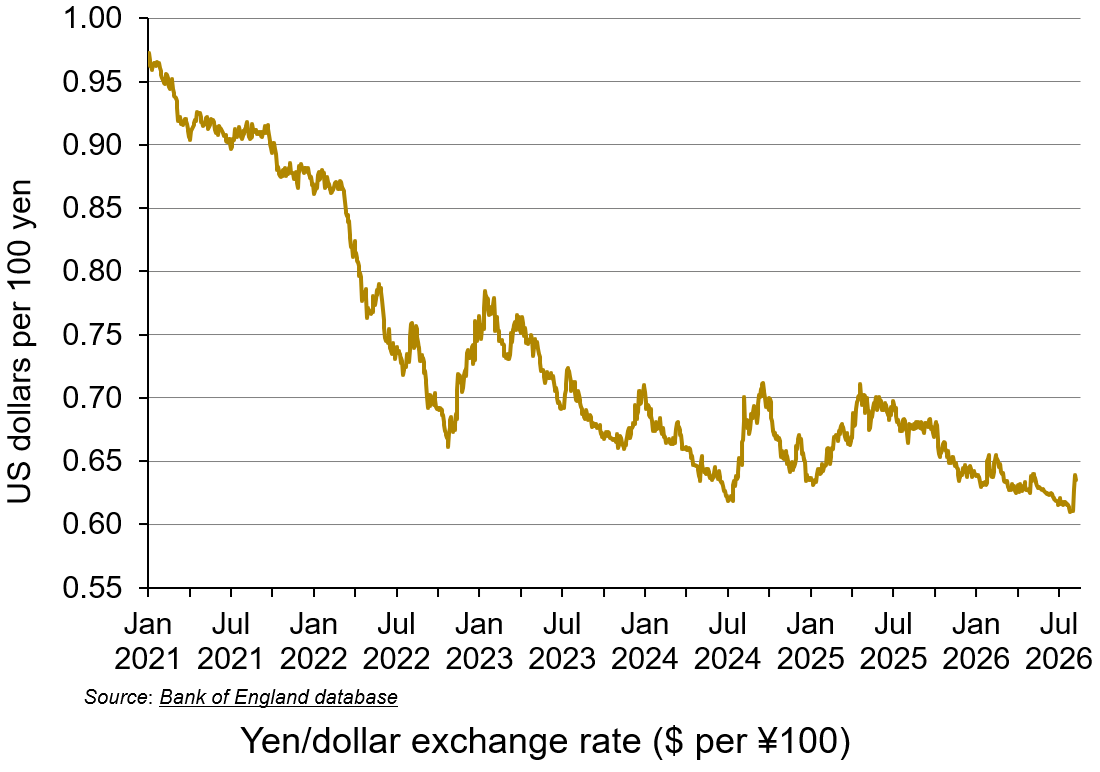 There have been two main drivers.
The first is fiscal policy. For many years, Japan has been pursuing expansionary fiscal policy in an attempt to stimulate the sluggish economy. This has led to large budget deficits and public-sector debt. Since 2020, general government gross debt has been around 255% of GDP, the largest of any high-income economy.
Recently, the Japanese government has adopted aggressive supplementary budgets to fund, among other things, fuel subsidies and public-private investment initiatives. This has involved the issuance of more government bonds to fund the necessary borrowing.
 Fiscal pressures have also increased becase of demography. A rapidly aging population and declining birth rates have required substantial public spending on healthcare, social security and pensions. Meanwhile, the tax-paying working-age population has declined as a proportion of total population.
On the plus side, unlike most highly indebted nations, over 90% of Japan’s debt is held domestically by Japanese residents, Japanese institutional investors, banks and the Bank of Japan (BoJ). This lowers the risk of default and hence the risk premium on Japanese bonds.
 The second driver is monetary policy. Interest rates have been kept low over many years, including periods of negative rates, as the BoJ has attempted to stimulate the economy. Low interest rates have sometimes been backed up with quantitative easing to increase money supply.
Since March 2024, however, there have been four interest rate increases. The latest was in June 2026 when the BoJ raised the short-term policy rate from 0.75% to 1.0% – the highest level since 1995. Despite this, interest rates have remained below those in other countries, and this contributed to the continuing fall of the yen.
A falling yen has helped to increase Japanese exports by making them more competitive, but more expensive imports have contributed to rising Japanese inflation.
Low interest rates have also stimulated the yen-dollar carry trade. This is where investors borrow money in yen at low interest rates, convert it into US dollars and invest it in higher-yielding US assets, typically US government bonds (‘Treasury bonds’). This borrowing in yen to buy dollars further contributed to the depreciation of the yen against the dollar.
Co-ordinated intervention
 In an attempt to raise the value of the yen, the Bank of Japan and the US Federal Reserve acted together – their first joint currency rescue operation since 2011. The BoJ spent tens of billions of dollars to buy yen; the US Treasury bought yen by selling euros. Prior to the intervention, global hedge funds held near-record short positions against the yen, meaning that they sold yen at a current price, agreeing to buy them back at a particular later date, hoping that the yen would fall in the meantime and that they would therefore make a profit. The sudden joint intervention forced these traders to buy back the yen to cut their losses before the rate rose further. This accelerated the yen’s appreciation.
But why did the USA join Japan in intervening? Japan is the largest foreign holder of US Treasuries ($1.1 trillion). The USA intervened to discourage Japanese investors from selling US Treasuries in order to raise cash, thereby pushing up US borrowing costs.
The rise in the yen was also encouraged by speculators who are expecting further interest rate rises from the BoJ to counter inflation and support public finances, driving domestic bond yields higher. This will lead to a narrowing of interest rates between Japan and other countries.
Effects on the Japanese economy
 If the yen continues to appreciate, this will help to reduce inflation by making imports cheaper and will help to ease cost-of-living pressures on Japanese consumers. Japan is heavily reliant on imported energy and raw materials.
However, the decline in the yen over recent years has provided a large boost to Japanese exports. A sharp reversal in this could severely affect exporters’ profits and have a serious negative impact on economic growth.
If the appreciation continues, it would lead to an unwinding of the carry trade. To prevent mounting currency losses, highly leveraged institutional investors would be forced to sell assets, such as US and other countries’ shares and bonds to buy back yen and pay off their debts. This potentially massive unwinding would be likely to create global market volatility and drive up interest rates.
Articles
- Yen holds gains after Japan, US confirm joint intervention, signal more action
- Yen surges to three-month peak, dollar pares losses after intervention
- US dollar weakens sharply against the Japanese yen after officials intervene in markets
- Yen hits three-month high after Trump helps prop up currency
- Why has Trump stepped in to prop up Japan’s currency?
- Why the U.S. stepped in after decades to prop up Japan’s yen — and what’s at stake
- Politics & Policy Analysis: How Bessent is pushing Warsh’s Fed to expand backstop for Japan’s yen defense
- Why Japan is propping up the yen – and why the US helped
- The Pros and Cons of a Strong Dollar
- Why the U.S. Stepped In to Prop Up Japan’s Yen Currency
- Why the U.S. Is Helping Prop Up Japan’s Weak Currency
- U.S.-Japan Intervention Triggers Yen Carry Trade Fears
- What top minds in markets are saying about the US intervention to prop up Japan’s currency
Reuters, Makiko Yamazaki and Leika Kihara (3/8/26)
Reuters, Chibuike Oguh (3/8/26)
ABC7 Eyewitness News, Mayuko Ono and Elaine Kurtenbach (3/8/26)
The Guardian, Graeme Wearden (3/8/26)
The Guardian, Jonathan Yerushalmy (3/8/26)
CNBC, Lee Ying Shan (3/8/26)
CNBC, Matt Peterson (3/8/26)
The Straits Times (4/8/26)
Johnston Investment Counsel (3/8/26)
Yahoo!Finance, Tiago Ventura (3/8/26)
The New York Times, Eshe Nelson (3/8/26)
The Chosun Daily, Lee Hai-woon (3/8/26)
Business Insider, Jennifer Sor (3/8/26)
Data
- Interest & exchange rates data
Bank of England
Questions
- What have been the benefits and costs to Japan of a depreciating exchange rate?
- Explain the carry trade.
- Why might the yen-dollar carry trade unwind and what would be the consequences for Japan and the USA?
- Find out what has happened to the exchange rate between the yen and the euro. Has this been driven by the carry trade?
- For what reasons might the yen (a) now continue rising; (b) resume depreciating?
- Find out what has happened to the yen/dollar exchange rate since this blog was written. Explain your findings.