 With many countries struggling to recover from the depression of the past few years, central banks are considering more and more doveish moves to kick-start lending. But with short-term interest rates in the USA, the UK and Japan close to zero, the scope for further cuts are limited. So what can central banks do?
The first thing that can be done is to adopt a higher inflation target or to accept inflation above target – at least for the time being. This could be accompanied by explicitly targeting GDP growth (real or nominal) or unemployment (see the blog from last December, Rethinking central bank targets).
 The second option is to increase quantitative easing. Although in a minority at the last MPC meeting, Mervyn King, the current Bank of England Governor, argued for a further £25 billion of asset purchases (bringing the total to £400bn) (see MPC minutes paragraph 39). It is highly likely that the MPC will agree to further QE at its next meeting in March. In Japan, the new governor of the Bank of Japan is expected to include asset purchases as part of the policy of monetary easing.
The third option is for the central bank to provide finance at below-market rates of interest directly to the banking sector specifically for lending: e.g. to small businesses or for house purchase. The Bank of England’s Funding for Lending Scheme is an example and the Bank is considering extending it to other financial institutions.
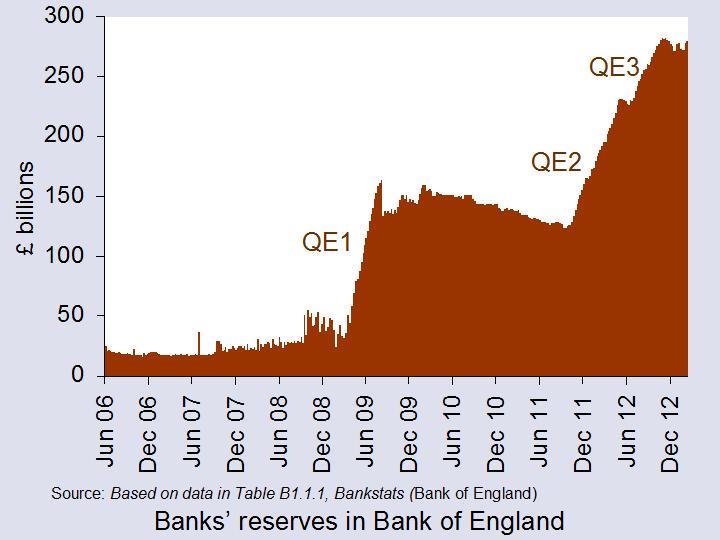 One other approach, mooted by the Bank of England’s Deputy Governor before the House of Commons Treasury Select Committee, is for negative interest rates paid on Banks’ reserves in the Bank of England. This would, in effect, be a fee levied on banks for keeping money on deposit. The idea would be to encourage banks to lend the money and not to keep excessive liquidity. As you can see from the chart, three rounds of quantitative easing have led to a huge increase in bank’s reserves at the Bank of England. (Click here for a PowerPoint of the chart.)
The following articles consider these various proposals and whether they will work to stimulate lending and thereby aggregate demand and economic recovery.
Central banks: Brave new words The Economist (23/2/13)
Phoney currency wars The Economist (16/2/13)
Analysis: Global central banks will keep taking it easy Reuters, Alan Wheatley (22/2/13)
Quantitative easing: the markets are struggling with a serious drug habi The Guardian, Larry Elliott (24/2/13)
Negative interest rates idea floated by Bank’s Paul Tucker BBC News (26/2/13)
Bank of England mulls negative interest rates Independent, Ben Chu (26/2/13)
BoE floats extending Funding for Lending to non-banks Mortgage Solutions, Adam Williams (26/2/13)
Funding for Lending Scheme failing to get banks lending Left Foot Forward, James Bloodworth (26/2/13)
Mortgage market boosted by lending schemes, says Redrow BBC News (26/2/13)
Widespread quantitative easing risks ‘QE wars’ and stagnation The Guardian, Nouriel Roubini (28/2/13)
Questions
- Consider each of the methods outlined above and their chances of success in stimulating aggregate demand.
- Go through each of the methods and consider the problems they are likely to create/have created.
- How important is it that monetary policy measures affect people’s expectations?
- What effects do the measures have on the distribution of income between borrowers and savers?
- What are annuities? How are these affected by policies of monetary easing?
- How has actual and anticipated Japanese monetary policy affected the exchange rate of the Japanese yen? How is this likely to affect the Japanese economy?
- Explain the sub-heading of the final article above, “When several major central banks pursue QE at the same time, it becomes a zero-sum game”. Do you agree?
 What lies ahead for economic growth in 2013 and beyond? And what policies should governments adopt to aid recovery? These are questions examined in four very different articles from The Guardian.
The first is by Nouriel Roubini, Professor of Economics at New York University’s Stern School of Business. He was one of the few economists to predict the collapse of the housing market in the USA in 2007 and the credit crunch and global recession that followed. He argues that continuing attempts by banks, governments and individuals to reduce debt and leverage will mean that the advanced economies will struggle to achieve an average rate of economic growth of 1%. He also identifies a number of other risks to the global economy.
 In contrast to Roubini, who predicts that ‘stagnation and outright recession – exacerbated by front-loaded fiscal austerity, a strong euro and an ongoing credit crunch – remain Europe’s norm’, Christine Lagarde, head of the IMF and former French Finance Minister, predicts that the eurozone will return to growth. ‘It’s clearly the case’, she says, ‘that investors are returning to the eurozone, and resuming confidence in that market.’ Her views are echoed by world leaders meeting at the World Economic Forum in Davos, Switzerland, who are generally optimistic about prospects for economic recovery in the eurozone.
The third article, by Aditya Chakrabortty, economics leader writer for The Guardian, looks at the policies advocated at the end of World War II by the Polish economist, Michael Kalecki and argues that such policies are relevant today. Rather than responding to high deficits and debt by adopting tough fiscal austerity measures, governments should adopt expansionary fiscal policy, targeted at expanding infrastructure and increasing capacity in the economy. That would have an expansionary effect on both aggregate demand and aggregate supply. Sticking with austerity will result in continuing recession and the ‘the transfer of wealth and power into ever fewer hands.’
 But while in the UK and the eurozone austerity policies are taking hold, the new government in Japan is adopting a sharply expansionary mix of fiscal and monetary policies – much as Kalecki would have advocated. The Bank of Japan will engage in large-scale quantitative easing, which will become an open-ended commitment in 2014, and is raising its inflation target from 1% to 2%. Meanwhile the Japanese government has decided to raise government spending on infrastructure and other government projects.
So – a range of analyses and policies for you to think about!
Risks lie ahead for the global economy The Guardian, Nouriel Roubini (21/1/13)
Eurozone showing signs of recovery, says IMF chief The Guardian, Graeme Wearden (14/1/13)
Austerity? Call it class war – and heed this 1944 warning from a Polish economist The Guardian, Aditya Chakrabortty (14/1/13)
Bank of Japan bows to pressure with ‘epoch-making’ financial stimulus The Guardian, Phillip Inman (22/1/13)
Questions
- What are the dangers facing the global economy in 2013?
- Make out a case for sticking with fiscal austerity measures.
- Make out a case for adopting expansionary fiscal policies alongside even more expansionary monetary policies.
- Is is possible for banks to increase their capital-asset and liquidity ratios, while at the same time increasing lending to business and individuals? Explain.
- What are the implications of attempts to reduce public-sector deficits and debt on the distribution of income? Would it be possible to devise austerity policies that did not have the effect you have identified?
- What will be the effect of the Japanese policies on the exchange rate of the yen with other currencies? Will this be beneficial for the Japanese economy?
For the past three years the Japanese yen has been appreciating against the US dollar and many other currencies. From the end of June 2007 to 14 September 2010, the yen appreciated from ¥100 = $0.81 to ¥100 = $1.20 (a 48% appreciation). Over the same period the yen exchange rate index rose from 113.3 to 172.4 (a 52% appreciation). The rising yen has been impeding Japan’s recovery as it has made its exports more expensive, while, at the same time, making imports cheaper and thus making it harder for domestic firms to compete.
Until 14 September 2010, the yen was freely floating. But on 15 September, the Japanese central bank decided to intervene by selling yen and buying dollars and other currencies.
But why had the yen risen so strongly? There are four main reasons.
The first is the persistent Japanese trade surpluses, partly stimulated by falling costs of production in Japan.
The second is the unwinding of the carry trade. Before the banking crisis of 2007/8, many banks and other financial institutions borrowed yen, given the low interest rates in Japan, and used the yen to purchase dollars and pounds, given the much higher interest rates in the USA and the UK. The effect of this ‘carry trade’, as it was known, was to drive up the exchange rates of the dollar and sterling and drive down the value of the yen. This encouraged further speculation as people sold yen in anticipation of further depreciation and purchased dollars and sterling in anticipation of further appreciation. With the banking crisis, however, short-term financial flows decreased and the current account became more important in determining exchange rates. The carry trade began to unwind and people began selling dollars and sterling and buying yen. What is more, towards the end of 2008, interest rates were reduced substantially in the USA and the UK in order to stimulate aggregate demand. The interest rate differential between Japan and the USA and UK virtually disappeared. This further encouraged the purchase of yen and the sale of dollars and sterling as carry trade investors began paying back their loans to Japan.The third reason for the appreciation of the yen is the actions of the Chinese who have used their surpluses to buy other currencies: originally mainly dollars, but increasingly yen.
The fourth reason is speculation. As the yen has risen, so increasingly people have bought yen in anticipation of further appreciation. But, of course, this speculation has brought about the very effect the speculators anticipated. Such speculation can be very powerful, given that some $4 trillion goes across the foreign exchange markets every day (see The inexorable growth of FOREX).
So will the intervention by the Bank of Japan be successful in causing the yen to depreciate? Or will the forces that drove up the yen prove impossible to resist? The following articles consider this question and also look at the factors that caused the yen to appreciate and its effects on the Japanese economy.
Articles
Japan’s $21b move to weaken yen may be futile Sydney Morning Herald (16/9/10)
Japan acts to weaken surging yen Guardian, Larry Elliott and Graeme Wearden (15/9/10)
Q+A: How is Japan judging success in yen intervention? Reuters, Hideyuki Sano and Charlotte Cooper (17/9/10)
Tokyo action puts brake on yen Financial Times, Peter Garnham (17/9/10)
It’s hard to keep a strong yen down CTV, Canada, Brian Milner (16/9/10)
Firm stance on yen stressed / Govt, BOJ strike decisive pose, but drastic action still required Daily Yomiuri, Japan, Tadashi Isozumi and Yomiuri Shimbun (16/9/10)
Bernanke Shadow of Easing Limits BOJ Success With Yen Weakness Bloomberg, Ron Harui and Joshua Zumbrun (17/9/10)
The Bank Of Japan Is Spitting In The Wind Wall Street Journal blogs: The Source, Nicholas Hastings (16/9/10)
 Japan intervenes in markets to combat rising yen BBC News, Mariko Oi (15/9/10)
Q&A: What’s moving the Japanese yen? BBC News (15/9/10)
Currency intervention’s mixed record of success BBC News, Russell Hotten (16/9/10)
Yen intervention: Because I Kan The Economist (16/9/10)
Beggar, then sneakily enrich, thy neighbour The Economist (15/9/10)
The yen and gold The Economist, Buttonwood (15/9/10)
Data
Dollar/yen exchange rate X-rates.com
Statistical Interactive Database – interest and exchange rates data Bank of England
Currencies BBC News
Currency converter Yahoo Finance
Questions
- Why has the Japanese yen appreciated so much over the past three years?
- What will be the effect of the Bank of Japan’s exchange market intervention on Japanese money supply? What will determine the size of this effect?
- Why might the Bank of Japan’s actions have been influenced by the anticipation of further quantitative easing by the US Federal Reserve Bank?
- What factors determine the likely success of foreign exchange market intervention by central banks?
- What will determine how speculators will react to the Bank of Japan’s actions?
- Discuss the following quote from the second The Economist article above: “A bit of inflation in Japan wouldn’t just be a good thing. It would be a really, really great thing. And if other countries react to Japan’s intervention by attempting to print and sell their own currencies in order to toss the deflationary potato to someone else, well then so much the better.”
- If all countries seek to achieve export-led growth, is this a zero-sum game?
- Why has the price of gold been rising?