 The Consumer Prices index (CPI) measures the rate of inflation and in October, this rate fell to 2.2%, bringing inflation to its lowest level since September 2012. For many, this drop in inflation came as a surprise, but it brings the rate much closer to the Bank of England’s target and thus reduces the pressure on changing interest rates.
The CPI is calculated by calculating the weighted average price of a basket of goods and comparing how this price level changes from one month to the next. Between September and October prices across a range of markets fell, thus bringing inflation to its lowest level in many months. Transport prices fell by their largest amount since mid-2009, in part driven by fuel price cuts at the big supermarkets and this was also accompanied by falls in education costs and food. The Mail Online article linked below gives a breakdown of the sectors where the largest price falls have taken place. One thing that has not yet been included in the data is the impact of the price rises by the energy companies. The impact of his will obviously be to raise energy costs and hence we can expect to see an impact on the CPI in the coming months, once the price rises take effect.
 With inflation coming back on target, pressures on the Bank of England to raise interest rates have been reduced. When inflation was above the target rate, there were concerns that the Bank of England would need to raise interest rates to cut aggregate demand and thus bring inflation down.
However, the adverse effect of this would be a potential decline in growth. With inflation falling to 2.2%, this pressure has been removed and hence interest rates can continue to remain at the record low, with the objective of stimulating the economy. Chris Williamson from Markit said:
The easing in the rate of inflation and underlying price pressures will provide greater scope for monetary policy to be kept looser for longer and thereby helping ensure a sustainable upturn in the economy … Lower inflation reduces the risk of the Bank of England having to hike rates earlier than it may otherwise prefer to, allowing policy to focus on stimulating growth rather than warding off rising inflationary pressures.
The lower rate of inflation also has good news for consumers and businesses. Wages remain flat and thus the reduction in the CPI is crucial for consumers, as it improves their purchasing power. As for businesses, a low inflation environment creates more certainty, as inflation tends to be more stable. Businesses are more able to invest with confidence, again benefiting the economy. Any further falls in the CPI would bring inflation back to its target level of 2% and then undoubtedly concerns will turn back to the spectre of deflation, though with the recent announcements in energy price rises, perhaps we’re getting a little ahead of ourselves! Though we only need to look to countries such as Spain and Sweden where prices are falling to realise that it is certainly a possibility. The following articles consider the data and the impact.
UK inflation falls in October: what the economists say The Guardian, Katie Allen (12/11/13)
British inflation hits 13-month low, easing pressure on central bank Reuters, David Milliken and William Schomberg (12/11/13)
UK inflation falls to 2.2% in October BBC News (1211/13)
UK inflation falls to 13-month low: reaction The Telegraph (12/11/13)
Fall in inflation to 2.2% welcome by government The Guardian, Katie Allen (12/11/13)
Inflation falls to lowest level for a year as supermarket petrol price war helps ease the squeeze on family finances Mail Online, Matt Chorley (12/11/13)
Inflation falls to its lowest level for more than a year as consumers benefit from petrol pump price war Independent, John-Paul Ford Rojas (12/11/13)
UK inflation slows to 2.2%, lowest level in a year Bloomberg, Scott Hamilton and Jennifer Ryan (12/11/13)
Are we facing deflation? Let’s not get carried away The Telegraph, Jeremy Warner (12/11/13)
Questions
- How is the CPI calculated?
- Use an AD/AS diagram to illustrate how prices have been brought back down. Is the reduction in inflation due to demand-side or supply-side factors?
- What are the benefits of low inflation?
- The Telegraph article mentions the possibility of deflation. What is deflation and why does it cause such concern?
- Explain why a fall in the rate of inflation eases pressure on the Bank of England.
- How does the rate of inflation affect the cost of living?
- Is a target rate of inflation a good idea?
 House prices in the UK are rising and the rise seems to be accelerating – at least until the latest month (August). They are now growing at an annualised rate of nearly 4%. This is the fastest rate for three years (see chart below: click here for a PowerPoint of the chart).
This may be worrying for Mark Carney, the Governor of the Bank of England, who is committed to avoiding a new house price bubble. 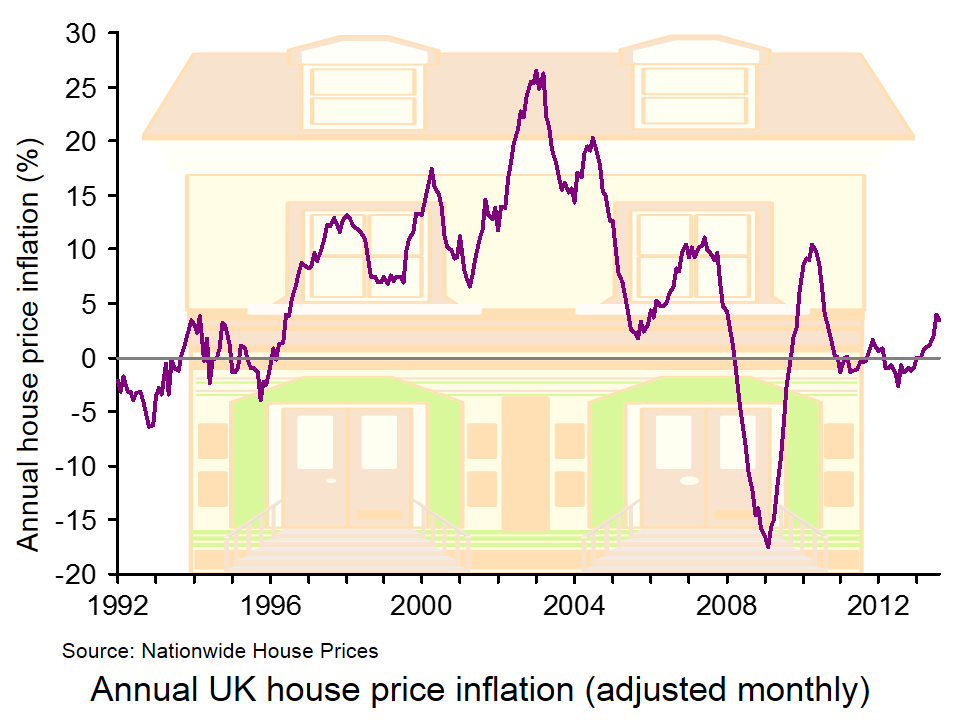 The problem is that, under the recently issued forward guidance, the Bank of England is set to retain the current historically low Bank rate of 0.5% until unemployment has fallen to 7%. But that could be some time – probably around two years.
So what can the Bank do in the meantime and what will be the consequences?
The following article from The Guardian looks at the options.
Article
How can the Bank of England prick the house price bubble? The Guardian, Patrick Collinson and Heather Stewart (30/8/13)
Data
Links to house price data The Economics Network, John Sloman
Questions
- What constitutes a housing price boom? Is the UK currently experiencing such a boom?
- What factors have led to the recent house price rises? Have these factors affected the demand or supply of houses (or both)?
- Who gains and who loses from rising house prices?
- Explain the policy adopted in New Zealand to curb house price inflation.
- Consider the merits of this option?
- Could borrowers find ways around this measure?
- Are there any other options open to the Bank of England?
 UK unemployment fell by 4000 to 2.51 million in second quarter of this year. But this was too small to have any significant effect on the unemployment rate, which remained at 7.8%.
According to the forward guidance issued by the Bank of England, Bank Rate will stay at 0.5%, barring serious unforeseen circumstances, until unemployment reaches 7%. So will this be soon?
There are good reasons to suggest that the answer is no. Reasons include the following:
(a) Many firms may choose to employ their part-time workers for more hours, rather than taking on extra staff, if the economy picks up.
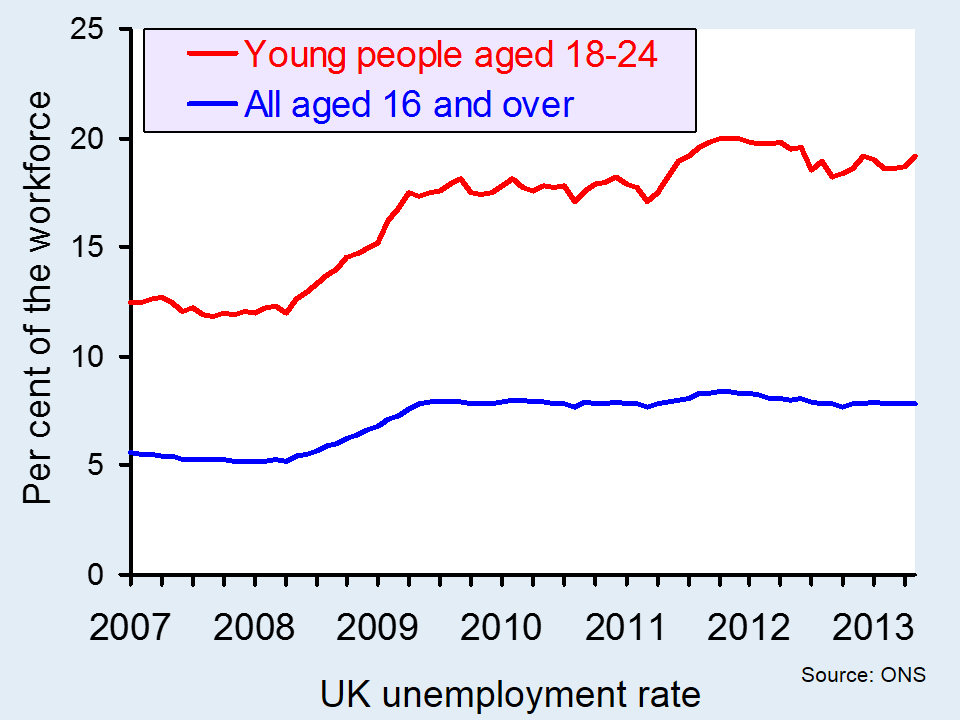 (b) The recovery is being fuelled by a rise in consumption, which, in turn, is being financed by people drawing on savings or borrowing more. The household saving ratio fell from 7.4% in 2012 Q1 to 4.2% in 2013 Q1. This trend will be unsustainable over the long run, especially as the Bank of England may see a rapid rise in borrowing/decline in saving as serious enough to raise interest rates before the unemployment rate has fallen to 7%.
(c) Despite the modest recovery, people’s average real incomes are well below the levels prior to the deep recession of 2008/9.
The articles consider the outlook for the economy and unemployment
Articles
UK unemployment holds steady at 7.8pc The Telegraph, Rebecca Clancy (14/8/13)
Unemployment rate is unlikely to fall sharply The Guardian, Larry Elliott (14/8/13)
UK unemployment falls by 4,000 to 2.51 million BBC News (14/8/13)
UK wages decline among worst in Europe BBC News (11/8/13)
Squeezing the hourglass The Economist (10/8/13)
 More people in work than ever before as unemployment falls Channel 4 News, Faisal Islam (14/8/13)
Data
Labour Market Statistics, August 2013 ONS
United Kingdom National Accounts, The Blue Book, 2013: Chapter 06: Households and Non-profit Institutions Serving Households (NPISH) ONS
Questions
- What factors determine the rate of unemployment?
- With reference to the ONS data in Labour Market Statistics, August 2013 above, what has happened to (a) the long-term unemployment rate; (b) the unemployment rate for 18–24 year olds?
- How would you define ‘living standards’?
- How is labour productivity relevant to the question of whether unemployment is likely to fall?
- How much have living standards fallen since 2008?
- Under what circumstances might the Bank of England raise interest rates before the rate of unemployment has fallen to 7%?
- Property prices are beginning to rise. Consider the effects of this and whether, on balance, a rise in property prices is beneficial.
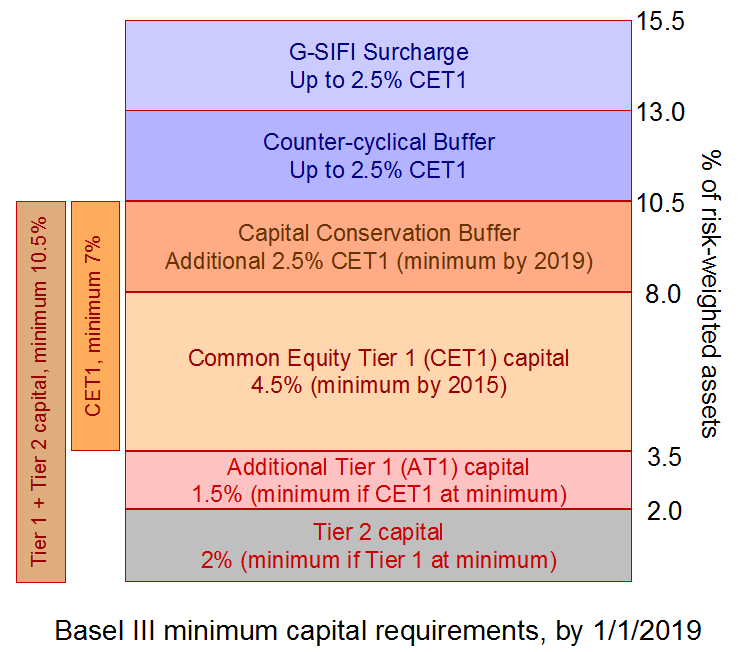
 Following the banking crisis of 2007/8 a new set of international banking regulations was agreed in 2010 by the Basel Committee on Banking Supervision. The purpose was to strengthen banks’ capital base. Under ‘Basel III’, banks would be required, in stages, to meet specific minimum capital adequacy ratios: i.e. minimum ratios of capital to (risk-weighted) assets. The full regulations would come into force by 2019. These are shown in the chart below.
The new Financial Policy Committee of the Bank of England has judged that some UK banks have insufficient ‘common equity tier 1 capital’. This is defined as ordinary shares in the bank plus the bank’s reserves. According to the Bank of England:
… the immediate objective should be to achieve a common equity tier 1 capital ratio, based on Basel III definitions and, after the required adjustments, of at least 7% of risk-weighted assets by end 2013. Some banks, even after the adjustments described above, have capital ratios in excess of 7%; for those that do not, the aggregate capital shortfall at end 2012 was around £25 billion.
Thus the banking system in the UK is being required, by the end of 2013, to meet the 7% ratio. This could be done, either by increasing the amount of capital or by reducing the amount of assets. The Bank of England is keen for banks not to reduce assets, which would imply a reduction in lending. Similarly, it does not want banks to increase reserves at the expense of lending. Either action could push the economy back into recession. Rather the Bank of England wants banks to raise more capital. But that requires sufficient confidence by investors.
 And the end of this year is not the end of the process. After that, further increases in capital will be required, so that by 2019 banks are fully compliant with Basel III. All this will make it difficult for certain banks to raise enough capital from investors. As far as RBS and the Lloyds Banking Group are concerned, this will make the prospect of privatising them more difficult. But that is what the government eventually wants. It does not want the taxpayer to have to find the extra capital. Re-capitalising the banks, or at least some of them, may prove difficult.
The following articles look at the implications of the FPC judgement and whether strengthening the banks will strengthen or weaken the rest of the economy.
Articles
Financial policy committee identifies £25bn capital shortfall in UK banks The Guardian, Jill Treanor (27/3/13)
Banks Told To Raise Capital By Financial Policy Committee To Cushion Against A Crisis Huffington Post (27/3/13)
UK banks’ £25bn shortfall: positive for banks, negative for BoE credibility, Sid Verma (27/3/13)
Doubts over Bank of England’s £25bn confidence game The Telegraph, Harry Wilson (27/3/13)
Bank of England tells banks to raise £25bn BBC News (27/3/13)
Q&A: Basel rules on bank capital – who cares? Laurence Knight (13/9/10)
U.K. Banks Seen Avoiding Share Sales After BOE Capital Review Bloomberg Businessweek, Gavin Finch and Howard Mustoe (27/3/13)
Banks Cut Basel III Shortfall by $215 Billion in Mid-2012 Bloomberg (19/3/13)
Will strengthening banks weaken the economy? BBC News, Robert Peston (27/3/13)
Bank of England News Release
Financial Policy Committee statement from its policy meeting, 19 March 2013 Bank of England (27/3/13)
Questions
- Explain the individual parts of the chart.
- What do you understand by risk-weighted assets?
- Distinguish between capital adequacy ratios and liquidity ratios.
- What could the banks do to increase their capital adequacy ratios? Compare the desirability of each method.
- If all banks around the world were Basel III compliant, would this make another global banking crisis impossible?
 With many countries struggling to recover from the depression of the past few years, central banks are considering more and more doveish moves to kick-start lending. But with short-term interest rates in the USA, the UK and Japan close to zero, the scope for further cuts are limited. So what can central banks do?
The first thing that can be done is to adopt a higher inflation target or to accept inflation above target – at least for the time being. This could be accompanied by explicitly targeting GDP growth (real or nominal) or unemployment (see the blog from last December, Rethinking central bank targets).
 The second option is to increase quantitative easing. Although in a minority at the last MPC meeting, Mervyn King, the current Bank of England Governor, argued for a further £25 billion of asset purchases (bringing the total to £400bn) (see MPC minutes paragraph 39). It is highly likely that the MPC will agree to further QE at its next meeting in March. In Japan, the new governor of the Bank of Japan is expected to include asset purchases as part of the policy of monetary easing.
The third option is for the central bank to provide finance at below-market rates of interest directly to the banking sector specifically for lending: e.g. to small businesses or for house purchase. The Bank of England’s Funding for Lending Scheme is an example and the Bank is considering extending it to other financial institutions.
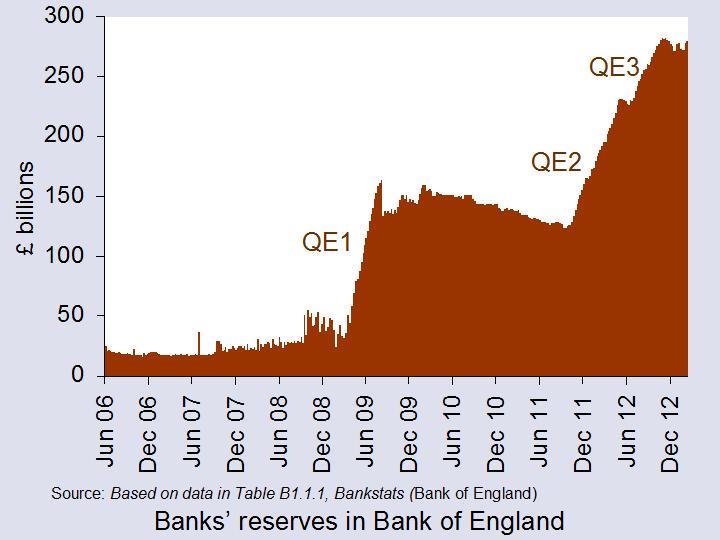 One other approach, mooted by the Bank of England’s Deputy Governor before the House of Commons Treasury Select Committee, is for negative interest rates paid on Banks’ reserves in the Bank of England. This would, in effect, be a fee levied on banks for keeping money on deposit. The idea would be to encourage banks to lend the money and not to keep excessive liquidity. As you can see from the chart, three rounds of quantitative easing have led to a huge increase in bank’s reserves at the Bank of England. (Click here for a PowerPoint of the chart.)
The following articles consider these various proposals and whether they will work to stimulate lending and thereby aggregate demand and economic recovery.
Central banks: Brave new words The Economist (23/2/13)
Phoney currency wars The Economist (16/2/13)
Analysis: Global central banks will keep taking it easy Reuters, Alan Wheatley (22/2/13)
Quantitative easing: the markets are struggling with a serious drug habi The Guardian, Larry Elliott (24/2/13)
Negative interest rates idea floated by Bank’s Paul Tucker BBC News (26/2/13)
Bank of England mulls negative interest rates Independent, Ben Chu (26/2/13)
BoE floats extending Funding for Lending to non-banks Mortgage Solutions, Adam Williams (26/2/13)
Funding for Lending Scheme failing to get banks lending Left Foot Forward, James Bloodworth (26/2/13)
Mortgage market boosted by lending schemes, says Redrow BBC News (26/2/13)
Widespread quantitative easing risks ‘QE wars’ and stagnation The Guardian, Nouriel Roubini (28/2/13)
Questions
- Consider each of the methods outlined above and their chances of success in stimulating aggregate demand.
- Go through each of the methods and consider the problems they are likely to create/have created.
- How important is it that monetary policy measures affect people’s expectations?
- What effects do the measures have on the distribution of income between borrowers and savers?
- What are annuities? How are these affected by policies of monetary easing?
- How has actual and anticipated Japanese monetary policy affected the exchange rate of the Japanese yen? How is this likely to affect the Japanese economy?
- Explain the sub-heading of the final article above, “When several major central banks pursue QE at the same time, it becomes a zero-sum game”. Do you agree?
 The Consumer Prices index (CPI) measures the rate of inflation and in October, this rate fell to 2.2%, bringing inflation to its lowest level since September 2012. For many, this drop in inflation came as a surprise, but it brings the rate much closer to the Bank of England’s target and thus reduces the pressure on changing interest rates.
 With inflation coming back on target, pressures on the Bank of England to raise interest rates have been reduced. When inflation was above the target rate, there were concerns that the Bank of England would need to raise interest rates to cut aggregate demand and thus bring inflation down.