 Europe’s largest economy is Germany and the prospects and growth figures of this country are crucial to the growth of the Eurozone as a whole. The EU is a key trading partner for the UK and hence the growth data of Germany and in turn of the Eurozone is also essential in creating buoyant economic conditions within our borders. The bad news is that the economic growth forecast for Germany has been cut by the German government.
The German government had previously estimated that the growth rate for this year would be 1.8%, but the estimate has now been revised down to 1.2% and next year’s growth rate has also been revised downwards from 2% to 1.3%. Clearly the expectation is that low growth is set to continue.
Whenever there are changes in macroeconomic variables, a key question is always about the cause of such change, for example is inflation caused by demand-pull or cost-push factors. The German government has been quick to state that the lower growth rates are not due to internal factors, but have been affected by external factors, in particular the state of the global economy. As such, there are no plans to make significant changes to domestic policy, as the domestic economy remains in a strong position. The economy Minister said:
“The German economy finds itself in difficult external waters … Domestic economic forces remain intact, with the robust labour market forming the foundation … As soon as the international environment improves, the competitiveness of German companies will bear fruit and the German economy will return to a path of solid growth … [for this reason there is] no reason to abandon or change our economic or fiscal policy.”
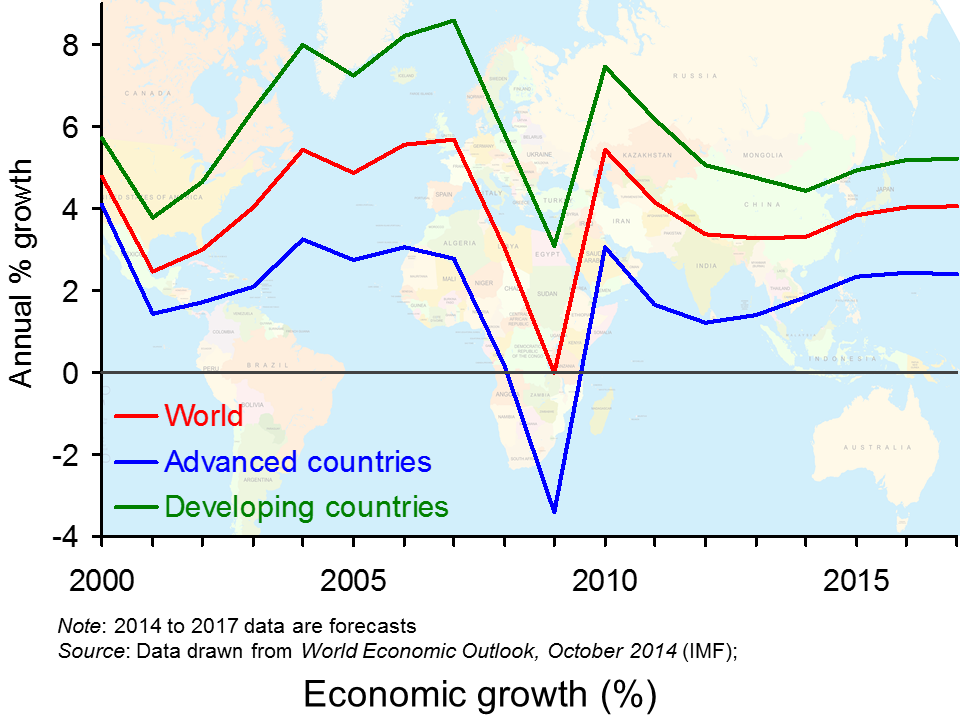 The global picture remains relatively weak and while some economies, including the UK, have seen growth pick up and unemployment fall, there are concerns that the economic recovery is beginning to slow. With an increasingly interdependent world, the slowing down of one economy can have a significant impact on the growth rate of others. If country A begins to slow, demand for imports will fall and this means a fall in the demand for exports of country B. For countries that are dependent on exports, such as Germany and China, a fall in the demand for exports can mean a big decline in aggregate demand and in August, Germany saw a 5.8% drop in exports.
Adding to the gloom is data on inflation, suggesting that some other key economies have seen falls in the rate of inflation, including China. The possibility of a triple-dip recession for the Eurozone has now been suggested and with its largest economy beginning to struggle, this suggestion may become more real. The following articles consider the macroeconomic picture.
Articles
Germany cuts growth forecasts amid recession fears, as Ireland unveils budget The Guardian, Graeme Wearden (14/10/14)
As cracks in its economy widen, is Germany’s miracle about to fade? The Observer, Philip Oltermann (19/10/14)
Why the German economy is in a rut The Economist (21/10/14)
Germany’s flagging economy: Build some bridges and roads, Mrs Merkel The Economist (18/10/14)
Germany cuts 2014 growth forecast from 1.8% to 1.2% BBC News (14/10/14)
IMF to cut growth forecast for Germany – der Spiegel Reuters (5/10/14)
Fears of triple-dip eurozone recession, as Germany cuts growth forecast The Guardian, Phillip Inman (15/10/14)
Germany slashes its economic forecasts Financial Times, Stefan Wagstyl (14/10/14)
 Merkel vows austerity even as growth projection cut Bloomberg, Brian Parkin, Rainer Buergin and Patrick Donahue (14/10/14)
Is Europe’s economic motor finally stalling? BBC News, Damien McGuinness (17/10/14)
Why Germany won’t fight deflation BBC News, Robert Peston (16/10/14)
Data
World Economic Outlook Database IMF (15/10/14)
World Economic Outlook IMF (October 2014)
Questions
- How do we measure economic growth and is it a good indicator of the state of an economy?
- What are the key external factors identified by the Germany government as the reasons behind the decline in economic growth?
- Angela Merkel has said that austerity measures will continue to balance the budget. Is this a sensible strategy given the revised growth figures?
- Why is low inflation in other economies further bad news for those countries that have seen a decline or a slowdown in their growth figures?
- Why is interdependence between nations both a good and a bad thing?
- Using AS and AD analysis, illustrate the reasons behind the decline German growth. Based on your analysis, what might be expected to happen to some of the other key macroeconomic variables in Germany and in other Eurozone economies?
 Investment is essential for the growth of any economy, but none more so for an economy recovering from a severe downturn, such as the UK. Not only will it bring in much needed money and then create jobs for UK residents, but it will also continue to build ties between the UK and the world’s fastest growing economy.
George Osborne has been in China promoting business opportunities for investment in the UK and one such investment is into Manchester Airport. The ‘Airport City’ Project will be a combined effort, or a Joint Venture, between the Greater Manchester Pension Fund, the UK’s Carillion Plc and Beijing Construction Engineering Group. The plan is to create offices, hotels, warehouses and manufacturing firms, bringing in thousands of jobs in the process, thus providing a much needed boost to the British economy. Britain is already one of the top nations attracting Chinese investment, with more than double the amount of any other European nation. George Osborne is clearly in favour of further improving business ties with China, saying:
I think it shows that our economic plan of doing more business with China and also making sure more economic activity in Britain happens outside the City of London is working…That’s good for Britain and good for British people.
 However, the benefit of such investment from China into the UK, is not just of benefit to our domestic economy. China will also reap benefits from its involvement in projects, such as the development of Manchester’s airport. The Managing Director of BCEG, Mr Xing Yan, said:
To be included in such an interesting and unique development is a real honour…We see our involvement in Airport City as an extension of the memorandum of understanding between China and the UK, where we have been looking to further explore joint infrastructure opportunities for some time.
The airport investment by China is only one of many of its recent forays into the UK economy. Other investments include plans to rebuild London’s Crystal Palace and plans to create a third financial district near London’s City Airport.
Some may see more Chinese involvement in UK business as a threat, but for most it is viewed as an opportunity. An opportunity that both Boris Johnson and George Osborne will undoubtedly exploit as far as possible, with the hope that it will generate income, employment and growth. The following articles consider this investment opportunity.
Manchester Airport Group announces jobs boost The Telegraph, David Millward (13/10/13)
China’s BCEG joins UK Manchester airport joint venture Reuters (13/10/13)
Manchester Airport to receive investment from China BBC News (13/10/13)
George Osborne hails China’s airport investment The Telegraph (13/10/13)
Chinese group in $1.2bn British airport development deal The Economic Times (13/10/13)
China in £800m Manchester airport deal Financial Times, Elizabeth Rigby and Lucy Hornby (13/10/13)
Boris and Osborne in China to push trade Sky News, Mark Stone (13/10/13)
What does China own in Britain? BBC News (14/10/13)
Questions
- What is a joint venture? What are the advantages and disadvantages of a joint venture relative to other business structures?
- How important are political ties with China?
- Do you view Chinese investment in the UK as an opportunity or a threat? Make a list for each side of the argument, ensuring you offer explanations for each reason.
- What macroeconomic benefits will the development of the Manchester Airport bring to the city?
- Will there be wider economic benefits to the rest of the UK, despite the investment being located in Manchester?
- Using the AD/AS model, illustrate and explain why investment is so important to the recovery of the UK economy.
 If aggregate demand were to expand, would there be sufficient spare capacity to allow aggregate supply to expand to meet the additional demand? This is the question addressed by the podcast and article below.
If there is plenty of spare capacity, policies to increase aggregate demand could help to take up the slack and thereby achieve economic growth – at least as long as spare capacity remains. In other words, in the short run the aggregate supply curve may be horizontal or only gently upward sloping at the current point of intersection with the aggregate demand curve. This is illustrated by point a in the diagram. A rightward shift in the aggregate demand curve would cause a movement along the aggregate supply curve to a new higher level of real national income (Y).
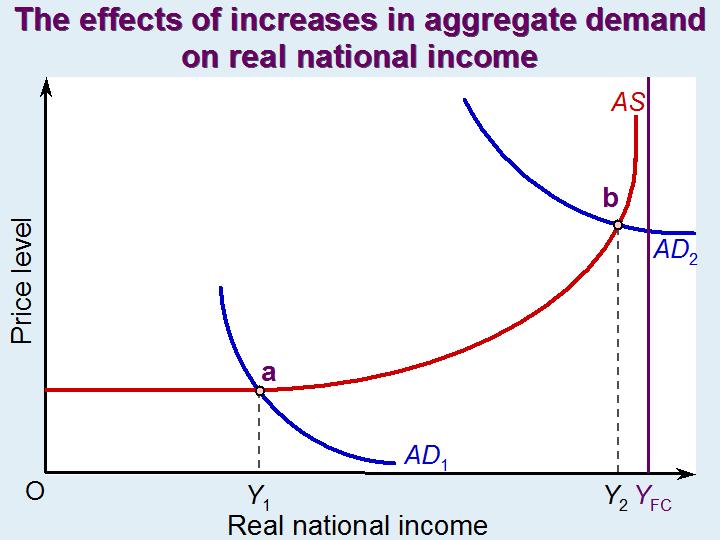
If, however, there is little or no spare capacity, an increase in nominal aggregate demand is likely to be purely inflationary, or virtually so. This would the case at point b in the diagram. Real national income cannot expand beyond the full-capacity level, YFC. Under such circumstances, any attempt by the government to stimulate economic growth should focus on the supply side and attempt to shift the aggregate supply curve to the right. Examples of supply-side policy include incentives to encourage research and development, incentives for the private sector to invest in new capacity and direct public investment in infrastructure.
Unemployment is not just caused by a lack of aggregate demand relative to aggregate supply. It may be the result of a mismatching of labour supply with the demand for labour. People may have the wrong qualifications or not be where the jobs are. Unemployment may co-exist with quite high levels of vacancies. There may be vacancies for highly qualified scientists, technicians or craftspeople and unemployment of people with low skills or skills no longer in high demand. The same may apply to capital equipment. There may be a shortage of high-tech equipment or equipment to produce goods in high demand and redundant older equipment or equipment in areas of declining demand.
Part of a comprehensive set of policies to tackle unemployment and achieve economic growth would be to focus on the whole balance of the economy and the matching of the demand and supply of inputs.
Podcast
Is there ‘spare capacity’ in the economy? BBC Today Programme, Evan Davis and Andrew Sentance (4/12/12)
Article
OBR’s supply pessimism could be the ruin of this government The Telegraph, Roger Bootle (25/11/12)
Data
Claimant count and vacancies dataset ONS (14/11/12)
Labour Market Statistics, November 2012 ONS (14/11/12)
Actual weekly hours worked ONS (14/11/12)
Usual weekly hours worked ONS (14/11/12)
Questions
- Distinguish between ‘unemployment’, ‘underemployment’ and ‘disguised unemployment’?
- To what extent does the level of unemployment provide a good measure of spare capacity?
- Is the UK economy suffering from a deflationary gap? If so, how would you measure the size of that gap?
- If there is substantial spare capacity, is expansionary fiscal policy the best means of achieving economic growth?
- What policies are likely to have both a positive supply-side effect and a positive demand-side effect?
- What constraints does the government face in attempting to boost aggregate demand?
- Why might policies designed to stimulate aggregate demand also increase supply capacity?
- What policies would you recommend for tackling the mismatching of the demand and supply of inputs?
 Many developing Asian countries have experienced rapid and yet relatively stable economic growth over a number of years. In other words, this has not been a short-term unsustainable boom associated with the expansionary phase of the business cycle – with aggregate demand expanding more rapidly than aggregate supply. Rather it is the result of a rapid growth in aggregate supply.
Over the period from 2000 to 2011, several Asian countries experienced average annual growth rates of over 4% and some, such as China and India, much more than that, as the following table shows. The table also shows forecasts for the period from 2012 to 2017. The high forecast growth rates are based on a continuing rapid growth in aggregate supply as the countries invest in infrastructure and adopt technologies, many of which have already been developed elsewhere.
Average annual economic growth rates
|
2000–11 |
2012–17 |
| China |
10.2 |
8.4 |
| India |
7.2 |
6.3 |
| Lao |
7.1 |
7.9 |
| Vietnam |
7.1 |
6.5 |
| Indonesia |
5.2 |
6.5 |
| Malaysia |
5.0 |
4.9 |
| Philippines |
4.7 |
4.9 |
| Thailand |
4.0 |
5.1 |
 Europe’s largest economy is Germany and the prospects and growth figures of this country are crucial to the growth of the Eurozone as a whole. The EU is a key trading partner for the UK and hence the growth data of Germany and in turn of the Eurozone is also essential in creating buoyant economic conditions within our borders. The bad news is that the economic growth forecast for Germany has been cut by the German government.