 Here are two thought-provoking articles from The Guardian. They look at macroeconomic policy failures and at the likely consequences.
In first article, Larry Elliott, the Guardian’s Economics Editor, argues that Keynesian expansionary fiscal and monetary policy by the USA has allowed it to achieve much more rapid recovery than Europe, which, by contrast, has chosen to follow fiscal austerity policies and only recently mildly expansionary monetary policy through a belated QE programme.
In the UK, the recovery has been more significant than in the eurozone because of the expansionary monetary policies pursued by the Bank of England in its quantitative easing programme. ‘And when it came to fiscal policy, George Osborne quietly abandoned his original deficit reduction targets when the deleterious impact of an over-aggressive austerity strategy became apparent.’
So, according to Larry Elliott, Europe should ease up on austerity and governments should invest more though increased borrowing.
‘This is textbook Keynesian stuff. Unemployment is high, which means businesses are reluctant to invest. The lack of investment means that demand for new loans is weak. The weakness of demand for loans means that driving down the cost of borrowing through QE will have little impact. Therefore, it is up to the state to break into the vicious circle by investing itself, something it can do cheaply and – because there are so many people unemployed and businesses working well below full capacity – without the risk of inflation.’
In the second article, Paul Mason, the Economics Editor at Channel 4 News, points to the large increases in both public- and private- sector  debt since 2007, despite the recession. Such debt, he argues, is becoming unsustainable and hence the world could be on the cusp of another crash.
Mason quotes from the Bank for International Settlements Quarterly Review September 2015 – media briefing. In this briefing, Claudio Borio,
Head of the Monetary & Economic Department, argues that:
‘Since at least 2009, domestic vulnerabilities have developed in several emerging market economies (EMEs), including some of the largest, and to a lesser extent even in some advanced economies, notably commodity exporters. In particular, these countries have exhibited signs of a build-up of financial imbalances, in the form of outsize credit booms alongside strong increases in asset prices, especially property prices, supported by unusually easy global liquidity conditions. It is the coincidence of the reversal of these booms with external vulnerabilities that should be watched most closely.’
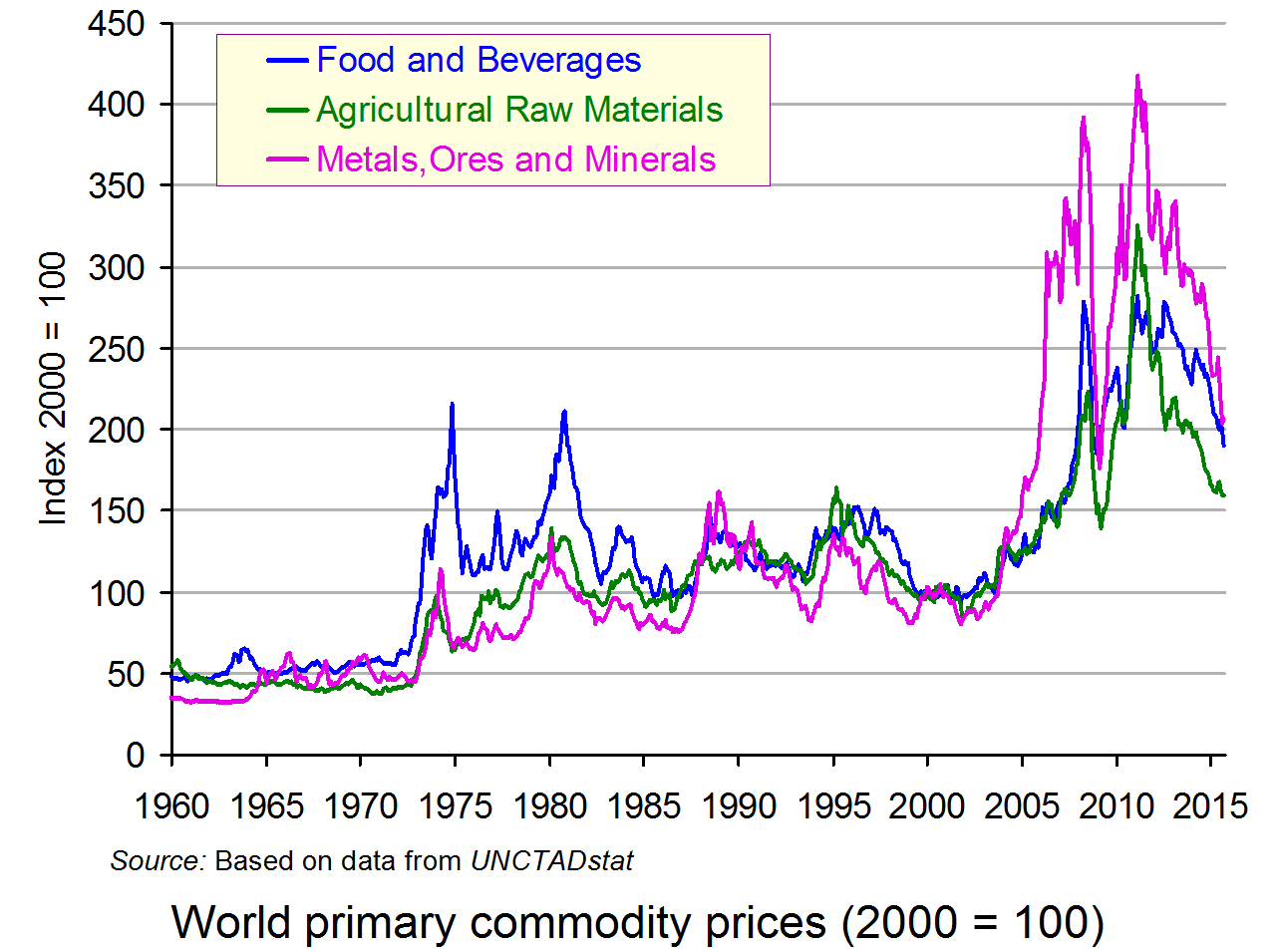 We have already seen a fall in commodity prices, reflecting the underlying lack of demand, and large fluctuations in stock markets. The Chinese economy is slowing markedly, as are several other EMEs, and Europe and Japan are struggling to recover, despite their QE programmes. The USA is no longer engaging in QE and there are growing worries about a US slowdown as growth in the rest of the world slows. Mason, quoting the BIS briefing, states that:
‘In short, as the BIS economists put it, this is “a world in which debt levels are too high, productivity growth too weak and financial risks too threatening”. It’s impossible to extrapolate from all this the date the crash will happen, or the form it will take. All we know is there is a mismatch between rising credit, falling growth, trade and prices, and a febrile financial market, which, at present, keeps switchback riding as money flows from one sector, or geographic region, to another.’
So should there be more expansionary policy, or should rising debt levels be reduced by tighter monetary policy? Read the articles and then consider the questions.
I told you so. Obama right and Europe wrong about way out of Great Recession The Guardian, Larry Elliott (1/11/15)
Apocalypse now: has the next giant financial crash already begun? The Guardian, Paul Mason (1/11/15)
Questions
- To what extent do the two articles (a) agree and (b) disagree?
- How might a neo-liberal economist reply to the argument that what is needed is more expansionary fiscal and monetary policies?
- What is the transmission mechanism whereby quantitative easing affects real output? Is it a reliable mechanism for policymakers?
- What would make a financial crash less likely? Is this something that governments or central banks can influence?
- Why has productivity growth been so low in many countries? What would increase it?
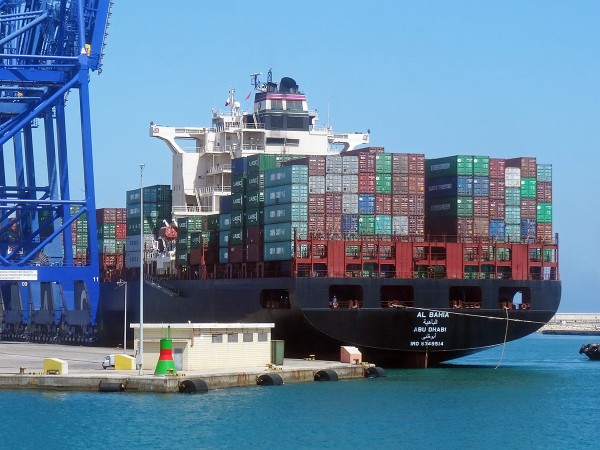 Economic growth is vital to an economy: it helps to create jobs and is crucial in stimulating confidence, both for businesses and consumers. Growth comes from various sources, both domestic and external, and so for each individual country it’s not just its growth rate that is important, but the growth rates of other countries, in particular those it trades with.
Recent data suggest that the global economy could be on the downturn and here we consider three countries/continents.
The US economy has been doing relatively well and we saw discussion by the Federal Reserve as to whether the economy was in a position to be able to handle an increase in interest rates. Although rates didn’t rise, there was a general consensus that a rate rise would not significantly harm the economy. However, perhaps those opinions may now be changing with the latest information regarding US growth. In the second quarter of 2015, growth was recorded at 3.9%, but according to the Department of Commerce, it fell to 1.5% for the third quarter. Though it’s still a solid growth rate, especially compared to other economies, it does represent a significant fall from quarter to quarter.
Many analysts suggest that this slowing is just a blip, partly the result of running down stocks, but it’s also a trend that has occurred in the UK. Although the fall in growth in the UK (see series IHYR) has been less than in the USA, it is still a fall. Annual growth was recorded at 2.7% in quarter 1, but fell to 2.4% in quarter 2 and to 2.3% in quarter 3 (with GDP in quarter 3 only 0.5% higher than in quarter 2). A big cause of this slowdown in growth has been a fall in manufacturing output and it is the service sector that prevented an even larger slowdown.
And it’s not just the West that is experiencing declining growth. The IMF has warned of a slowdown in economic growth in Africa. Although the absolute annual rate of growth at 3.75% is high compared to the UK, it does represent the slowest rate of growth in the past six years. One key factor has been the lower oil prices. Although this has helped to stimulate consumer spending in many countries, it has hit oil-producing countries.
With some of the big players experiencing slowdowns, world economic growth may be taking something of a dive. The Christmas period in many countries is when companies will make significant contributions to their annual sales, and this year these sales are going to be vital. The following articles consider the slowdowns in growth around the world.
Articles
US growth slows despite spending free Financial Times, Sam Fleming and Richard Blackden (29/10/15)
US economic growth slows in third quarter as businesses cut back The Guardian, Dominic Rushe (30/10/15)
US economic growth slows sharply BBC News (29/10/15)
US Q3 gross domestic product up 1.5% vs 1.6% growth expected CNBC, Reuters (29/10/15)
US growth cools in third quarter Wall Street Journal, Eric Morath (29/10/15)
UK economic growth slows to 0.5% in third quarter BBC News (27/10/15)
GDP growth in the UK slows more than expected to 0.5% The Guardian, Julia Kollewe (27/1015)
UK growth slows as construction and manufacturing output shrinks The Telegraph, Szu Ping Chan (27/10/15)
UK economy loses steam as GDP growth slows to 0.5% Financial Times, Ferdinando Giugliano (27/10/15)
No UK growth without services BBC News, Robert Peston (27/10/15)
IMF warns of African economic slowdown BBC News (27/10/15)
African growth feels the strain from China’s slowdown Financial Times, Andrew England (27/10/15)
Tax credits: George Osborne ‘comfortable’ with ‘judgement call’ BBC News (22/10/15)
IMF revises down Sub-Saharan Africa 2015 growth Wall Street Journal, Matina Stevis (27/10/15)
WEO publications
World Economic Outlook, October 2015: Adjusting to Lower Commodity Prices IMF (6/10/15)
 Global Growth Slows Further, IMF’s latest World Economic Outlook IMF Podcast, Maurice Obstfeld (6/10/15)
Transcript of the World Economic Outlook Press Conference IMF (6/10/15)
World Economic Outlook Database IMF (October 2015 edition)
Questions
- How do we measure economic growth?
- Using an AD/AS diagram, explain why economic growth has fallen in (a) the US, (b) the UK and (c) Africa.
- How have oil prices contributed towards recent growth data?
- Why has the IMF forecast slowing growth for Africa and how dependent is the African economy on growth in China?
- Which sectors are contributing towards slower growth in each of the 3 countries/continents considered? Can you explain the reason for the downturn in each sector?
- What do you think should be done regarding interest rates in the coming months?
The International Monetary Fund has just published its six-monthly World Economic Outlook (WEO). The publication assesses the state of the global economy and forecasts economic growth and other indicators over the next few years. So what is this latest edition predicting?
Well, once again the IMF had to adjust its global economic growth forecasts down from those made six months ago, which in turn were lower than those made a year ago. As Larry Elliott comments in the Guardian article linked below:
Every year, economists at the fund predict that recovery is about to move up a gear, and every year they are disappointed. The IMF has over-estimated global growth by one percentage point a year on average for the past four years.
In this latest edition, the IMF is predicting that growth in 2015 will be slightly higher in developed countries than in 2014 (2.0% compared with 1.8%), but will continue to slow for the fifth year in emerging market and developing countries (4.0% in 2015 compared with 4.6% in 2014 and 7.5% in 2010).
In an environment of declining commodity prices, reduced capital flows to emerging markets and pressure on their currencies, and increasing financial market volatility, downside risks to the outlook have risen, particularly for emerging market and developing economies.
So what is the cause of this sluggish growth in developed countries and lower growth in developing countries? Is lower long-term growth the new norm? Or is this a cyclical effect – albeit protracted – with the world economy set to resume its pre-financial-crisis growth rates eventually?
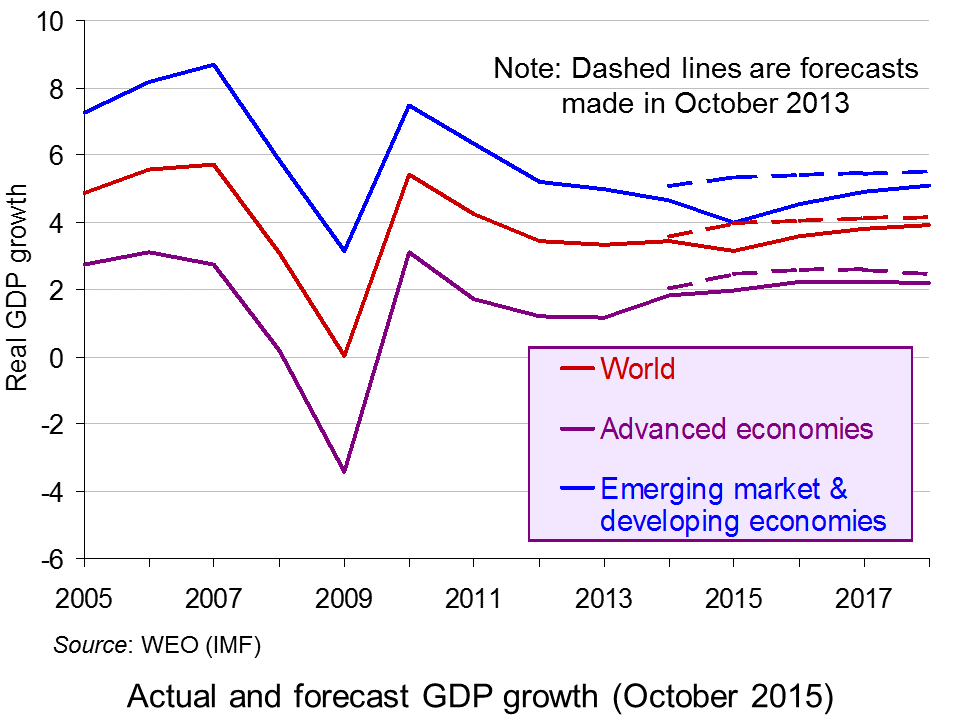 To achieve faster economic growth in the longer term, potential national output must grow more rapidly. This can be achieved by a combination of more rapid technological progress and higher investment in both physical and human capital. But in the short term, aggregate demand must expand sufficiently rapidly. Higher short-term growth will encourage higher investment, which in turn will encourage faster growth in potential national output.
But aggregate demand remains subdued. Many countries are battling to cut budget deficits, and lending to the private sector is being constrained by banks still seeking to repair their balance sheets. Slowing growth in China and other emerging economies is dampening demand for raw materials and this is impacting on primary exporting countries, which are faced with lower exports and lower commodity prices.
Quantitative easing and rock bottom interest rates have helped somewhat to offset these adverse effects on aggregate demand, but as the USA and UK come closer to raising interest rates, so this could dampen global demand further and cause capital to flow from developing countries to the USA in search of higher interest rates. This will put downward pressure on developing countries’ exchange rates, which, while making their exports more competitive, will make it harder for them to finance dollar-denominated debt.
As we have seen, long-term growth depends on growth in potential output, but productivity growth has been slower since the financial crisis. As the Foreword to the report states:
The ongoing experience of slow productivity growth suggests that long-run potential output growth may have fallen broadly across economies.  Persistently low investment helps explain limited labour productivity and wage gains, although the joint productivity of all factors of production, not just labour, has also been slow. Low aggregate demand is one factor that discourages investment, as the last World Economic Outlook report showed. Slow expected potential growth itself dampens aggregate demand, further limiting investment, in a vicious circle.
But is this lower growth in potential output entirely the result of lower demand? And will the effect be permanent? Is it a form of hysteresis, with the effect persisting even when the initial causes have disappeared? Or will advances in technology, especially in the fields of robotics, nanotechnology and bioengineering, allow potential growth to resume once confidence returns?
Which brings us back to the short and medium terms. What can be done by governments to stimulate sustained recovery? The IMF proposes a focus on productive infrastructure investment, which will increase both aggregate demand and aggregate supply, and also structural reforms. At the same time, loose monetary policy should continue for some time – certainly as long as the current era of falling commodity prices, low inflation and sluggish growth in demand persists.
Articles
Uncertainty, Complex Forces Weigh on Global Growth IMF Survey Magazine (6/10/15)
A worried IMF is starting to scratch its head The Guardian, Larry Elliott (6/10/15)
Storm clouds gather over global economy as world struggles to shake off crisis The Telegraph, Szu Ping Chan (6/10/15)
Five charts that explain what’s going on in a miserable global economy right now The Telegraph, Mehreen Khan (6/10/15)
IMF warns on worst global growth since financial crisis Financial Times, Chris Giles (6/10/15)
Global economic slowdown in six steps Financial Times, Chris Giles (6/10/15)
IMF Downgrades Global Economic Outlook Again Wall Street Journal, Ian Talley (6/10/15)
WEO publications
World Economic Outlook, October 2015: Adjusting to Lower Commodity Prices IMF (6/10/15)
Global Growth Slows Further, IMF’s latest World Economic Outlook IMF Podcast, Maurice Obstfeld (6/10/15)
Transcript of the World Economic Outlook Press Conference IMF (6/10/15)
World Economic Outlook Database IMF (October 2015 edition)
Questions
- Look at the forecasts made in the WEO October editions of 2007, 2010 and 2012 for economic growth two years ahead and compare them with the actual growth experienced. How do you explain the differences?
- Why is forecasting even two years ahead fraught with difficulties?
- What factors would cause a rise in (a) potential output; (b) potential growth?
- What is the relationship between actual and potential economic growth?
- Explain what is meant by hysteresis. Why may recessions have a permanent negative effect, not only on trend productivity levels, but on trend productivity growth?
- What are the current downside risks to the global economy?
- Why have commodity prices fallen? Who gains and who loses from lower commodity prices? Does it matter if falling commodity prices in commodity importing countries result in negative inflation?
- To what extent can exchange rate depreciation help commodity exporting countries?
- What is meant by the output gap? How have IMF estimates of the size of the output gap changed and what is the implication of this for actual and potential economic growth?
 Productivity has been a bit of a problem for the UK economy for a number of years. Earlier posts from 2015 have discussed the trend in Tackling the UK’s poor productivity and The UK’s poor productivity record. Although the so-called ‘productivity gap’ has been targeted by the government, with George Osborne promising to take steps to encourage more long-term investment in infrastructure and create better incentives for businesses to improve productivity, the latest data suggest that the problem remains.
The ONS has found that the UK continues to lag behind the other members of the G7, but perhaps more concerning is that the gap has grown to its biggest since 1991. The data showed that output per hour worked was 20 percentage points lower in the UK than the average for the other G7 countries. The economic downturn did cause falls in productivity, but the UK has not recovered as much as other advanced nations. One of the reasons, according to the Howard Archer, chief UK economist at IHS Global Insight is that it ‘had been held back since the financial crisis by the creation of lots of low-skilled, low-paid jobs’. These are the jobs where productivity is lowest and this may be causing the productivity gap to expand. Other cited reasons include the lack of investment which Osborne is attempting to address, fewer innovations and problems of finance.
Despite these rather dis-heartening data, there are some signs that things have begun to turn around. In the first quarter of 2015, output per hour worked did increase at the fastest annual growth rate in 3 years and Howard Archer confirmed that this did show ‘clear sign that UK productivity is now seeing much-needed improvement.’ There are other signs that we should be optimistic, delivered by the Bank of England. Sir John Cunliffe, Deputy Governor for financial stability said:
“firms have a greater incentive to find efficiency gains and to switch away from more labour-intensive forms of production. This should boost productivity.”
The reason given for this optimism is the increase in the real cost of labour relative to the cost of investment. So, a bit of a mixed picture here. UK productivity remains a cause for concern and given its importance in improving living standards, the Conservative government will be keen to demonstrate that its policies are closing the productivity gap. The latest data is more promising, but that still leaves a long way to go. The following articles consider this data and news.
Articles
UK productivity shortfall at record high Financial Times, Emily Cadman (18/9/15)
UK productivity lags behind rest of 7 BBC News (17/9/15)
UK’s poor productivity figures show challenge for the government The Guardian, Katie Allen (18/9/15)
UK productivity lags G7 peers in 2014-ONS Reuters (18/9/15)
UK productivity second lowest in G7 Fresh Business Thinking, Jonathan Davies (18/9/15)
UK is 33% less productive than Germany Economia (18/9/15)
UK productivity is in the G7 ‘slow lane’ Sky News (18/9/15)
Data
AMECO Database European Commission, Economic and Financial Affairs
Labour Productivity, Q1 2015 ONS (1/7/15)
International Comparisons of Productivity, 2014 – First Estimates ONS (18/9/15)
Questions
- How could we measure productivity?
- Why should we be optimistic about productivity if the real cost of labour is rising?
- If jobs are being created at slower rate and the economy is still expanding, why does this suggest that productivity is rising? What does it suggest about pay?
- Why is a rise in productivity needed to improve living standards?
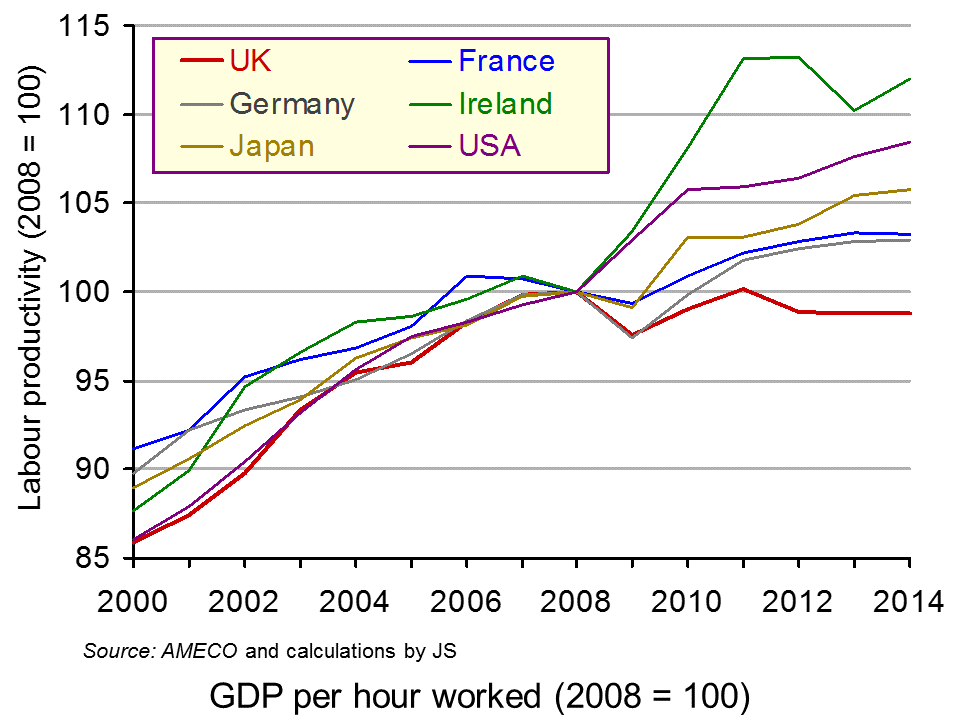
 As we saw in the blog post The UK’s poor productivity record, the UK’s productivity, as measured by output per hour worked, has grown much slower than in other major developed countries since the financial crisis. In fact, output per hour is lower now than in 2008. In France and Germany it is around 3 per higher than in 2008; in Japan it is nearly 6% higher; in the USA it is over 8% higher; and in Ireland it is 12% higher.
The chart below shows international comparisons of labour productivity from 2000 to 2014. (Click here for a PowerPoint of the chart.)
And it is not just labour productivity that has fallen in the UK. Total factor productivity of labour and capital combined has also fallen. This reflects the fall in business investment after the financial crisis and, more recently, meeting the demand for extra output by employing more labour rather than by investing in extra capital.
 In his first major speech since the election, the Chancellor of the Exchequer, George Osborne, told the CBI that the government was intent on tackling the problem of low and stagnant productivity. This would require investment in infrastructure, such as high-speed rail, better roads, superfast broadband and a new runway in the south east. It would require investment in education, training and research; it would involve cutting red tape for business; it would require making it easier for both parents in a family to work by cutting the cost of childcare. The details of the government’s policies would be made clear in the soon-to-be published Productivity Plan.
But how much difference can the government make? Are there intractable problems that will prove virtually impossible to overcome? How much, indeed, can a government do, however much it would like to? The articles explore the issues.
Articles
Will George Osborne’s productivity plan help make Britain a world-beater? The Guardian, Larry Elliott (24/5/15)
UK productivity has stayed stubbornly low for years. Dare we hope for better? The Guardian (24/5/15)
Joseph Stiglitz: ‘GDP per capita in the UK is lower than it was before the crisis. That is not a success’ The Observer, Anthony Andrew (24/5/15)
Osborne says low productivity key economic challenge BBC News (20/5/15)
Solving the productivity puzzle BBC News, Duncan Weldon (20/4/15)
Osborne faces up to productivity challenge BBC News, Robert Peston (20/5/15)
Osborne makes priority of boosting UK productivity Financial Times, George Parker (20/5/15)
The Bank of England is living in cloud-cuckoo land on wages Independent, David Blanchflower (18/5/14)
Cameron’s Plan Hasn’t Cracked Productivity Slump Flagged by BOE Bloomberg, Jill Ward (14/5/15)
To solve Britain’s productivity puzzle, try asking the workers The Conversation, Stephen Wood (29/6/15)
Report
Inflation Report: Chapter 3, Output and Supply Bank of England (May 2015)
Questions
- Define (a) labour productivity; (b) capital productivity; (c) total factor productivity.
- Why has the UK experienced lower productivity than other developed countries?
- Why may the UK’s lower unemployment than other countries in the post-recession period be the direct consequence of lower productivity growth?
- For what reasons might it be difficult for the government to achieve a significant increase in UK productivity?
- How might demand-side policy negatively impact on the supply-side policies that the government might adopt to increase productivity?
- How might the period up to and beyond the referendum in the UK on continuing EU membership impact on productivity?
- How might poor productivity be tackled?
 debt since 2007, despite the recession. Such debt, he argues, is becoming unsustainable and hence the world could be on the cusp of another crash.