 When people take out loans they typically do so to spend and with the UK economy in its current state, many would argue that this is a good thing. The ‘payday loan’ industry took advantage of the weak economy and the squeezed households in the UK and for the past few years, we have seen constant adverts that will appeal to many households. But, is the industry as competitive as the adverts would have us believe?
An inquiry into this industry has been on-going for some time, and it has now been referred to the Competition Commission, due to ‘deep-rooted problems with the way competition works’. For some, a payday loan is a short term form of finance, but for others it has become a way of living that has led to a debt spiral. Frank McKillop, policy manager at Abcul said:
There is a clear demand for instant credit and across the country we are increasingly seeing members who have debts with multiple payday lenders and a record of rolling over debts, or going to one payday lender to clear the debt to another.
One problem identified by the OFT is that customers have found it difficult to compare costs and this has led, in some cases, to customers paying back significantly more than they originally thought. Customers being unable to repay loans will ring warning bells for many people, with no-one wanting a return to the height of the credit crunch.
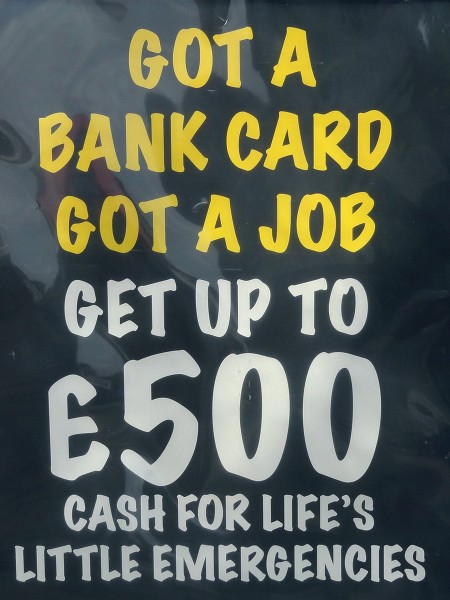 The OFT has criticized payday loan companies for competing not on costs, but on the speed of approval and using certain unapproved tactics as part of their advertising. The selling point of such companies is that you can have the money in a very short time period. However, the criticism is that this leads to loans being given to those who are unable to afford them. Key credit checks are not being done and with late night texts being sent to often financially vulnerable people, it is no wonder that complaints have been received. In a statement, the OFT said:
The competitive pressure to approve loans quickly may give firms an incentive to skimp on the affordability assessment which is designed to prevent irresponsible lending and protect consumers.
[the business models of companies were] predicated on making loans which are unaffordable, leading to borrowers paying far more than expected through rollovers, additional interest and other charges.
While payday loans are legal and there are many companies offering them, it is what they are competing over, which seems to be in question. The industry itself has begun to change its practices, providing more information to customers, only allowing loans to be rolled over three times and the potential to freeze repayments if the customer gets into financial difficulty. If more stringent checks are completed and hence timing does not become the only grounds for competition, then the problems above may become less significant. With the ongoing OFT inquiry into the practices of the payday loan industry and the continuing demand for such financing, it is likely that we will see much more of both the good and the bad that it has to offer. The following articles consider the investigation.
Webcasts
 Balls warns against payday loans ‘blank cheque’ BBC News (27/6/13)
Payday lender investigation could be delayed by bureaucracy Telegraph, Steve Hawkes (27/6/13)
Payday lenders to face ‘tougher restrictions’ on advertising BBC News, Simon Gompertz (1/7/13)
Payday lending rates BBC News, Julio Martino and Stella Creasy (2/7/13)
Articles
Regulator to investigate payday loan industry Financial Times, Elaine Moore and Robert Cookson (27/6/13)
Q&A: Payday loans BBC News (31/5/13)
Payday loans: reining in an industry that is a law unto itself Guardian (27/6/13)
Payday loans industry to face competition inquiry BBC News (27/6/13)
Payday loans firms face competition inquiry Sky News (27/6/13)
Payday loans market faces competition inquiry Guardian, Hilary Osborne (27/6/13)
OFT refers payday loans to Competition Commission Scotsman, Jane Bradley (27/6/13)
Five reasons why we all need to worry about payday lenders Telegraph, Emma Simon (27/6/13)
OFT documents
Payday lending compliance review Office of Fair Trading (27/6/13)
Questions
- Into which market structure would you place the payday loans industry? Make sure you justify your answer.
- What is the role of the (a) the OFT and (b) the Competition Commission? Do these authorities overlap?
- What part does advertising play in this industry?
- To what extent is the payday loan industry a possible cause of another credit crunch?
- Why has the OFT referred this industry to the Competition Commission?
- To what extent are payday loans an essential part of an economy?
 The pricing model for low-cost airline seats seems simple. As the seats get booked, so the price rises. Thus the later you leave it to book, the more expensive it will be. But, in fact, it’s not as simple as this. Seat prices sometimes come down as the take-off date approaches. So what is the pricing model?
The general principle of raising prices as the plane fills up still applies. This enables the airline to discriminate between passengers. Holidaymakers and those with flexibility about when, and possibly where, to travel tend to have a relatively high price elasticity of demand. People who wish to travel at the last minute, such as businesspeople and those facing a family emergency, tend to have a much lower price elasticity of demand and would be prepared to pay a higher, possibly much higher, price.
 With relatively high fixed costs for each flight, low-cost airlines need to fill, or virtually fill, their planes if they are to make a profit. And it’s not just about the direct revenue from ticket sales. Low-cost carriers also rely on the revenue from selling extras, such as on-board refreshments, hold luggage, hotels, car hire and travel insurance. With variable costs being tiny, the pricing model is about maximising revenue for each flight. So the fuller the plane, the better it is for the airline.
 The airlines are very experienced in estimating demand over the period from a flight coming on sale and the departure date. If they get it right, then prices will indeed rise as take-off approaches. But sometimes they get it wrong. If, as time passes, a given flight is filling up too slowly, then it makes sense to be more flexible on prices, cutting them if necessary. Pricing may be easy in principle; but not always easy in practice!
Article
Low-cost air fares: How ticket prices fall and rise BBC News, Erica Gornall (21/6/13)
Papers
Pricing strategies of low cost airlines Air Transport Group, Cranfield University, Keith J Mason (2002)
Pricing strategies of low-cost airlines: The Ryanair case study Journal of Air Transport Management, 15, Paolo Malighetti, Stefano Paleari and Renato Redondi (2009)
Questions
- Does a low-cost airline always charge lower prices than a traditional scheduled airline? If not, why not?
- Identify the various reasons why holidaymakers may have a relatively elastic demand for a particular flight?
- Explain the system of ‘buckets’ of seats?
- Are low-cost airlines engaging in price discrimination and, if so, which type?
- Are there any variable costs of operating a particular flight (assuming that the flight does actually take place)?
- If demand for a flight becomes less elastic as the date of departure gets nearer, why might a budget airline choose to lower the price, at least for a few days?
- Why can Ryanair operate with lower costs than easyJet?
- Would it be in low-cost airlines’ interests to charge more (a) to overweight people; (b) for using the toilet?
 The UK electricity supply market is an oligopoly. Over 95% of the market is supplied by the ‘big six’: British Gas (Centrica), EDF Energy, E.ON, npower (RWE), Scottish Power (Iberdrola) and SSE. The big six also generate much of the electricity they supply; they are vertically integrated companies. Between them they generate nearly 80% of the country’s electricity. There are a further two large generators, Drax Power Limited and GDF Suez Energy UK, making the generation industry an oligopoly of eight key players.
Ofgem, the energy market regulator, has just published a report on the wholesale electricity market, arguing that it is insufficiently liquid. This, argues the report, acts as a barrier to entry to competitor suppliers. It thus proposes measures to increase liquidity and thereby increase effective competition. Liquidity, according to the report, is:
… the ability to quickly buy or sell a commodity without causing a significant change in its price and without incurring significant transaction costs. It is a key feature of a well-functioning market. A liquid market can also be thought of as a ‘deep’ market where there are a number of prices quoted at which firms are prepared to trade a product. This gives firms confidence that they can trade when needed and will not move the price substantially when they do so.
 A liquid wholesale electricity market ensures that electricity products are available to trade, and that their prices are robust. These products and price signals are important for electricity generators and suppliers, who need to trade to manage their risks. Liquidity in the wholesale electricity mark et therefore supports competition in generation and supply, which has benefits for consumers in terms of downward pressure on bills, better service and greater choice.
So how can liquidity be increased? Ofgem is proposing that the big six publish prices for two years ahead at which they are contracting to purchase electricity from generators in long-term contracts. These bilateral deals with generators are often with their own company’s generating arm. Publishing prices in this way will allow smaller suppliers to be able to seek out market opportunities. The generating companies will not be allowed to refuse to contract to supply smaller companies at the prices they are being forced to publish.
In addition, Ofgem is proposing that generators would have to sell 20% of output in the open market instead of through bilateral deals. As it is, however, some 30% of output is currently auctioned on the wholesale spot market (i.e. the market for immediate use).
But it is pricing transparency plus small suppliers being able to gain access to longer-term contracts that are the two key elements of the proposed reform.
Articles
UK utilities face having to disclose long-term deals Reuters, Karolin Schaps and Rosalba O’Brien (12/6/13)
Ofgem set to ‘break stranglehold’ in the energy market BBC News, John Moylan (12/6/13)
Ofgem plan ‘to end energy stranglehold’ BBC Today Programme, John Moylan and Ian Marlee (12/6/13)
Ofgem outlines proposals to ‘break stranglehold’ of big six energy suppliers on electricity market The Telegraph (12/6/13)
Ofgem widens investigation into alleged rigging of gas and power markets The Guardian, Terry Macalister (6/6/13)
Ofgem moves to break stranglehold of ‘big six’ energy suppliers Financial Times, Guy Chazan (12/6/13)
Ofgem to crackdown on Big Six energy suppliers in bid to cut electricity prices Independent, Simon Read (12/6/13)
Reports and data
Opening up Electricity Market to Effective Competition Ofgem Press Release (12/6/13)
Wholesale power market liquidity: final proposals for a ‘Secure and Promote’ licence condition – Draft Impact Assessment Ofgem (12/6/13)
Electricity statistics Department of Energy & Climate Change
The Dirty Half Dozen Friends of the Earth (Oct 2011)
Questions
- What barriers to entry exist in (a) the wholesale and (b) the retail market for electricity?
- Distinguish between spot and forward markets. Why is competition in forward markets particularly important for small suppliers of electricity?
- How will ‘liquidity’ be increased by the measures Ofgem is proposing?
- To what extent does vertical integration in the energy industry benefit consumers of electricity?
- What is a price reporting agency (PRA)? What anti-competitive activities have been taking place in the short-term energy market and why may PRAs not be ‘fit for purpose’?
- Do you think that the measures Ofgem is proposing will ensure that the big generators trade fairly with small suppliers? Explain.
- What are the dangers in the proposals for the large generators?
 How important are emotions when you go shopping? Many people go shopping when they ‘need’ to buy something, whether it be a new outfit, food/drink, a new DVD release, a gift, etc. Others, of course, simply go window shopping, often with no intention of buying. However, everyone at some point has made a so-called ‘impulse’ purchase.
There is only one article below, which is from the BBC and draws on data released from the National Employment Savings Trust’s survey. This report suggests that British people spend over £1 billion every year on impulse buys – purchases that are not needed, were not intended and are often regretted once the ‘high’ has worn off. Often, it is the way in which a product is advertised or positioned that leads to a spontaneous purchase – seeing chocolate bars/sweets at the tills; a product offered at a huge discount advertised in the window of a shop; 2 for 1 purchases; points for loyalty etc. All of these and more are simple techniques used by retailers to encourage the impulse buy. As consumer psychologist, Dr. James Intriligator says:
Retailers have clever ways of manipulating customers to spend more but if you stick to your plans you can avoid being affected by their tactics.

In other cases, it’s simply the frame of mind of the consumer that can lead to such purchases, such as being hungry when you’re food shopping or having an event to attend the next day and deciding to go window shopping, despite already having something to wear! Dr. Intriligator continues, saying:
Your ability to resist and make rational choices is diminished when your glucose levels are down … When you get irrational, you fall back on trusted brands, which often leads you to spend more money … Later in the shop, you’re more tired and less likely to resist [impulse buys]
But are such purchases irrational? One of the key assumptions made by economists (at least in traditional economics) is that consumers are rational. This implies that consumers weigh up marginal costs and benefits when making a decision, such as deciding whether or not to purchase a product. But, do impulse buys move away from this rational consumer approach? Is buying something because it makes you happy in the short term a rational decision? Behavioural economics is a relatively new ‘branch’ of economics that takes a closer look at the decisions of consumers and what’s behind their behaviour. The following article from the BBC considers the impulse buy and leaves you to consider the question of irrational consumers.
Article
How to stop buying on impulse BBC Consumer (30/5/13)
Questions
- If the marginal benefit of purchasing a television outweighs the marginal cost, what is the rational response?
- Using the concept of marginal cost and benefit, illustrate them on a diagram and explain how equilibrium should be reached.
- What is behavioural economics?
- What are the key factors that can be used to explain impulse buys?
- How can framing help to explain irrational purchases?
- If a product is advertised at a significant discount, what figure for elasticity is it likely to have to encourage further purchases in-store?
- Is bulk-buying always a bad thing?
 The Competition Commission (CC) recently completed their provisional investigation into the cement and concrete market in Great Britain (press release). They concluded that coordination between the main cement producers is resulting in high prices.
In contrast, to illegal cartels (see for example the recent post on this site), the firms in this market are not accused of doing anything illegal. Instead, the CC’s concern is with tacit collusion. Here, no illegal communication between firms takes place, firms simply do not compete intensely due to a mutual understanding that high prices are collectively beneficial.
Economic theory suggests that one key factor that facilitates tacit coordination is a low number of firms in the market. The UK cement market certainly meets this criteria as it is an oligopoly with just three main players plus a new entrant. The CC concluded that:
In a highly concentrated market where the product doesn’t vary, the established producers know too much about each other’s businesses and have concentrated on retaining their respective market shares rather than competing to the full.
They estimate that this cost consumers over £180m in a 3 year period.
Whilst tacit collusion is not illegal, competition authorities can try to prevent it from arising by intervening in mergers that they believe will make it more likely. In fact, the new entrant to the cement market came about due to sales required by the CC before they would allow a joint-venture between two of the main players to go ahead. Clearly the CC’s recent findings suggest that this intervention was not sufficient to ensure intense competition in the market. However, an additional tool available to the authorities in the UK is to be able to remedy harm to competition undercovered as a result of an investigation into the market. In some cases this may even involve breaking-up firms in the market (see for example the decision to force BAA to sell several airports).
 When deciding on how to remedy the problem in the cement market, the CC will be keen to avoid the past mistakes of their Danish counterparts. In a famous case, in 1993 the Danish authorities attempted to increase competition in the concrete market by publishing individual sellers’ prices. The idea was that this would stimulate competition by encouraging buyers to shop around. However, evidence published here suggests that this in fact increased prices by around 15%! Why? The paper examines possible explanations and concludes that the information published by the competition authorities helped firms to monitor each others behaviour and therefore facilitated tacit coordination in the market. This is entirely consistent with economic theory which shows that another key factor which facilitates tacit coordination is market transparency.
The CC suggest that such monitoring is also possible in the GB market:
Established information channels such as price announcement letters can signal their plans, and tit-for-tat behaviour and cross-sales can be used to prevent or retaliate against any moves to disturb the overall balance between the different players in this market.
According to the above press release, the remedies the CC are considering include: the sale of capacity or plants by the leading players in the market, creation of buying groups, prohibition on price announcements and restrictions on the publication of industry level data. This suggests that the CC are well aware that reducing market transparency can play a key role in preventing coordination. It will be fascinating to, first, see what the CC opt for, then, what impact this has on competition in the industry.
Articles
Same product, same price? Competition in the UK Global Cement (22/05/13)
Competition Commission uncovers `serious problems’ in cement market Graham Huband, The Courier (22/05/13)
Competition Commission call for cement sell-off Mark Leftley, London Evening Standard (21/05/13)
Competition Commission documents
CC looks to break open cement market Competition Commission Press Release (21/5/13)
Aggregates, cement and ready-mix concrete market investigation Competition Commission core documents (various dates)
Questions
- Explain tacit collusion using a Prisoner’s dilemma game.
- Is cement the type of product where we might expect coordination to be most likely?
- Why is cement an important market in the UK economy?
- The first article above suggests that most of the management team at the new entrant came from the other main players in the market. Do you think this may significantly affect the likelihood of tacit collusion?
- Evaluate the pros and cons of the alternative remedies the CC are considering.
 When people take out loans they typically do so to spend and with the UK economy in its current state, many would argue that this is a good thing. The ‘payday loan’ industry took advantage of the weak economy and the squeezed households in the UK and for the past few years, we have seen constant adverts that will appeal to many households. But, is the industry as competitive as the adverts would have us believe?
 The OFT has criticized payday loan companies for competing not on costs, but on the speed of approval and using certain unapproved tactics as part of their advertising. The selling point of such companies is that you can have the money in a very short time period. However, the criticism is that this leads to loans being given to those who are unable to afford them. Key credit checks are not being done and with late night texts being sent to often financially vulnerable people, it is no wonder that complaints have been received. In a statement, the OFT said: