 The Bank of England was granted independence to set interest rates back in 1997. In setting rates its looks to meet the government’s annual inflation rate target of 2 per cent (with a range of tolerance of up to 1 percentage point).
The economic benefits of delegating interest rate decisions to a body like the Monetary Policy Committee (MPC) are often taken for granted. But, in David Blanchflower’s article in the Independent Newspaper on 14 May, the former MPC member questions whether, at least in recent years, better decisions would have been made by the Treasury and the Chancellor of the Exchequer. In other words, could politicians have made more appropriate monetary policy choices?
Central bank independence has become increasingly popular. Many governments have taken steps to depoliticise monetary policy choices and to hand over important powers, such as setting interest rates, to central bankers. One of the main advantages, it is argued, is that politicians are no longer able to manipulate monetary policy choices in order to try and affect their popularity and their chances of being re-elected. The policy announcements of central bankers are said to be more credible because they do not have the incentive to deviate from their announced policy. For instance, the low inflation announcements of elected policy-makers lack credibility because politicians have an incentive to inflate the economy and so boost growth and employment prior to the election.
The incentive for a pre-election dash for growth means that the general public are reluctant to bargain for low wage increases in case policy is loosened or is looser than it should be given the prevailing economic climate. In this case, it might mean that interest rates are lower than they would otherwise be in the run up to the election. In order to protect their spending power households bargain for higher wage increases than they would if the policy announcements could be trusted. In contrast, the low inflation announcements of central bankers have credibility and so inflation will be lower. In terms of economic jargon, central bank independence will reduce inflation bias as well as promoting economic stability.
Blanchflower questions whether the path of interest rates in the UK between 1997 and 2007 would have been materially different should the Treasury have been setting interest rates rather than the MPC. But, he believes that:
Interest rates would probably have been higher in 2007 as the housing boom was ranging and house price to earnings ratios approached unsustainable levels. Alistair Darling has made it clear he would have cut rates earlier in 2008, if it had been left to him….
Blanchflower argues that part of the reason that the Treasury might have made better choices in the more recent past is the narrow remit of the Bank of England to target inflation. He argues:
Now is the time to consider switching to a dual mandate that would include growth, which would give much needed flexibility.
Blanchflower calls into question the idea that targeting inflation alone can bring stability. The recent past he argues simply dispels this notion. To help form your own views try having a read of the full article and then answer the questions below.
David Blanchflower Article
The recession deniers have gone strangely quiet this month Independent, David Blanchflower (14/05/12)
Questions
- If economic growth is a good thing, why might we want to reduce the chances of policymakers manipulating policy to attempt a pre-election dash for growth?
- What do you understand by credible economic policy announcements? How might a lack of credibility affect the economy’s rate of inflation?
- What does central bank independence mean for the conduct of monetary policy in the UK? In answering this you might wish to visit the Bank of England website and read about the UK’s monetary policy framework.
- Try summarising David Blanchflower’s argument against the inflation rate remit of the Bank of England.
- What do you consider to be the possible dangers of widening the Bank of England’s remit beyond just targeting the annual rate of CPI inflation?
- Central bank independence is one way in which governments can constrain their discretion over economic policy. In what other ways can they constrain their policy choices?
- Do you think governments should have full discretion over their policy choices or do you think there should be limits?
 Australia was one of the few economies that seemed to be somewhat insulated from the 2008/09 recession and credit crunch. However, with the UK now back in recession and global economic conditions worsening in much of Europe, Australia has now joined the list of countries that are experiencing economic conditions that are ‘weaker than forecast’.
Today’s world involves economies that are increasingly interdependent, hence the spread of the world economic slowdown. As such, with weak global demand, Australia has started to feel the effects, with demand for its goods and raw materials falling. This has led Australia’s central bank – the Reserve Bank of Australia – to cut its key interest rate (the ‘cash rate’) by more than expected. The rate had been at 4.25% and it was widely believed that a 0.25 percentage point cut would occur. However, the central bank cut the cash rate rate to 3.75% to counter the weakening conditions. The Reserve Bank said:
“This decision is based on information received over the past few months that suggests that economic conditions have been somewhat weaker than expected, while inflation has moderated …Growth in the world economy slowed in the second half of 2011, and is likely to continue at a below-trend pace this year.”
Banks’ interest rates have been falling in Australia for the past few months and this latest cut will do much to help financially squeezed households. Data show that Australian house sales have fallen, as have house prices, and retail sales have fared little better.
Lower interest rates are often a tool used to steer inflation and the Australian central bank may not have been as willing to cut rates had the inflation rate not come down in recent months. Keeping consumer prices under control remains a top priority for the central bank and so it will be interesting to see the impact that these rate cuts will have on the Australian economy.
Articles
Australia cenbank surprises with aggressive half point rate cut Reuters, Wayne Cole (1/5/12)
Australia cuts rates by than forecast to 3.75% BBC News (1/5/12)
Banks unlikely to pass on full rate cut The Australian, Wall Street Journal, Peter Trute (1/5/12)
Australia cuts rate to support economy Financial Times, Neil Hume (1/5/12)
Australia slashes interest rates by 0.5pc to boost economy The Telegraph (1/5/12)
Australia cuts interest rates as economy slows Guardian, Phillip Inman (1/5/12)
Banks must pass on rate cut: businesses Sydney Morning Herald, Ehssan Veiszadeh (1/5/12)
Bond prices rally after rate cut Sydney Morning Herald (1/5/12)
Surplus remains appropriate: Swan Sydney Morning Herald, Colin Brinsden (1/5/12)
Webcasts
 Reserve Bank of Australia Cuts Rates by 50 Basis Points to 3.75% CNBC video, Lauren Rosborough (1/5/12)
Further `Modest’ RBA Easing Possible, ANZ Says Bloomberg, Tony Morriss (1/5/12)
Australia’s central bank shifts focus to growth BBC News, Duncan Kennedy (1/5/12)
Questions
- Which factors will a central bank consider when setting interest rates?
- Explain the components of aggregate demand that will be affected by a lower rate of interest.
- Using diagrams to illustrate the process, explain both the interest-rate and the exchange-rate transmission mechanisms of the fall in interest rates.
- How are interest rates used to target inflation?
- How will lower rates of interest help the Australian economy recover from weakening global economic conditions?
- Why are Australia’s banks unlikely to pass on the full rate cut to consumers?
- Why did bond prices rise and the Australian dollar depreciate after the rate cut? Why does this suggest that a 0.5% cut was greater than anticpated by markets?
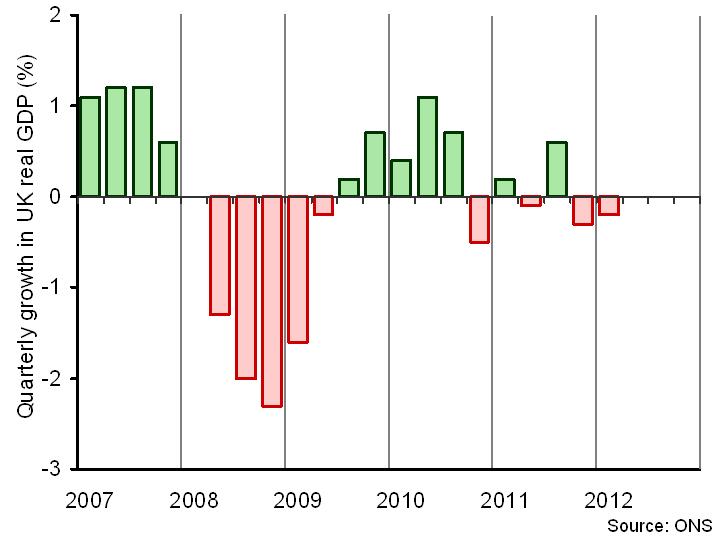 The UK is officially back in recession: or to be more accurate, a double-dip recession.
The generally accepted definition of a recession is two or more quarters of negative growth in real GDP. According to figures released by the Office for National Statistics, the UK economy shrank by 0.2% in quarter 1, 2012, having shrunk by 0.3% in quarter 4, 2011.
(Click on the following link for a PowerPoint of the above chart: Double dip 2)
As you can see from the chart (click chart for a larger version), these declines are tiny compared with the recession of 2008/9. Nevertheless, with the eurozone economy slowing (Britain’s largest export market), and with cuts to government expenditure set to bite harder in the coming months, there are worries that there may be more quarters of negative growth to come.
So what are the causes of this double-dip recession? Are they largely external, in terms of flagging export markets; or are they internal? Is the new recession the direct result of the tight fiscal policy pursued by the Coalition government?
And what is to be done? Is there no option but to continue with the present policy – the government’s line? Or should the austerity measures be reined in? After all, as we saw in the last blog post (Economic stimulus, ‘oui’; austerity, ‘non’), the mood in many European countries is turning against austerity.
The following articles explore the causes and policy implications of the latest piece of bad news on the UK economy.
Articles
Double-dip recession a terrible blow for George Osborne Guardian, Larry Elliott (25/4/12)
Double-dip recession figures mark another bad day for George Osborne Guardian, Larry Elliott (25/4/12)
UK double-dip recession: what the economists say Guardian (25/4/12)
Feared double dip recession becomes reality as British economy contracts again in first quarter of 2012 Daily Record (25/4/12)
Britain in double-dip recession as growth falls 0.2pc The Telegraph, Angela Monaghan and Szu Ping Chan (25/4/12)
Did the eurozone crisis cause the double-dip recession? Guardian, Polly Curtis (25/4/12)
UK’s double-dip recession Financial Times, Chris Giles (25/4/12)
UK is in ‘double dip’ recession FT Adviser, Rebecca Clancy and John Kenchington (25/4/12)
Flanders explains GDP figure BBC News, Stephanie Flanders (25/4/12)
No recovery for UK: No let up for ONS BBC News, Stephanie Flanders (25/4/12)
Double-dip recession: There’s always fantasy island BBC News, Paul Mason (25/4/12)
UK double-dip recession to drag on into summer, economists warn The Telegraph, Philip Aldrick (26/4/12)
George Osborne can stop the rot, but only by spending as he slashes The Telegraph, Jeremy Warner (25/4/12)
Double dip has arrived – and Osborne is running out of escape routes Independent, Ben Chu (26/4/12)
Britain’s bosses tell the ONS: it’s bad, but not a recession Independent, Tom Bawden, Lucy Tobin , Gideon Spanier (26/4/12)
The Chancellor received plenty of warning Independent, David Blanchflower (26/5/12)
Data
Gross Domestic Product: Preliminary Estimate, Q1 2012 ONS (25/4/12)
Preliminary Estimate of GDP Time Series Dataset 2012 Q ONS (25/4/12)
World Economic Outlook Database IMF (17/4/12)
Business and Consumer Surveys (for all individual EU countries and for the EU as a whole) European Commission: Economic and Financial Affairs
Consumer Confidence Nationwide Building Society
Questions
- Assess the current state of the UK economy and its likely course over the coming few months.
- Why may looking at the business surveys provide a truer picture of the state of the UK economy than the official measure of GDP?
- Why has the UK economy gone back into recession?
- Compare the policy approaches of the Coalition government with those of the Labour opposition.
- How important is it for the UK to retain its AAA credit rating?
 A crucial determinant of the economy’s short-term prospects is the appetite of households for spending. This is because household spending makes up roughly two-thirds of the total demand for firms’ goods and services or two-thirds of what economists refer to as aggregate demand. So what are the latest forecasts for consumer spending? We briefly consider the forecasts of the Office for Budget Responsibility for consumer spending and, in doing so, update an earlier bog Gloomy prospects for spending in 2012?
In its March 2012 Economic and Fiscal Outlook the Office for Budget Responsibility presents it forecasts for economic growth and household spending. The following table summarises these forecasts.
OBR Forecasts (annual real percentage change)
|
2012 |
2013 |
2014 |
2015 |
2016 |
| GDP |
0.8 |
2.0 |
2.7 |
3.0 |
3.0 |
| Consumption |
0.5 |
1.3 |
2.3 |
3.0 |
3.0 |
| Disposable income |
–0.2 |
0.5 |
1.9 |
2.4 |
2.5 |
 The Bank of England was granted independence to set interest rates back in 1997. In setting rates its looks to meet the government’s annual inflation rate target of 2 per cent (with a range of tolerance of up to 1 percentage point).