 The price of petrol is of interest to most families, occupying a key component of weekly expenditure. Over the past decade, it has fluctuated significantly, from around 85p per litre to over £1.40. More recently, prices have been around £1.03 to £1.10, depending on the brand and the location. But, will we see prices falling below that magical £1 per litre mark?
We have recently seen a 2p drop in wholesale fuel prices and it is this which has led to speculation about a further fall in prices at petrol stations to below £1. This, according to the RAC, has a ‘very good chance’ of happening.
A key determinant of petrol prices is the market price for crude oil and it is this which has been contributing towards the low petrol prices. As these prices filter through to the pumps, the RAC suggests that prices may once again come down. Furthermore, with some of the key petrol stations being operated by the big supermarkets, competition for sales and hence on prices may be fierce.
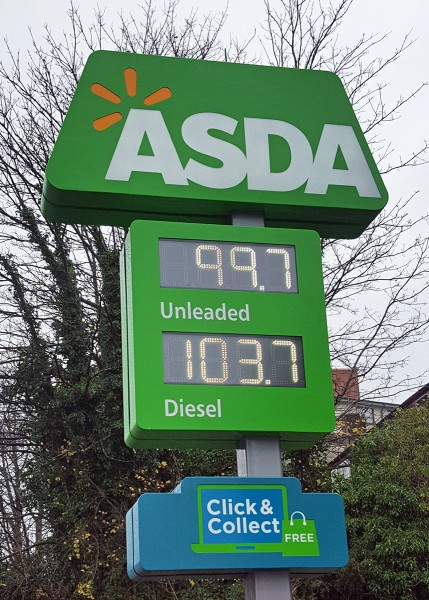 But, now let’s consider another well-informed organisation. According to the AA, the chances of petrol prices falling below £1 are ‘remote’. So, who should we believe? In fact, we can probably believe both. The market price may not fall below £1, but in the run-up to Christmas and in the start of the New Year, we may well see petrol on sale for under £1 as a means to entice shoppers or, as the AA has said, as a ‘marketing gimmick’. As you can see from the picture, Asda has dropped the price below £1 per litre in some of its petrol stations.
You might think this is a little strange, given the inelastic nature of the demand for petrol: after all, as prices of petrol rise and fall, I for one, don’t change my demand. This is also confirmed by HMRC, which reports that total petrol consumption is falling despite the low prices. But, it’s probably less about changing your total demand for petrol and more about from where you buy that total demand. For any one petrol station, the demand may be relatively elastic. It is this which may fuel a price war on petrol. The following articles consider this.
£1 per litre petrol? It’s unlikely The Telegraph, Rozina Sabur (20/11/15)
‘Good chance’ of £1 per litre petrol, says RAC BBC News (20/11/15)
Petrol prices ‘could fall below £1 per litre’ ITV News (20/11/15)
Fuel Prices: ‘Good chance’ of £1 a litre Sky News (20/11/15)
Questions
- What are they demand-side and supply-side factors which have helped to cut the price of petrol? Use a diagram to illustrate your answer.
- How much of a role has OPEC played in keeping petrol prices down in the UK?
- Why is the demand for petrol price inelastic?
- HMRC suggests that despite low prices, the demand for petrol has been falling. Does this suggest that the demand curve for petrol is upward sloping? Explain your answer.
- If the demand for petrol is falling, can this tell car companies anything about the future demand for vehicles? Which concepts are important here?
- If petrol prices do not fall to reflect falling oil prices, what does this suggest about the profit margins on petrol? Should government intervene?
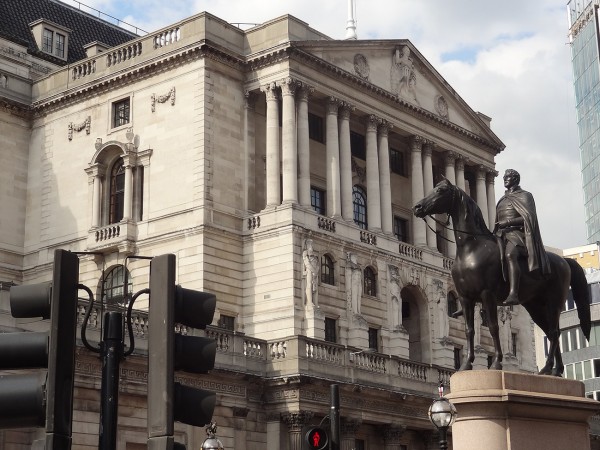 Interest rates in the UK have been at a record low since 2009, recorded at just 0.5%. In July, the forward guidance from Mark Carney seemed to indicate that a rate rise would be likely towards the start of 2016. However, with the recovery of the British economy slowing, together with continuing problems in Europe and slowdowns in China, a rate rise has become less likely. Forward guidance hasn’t been particularly ‘guiding’, as a rate rise now seems most likely well into 2016 or even in 2017 and this is still very speculative.
Interest rates are a key tool of monetary policy and one of the government’s demand management policies. Low interest rates have remained in the UK as a means of stimulating economic growth, via influencing aggregate demand. Interest rates affect many of the components of aggregate demand, such as consumption – through affecting the incentive to save and spend and by affecting mortgage rates and disposable income. They affect investment by influencing the cost of borrowing and net exports through changing the exchange rate and hence the competitiveness of exports.
Low interest rates therefore help to boost all components of aggregate demand and this then should stimulate economic growth. While they have helped to do their job, circumstances across the global economy have acted in the opposite direction and so their effectiveness has been reduced.
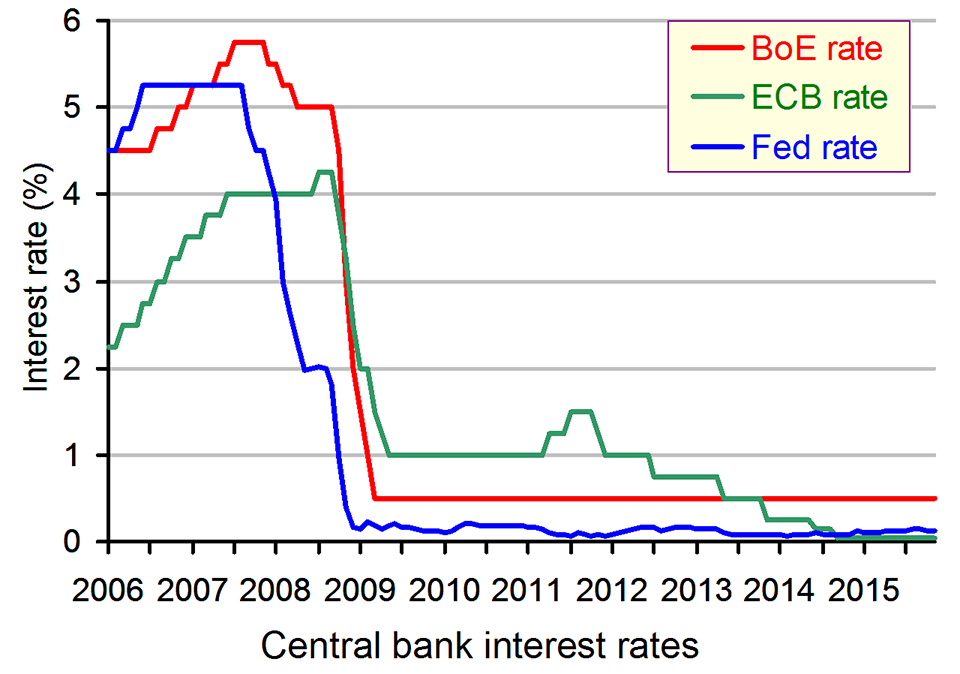 Although the latest news on interest rates may suggest some worrying times for the UK, the information contained in the Bank of England’s Inflation Report isn’t all bad. Despite its predictions that the growth rate of the world economy will slow and inflation will remain weak, the predictions from August remain largely the same. The suggestion that interest rates will remain at 0.5% and that any increases are likely to be at a slow pace will flatten the yield curve, and, with predictions that inflation will remain weak, there will be few concerns that continuing low rates will cause inflationary pressures in the coming months. Mark Carney said:
“The lower path for Bank Rate implied by market yields would provide more than adequate support to domestic demand to bring inflation to target even in the face of global weakness.”
However, there are many critics of keeping interest rates down, both in the UK and the USA, in particular because of the implications for asset prices, in particular the housing market and for the growth in borrowing and hence credit debt. The Institute of Directors Chief Economist, James Sproute said:
“There is genuine apprehension over asset prices, the misallocation of capital and consumer debt…Borrowing is comfortably below the unsustainable pre-crisis levels, but with debt once against rising there is a need for vigilance…The question is, will the Bank look back on this unprecedented period of extraordinary monetary policy and wish they had acted sooner? The path of inaction may seem easier today, but maintaining rates this low, for this long, could prove a much riskier decision tomorrow.”
hanges in the strength of the global economy will certainly have a role to play in forming the opinions of the Monetary Policy Committee and it will also be a key event when the Federal Reserve pushes up its interest rates. This is certainly an area to keep watching, as it’s not a question of if rates will rise, but when.
Articles
Bank of England dampens prospects of early UK rate rise BBC News (5/11/15)
Bank of England Governor gets his forward guidance on interest rates wrong Independent, Ben Chu (6/11/15)
Interest rates set to remain at rock-bottom right through 2016 as Bank of England cuts UK growth and inflation forecasts This is Money, Adrian Lowery (5/11/15)
 Pound slides as Bank of England suggests interest rates will stay low for longer – as it happened 5 November 2015 The Telegraph, Peter Spence (5/11/15)
UK’s record low interest rates should be raised next Februrary says NIESE The Telegraph, Szu Ping Chan (4/11/15)
Fresh signs of slowdown will force interest rates rise to be put on hold The Guardian, Katie Allen (2/11/15)
The perils of keeping interest rates so low The Telegraph, Andrew Sentence (6/11/15)
Time to ask why we are still in the era of ultra-low rates Financial Times, Chris Giles (4/11/15)
No interest rate rise until 2017: Joy for homeowners as Bank of England delays hike in mortgage costs again Mail Online, Matt Chorley (5/11/15)
Pound tumbles after Carney warns its strength threatens recovery Bloomberg, Lucy Meakin (5/11/15)
Is Carney hurt by wrong rate steer? BBC News, Robert Peston (5/11/15)
Data and Reports
Inflation Report Bank of England (August 2015)
Inflation Report Bank of England (November 2015)
Historical Fan Chart Data Bank of England (2015)
Questions
- Use and AD/AS diagram, explain how low interest rates affect the key components of aggregate demand and in turn how this will affect economic growth.
- What is meant by the ‘yield curve’? How has it been affected by the latest release from the Monetary Policy Committee?
- Why has the value of the pound been affected following the decision to keep interest rates at 0.5%?
- How has the sterling exchange rate changed and how might this affect UK exports?
- What are the main concerns expressed by those who think that there is a danger from keeping interest rates low for too long?
- Why is the outlook of the global economy so important for the direction of interest rate changes?
 There are countless people who work 12-hour days – some get rewarded with huge salaries, while others are paid peanuts. A key question is: are these people happy? With 24 hours in a day for both rich and poor, the more hours we work, the fewer hours we have for leisure time. So, how do we choose the optimal work-life balance?
In economics, we often talk about the concept of diminishing marginal utility and this concept can be applied to working life. For many people, each additional hour worked is tougher or adds less to your utility – we get tired, bored and the job may seem more unpleasant the more hours you work. The typical day of work is around 7-8 hours, but across Sweden, some offices are now closing at 3.30, with a 6-hour working day, but with salaries remaining the same.  It’s not a new idea in Sweden and trials of this shorter working day concept have proved successful, with higher reported profits, better service to customers (or patients) and happier, more productive staff.
This shorter working day is not a common occurrence across Sweden or other countries, but it’s a practice that is certainly garnering media attention. Companies will certainly be keen if this means an increase in productivity, but one key concern will be the potential loss of business from companies who do keep working after 3.30 and expect phones to be answered.
It would certainly be an attractive prospect for employees and perhaps is a good way of ‘poaching’ the best staff and hence of boosting worker productivity. With more free time, perhaps an employee’s happiness would also increase, which could have significant effects on a range of variables. The following article considers this shorter working day.
The truth about Sweden’s short working hours BBC News, Maddy Savage (2/11/15)
Questions
- Explain the concept of diminishing marginal utility with respect to hours worked. Can this be used to explain why overtime often receives higher rates of pay?
- Using indifference analysis, explain how a change in the number of hours worked might affect an individual’s happiness.
- Why might a shorter working day help to increase a firm’s profits?
- If a shorter working day did increase happiness, what other factors might be affected? Does this explain why other countries are so interested in the success of this initiative?
 Economic growth is vital to an economy: it helps to create jobs and is crucial in stimulating confidence, both for businesses and consumers. Growth comes from various sources, both domestic and external, and so for each individual country it’s not just its growth rate that is important, but the growth rates of other countries, in particular those it trades with.
Recent data suggest that the global economy could be on the downturn and here we consider three countries/continents.
The US economy has been doing relatively well and we saw discussion by the Federal Reserve as to whether the economy was in a position to be able to handle an increase in interest rates. Although rates didn’t rise, there was a general consensus that a rate rise would not significantly harm the economy. However, perhaps those opinions may now be changing with the latest information regarding US growth. In the second quarter of 2015, growth was recorded at 3.9%, but according to the Department of Commerce, it fell to 1.5% for the third quarter. Though it’s still a solid growth rate, especially compared to other economies, it does represent a significant fall from quarter to quarter.
Many analysts suggest that this slowing is just a blip, partly the result of running down stocks, but it’s also a trend that has occurred in the UK. Although the fall in growth in the UK (see series IHYR) has been less than in the USA, it is still a fall. Annual growth was recorded at 2.7% in quarter 1, but fell to 2.4% in quarter 2 and to 2.3% in quarter 3 (with GDP in quarter 3 only 0.5% higher than in quarter 2). A big cause of this slowdown in growth has been a fall in manufacturing output and it is the service sector that prevented an even larger slowdown.
And it’s not just the West that is experiencing declining growth. The IMF has warned of a slowdown in economic growth in Africa. Although the absolute annual rate of growth at 3.75% is high compared to the UK, it does represent the slowest rate of growth in the past six years. One key factor has been the lower oil prices. Although this has helped to stimulate consumer spending in many countries, it has hit oil-producing countries.
With some of the big players experiencing slowdowns, world economic growth may be taking something of a dive. The Christmas period in many countries is when companies will make significant contributions to their annual sales, and this year these sales are going to be vital. The following articles consider the slowdowns in growth around the world.
Articles
US growth slows despite spending free Financial Times, Sam Fleming and Richard Blackden (29/10/15)
US economic growth slows in third quarter as businesses cut back The Guardian, Dominic Rushe (30/10/15)
US economic growth slows sharply BBC News (29/10/15)
US Q3 gross domestic product up 1.5% vs 1.6% growth expected CNBC, Reuters (29/10/15)
US growth cools in third quarter Wall Street Journal, Eric Morath (29/10/15)
UK economic growth slows to 0.5% in third quarter BBC News (27/10/15)
GDP growth in the UK slows more than expected to 0.5% The Guardian, Julia Kollewe (27/1015)
UK growth slows as construction and manufacturing output shrinks The Telegraph, Szu Ping Chan (27/10/15)
UK economy loses steam as GDP growth slows to 0.5% Financial Times, Ferdinando Giugliano (27/10/15)
No UK growth without services BBC News, Robert Peston (27/10/15)
IMF warns of African economic slowdown BBC News (27/10/15)
African growth feels the strain from China’s slowdown Financial Times, Andrew England (27/10/15)
Tax credits: George Osborne ‘comfortable’ with ‘judgement call’ BBC News (22/10/15)
IMF revises down Sub-Saharan Africa 2015 growth Wall Street Journal, Matina Stevis (27/10/15)
WEO publications
World Economic Outlook, October 2015: Adjusting to Lower Commodity Prices IMF (6/10/15)
Global Growth Slows Further, IMF’s latest World Economic Outlook IMF Podcast, Maurice Obstfeld (6/10/15)
Transcript of the World Economic Outlook Press Conference IMF (6/10/15)
World Economic Outlook Database IMF (October 2015 edition)
Questions
- How do we measure economic growth?
- Using an AD/AS diagram, explain why economic growth has fallen in (a) the US, (b) the UK and (c) Africa.
- How have oil prices contributed towards recent growth data?
- Why has the IMF forecast slowing growth for Africa and how dependent is the African economy on growth in China?
- Which sectors are contributing towards slower growth in each of the 3 countries/continents considered? Can you explain the reason for the downturn in each sector?
- What do you think should be done regarding interest rates in the coming months?
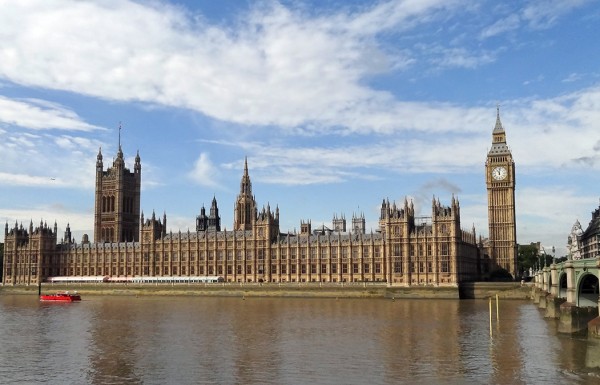 One of the most controversial policy changes being made by the Conservative government relates to the tax credit system. For many years, the tax and benefits system in the UK has come in for significant criticism. It has been described as overly complex, a system that doesn’t reward work and yet a system that doesn’t provide sufficient incentives to move off benefits and into work.
The changes that the government is proposing are wide-ranging and focused in part on reducing the deficit. With changes to tax thresholds, the introduction of the National Living Wage (NLW) and changes to the thresholds at which tax credits are available, the Treasury suggests that £4.5 billion will be saved per year. It also says that most working families will be made better off. However, the IFS suggests that some families could lose up to £1000 per year following the changes.
In addition to these changes, the amount of tax-free childcare is also set to increase, helping those households with young children
Tax credits are designed to help low income families and working tax credit, in particular, is aimed to encourage people to move into work. A key change to this tax credit will see the threshold at which the recipient’s payments of this benefit begin to decline move from £6420 to £3850. The withdrawal rate – the rate at which the benefit is withdrawn – will also be increased.
 The idea is that this will help to target the benefit more tightly – make it more vertically efficient. But, the concern is that this will also mean that low-income working households are worse off, despite the introduction in April 2016 of the National Living Wage. The Chancellor suggests that anyone who is working full time will be better off following these changes and that as such the changes will actively encourage work and lead to an increase in the supply of labour. This, the government argues, is a good policy for the working population, tax payers and for the wider economy.
This policy will remain controversial, with changes set to come in from 2016 and then 2017. It is certainly difficult to assess the impact of these changes on households and part of that stems from the complexities of the existing system, which mean that some households are eligible for some benefits, whereas others are not.
The final impact, if such changes are approved, will only be known once the tax credit changes are implemented. The House of Lords will vote on whether to ‘kill’ the tax credit cuts and Mr. Osborne, despite some concerns from Conservative back-benchers has said he is ‘comfortable’ with the policy and that the House of Lords should respect the views of the other house. Until we see the results of the vote and, even then, the impact of the changes on households, both sides will continue to produce data and estimates in support of their views.
Tax credit changes: who will be the winners and losers? BBC News, Brian Milligan (20/10/14)
Tax credit cuts: Osborne ‘comfortable’ with plan despite pressure from fellow Tories The Guardian, Rowena Mason and Heather Stewart (22/10/15)
George Osborne insists he signalled tax credit cuts before the election Independent, Jon Stone (22/10/15)
George Osborne: I am “comfortable” with tax credit cuts The Telegraph, Steven Swinford (22/10/15)
Commons Speaker warns Lords not to block tax credit cuts The Guardian, Patrick Wintour (21/10/15)
Tax credits: George Osborne ‘comfortable’ with ‘judgement call’ BBC News (22/10/15)
Osborne stands firm despite tax credits unease Financial Times, George Parker and Ferdinando Giugliano (22/10/15)
Austerity was a political choice. Now it’s starting to look like a bad one The Guardian. Heather Stewart (25/10/15)
Questions
- What are tax credits?
- How do they aim to affect the supply of labour?
- Using indifference analysis, explain how the income and substitution effects will work, following a change to tax thresholds.
- What is meant by vertical efficiency and the targeting of benefits?
- Why would the changes to tax credits help those in full-time work more than those in part-time work?
- What are the main arguments for and against the changes to tax credits?
 The price of petrol is of interest to most families, occupying a key component of weekly expenditure. Over the past decade, it has fluctuated significantly, from around 85p per litre to over £1.40. More recently, prices have been around £1.03 to £1.10, depending on the brand and the location. But, will we see prices falling below that magical £1 per litre mark?
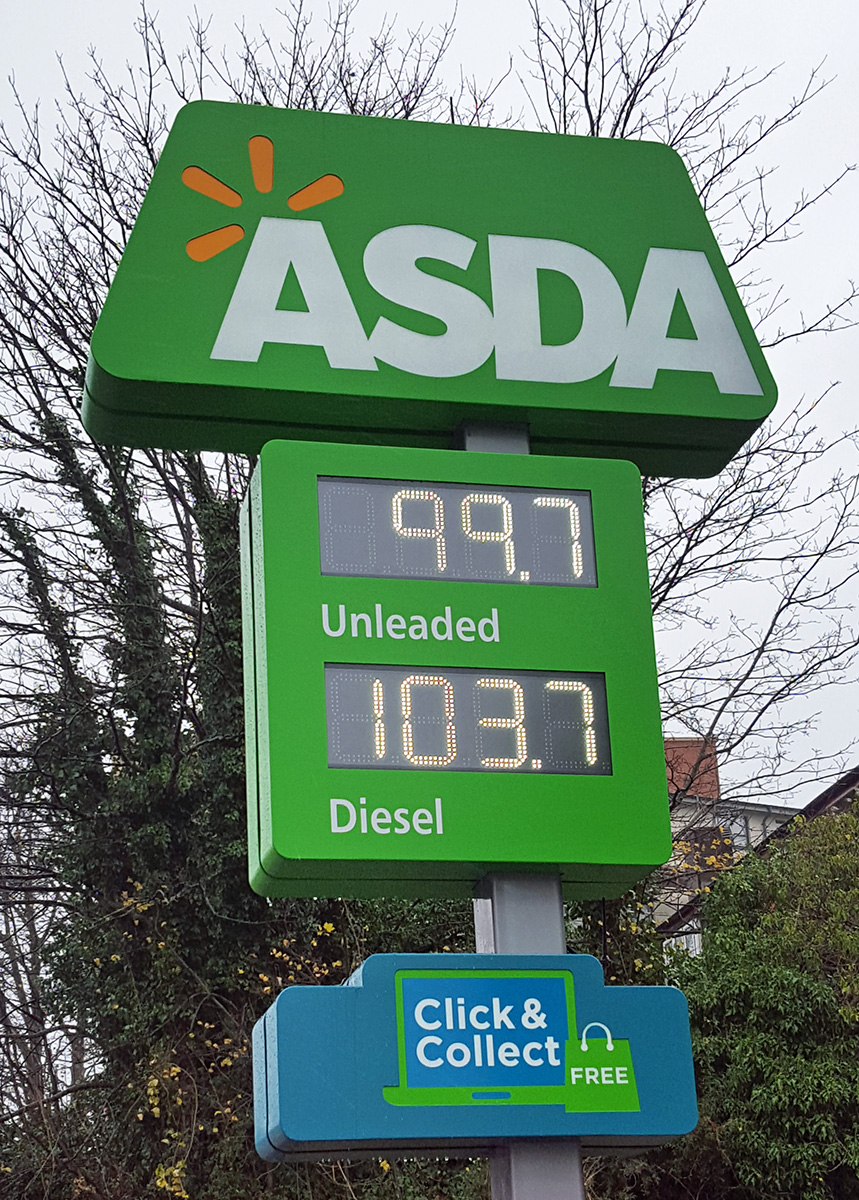 But, now let’s consider another well-informed organisation. According to the AA, the chances of petrol prices falling below £1 are ‘remote’. So, who should we believe? In fact, we can probably believe both. The market price may not fall below £1, but in the run-up to Christmas and in the start of the New Year, we may well see petrol on sale for under £1 as a means to entice shoppers or, as the AA has said, as a ‘marketing gimmick’. As you can see from the picture, Asda has dropped the price below £1 per litre in some of its petrol stations.