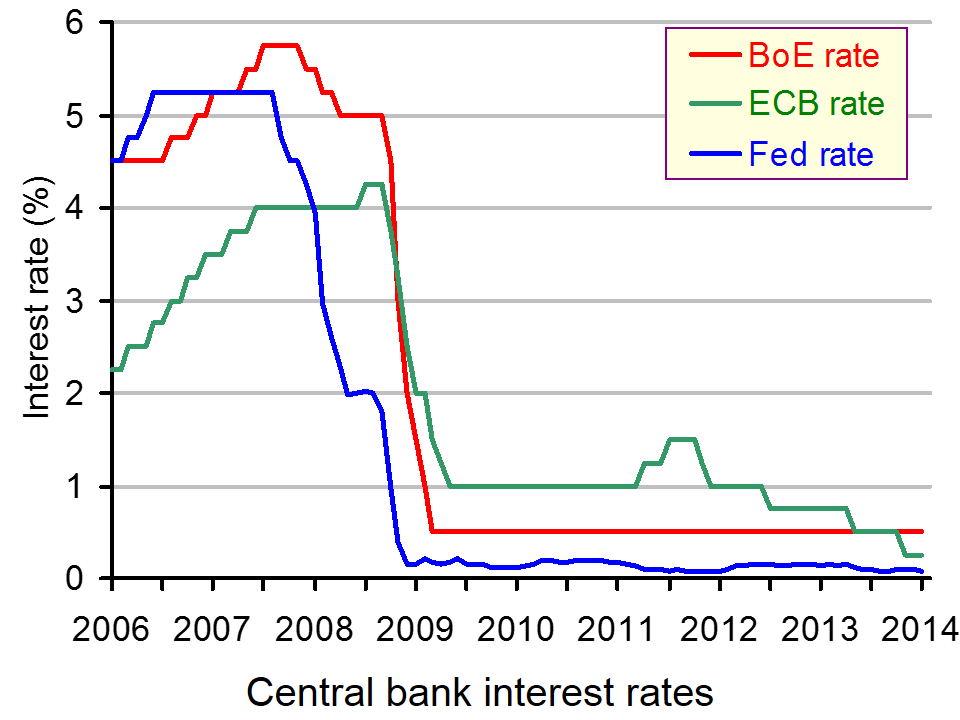
Although the Monetary Policy Committee (MPC) of the Bank of England is independent in setting interest rates, until recently it still had to follow a precise remit set by the government. This was to target inflation of 2% (±1%), with interest rates set to meet this target in 24 months’ time. But things have changed since the new Governor, Mark Carney, took up office in July 2013. And now things are not so clear cut.
The Bank announced that it would keep Bank Rate at the current historically low level of 0.5% at least until unemployment had fallen to 7%, subject to various conditions. More generally, the Bank stated that:
The MPC intends at a minimum to maintain the present highly stimulative stance of monetary policy until economic slack has been substantially reduced, provided this does not entail material risks to price stability or financial stability.
This ‘forward guidance’ was designed to provide more information about future policy and thereby more certainty for businesses and households to plan.
But unemployment has fallen rapidly in recent months. It fell from a 7.7% average for the three months May to July 2013 to 7.1% for the latest available three months (September to November 2013). And yet there is still considerable slack in the economy.
It now, therefore, looks highly unlikely that the MPC will raise Bank Rate as soon as unemployment falls below 7%. This then raises the question of how useful the 7% target has been and whether, if anything, it has created further uncertainty about future MPC decisions.
The following still appears on the Bank of England website:
The MPC intends at a minimum to maintain the present highly stimulative stance of monetary policy until economic slack has been substantially reduced, provided this does not entail material risks to price stability or financial stability.
But this raises two questions: (a) how do you measure ‘economic slack’ and (b) what constitutes a substantial reduction?
So what should the Bank do now? What, if any, forward guidance should it offer to the markets? Will that forward guidance be credible? After all, credibility among businesses and households is an important condition for any policy stance. According to Larry Elliott in the first article below, there are five options.
It is rising inflation that typically causes problems for countries, whether it is demand-pull or cost-push. However, one country that has not been subject to problems of rising prices is Japan. Instead, this economy has been suffering from the gloom of deflation for many years and many argue that this is worse than high inflation.
Falling prices are popular among consumers. If you see a product whose price has fallen from one day to the next, you can use your income to buy more goods. What’s the problem with this? The Japanese economy has experienced largely stagnant growth for two decades and a key cause has been falling prices. When the prices of goods begin to fall over and over again, people start to form expectations about the future direction of prices. If I expect the price of a good to fall next week, then why would I buy now, if I can buy the same good next week at a lower price? But, when next week arrives and the price has fallen as expected, why would I purchase the product, if I think that the price fall is set to continue? The problem of deflation is that with continuously falling prices, consumers stop spending. Aggregate demand therefore declines and economic growth all but disappears. This is the problem that the Japanese economy has been faced with for more than 20 years.
However, the latest data from Japan shows core consumer prices growing faster than expected in December 2013, compared to the previous year. This figure was above market forecasts and was the fastest rate of growth in the past 5 years. These data, together with those on unemployment have given the economy a much needed boost.
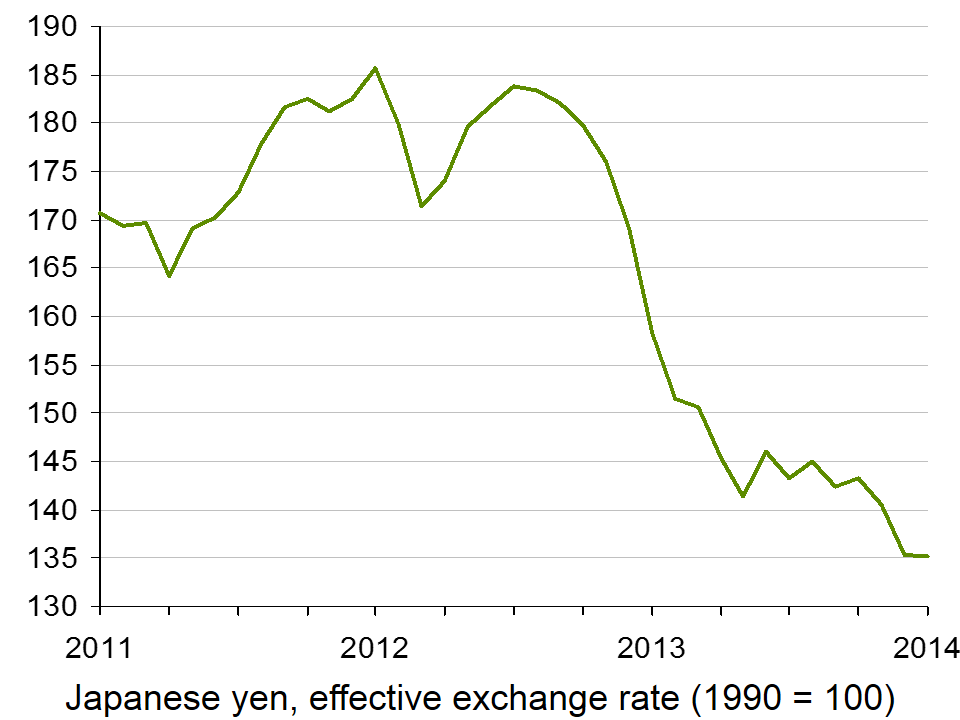
Recent government policy has been focused on boosts in government spending, with an aim of reducing the value of the currency (click here for a PowerPoint of the chart). Such policies will directly target aggregate demand and this in turn should help to generate an increase in national output and push up prices. If the price trend does begin to reverse, consumers will start to spend and again aggregate demand will be stimulated.
The future of the economy remains uncertain, though the same can be said of many Western economies. However, the signs are good for Japan and if the recovery of other economies continues and gathers pace, Japan’s export market will be a big contributor to recovery. The following articles consider the Japanese economy.
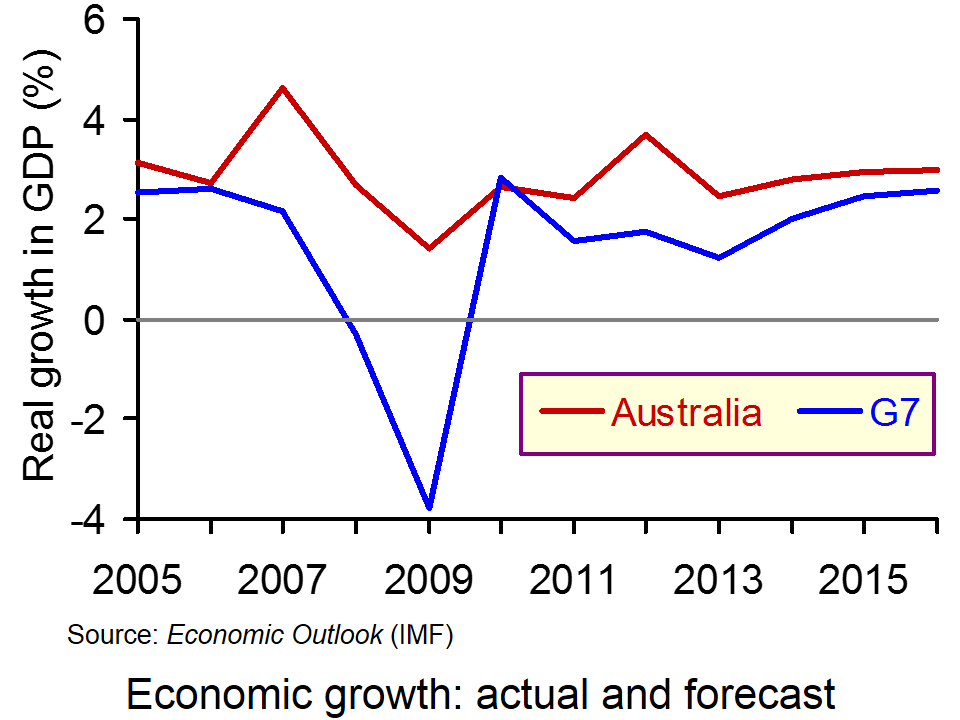
When the rest of the developed world went into recession after the financial crisis of 2007/8, the Australian economy kept growing, albeit at a slightly lower rate (see chart 1: click here for a PowerPoint). Then as the world economy began to grow again after 2009, Australian grow accelerated. Partly this was the result of a strong growth in demand for Australian mineral exports, such as coal, iron ore and bauxite, especially from China and other east Asian countries.
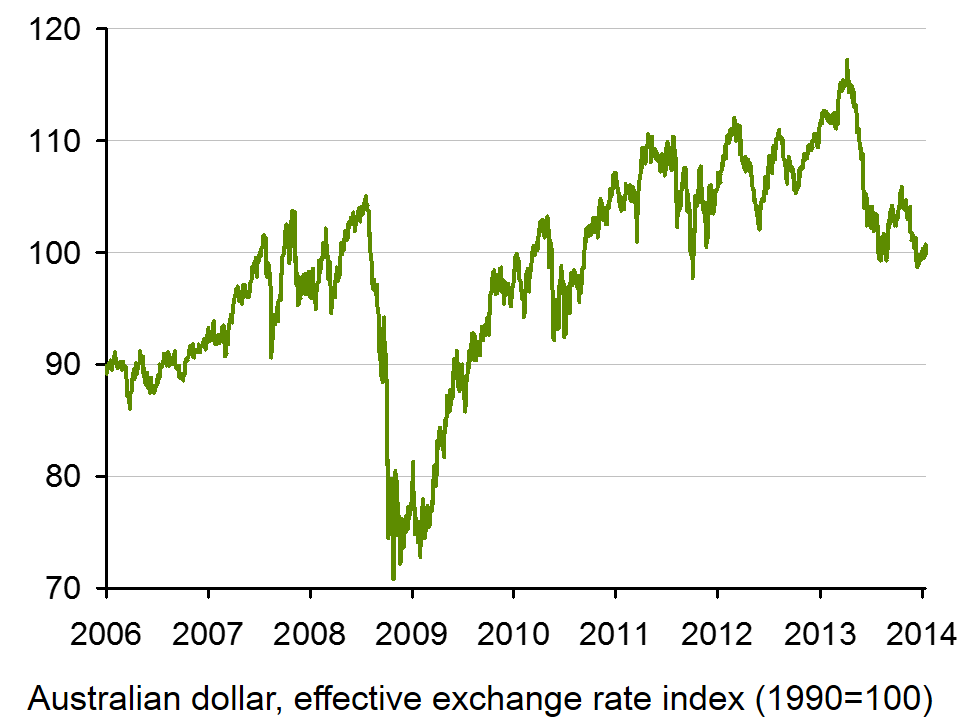
But in 2013, Australian growth slowed and jobs grew by their lowest rate for 17 years. Employment actually fell by 22,600 in December and unemployment was only prevented from rising by a fall in the participation rate. The Australian dollar, which has been depreciating in recent months, fell further on the news about jobs, reaching its lowest level for over two years (see chart 2: click here for a PowerPoint).
Chart 1 Chart 2
The following articles look at the reasons behind Australia’s slowing growth and at possible reactions of the Australian government and the Reserve Bank of Australia (Australia’s central bank). They also look at the link between economic performance and policy on the one hand and the exchange rate on the other.
Why has the Australian dollar been depreciating in recent months?
Why did the Australian dollar fall further on the news that economic growth had slowed and employment had fallen?
Find out what has been happening to commodity prices in the past three years (see Economic Data freely available online and especially site 26) How has this affected (a) the current account of Australia’s balance of payments; (b) the exchange rate of the Australian dollar?
If commodity prices are in US dollars, how is a depreciation of the Australian dollar likely to affect Australia’s balance of payments?
How are possible fiscal and monetary responses in Australia likely to affect the exchange rate of the Australian dollar?
What determines the magnitude of the rise or fall in demand for Australian exports as the world economy grows or declines? How are the determinants of the price and income elasticities of demand for Australian exports relevant to your answer?
Conservative Party leaders are considering the benefits of an above-inflation rise in the minimum wage. This policy has been advocated by both the Labour Party and the Liberal Democrats as a means of helping the lowest paid workers. From 2008 to 2013, minimum wage rates fell 5.2% in real terms: in other words, nominal increases were less than the increase in both the RPI and CPI (see UK minimum wage: a history in numbers).
Advocates of a real rise in the minimum wage argue that not only would it help low-paid workers, many of whom are in severe financial difficulties, but it would benefit the Treasury. According to Policy Exchange, a free-market think tank closely aligned to the Conservative Party, increasing the minimum wage by 50p would save the Government an estimated £750m a year through higher tax revenues and lower benefit payments.
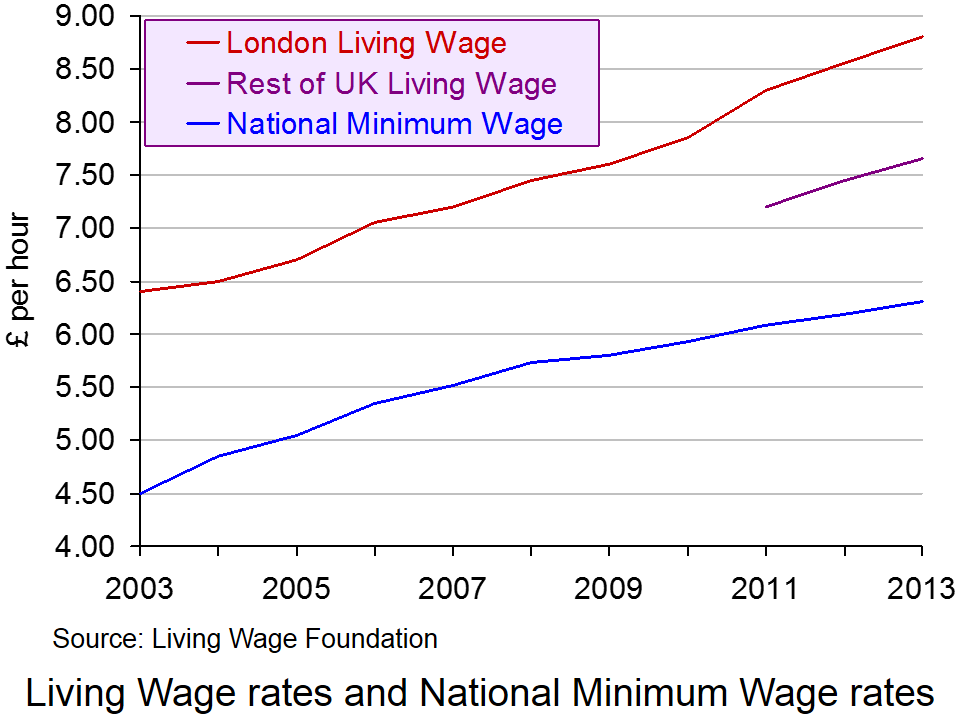
But even such a rise to £6.81 would still leave the minimum wage substantially below the living wage of £8.80 in London and £7.65 in the rest of the UK, as estimated by the Living Wage Foundation (see The cost of a living wage). Although many businesses are now paying at least the living wage, many others, especially small businesses, argue that a rise in the minimum wage above the rate of inflation would force them to consider cutting the number of employees or reducing hours for part-time workers.
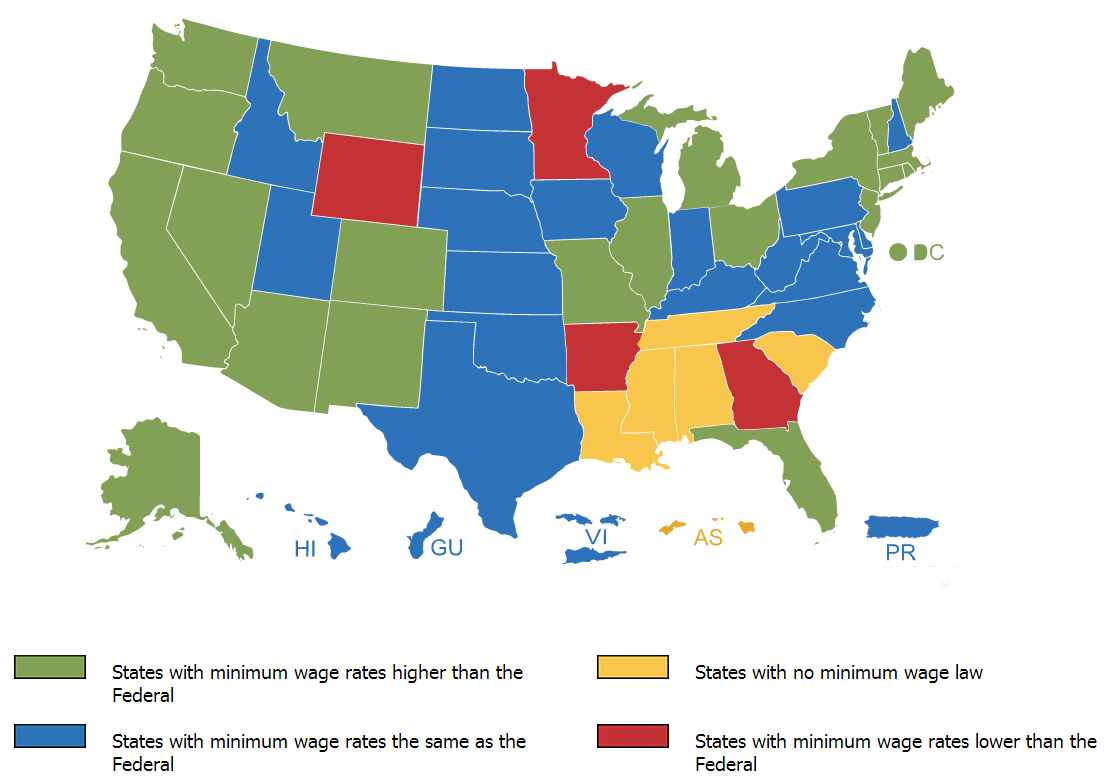
Meanwhile, in the USA 13 states have raised their minimum wage rates from the 1st January 2014 (see). Some of the rises, however, were tiny: as little as 15 cents. In a couple of cases, the rise is $1. Currently 21 states and DC have minimum wage rates above the Federal level of $7.25 (approx. £4.40); 20 states have rates the same as the Federal level; 4 states have rates below the Federal level. At $9.32 per hour, Washington State has the highest state minimum wage; the lowest rates ($5.15) are in Georgia and Wyoming. In 5 states there is no minimum wage at all. As the ABC article below states:
The piecemeal increases at the local level are occurring amidst a national debate over low wages and income inequality. Fast food and retail workers have been staging protests and walking off work for more than a year, calling for better pay and more hours. Currently, fast food workers nationally earn an average of about $9 per hour.
Workers from McDonald’s, Wendy’s, Burger King and other fast food joints are calling for $15 per hour. Wal-Mart workers organizing as part of the union-backed OUR Walmart aren’t asking for a specific dollar amount increase, but they say it’s impossible to live on the wages they currently receive.
President Obama has been throwing his weight behind the issue. Earlier this month, the President said in a speech that it’s “well past the time to raise the minimum wage that in real terms right now is below where it was when Harry Truman was in office.” But such legislation has a bleaker outlook if it reaches the Republican-led House of Representatives. House Speaker John Boehner has said that raising the minimum wage leads to a pullback in hiring.
So what are the costs and benefits of a significant real rise is the minimum wage on either side of the Atlantic? The articles explore the issues.
Draw two diagrams to demonstrate the direct microeconomic effect of a rise in the minimum wage for two employers, both currently paying the minimum wage, where the first is operating in an otherwise competitive labour market and the other is a monopsonist.
What is meant by the term ‘efficiency wage rate’? How is the concept relevant to the debate about the effects of raising the minimum wage rate?
What are the likely macroeconomic effects of raising the minimum wage rate?
What is the likely impact of raising the minimum wage rate on public finances?
Is raising the minimum wage rate the best means of tackling poverty? Explain your answer.
Interest rates in the UK have been at 0.5% since mid-2009, when they were reduced with the objective of stimulating the economy, through encouraging consumption and investment. Over the past 12 months, economic recovery has begun and with the housing market rising by 8.4% over the past year, what can we expect from interest rates?
Interest rates are a powerful tool of monetary policy and affect many of the components of aggregate demand. As such, they are also a key tool in achieving low and stable inflation rates and keeping unemployment low. Unemployment has been falling, as the economic recovery has taken hold, but is still above the 7% level that the Bank of England has said is needed before rates are increased. However, with the improvements in the housing market, some are now expecting interest rates to go up sooner than previously thought. (Click here for a PowerPoint of the chart.)
28 economists were questioned about the future of interest rates in the UK and 93% of those asked were of the opinion that interest rates will still be at 0.5% by the end of 2014. Furthermore, more than 50% think that interest rates will not begin to go up until the second half of 2015 and 15% suggest that they will not increase until 2016.
What happens to interest rates will depend on many things, including changes in productivity, unemployment trends, wage growth and inflation. It is also likely to depend on economic changes in countries around the world. The following articles consider the future of interest rates.
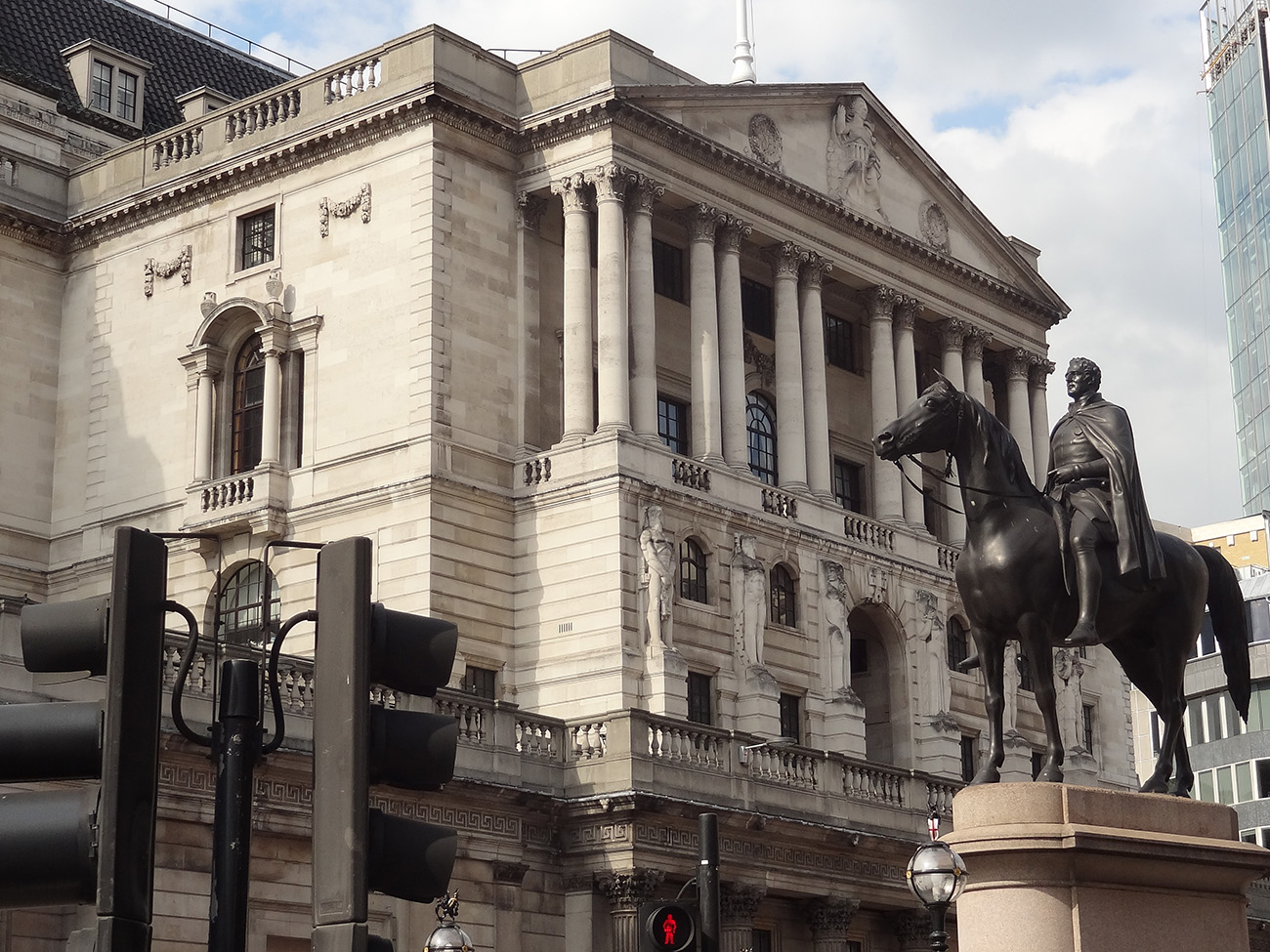 Although the Monetary Policy Committee (MPC) of the Bank of England is independent in setting interest rates, until recently it still had to follow a precise remit set by the government. This was to target inflation of 2% (±1%), with interest rates set to meet this target in 24 months’ time. But things have changed since the new Governor, Mark Carney, took up office in July 2013. And now things are not so clear cut.
 And yet there is still considerable slack in the economy.