 George Osborne in his recent Autumn Statement, once again stressed that ‘the government is committed to strong, sustainable and balanced growth’. But while he plans to reduce government debt as a percentage of GDP, consumer debt is rising, both absolutely and as a percentage of household disposable income. The rise in household borrowing, and the resulting rise in consumer expenditure, has been the main factor driving economic growth. It has not been exports nor, until recently, investment, as the Chancellor had hoped. Indeed, investment in new housing is falling.
The Office for Budget Responsibility in its latest Economic and Fiscal Outlook forecasts that gross household debt will reach 163 per cent of household disposable income by 2021, up from 146% at the end of 2015.
Consumer gross debt includes both secured debt and unsecured debt. Secured debt is essentially debt secured on property (i.e. mortgages), while unsecured debt is largely in the form of credit card debt, overdrafts and personal loans.
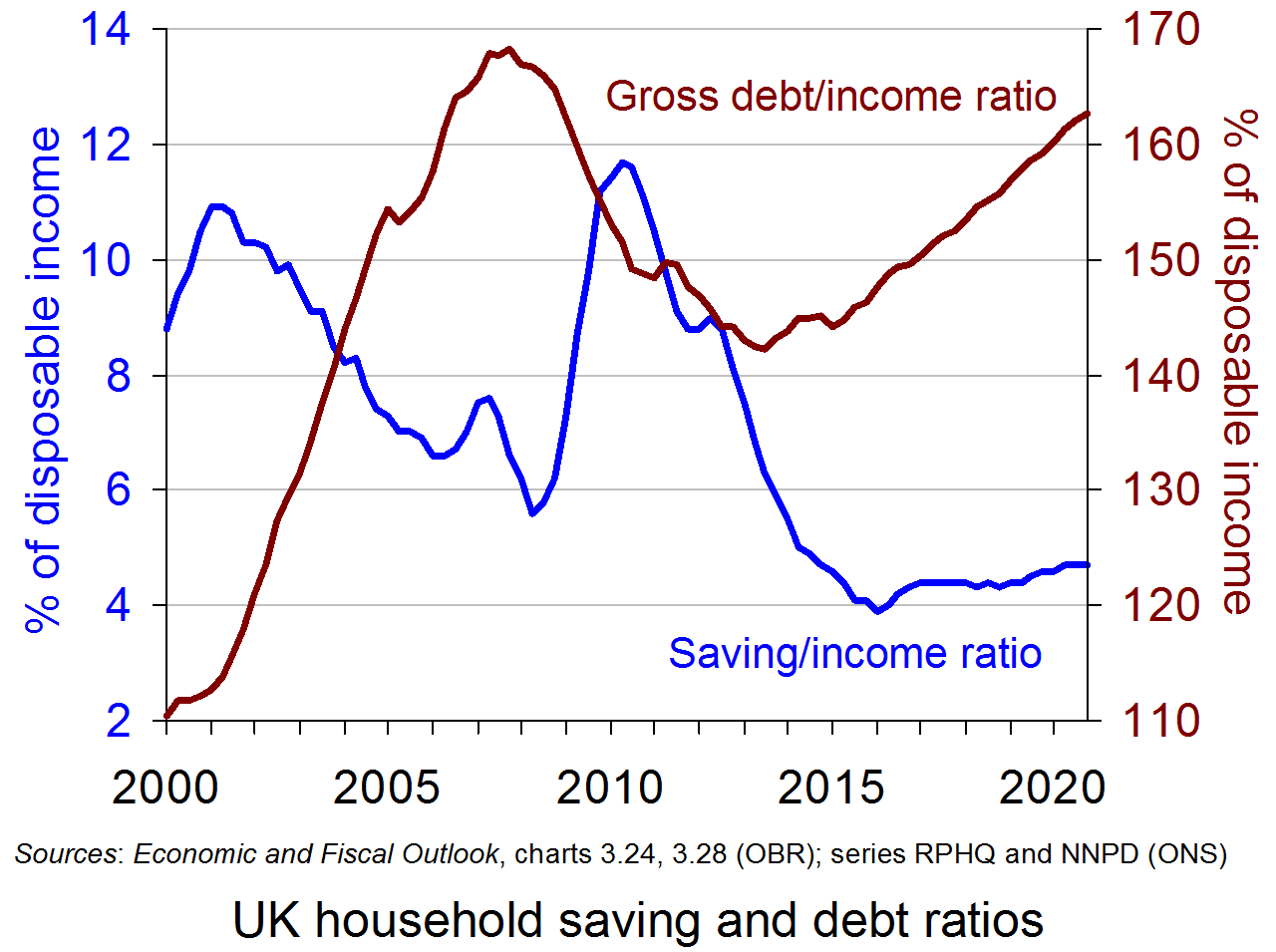 The chart shows that from 2008 to 2013, gross debt fell as a percentage of personal disposable income. Following the financial crisis, banks were more cautious about lending as they sought to increase their capital and liquidity ratios. And consumers were more cautious about borrowing as the uncertainty made many people keen to reduce their debts. This decline in credit reversed the massive growth in household debt from 2000 to 2008: one of the contributing factors to the financial crisis. (Click here for a PowerPoint of the chart.)
But since late 2013, household debt – both secured and unsecured – has been rising. In absolute (nominal) terms, individuals’ debt is now £1.43 trillion, slightly above the previous high in 2008. And as the chart shows, the OBR forecasts that it will continue rising. This makes consumers more vulnerable to adverse economic shocks, such as a downturn in emerging markets, another crisis in the eurozone or financial crises in other parts of the world.
 And as consumer debt has been rising, the personal saving ratio (the ratio of saving to personal disposable incomes) has been falling and is now lower than before the financial crisis.
The rise in consumer borrowing has been of some concern to the Bank of England. Andy Haldane, the Bank’s Chief Economist, appearing before the Treasury Select Committee, warned that consumer credit, and in particular personal loans, had been ‘picking up at a rate of knots. That ultimately might be an issue that the Financial Policy Committee might want to look at fairly carefully.’
Articles
The UK economy may be growing, but in a highly unbalanced way The Guardian, Phillip Inman (27/11/15)
UK growth hit by biggest drag from net trade on record The Telegraph, Szu Ping Chan (27/11/15)
Surge in consumer lending could prompt Bank of England intervention The Guardian, Patrick Collinson and Jill Treanor (30/11/15)
Consumer spending rise troubles Bank of England The Guardian, Heather Stewart (24/11/15)
Between Debt and the Devil by Adair Turner review – should the government start printing money? The Guardian, Tom Clark (25/11/15)
Lending rises as Bank of England ponders new curbs Financial Times, Ferdinando Giugliano (30/11/15)
Carney indicates BoE’s willingness to rein in credit Financial TImes, Chris Giles (5/11/15)
FCA sounds alarm at rising credit card debt Financial Times, Emma Dunkley (3/11/15)
Interest rates will stay low for longer – but household debt is a worry, says BoE The Telegraph, Szu Ping Chan (24/11/15)
Seven years after the crisis, Britain is still addicted to the drug of debt Independent, James Moore (1/12/15)
Vince Cable: Former Business Secretary warns that ‘severe economic storms’ are on the way Independent, Ben Chu (14/11/15)
The risks stalking the UK economy BBC News, Kamal Ahmed (1/12/15)
OBR publications
Economic and fiscal outlook Office for Budget Responsibility (25/11/15)
Economic and fiscal outlook charts and tables (Excel file) Office for Budget Responsibility (25/11/15)
Questions
- Does it matter if economic growth is driven by a rise in consumer demand, in turn driven by a risen in consumer credit?
- Is there an inflation risk from growth being driven by a rise in consumer credit?
- What is the precise relationship between the household saving ratio and the household debt ratio? (Which of these ratios is a stock and which is a flow?)
- What might cause a fall in consumer borrowing? Would this be a good thing?
- Why did consumer borrowing fall following the financial crisis of 2007–8?
- What could the Bank of England’s Financial Policy Committee do to curb consumer borrowing?
- If banks were forced to hold more reserves, how could aggregate demand be maintained? Would ‘helicopter money’ be a good idea?
- What are ‘countercyclical buffers for banks’? What are the arguments for raising them at the current time?
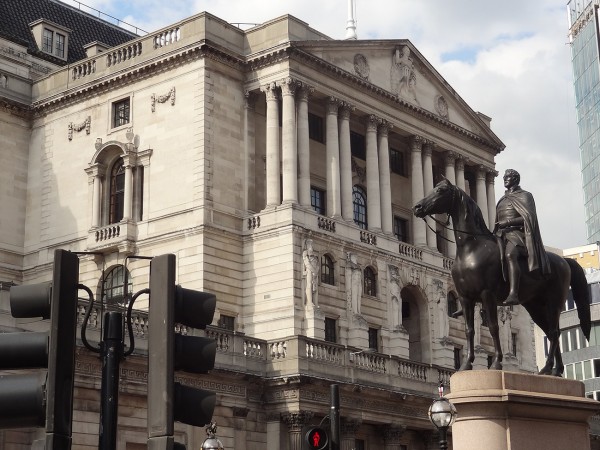 Jim Slater, who has just died at the age of 86, was a tycoon of the 1970s, probably unknown to most reader of this blog. But his legacy lives on and many will question whether the actions of the banking sector and big business today is a reflection of the lessons that were not learnt 40 years ago.
Slater was a businessman: perhaps the businessman in the 1970s, building up a company that in today’s money and the height of its success, would have been worth billions. Buying and selling companies, asset stripping and investing created Slater Walker, which shot to success and then crumbled to failure, taking with it a bailout from the Bank of England of £110 million. You might look at that figure and compare it with the bail outs of more recent times and think – peanuts. But think about how prices have changed and convert £110 million into today’s money and that’s a hefty bail out. A key question is whether the willingness of the government and Bank of England to bail out key banks and financial sector businesses has encouraged the irresponsible lending that led to the credit crunch. Was there a moral hazard? Had Slater Walker been left to fail, would the world look a slightly different place?
Perhaps a little extreme, but I wonder, if we were to look back over the past 50 to 60 years, whether we would find other cases of key businesses being bailed out, which set a precedent for other companies to grow, without necessarily taking full responsibility for it. Jim Slater will certainly leave a legacy behind him .
Jim Slater and the warning from the 1970s that we ignored BBC News, Jonty Bloom (20/11/15)
Questions
- What is meant by asset stripping?
- If a company like Slater Walker had not been bailed out, do you think the economy would have suffered?
- If Slater Walker had been left to fail, would that have changed the business model of some of our largest banks and reduced the chance of a financial crisis 40 years later?
- Do you think the concept of moral hazard is relevant here?
Interest rates in the UK have been at a record low since 2009, recorded at just 0.5%. In July, the forward guidance from Mark Carney seemed to indicate that a rate rise would be likely towards the start of 2016. However, with the recovery of the British economy slowing, together with continuing problems in Europe and slowdowns in China, a rate rise has become less likely. Forward guidance hasn’t been particularly ‘guiding’, as a rate rise now seems most likely well into 2016 or even in 2017 and this is still very speculative.
Interest rates are a key tool of monetary policy and one of the government’s demand management policies. Low interest rates have remained in the UK as a means of stimulating economic growth, via influencing aggregate demand. Interest rates affect many of the components of aggregate demand, such as consumption – through affecting the incentive to save and spend and by affecting mortgage rates and disposable income. They affect investment by influencing the cost of borrowing and net exports through changing the exchange rate and hence the competitiveness of exports.
Low interest rates therefore help to boost all components of aggregate demand and this then should stimulate economic growth. While they have helped to do their job, circumstances across the global economy have acted in the opposite direction and so their effectiveness has been reduced.
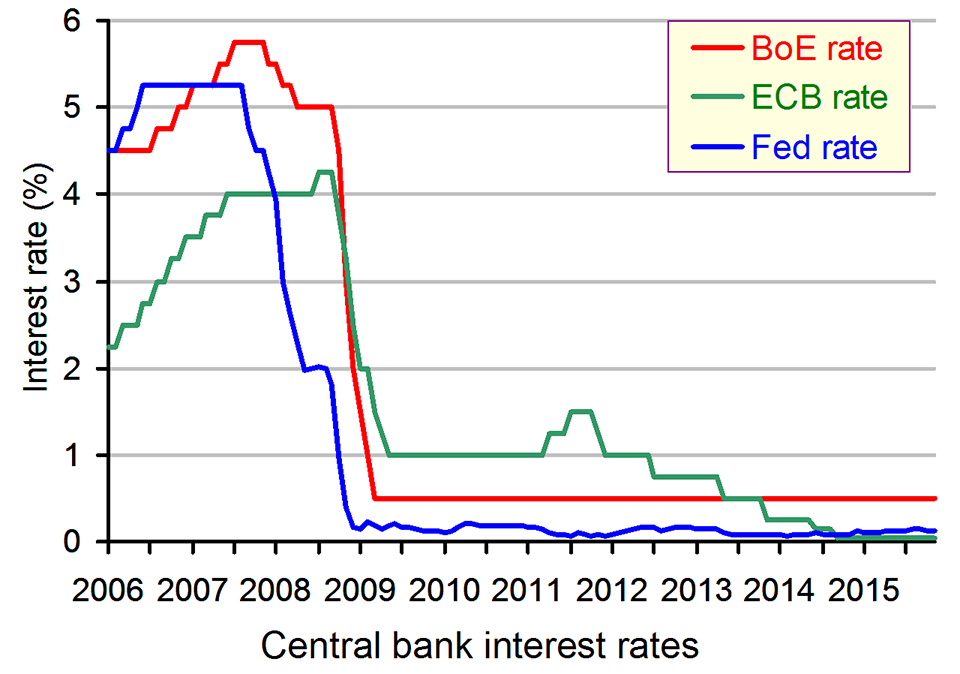 Although the latest news on interest rates may suggest some worrying times for the UK, the information contained in the Bank of England’s Inflation Report isn’t all bad. Despite its predictions that the growth rate of the world economy will slow and inflation will remain weak, the predictions from August remain largely the same. The suggestion that interest rates will remain at 0.5% and that any increases are likely to be at a slow pace will flatten the yield curve, and, with predictions that inflation will remain weak, there will be few concerns that continuing low rates will cause inflationary pressures in the coming months. Mark Carney said:
“The lower path for Bank Rate implied by market yields would provide more than adequate support to domestic demand to bring inflation to target even in the face of global weakness.”
However, there are many critics of keeping interest rates down, both in the UK and the USA, in particular because of the implications for asset prices, in particular the housing market and for the growth in borrowing and hence credit debt. The Institute of Directors Chief Economist, James Sproute said:
“There is genuine apprehension over asset prices, the misallocation of capital and consumer debt…Borrowing is comfortably below the unsustainable pre-crisis levels, but with debt once against rising there is a need for vigilance…The question is, will the Bank look back on this unprecedented period of extraordinary monetary policy and wish they had acted sooner? The path of inaction may seem easier today, but maintaining rates this low, for this long, could prove a much riskier decision tomorrow.”
hanges in the strength of the global economy will certainly have a role to play in forming the opinions of the Monetary Policy Committee and it will also be a key event when the Federal Reserve pushes up its interest rates. This is certainly an area to keep watching, as it’s not a question of if rates will rise, but when.
Articles
Bank of England dampens prospects of early UK rate rise BBC News (5/11/15)
Bank of England Governor gets his forward guidance on interest rates wrong Independent, Ben Chu (6/11/15)
Interest rates set to remain at rock-bottom right through 2016 as Bank of England cuts UK growth and inflation forecasts This is Money, Adrian Lowery (5/11/15)
 Pound slides as Bank of England suggests interest rates will stay low for longer – as it happened 5 November 2015 The Telegraph, Peter Spence (5/11/15)
UK’s record low interest rates should be raised next Februrary says NIESE The Telegraph, Szu Ping Chan (4/11/15)
Fresh signs of slowdown will force interest rates rise to be put on hold The Guardian, Katie Allen (2/11/15)
The perils of keeping interest rates so low The Telegraph, Andrew Sentence (6/11/15)
Time to ask why we are still in the era of ultra-low rates Financial Times, Chris Giles (4/11/15)
No interest rate rise until 2017: Joy for homeowners as Bank of England delays hike in mortgage costs again Mail Online, Matt Chorley (5/11/15)
Pound tumbles after Carney warns its strength threatens recovery Bloomberg, Lucy Meakin (5/11/15)
Is Carney hurt by wrong rate steer? BBC News, Robert Peston (5/11/15)
Data and Reports
Inflation Report Bank of England (August 2015)
Inflation Report Bank of England (November 2015)
Historical Fan Chart Data Bank of England (2015)
Questions
- Use and AD/AS diagram, explain how low interest rates affect the key components of aggregate demand and in turn how this will affect economic growth.
- What is meant by the ‘yield curve’? How has it been affected by the latest release from the Monetary Policy Committee?
- Why has the value of the pound been affected following the decision to keep interest rates at 0.5%?
- How has the sterling exchange rate changed and how might this affect UK exports?
- What are the main concerns expressed by those who think that there is a danger from keeping interest rates low for too long?
- Why is the outlook of the global economy so important for the direction of interest rate changes?
Interest rates are the main tool of monetary policy and crucially affect investment. There has been much discussion since the end of the financial crisis concerning when UK interest rates would eventually rise. Uncertainty over just when, and by how much, interest rates will rise affects business confidence and hence investment. Businesses therefore listen carefully to what the Bank of England says about future movements in Bank Rate. But Mark Carney has now spoken about another cause of uncertainty and its impct on investment. This is the uncertainty over the outcome of the referendum on whether the UK should leave the EU.
By 2017, the Prime Minister has promised a referendum on staying in the EU, but Mark Carney has urged for this to be held ‘as soon as possible’. Whether or not the UK remains in the EU will have a big effect on businesses and with the uncertainty surrounding the UK’s future, this may soon turn to a lack of investment.  As yet, businesses have not responded to this uncertainty, but the longer the delay for the referendum, the more inclined firms will be to postpone investment. As Mark Carney said:
“We talk to a lot of bosses and there has been an awareness of some of this political uncertainty – whether because of the election or because of the referendum … What they’ve been telling us, and we see it in the statistics, is they have not yet acted on that uncertainty – or to put it another way, they are continuing to invest, they are continuing to hire.”
Leaving the EU will have big effects on consumers and businesses, given that the EU is the UK’s largest market, trading partner and investor. With a referendum sooner rather than later, uncertainty will be more limited and any reaction by businesses will take place over a shorter time period. There are many other factors that affect business investment, some of which are related to the UK’s relationship with the EU and the following articles consider these issues.
EU referendum should be held ‘as soon as necessary’, says Mark Carney BBC News (14/5/15)
Business want an early EU referendum, Mark Carney indicates The Telegraph, Ben Riley-Smith (14/5/15)
EU poll should take place ‘as soon as necessary’, says Bank of England Chief The Guardian, Angela Monaghan (14/5/15)
Threat of business leaving the EU is fuelling business ‘uncertainty’, says Bank of England governor Mark Carney Mail Online, Matt Chorley (14/5/15)
Bank of England’s Mark Carney urges speedy EU referendum Financial Times, George Parker (14/5/15)
Questions
- Why is the EU important to the UK’s economic performance?
- If the UK were to leave the EU, what impact would this have on UK consumers?
- What would be the impact on UK firms if the UK were to leave the EU?
- Consider an AD/AS diagram and use this to explain the potential impact on the macroeconomic variables if the UK were to leave the EU.
- Why is uncertainty over the UK’s referendum likely to have an adverse effect on investment?
 The rate of inflation in the UK is measured using the Consumer Prices Index (CPI). This is made up of a basket of goods and the ONS updates this ‘basket’ each year to ensure it is representative of what the average UK household buys. The basket contains 703 items, with 110,000 individual prices collected each month.
In past years, items such as lip gloss have been added to the basket of goods, together with tablet computers and teenage fiction. In the recent update by the ONS, e-cigarettes have been added, together with specialist ‘craft’ beers and music streaming. On the other hand, other items have been removed, as the world changes. For example, during the recession, champagne was removed as an item that the representative household was no longer buying. In other cases, items are removed as they become outdated or obsolete with technology changing. This is the case with satellite navigation systems. As people turn to using their smartphones to navigate their way from A to B, satellite navigation systems are no longer seen as an item bought by the representative household.
The UK inflation rate is at an all-time low of 0.3% and there have been concerns that it may become negative, meaning we enter the world of deflation. However, if this does occur, many suggest that it is not bad deflation, as it is being driven by the extremely low oil prices. No matter what the inflation rate, the ONS will always continue to update the basket of goods that calculates inflation. It is therefore essential that these changes are made each year, as consumer buying habits do fluctuate considerably, as income changes, technology changes and general tastes change. The following articles consider what’s in and what’s out.
From craft beer to e-cigarettes, inflation basket reflects Britain’s changing shopping habits The Guardian, Katie Allen (17/3/15)
Inflation-measuring basket of goods adds protein powder, e-cigarettes The Grocer, Andrew Don (17/3/15)
E-cigareets and craft beers in updated inflation basket BBC News (17/3/15)
E-cigs added to inflation basket Mail Online (17/3/15)
Craft beer, e-cigarettes and protein shakes dded to price basket used to calculate inflation Independent, Hazel Sheffield (17/3/15)
U.K. hipsters and gym junkies win approval in new price basket Bloomberg, Tom Beardsworth (17/3/15)
Spotify in and sat navs out: take a look at the new inflation basket The Telegraph, Szu Ping Chan (17/3/15)
E-cigarettes, craft beer and Spotify enter UK inflation basket Reuters, Toby Melville (17/3/15)
Craft beer and e-cigarettes added to CPI basket Financial Times (17/3/15)
Questions
- What is the difference between the CPI and RPI? Which is usually higher? Explain your answer.
- Explain why champagne was removed from the basket of goods during the recession. What is sensible?
- How is the CPI calculated and hence how is inflation measured?
- Why has there been a movement towards chilled pizzas and away from frozen pizzas? Is the change likely to affect their relative price? Use a diagram to support your answer.
- What impact has technological progress had on the basket of goods that the representative household purchases? Do you think that technological progress make it more or less important for the basket of goods to be reviewed annually?
- Do you think products such as the iPad and e-cigarettes should be included in the CPI? Are they truly representative?
- In the BBC News article, you can access a list of the products that are ‘in and out’. Is there anything on there that you think should be in or that should be out? Be sure to justify your answer!
 George Osborne in his recent Autumn Statement, once again stressed that ‘the government is committed to strong, sustainable and balanced growth’. But while he plans to reduce government debt as a percentage of GDP, consumer debt is rising, both absolutely and as a percentage of household disposable income. The rise in household borrowing, and the resulting rise in consumer expenditure, has been the main factor driving economic growth. It has not been exports nor, until recently, investment, as the Chancellor had hoped. Indeed, investment in new housing is falling.