 The perceived wisdom is that nominal interest rates have a lower zero bound. The Swedish central bank (the Ricksbank) has effectively been charging financial institutions to deposit money at the central bank since 2009. On 29 January 2016 the Central Bank of Japan also introduced a negative interest rate on deposits. The -0.1 per cent rate currently applies to a portion of the reserves held by financial institutions at the central bank. The move is another attempt to pump energy into a struggling economy.
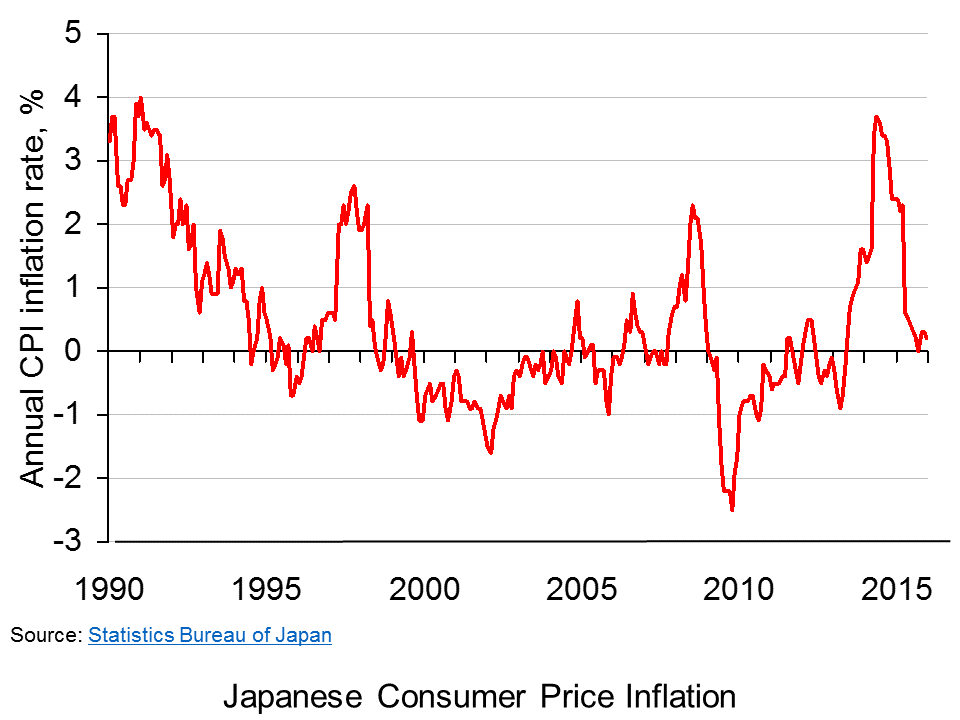 As the chart shows, since the mid 1990s there have been protracted periods of Japanese price deflation. In January 2013 Japan introduced a 2 per cent CPI inflation target. This was accompanied by a massive expansion of its quantitative easing programme, principally through purchases of government bonds from investors. Following the monetary loosening, buoyed too by a loosening of fiscal policy, the rate of inflation rose. It reached 3.7 per cent in May 2014.
However, through 2015 the rate of inflation began to fall sharply, partly the result of falling commodity prices, especially oil. Now there appears to be an increasing fear at the Bank of Japan that deflation may be set to return. The introduction of a negative deposit rate is intended to prevent deflation. In particular by affecting expectations of inflation. The hope is to prevent a deflationary mindset becoming re-established.
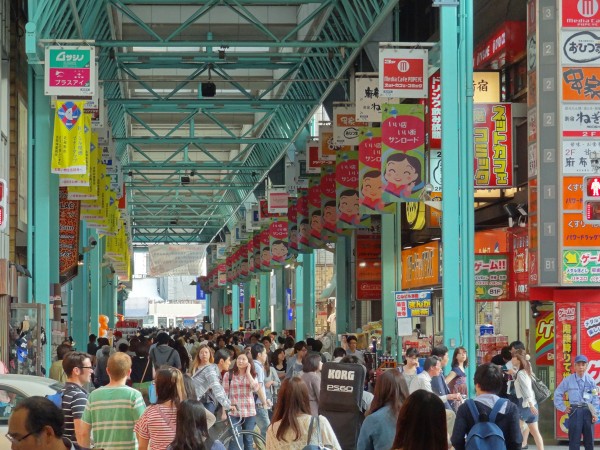 The further loosening of monetary policy through a negative interest rate follows on the heels of an acceleration of quantitative easing last October. Back then, the Bank of Japan said that it would conduct Open Market Operations so that the monetary base would increase annually be ¥80 trillion. This was reaffirmed in its 29 January announcement. For an economy that has experienced four recessionary contractions since 2008 and with provisional estimates suggesting that it contracted by 0.4 per cent in the final quarter of 2015, it remains to be seen whether further monetary loosening might yet be called for.
Data
Consumer Price Index Statistics Bureau of Japan
Articles
Bank of Japan adopts negative interest rate policy CNBC, Nyshka Chandran (29/1/16)
Japan adopts negative interest rate in surprise move BBC News (29/1/16)
Bank of Japan shocks markets by adopting negative interest rates Guardian, Justin McCurry (29/1/16)
Japan stuns markets by slashing interests rates into negative territory Telegraph, Mehreen Khan (29/1/16)
Japan introduces negative interest rate to boost economy The Herald, (29/1/16)
Questions
- What does a negative interest rate on deposits mean for depositors?
- What effect is the Bank of Japan hoping that a negative deposit rate will have on the Japanese economy? How would such effects be expected to occur?
- What effect might the Bank of Japan’s actions be expected to have on the structure of interest rates in the economy?
- How might the negative interest rate effect how people wish to hold their wealth?
- What are the dangers of deflation? Why is the Bank of Japan keen to avoid expectations of deflation becoming re-established?
- To what extent are national policy-makers able to exert pressure over the rate of inflation?
 Economics, but not as we know it. As the introduction to this programme on BBC radio 4 suggests, there has been criticism and concern about the way in which we think about economics. About, how it’s taught; the lessons we learn and whether we need to have a re-think. Tomas Sedlacek is a Czech economist and has a different way of thinking about this subject.
Humanomics is certainly a new way of thinking about economics and considering how it links and can be applied to a wide range of areas: the Bible; movies such as Fight Club and the Matrix. This 30 minute discussion between Evan Davies and Tomas Sedlacek provides some interesting insights and thoughts on some of the current challenges facing this subject and some novel insights into how we could change our thinking.
 Tomas Sedlacek: The Economics of Good and Evil BBC Radio 4 (25/01/16)
Questions
- How do we define and measure value? Is this always possible? Can you think of some things where we cannot assign prices or numbers to values?
- How could economics be relevant Adam and Eve?
- Think about the marriage market. How would you apply the model of demand and supply to this most unusual of markets?
- What insights does Tomas Sedlacek provide about the ancient business cycle and this might affect our thinking about debt and assets?
- Do you think that refugees are of benefit to a country? If you don’t think they are of benefit, does this mean that countries should not accept them?
- If we did find out that corruption or crime and terrorism were of benefit to the GDP of a country, would you encourage it? Or would you place the morality issue above the actual figure of contribution?
 As we saw in several posts on this site, last year was a tumultuous one for the Greek people and their economy. The economy was on the verge of bankruptcy; the Greek people rejected the terms of a bailout in a referendum; exit from the eurozone and having to return to the drachma seemed likely; banks were forced to closed at the height of the crisis; capital controls were imposed, with people restricted to drawing €60 a day or €420 a week – a policy still in force today; unemployment soared and many people suffered severe hardship.
To achieve the bailout, the Syriza government had to ignore the results of the referendum and agree to harsh austerity policies and sweeping market-orientated supply-side policies. This, at least, allowed Greece to stay in the eurozone. It held, and won, another election to seek a further mandate for these policies.
 But what are the prospects for 2016? Will it be a year of recovery and growth, with market forces working to increase productivity? Does 2016 mark the beginning of the end and, as prime minister Alexis Tsipras put it, “a final exit from economic crisis”?
Or will the continuing cuts simply push the economy deeper into recession, with further rises in unemployment and more and more cases of real human hardship? Is there a hysteresis effect here, with the past six years having created a demoralised and deskilled people, with cautious investors unable and/or unwilling to rebuild the economy?
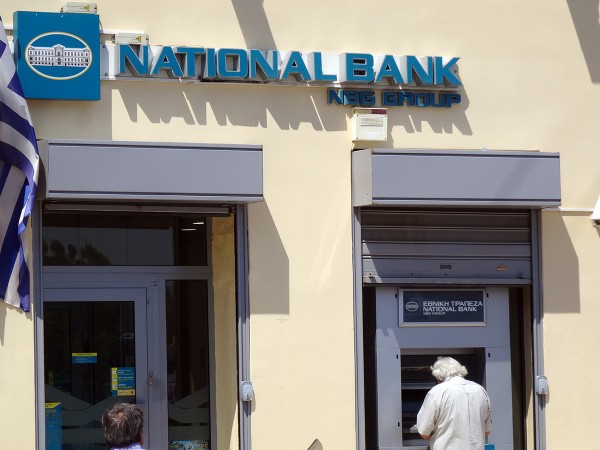 The article below looks at the rather gloomy prospects for Greece and at whether there are any encouraging signs. It also looks at the further demands of the troika of creditors – the IMF, the ECB and the European Commission’s European Stability Mechanism (ESM) – and at what the political and economic impact of these might be.
Greece’s economic crisis goes on, like an odyssey without end The Guardian, Helena Smith (4/1/16)
Questions
- Construct a timeline of Greece’s debt repayments, both past and scheduled, and of the bailouts given by the troika to prevent Greece defaulting.
- What supply-side reforms are being demanded by Greece’s creditors?
- What will be the effect of these supply-side reforms in (a) the short run; (b) the long run?
- Explain the meaning of hysteresis as it applies to an economy in the aftermath of a recession. How does the concept apply in the Greek situation?
- Discuss the alternative policy options open to the Greek government for tackling the persistent recession.
- Would it be better for Greece to leave the euro? Explain your arguments.
- “I cannot see how this government can survive the reforms. And I cannot see how it can avoid these reforms.” Is there any way out of this apparent impasse for the Greek government?
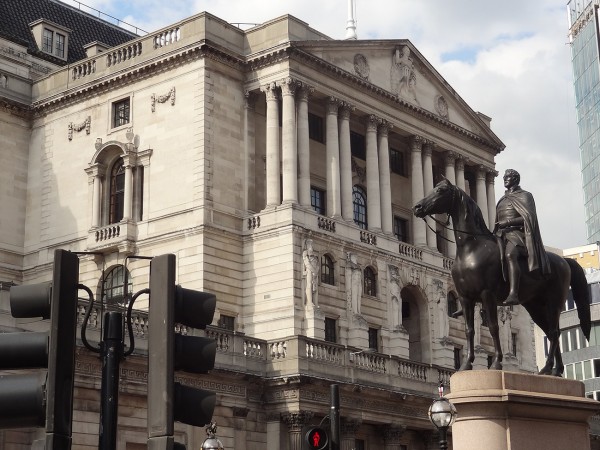 Sales during the weeks leading up to Christmas often make a significant contribution to retailers’ profits. For many consumers, it is a time to spend money on food, presents and decorations and this often means increased borrowing.
Data indicate that borrowing by consumers in the lead-up to Christmas increased by the biggest amount for almost 8 years: a figure of £1.5 billion. As a result, there were likely to have been many happy families at Christmas, with lots of gifts being exchanged. But what does this mean for the New Year? There are concerns about the increase we will see in consumer debt throughout 2016 and the number of borrowers who will, perhaps, be unable to repay their debts.
Could this significant increase in borrowing be a signal that we haven’t learnt from our past? This article from BBC News considers the borrowing data and their implications.
Borrowing jumped ahead of Christmas, Bank of England says BBC News, Brian Milligan (4/01/16)
Questions
- Is borrowing good or bad for the economy? Explain your answer.
- If borrowing is good for the economy, why are there concerns about the current level of borrowing?
- How will this higher level of borrowing affect aggregate demand? Use an AD/AS diagram to explain the impact this will have.
- Could this higher level of borrowing affect unemployment and inflation? In what ways?
- If interest rates had been higher, do you think the level of consumer borrowing would have been lower?
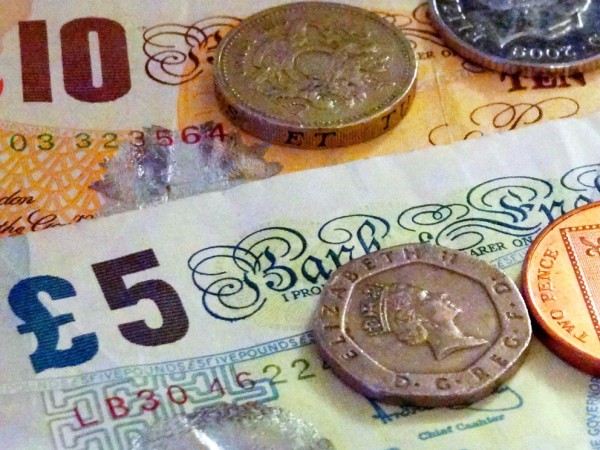 To what extent does history repeat itself? Minsky’s Financial Instability Hypothesis infers that credit cycles are fairly inevitable. We have seem them in the past and we will see them in the future. Human beings are subject to emotion, to irrational exuberance and to a large dose of forgetfulness! To what extent do the latest UK credit numbers suggest that we might be embarking on another credit binge? Are the credit data consistent with evidence of another credit cycle?
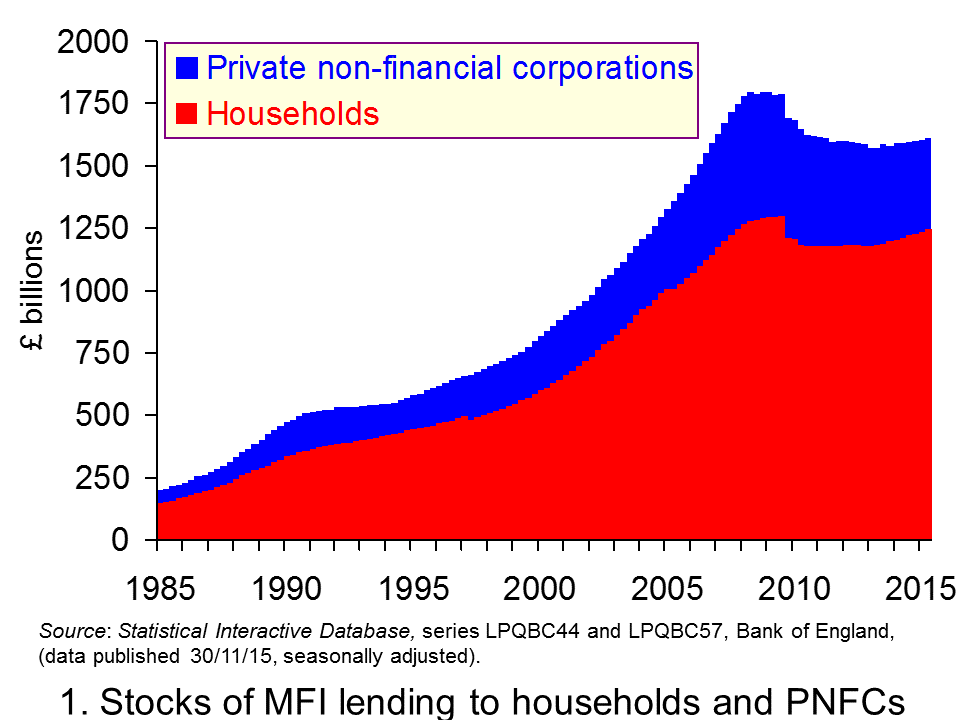 Chart 1 shows the stocks of debt acquired by households and private non-financial corporations from MFIs (Monetary Financial Institutions). The scale of debt accumulation in the late 1980s and again from the mid 1990s up to the financial crisis of the late 2000s is stark. At the start of 1985 the UK household sector had debts to MFIs of around £140 billion. By the start of 2009 this had hit £1.29 trillion. Meanwhile, private non-financial corporations saw their debts to MFIs rise from around £45 billion to over £500 billion. (Click here to download a PowerPoint of the chart.)
The path of debt at the start of the 2010s is consistent with a story of consolidation. Financially-distressed households, private non-financial corporations and, of course, MFIs themselves meant that corrective action was needed to repair their balance sheets. The demand for and supply of additional credit waned. Debt accumulation largely ceased and, in fact, debt numbers fell. This trend continues today for private non-financial corporations. But, for households debt accumulation resumed in the middle of 2013. At the end of the third quarter of 2015 the household sector had debt obligations to MFIs of £1.246 trillion.
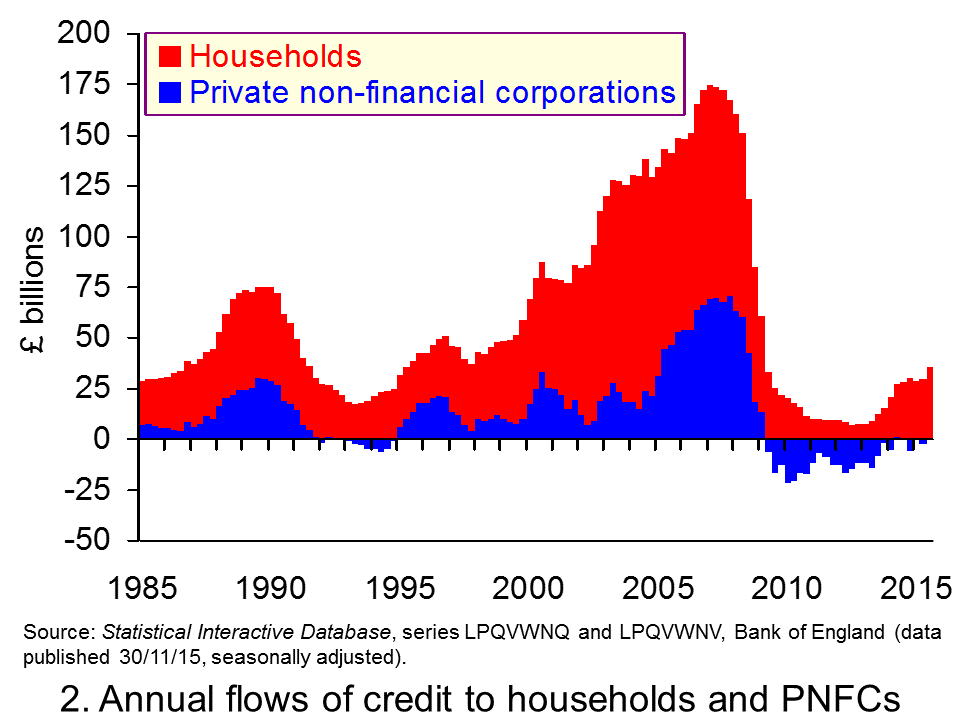 Chart 2 focuses on flows rather stocks. It allows us to see the accumulation of new credit (i.e. less repayments of debt). What is even more apparent from this chart is the evidence of cycles in credit. The growth in new credit during the 2000s is stark as is the subsequent squeeze on credit that followed.
The question that follows is what path are we now on? Clearly flows of credit to households are again on the rise. In part, this is driven by the rebound in the UK housing market. But, in fact there is a more rapid increase in consumer credit, i.e. unsecured debt. (Click here to download a PowerPoint of the chart.)
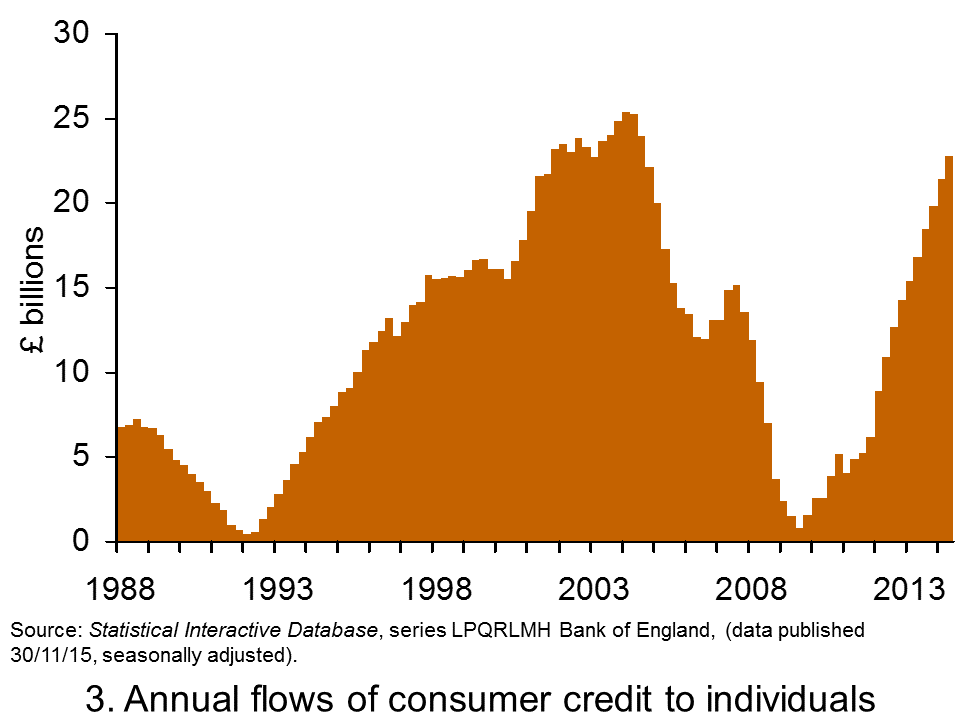 Chart 3 shows the flows of consumer credit from MFIs and other credit providers. Again, we see the marked evidence of cycles. In the year to the end of Q1 of 2015 net consumer credit flows amounted to £22.8 billion, the highest figure since the 12-month period up to the end of Q3 of 2005. Click here to download a PowerPoint of the chart.)
While it might be a little early to say that another Minsky cycle is well under way, policymakers will be keeping a keen eye on credit patterns. Is history repeating itself?
Articles
Average UK mortgage debt rises to £85,000 The Guardian, Phillip Inman (15/12/15)
Consumer spending rise troubles Bank of England The Guardian, Heather Stewart (24/11/15)
Recovery ‘too reliant on consumer debt’ as BCC downgrades forecast The Guardian, Heather Stewart (9/12/15)
BCC: UK Growth Too Reliant On Consumer Debt Sky News (9/12/15)
Interest rates will stay low for longer – but household debt is a worry, says BoE The Telegraph, Szu Ping Chan (24/11/15)
IMF: UK’s economic performance ‘very strong’, but risks remain BBC News (11/12/15)
Data
Bankstats (Monetary and Financial Statistics) – Latest Tables Bank of England
Statistical Interactive Database Bank of England
Questions
- How can the financial system affect the economy’s business cycle?
- What does it mean if households or firms are financially distressed? What responses might they take to this distress and what might the economic consequences be?
- How would you measure the net worth (or wealth) of an individual or a firm? What factors might affect their net worth?
- How might uncertainty affect spending and saving by households and businesses?
- What does it mean if bank lending is pro-cyclical?
- Why might lending be pro-cyclical?
- Are there measures that policymakers can take to reduce the likelihood that flows of credit become too excessive?
 The perceived wisdom is that nominal interest rates have a lower zero bound. The Swedish central bank (the Ricksbank) has effectively been charging financial institutions to deposit money at the central bank since 2009. On 29 January 2016 the Central Bank of Japan also introduced a negative interest rate on deposits. The -0.1 per cent rate currently applies to a portion of the reserves held by financial institutions at the central bank. The move is another attempt to pump energy into a struggling economy.
 The further loosening of monetary policy through a negative interest rate follows on the heels of an acceleration of quantitative easing last October. Back then, the Bank of Japan said that it would conduct Open Market Operations so that the monetary base would increase annually be ¥80 trillion. This was reaffirmed in its 29 January announcement. For an economy that has experienced four recessionary contractions since 2008 and with provisional estimates suggesting that it contracted by 0.4 per cent in the final quarter of 2015, it remains to be seen whether further monetary loosening might yet be called for.