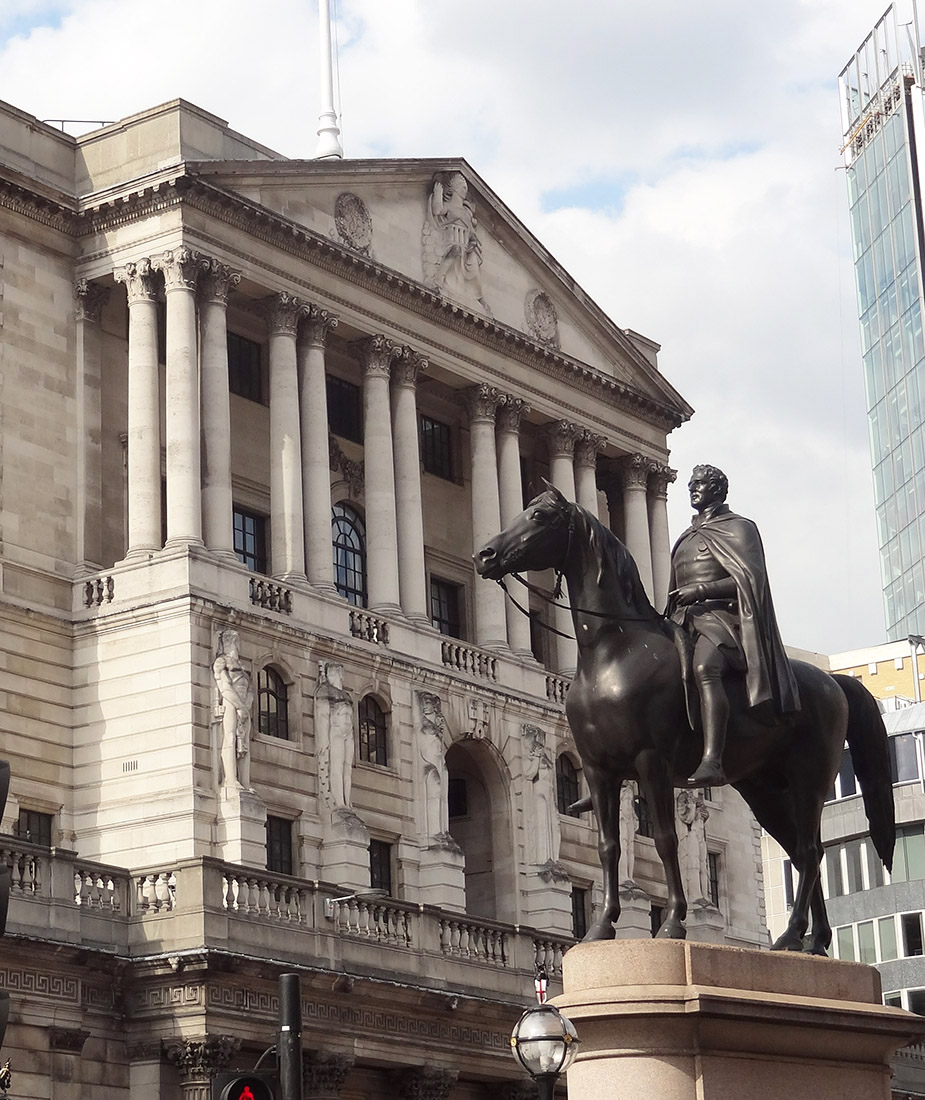
 House prices have been rising strongly in London. According to the Halifax House Price index, house prices in London in the first quarter of 2014 were 15.5% higher than a year ago. This compares with 8.7% for the UK as a whole, 1.3% for the North of England and –1.5% for Scotland. CPI inflation was just 1.6% for the same 12-month period.
The London housing market has been stoked by rising incomes in the capital, by speculation that house prices will rise further and by easy access to mortgages, fuelled by the government’s Help to Buy scheme, which allows people to put down a deposit of as little as 5%. House prices in London in the first quarter of 2014 were 5.3 times the average income of new mortgage holders, up from 3.5 times in the last quarter of 2007, just before the financial crisis.
Concerns have been growing about increasing levels of indebtedness, which could leave people in severe financial difficulties if interest rates were to rise significantly. There are also concerns that an increasing proportion of people are being priced out of the housing market and are being forced to remain in the rental sector, where rents are also rising strongly.
But how can the housing market in London be dampened without dampening the housing market in other parts of the country where prices are barely rising, and without putting a break on the still relatively fragile recovery in the economy generally?
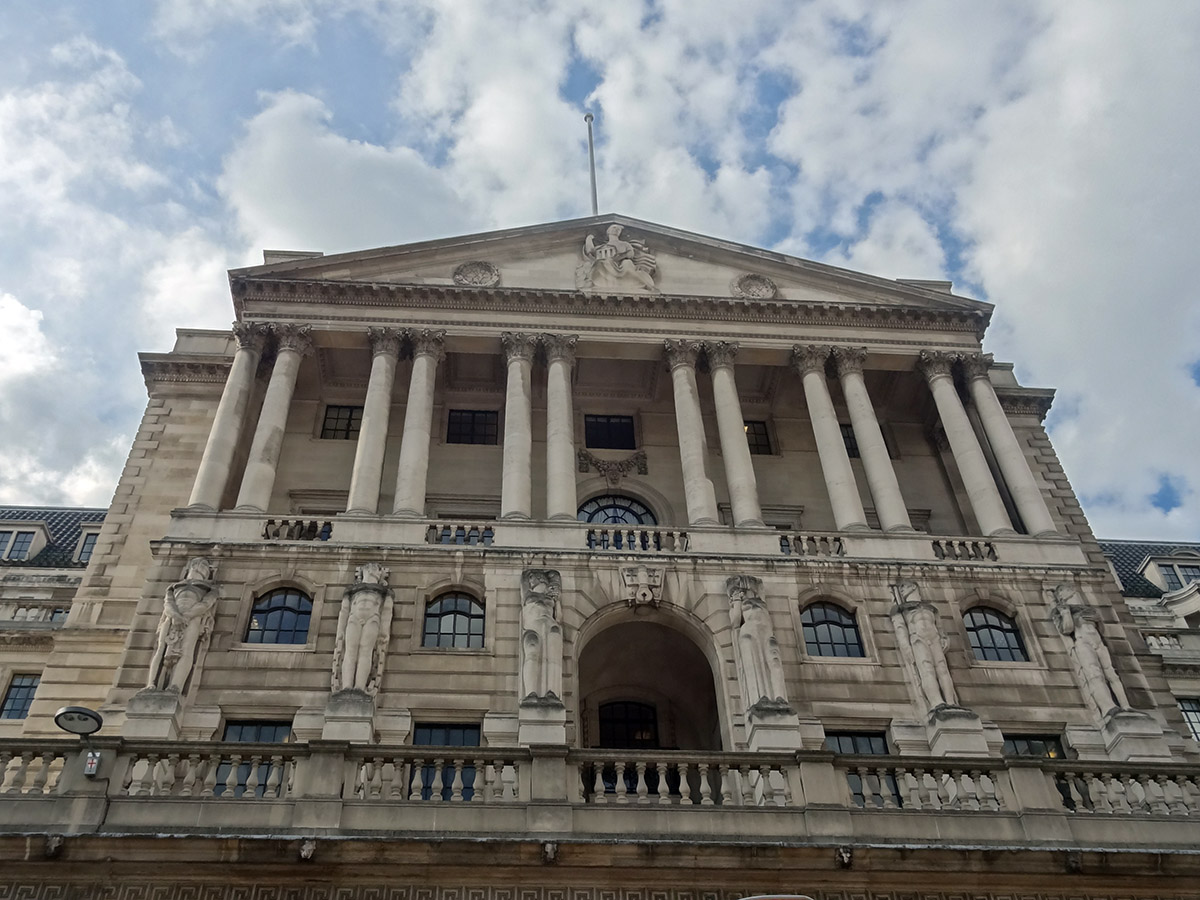
The Governor of the Bank of England has just announced two new measures specific to the housing market and which would apply particularly in London.
The first is to require banks to impose stricter affordability tests to new borrowers. Customers should be able demonstrate their ability to continue making their mortgage payments if interest rates were 3 percentage points higher than now.
The second is that mortgage lenders should restrict their lending to 4½ times people’s income for at least 85% of their lending.
Critics are claiming that these measures are likely to be insufficient. Indeed, Vince Cable, the Business Secretary, has argued for a limit of 3½ times people’s income. Also banks are already typically applying a ‘stress test’ that requires people to be able to afford mortgage payments if interest rates rose to 7% (not dissimilar to the Bank of England’s new affordability test).
The videos and articles look at the measures and consider their adequacy in dealing with what is becoming for many living in London a serious problem of being able to afford a place to live. They also look at other measures that could have been taken.
Webcasts and Podcasts
 The Bank of England announces plans for a new affordability test BBC News (26/6/14)
Bank of England moves to avert housing boom BBC News, Simon Jack (26/6/14)
Bank of England to act on house prices in south-east BBC News, Robert Peston (25/6/14)
Bank of England measures ‘insure against housing boom’ BBC News, Robert Peston (26/6/14)
Carney: There is a ‘new normal’ for interest rates BBC Today Programme, Mark Carney (27/6/14)
Articles
Bank of England imposes first limits on size of UK mortgages Reuters, Ana Nicolaci da Costa and Huw Jones (26/6/14)
Stability Report – Mark Carney caps mortgages to cool housing market: as it happened June 26, 2014 The Telegraph, Martin Strydom (26/6/14)
Bank of England cracks down on mortgages The Telegraph, Szu Ping Chan (26/6/14)
Mortgage cap ‘insures against housing boom’ BBC News (26/6/14)
Viewpoints: Is the UK housing market broken? BBC News (26/6/14)
How can UK regulators cool house prices? Reuters (25/6/14)
Bank will not act on house prices yet, says Carney The Guardian, Jill Treanor and Larry Elliott (26/6/14)
Mark Carney’s housing pill needs time to let economy digest it The Guardian, Larry Elliott (26/6/14)
Bank Of England Admits Plans To Cool Housing Market Will Have ‘Minimal’ Impact Huffington Post, Asa Bennett (26/6/14)
Carney Surprises Are Confounding Markets as U.K. Central Bank Manages Guidance Bloomberg, Scott Hamilton and Emma Charlton (26/6/14)
House prices: stop meddling, Mark Carney, and bite the bullet on interest rates The Telegraph, Jeremy Warner (27/6/14)
Mark Carney’s Central Bank Mission Creep Bloomberg, Mark Gilbert (26/6/14)
Consultation paper
Implementing the Financial Policy Committee’s Recommendation on loan to income ratios in mortgage lending Bank of England (26/6/14)
Bank of England consults on implementation of loan-to-income ratio limit for mortgage lending Bank of England News Release (26/6/14)
Data
Links to sites with data on UK house prices Economic Data freely available online, The Economics Network
Questions
- Identify the main factors on the demand and supply sides that could cause a rise in the price of houses. How does the price elasticity of demand and supply affect the magnitude of the rise?
- What other measures could have been taken by the Bank of England? What effect would they have had on the economy generally?
- What suggests that the Bank of England is not worried about the current situation but rather is taking the measures as insurance against greater-than-anticipated house price inflation in the future?
- Why are UK households currently in a ‘vulnerable position’?
- What factors are likely to determine the future trend of house prices in London?
- Is house price inflation in London likely to stay significantly above that in other parts of the UK, or is the difference likely to narrow or even disappear?
- Should the Bank of England be given the benefit of the doubt in being rather cautious in its approach to dampening the London housing market?
 The spectre of deflation haunts the eurozone economy. Inflation in the 12 months to May 2014 was 0.5%, down from 0.7% to April and well below the target of 2% (see). Price deflation can result in deflation of the whole economy. With the prospect of falling prices, many consumers put off spending, hoping to buy things later at a lower price. This delay in spending deflates aggregate demand and can result in a decline in growth or even negative growth: hardly a welcome prospect as the eurozone still struggles to recover from the long period of recession or sluggish growth that followed the 2007–8 financial crisis.
The ECB is well aware of the problem. Its President, Mario Draghi, has stated on several occasions that the central bank will do whatever it takes to ward off deflation and stimulate recovery. At its monthly meeting on 5 June, the ECB Council acted. It took the following measures (see Mario Draghi’s press conference and the press release):
• The main refinancing rate it charges banks on reverse repos (when using open-market operations) was cut from 0.25% to 0.15%.
• The rate it pays banks for depositing money in the ECB was cut from 0% to –0.1%. In other words, banks would be charged for ‘parking’ money with the ECB rather than lending it.
• It will provide targeted lending to banks (targeted longer-term refinancing operations (TLTROs)), initially of 7% of the total amount of each banks’ loans to the non-financial private sector within the eurozone. This will be provided in two equal amounts, in September and December 2014. These extra loans will be for bank lending to businesses and households (other than for house purchase). The total amount will be some €400 billion. Substantial additional lending will be made available quarterly from March 2016 to June 2016.
• It will make preparations for an asset purchase scheme. Unlike that in the UK, which involves the purchase of government bonds, this will involve the purchase of assets which involve claims on private-sector (non-financial) institutions. Depending on financing arrangements, this could amount to quantitative easing.
 • It will suspend sterilising the extra liquidity that has been injected under the Securities Markets Programme (operated from May 2010 to September 2012), which involved purchasing eurozone countries’ existing bonds on the secondary market. In other words it will stop preventing the securities that have been purchased from increasing money supply. This therefore, for the first time, represents a genuine form of quantitative easing.
The question is whether the measures will be enough to stimulate the eurozone economy, prevent deflation and bring inflation back to around 2%. The measures are potentially significant, especially the prospect of quantitative easing – a policy pursued by other main central banks, such as the Fed, the Bank of England and the Bank of Japan. A lot depends on what the ECB does over the coming months.
The following articles consider the ECB’s policy. The first ones were published before the announcement and look at alternatives open to the ECB. The others look at the actual decisions and assess how successful they are likely to be.
Articles published before the announcement
Mario Draghi faces moment of truth as man with power to steady eurozone The Observer, Larry Elliott (1/6/14)
What the ECB will do in June? Draghi spells it out The Economist (26/5/14)
Draghi as Committed as a Central Banker Gets, as Economists Await ECB Stimulus Bloomberg, Alessandro Speciale and Andre Tartar (19/5/14)
ECB’s credit and credibility test BBC News, Robert Peston (2/6/14)
90 ECB decamps to debate monetary fixes Financial Times, Claire Jones (25/5/14)
Speech
Monetary policy in a prolonged period of low inflation ECB, Mario Draghi (26/5/14)
Articles published after the announcement
ECB launches €400bn scheme, seeks to force bank lending Irish Independent (5/6/14)
The ECB’s toolbox BBC News, Linda Yueh (5/6/14)
ECB’s justified action will help but is no panacea for eurozone deflationary ills The Guardian, Larry Elliott (5/6/14)
Why Negative Rates Won’t Work In The Eurozone Forbes, Frances Coppola (4/6/14)
Germany’s fear of QE is what’s stopping us from cracking open the Cava The Telegraph, Roger Bootle (8/6/14)
Data
Euro area economic and financial data ECB
Questions
- Why has the eurozone experienced falling inflation and a growing prospect of negative inflation?
- Explain how the Securities Markets Programme (SMP) worked (check it out on the ECB site). What countries’ bonds were purchased and why?
- What is meant by sterilisation? Why did the ECB sterilise the effects of the assets purchased under the SMP?
- If it is practical for the ECB to set a negative interest rate on the deposit facility for banks, would it be practical to set a negative interest rate for the main refinancing operations or the marginal lending facility? Explain.
- Why has the ECB, up to now, been unwilling to engage in quantitative easing? What has changed?
- Why may the introduction of a negative interest rate on bank deposits in the ECB have only a very small effect on bank lending?
- How much is broad money supply growing in the eurozone? Is this enough or too much? Explain.
- What else could the ECB have done to ward off deflation? Should the ECB have adopted these measures?
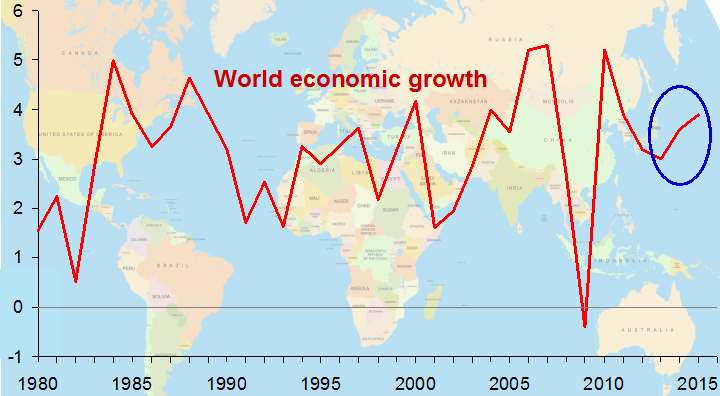 The IMF has just published its 6-monthly World Economic Outlook report. The report is moderately optimistic, arguing that ‘global activity has broadly strengthened and is expected to improve further in 2014–15’. World growth is expected to rise from 3.0% in 2013 to 3.6% in 2014 and 3.9% in 2015,
Much of the impetus for an acceleration in growth is expected to come from advanced countries. Growth in these countries is expected to average 2¼% in 2014–15, a rise of 1 percentage point compared with 2013. Part of the reason is that these countries still have large output gaps and thus have considerable scope to respond to rises in aggregate demand.
Monetary policy in advanced countries remains accommodative, although the USA has begun to taper off its quantitative easing programme. It is possible, however, that the ECB may make its monetary policy more accommodative, with signs that it might embark on quantitative easing if eurozone growth remains weak and if the risks of deflation rise. If the average price level in the eurozone does fall, this could dampen demand as consumers defer consumption until prices have fallen.
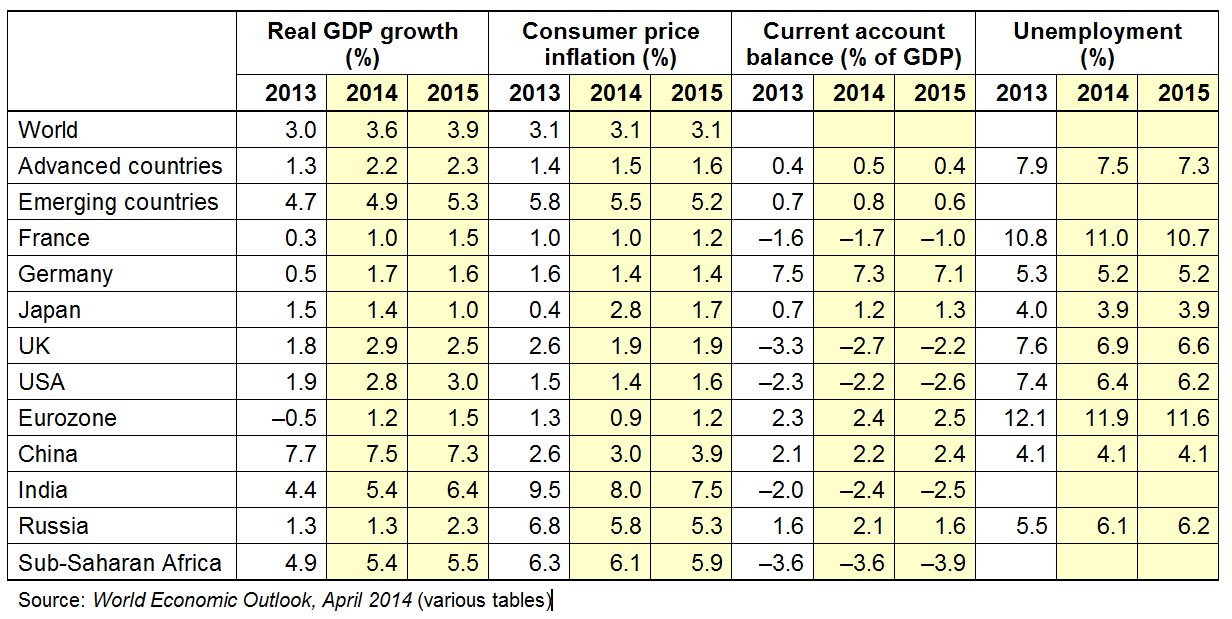
As far as emerging economies are concerned, growth is projected to ‘pick up gradually from 4.7 percent in 2013 to about 5 percent in 2014 and 5¼% in 2015’. Although predicted growth is higher in emerging countries than in advanced countries, its acceleration is less, and much of the predicted growth is dependent on rising export sales to the advanced countries.
Global growth, however, is still fragile. Emerging market economies are vulnerable to a slowing or even reversal of monetary flows from the USA as its quantitative easing programme winds down. Advanced countries are vulnerable to deflationary risks. ‘The result [of deflation] would be higher real interest rates, an increase in private and public debt burdens, and weaker demand and output.’
The UK is predicted to have the strongest growth (2.9%) of the G7 countries in 2014 (see above chart). But the IMF cautions about being too optimistic:
Growth has rebounded more strongly than anticipated in the United Kingdom on easier credit conditions and increased confidence. However, the recovery has been unbalanced, with business investment and exports still disappointing.
Articles
IMF: World economy stronger; recovery uneven USA Today, Paul Davidson (8/4/14)
Emerging markets feel the pressure The Telegraph, Szu Ping Chan (8/4/14)
IMF cuts downturn danger to near zero Financial Times, Chris Giles (8/4/14)
IMF warns eurozone and ECB on deflation threat RTE News (8/4/14)
Recovery strong but risk shifts to emerging markets: IMF CNBC, Kiran Moodley (8/4/14)
IMF: World economy is stronger but faces threats Bloomberg Businessweek, Christopher S. Rugaber (8/4/14)
IMF: UK economic growth to reach 2.9% in 2014 BBC News (8/4/14)
IMF: UK economic growth to reach 2.9% in 2014 BBC News, Hugh Pym (8/4/14)
Five signs that the global economic recovery may be an illusion The Guardian, Larry Elliott (6/4/14)
Report and data
World Economic Outlook (WEO) International Monetary Fund (8/4/14)
World Economic Outlook Database IMF (8/4/14)
Questions
- Why does the IMF expect the world economy to grow more strongly in 2014 and 2015 than in 2013?
- What are the greatest risks to economic growth for (a) advanced countries; (b) developing countries?
- What geo-political events could negatively affect economic growth in (a) the eurozone; (b) the global economy?
- In what ways is the UK’s economic growth unbalanced?
- How much credence should be given to economic forecasts?
- Should countries’ economic performance be judged primarily by their growth in GDP?
 In August 2012, the ECB president, Mario Draghi, said that the ECB would ‘do whatever it takes‘ to hold the single currency together and support the weaker economies, such as Greece, Portugal and Spain. At the same time, he announced the introduction of outright monetary purchases (OMTs), which would involve purchasing eurozone countries’ bonds in the secondary markets. There were no limits specified to such purchases, but they would be sterilised by the sale of other assets. In other words, they would not increase the eurozone money supply. But despite the fanfare when OMTs were announced, they have never been used.
Today, the eurozone economy is struggling to grow. The average annual growth rate across the eurozone is a mere 0.5%, albeit up from the negative rates up to 2013 Q3. GDP is still over 2% below the peak in 2008. Inflation is currently standing at 0.8%, well below the 2% target. The ECB’s interest rate (‘main refinancing operations rate’) is 0.25%.
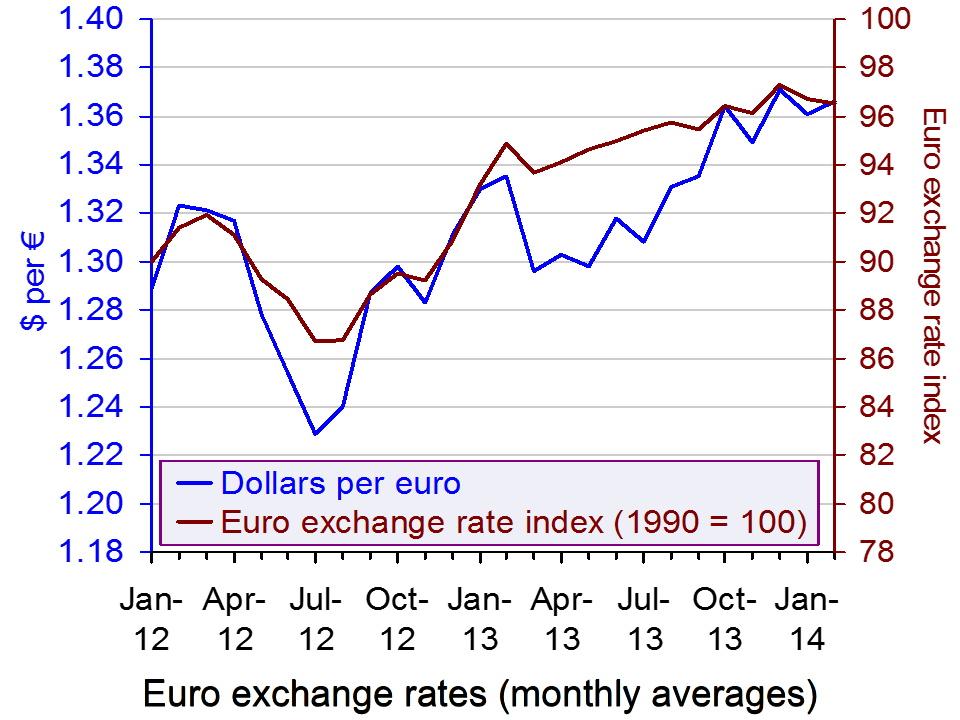
The recovery is hindered by a strong euro. As the chart shows, the euro has been appreciating against the dollar. The euro exchange rate index has also been rising. This has made it harder for the eurozone countries to export.
So what can the ECB do to stimulate the eurozone economy? Other central banks, such as the Bank of England, the US Federal Reserve and the Bank of Japan have all had substantial programmes of quantitative easing. The ECB has not. Perhaps OMTs could be used without sterilisation. The problem here is that there are no eurozone bonds issued by the ECB and hence none that could be purchased, only the bonds of individual member countries. Buying bonds of weaker countries in the eurozone would be seen as favouring these countries and might create a moral hazard.
Reducing interest rates is hardly an option given that they are at virtually zero already. And expansionary fiscal policy in the weaker countries has been ruled out by having to stick to the bailout conditions for these countries, which require the pursuit of austerity policies.
One possibility would be to intervene in the foreign currency market by buying US and other countries’ bonds. This would drive down the euro and provide a stimulus to exports. This option is considered in the Jeffrey Frankel article.
Articles
Why the European Central Bank should buy American The Guardian, Jeffrey Frankel (13/3/14)
Draghi holds course in face of deflation threat Reuters, Paul Carrel and Leika Kihara (13/3/14)
ECB’s Draghi: Strong Euro Pulling Down Euro Zone Inflation Wall Street Journal, Christopher Lawton and Todd Buell (13/3/14)
Draghi Bolstering Guidance Seen as Convincing on Rates Bloomberg, Jeff Black and Andre Tartar (13/3/14)
ECB president Mario Draghi counters euro upswing Financial Times, Claire Jones (13/3/14)
Turning Japanese? Euro zone exporters must hope not Reuters, Neal Kimberley (14/3/14)
Prospect of ECB QE drives eurozone bond rally Financial Times, Laurence Mutkin (12/3/14)
Data
Statistical Data Warehouse ECB
Winter forecast 2014 – EU economy: recovery gaining ground European Commission: Economic and Financial Affairs DG
AMECO online European Commission: Economic and Financial Affairs DG
Questions
- Why is the ECB generally opposed to quantitative easing of the type used by other central banks?
- What is meant by ‘sterilisation’? Why does sterilisation prevent OMTs being classed as a form of quantitative easing?
- Would it be possible for OMTs to be used without sterilisation in such as way as to avoid a moral hazard for the highly indebted eurozone countries?
- Is the eurozone in danger of experiencing deflation?
- What are the dangers of deflation?
- Why does the ECB not cut its main refinancing rate below zero?
- If the ECB buys US bonds, what effect would this have on the euro/dollar exchange rate?
- Would purchasing US bonds affect the eurozone money supply? Explain.
- What other means are there of the ECB stimulating the eurozone economy? How effective would they be likely to be?
 With the publication of the February 2014 Inflation Report the Bank of England has adjusted its forward guidance to the markets.
As we saw in Part 1 of this blog, the economy should soon fall below the 7% unemployment threshold adopted in the original forward guidance issued last August. But the Bank feels that there is still too much slack in the economy to raise interest rates when unemployment does fall below 7%.
The Bank has thus issued a new vaguer form of forward guidance.
The MPC’s view is that the economy currently has spare capacity equivalent to about 1%–1½% of GDP, concentrated in the labour market. Around half of that slack reflects the difference between the current unemployment rate of 7.1% and an estimate of its
medium-term equilibrium rate of 6%–6½%. The remaining slack largely reflects a judgement that employees would like to work more hours than is currently the case. Companies appear to be operating at close to normal levels of capacity, although this is subject to some uncertainty.
The existence of spare capacity in the economy is both wasteful and increases the risk that inflation will undershoot the target in the medium term. Moreover, recent developments in inflation mean that the near-term trade-off between keeping inflation close to the target and supporting output and employment is more favourable than at the time the MPC announced its guidance last August: CPI inflation has fallen back to the 2% target more quickly than anticipated and, with domestic costs well contained, is expected to remain at, or a little below, the target for the next few years. The MPC therefore judges that there remains scope to absorb spare capacity further before raising Bank Rate.
Just what will determine the timing and pace of tightening? The Bank identifies three factors: the sustainability of the recovery; the extent to which supply responds to demand; and the evolution of cost and price pressures. But there is considerable uncertainty about all of these.
Thus although this updated forward guidance suggests that interest rates will not be raised for some time to come, even when unemployment falls below 7%, it is not at all clear when a rise in Bank Rate is likely to be, and then how quickly and by how much Bank Rate will be raised over subsequent months. Partly this is because of the inevitable uncertainty about future developments in the economy, but partly this is because it is not clear just how the MPC will interpret developments.
So is this new vaguer forward guidance helpful? The following articles address this question.
Articles
Bank of England Governor Carney’s statement on forward guidance Reuters (12/2/14)
Why has Mark Carney tweaked forward guidance? The Telegraph, Denise Roland (12/2/14)
Interest rates: Carney rips up ‘forward guidance’ policy Channel 4 News (12/2/14)
Forward guidance version 2: will the public believe it? The Guardian, Larry Elliott (12/2/14)
Mark Carney adjusts Bank interest rate policy BBC News (12/2/14)
Mark Carney’s almost promise on rates BBC News, Robert Peston (12/2/14)
Did the Bank of England’s Forward Guidance work? Independent, Ben Chu (2/2/14)
Forward Guidance 2.0: Is Carney just digging with a larger shovel? Market Watch, The Tell (12/2/14)
The U.K. Economy: Five Key Takeaways Wall Street Journal, Alen Mattich (12/2/14)
Bank of England pages
Inflation Report, February 2014 Bank of England (12/2/14)
Monetary Policy Bank of England
MPC Remit Letters Bank of England
Forward Guidance Bank of England
Questions
- Summarize the new forward guidance given by the Bank of England.
- Why is credibility an important requirement for policy?
- What data would you need to have in order to identify the degree of economic slack in the economy?
- Why is it difficult to obtain such data – at least in a reliable form?
- What is meant by the ‘output gap’? Would it be a good idea to target the output gap?
- Is it possible to target the rate of inflation and one or more other indicators at the same time? Explain.
 House prices have been rising strongly in London. According to the Halifax House Price index, house prices in London in the first quarter of 2014 were 15.5% higher than a year ago. This compares with 8.7% for the UK as a whole, 1.3% for the North of England and –1.5% for Scotland. CPI inflation was just 1.6% for the same 12-month period.