 Unemployment is a term that economists and non-economists are familiar with, even if the non-economists perhaps have a less stringent definition of what we term unemployment. Typically, we say you are unemployed if you are of working age and available for work at the current wage rate, but are not in work. Another important and related concept is that of underemployment, which according to the ONS, is a growing problem in the economy.
Latest figures released by the ONS show that just over 10% of all workers in the UK would like to work more hours each week. This is essentially what underemployment is and it typically affects part-time workers who want to move closer to a full-time job, but are unable to find the necessary hours from their employer. As the economic situation in the UK worsened after the financial crisis, unemployment increased rapidly. Some people went from working full-time to part-time and others simply lost their job. As the economy started to stabilize, people began returning to work, but many found that part-time employment was the only option, despite wanting to work many more hours at the going wage rate. As the ONS said:
During this period [the economic downturn] many workers moved from full-time to part-time roles and many of those returning to work after a period of unemployment could only find part-time jobs … Of the extra one million underemployed workers in 2012 compared with 2008, three-quarters were in part-time posts.
The increase in underemployment has levelled off and though the recession has been a key contributing factor to the higher levels of underemployment, it’s important to note that it can be caused by a few things, as outlined by the ONS.
• employers only being able to offer a few hours of work each week
• workers, such as bar staff, being in jobs where they are only required for a few hours a day
• personal circumstances changing so that someone now wants to work more hours than before
• people settling for a part-time job as second-best when they would much rather have a full-time one
 Although many people are happy with their part-time jobs and hence would not see themselves as underemployed, for those who are underemployed, the fact that they cannot find sufficient hours seems to indicate an inefficiency within the economy, especially if long-term unemployment or underemployment emerges. This problem is particularly relevant amongst the young and those in low-skilled jobs. However, it is also an increasing problem amongst the self-employed.
The implications of underemployment are far-reaching. Naturally it adversely affects an individual’s financial situation, which at the current time with rising household bills can have devastating consequences. There are also wider effects such as the economic implications in terms of economic growth and inefficiency, as well as a potential increased strain on the tax and benefits system. Given these far-reaching consequences, it is an issue that everyone should be concerned about. The following articles consider the growth of underemployment in the UK economy.
Underemployed workers jump by 1m since financial crisis Telegraph, Rebecca Clancy (28/11/12)
 Underemployment affects 10.5% of UK workforce (including video) BBC News (28/11/12)
Economic crash leaves an extra 1million workers under-employed and wanting more hours Mail Online (28/11/12)
UK is underemployed: should we be surprised? BBC News, Stephanomics, Stephanie Flanders (28/11/12)
Unemployment affects 1 in 10 workers, ONS says Guardian, Mark King (28/11/12)
One in 10 workers no underemployed Financial Times, Brian Groom (28/11/12)
Underemployment rises to affect one in ten workers Channel 4 News (28/11/12)
Questions
- What is the difference between unemployment and underemployment? Is one worse than the other?
- Why did underemployment initially begin to rise after the financial crisis and what factors helped to slow the increase?
- How can underemployment be measured? Is it likely to be accurate?
- Part-time work has risen in recent decades, as part of a more flexible labour market. Do you think this is a good thing or does it add to the problem of underemployment?
- What are the economic implications of underemployment? You should think about the effects on an individual, their family, society and the wider economy.
- How can someone who is self-employed be classed as underemployed?
- What action, if any, can be taken by the government to tackle the rising problem of underemployment?
 UK Unemployment figures for the July to September period have just been published. Perhaps surprisingly, the rate has fallen to 7.8% from 8.0% in the previous 3-month period. What is more, there have been similar 0.2 percentage-point falls in each of the two 3-month periods prior to that (see chart below).
This would normally suggest that the economy has been growing strongly and faster than the growth in potential output. But, despite positive economic growth in quarter 3 (see A positive turn of events?), the economy has been experiencing a prolonged period of low or negative growth.
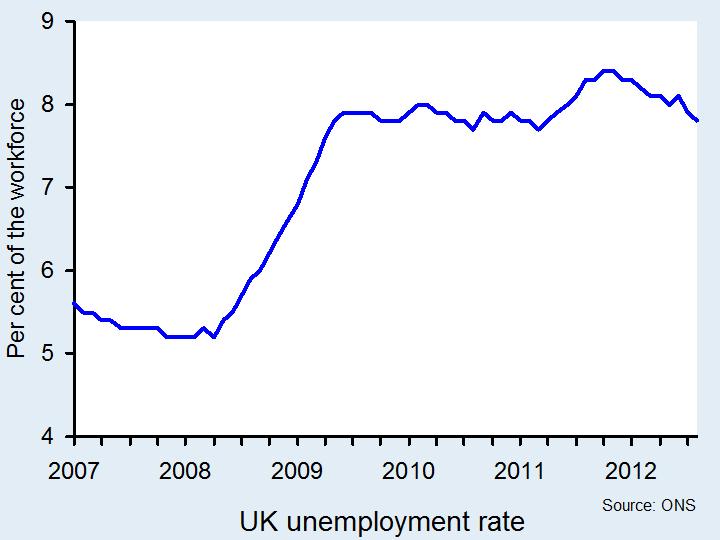
So what is the explanation for the fall in unemployment? (For a PowerPoint of the chart, click here)
One reason is a greater flexibility in the labour market than in previous recessions. People are more willing to accept below inflation wage increases, or even nominal wage cuts, in return for greater job security. Others are prepared to reduce their hours.
The other reason is a fall in productivity (i.e. output per hour worked). One explanation is that people are not working so hard because, with a lack of demand, there is less pressure on them to be productive; a similar explanation is that firms are ‘hoarding’ labour in the hope that the market will pick up again.
Another explanation is that employment growth has often occurred in the low productivity industries, such as labour-intensive service industries; another is that when people leave their jobs they are replace by less productive workers on lower wages; another is that workers are making do with ageing equipment, whose productivity is falling, because firms cannot afford to invest in new equipment. An range of possible explanations is given on page 33 of the Bank of England’s November 2012 Inflation Report.
But with many predicting that growth will be negative again in 2012 quarter 4, the fall in unemployment may not continue. Britain may join many other countries in Europe and experience rising unemployment as well as falling output.
Articles
Government hails fall in jobless total The Guardian, Hélène Mulholland (14/11/12)
UK unemployment figures: analysis The Guardian, Larry Elliott (14/11/12)
Jobless claims rise as Olympics effect wanes The Telegraph, Rachel Cooper and Louisa Peacock (14/11/12)
UK unemployment falls to 2.51 million, ONS says BBC News (14/11/12)
Unemployment continuing to fall BBC News, Stephanie Flanders (14/11/12)
Britain’s recession: Harsh but fair? BBC News, Stephanie Flanders (17/10/12)
The UK productivity puzzle (cont’d) BBC News, Stephanie Flanders (20/9/12)
UK jobs: The plot thickens BBC News, Stephanie Flanders (15/8/12)
Data
Unemployment: the key UK data and benefit claimants for every constituency Guardian Data Blog
Labour Market Statistics, November 2012 ONS
Video Summary: Latest on the Labour Market, November 2012 ONS
Labour Productivity, Q2 2012 ONS
International Comparisons of Productivity, First estimates for 2011 ONS
Questions
- What possible explanation are there for the latest fall in unemployment?
- What has been happening to employment, both full time and part time?
- What are the different ways of measuring productivity? Why will they be affected differently by a fall in the average number of hours worked?
- Why might it be in firms’ interests to maintain the level of their workforce despite falling sales?
- Assume that there has been a fall in aggregate demand. Compare the resulting effect on consumption of (a) a fall in wages rates; (b) a rise in unemployment. How might the design of the benefit system affect the answer?
 More and more food banks are opening every week across the developed world. In the UK alone, there are over 250 food banks. These are run by volunteers and provide food and other basic provisions to those who struggle to feed themselves and their children. The food is donated by people or sometimes supermarkets. Some food banks receive financial help from local authorities.
According to the Trussell Trust, which runs many food banks in the UK, “In 2011-12 food banks fed 128,687 people nationwide, 100% more than the previous year.” But why, in mixed economies, where the State is expected to provide benefits to the poor, do so many people have to resort to food handouts?

Partly the problem is a cut in benefits – a response of many countries to rising public-sector deficits; partly it’s delays in receiving benefits or the complexities in claiming; partly it’s because some people have had their benefits suspended because of a change in their circumstances or changes in the conditions for claiming benefits; partly it’s the inability of people to afford to feed their families properly in times of rising food and energy prices and rising rents, where incomes are not rising in line with the personal rates of inflation that poor households experience; partly it’s the sky-high interest rates that many poor people, often deep in debt, have to pay to continue obtaining credit – often from ‘payday loan companies’ or ‘doorstep lenders’; partly it’s the inability of many poor people to find work which pays enough to feed their families and pay all their other bills.
Food poverty is a real and growing problem. But are food banks the answer? The following videos and articles look at the issues.
Webcasts
UK
Growing demand for food banks in Britain BBC Newsnight, Paul Mason (5/9/12)
Children will go hungry warn Bristol food banks This is Bristol, (2/7/12)
Children going hungry ITV News (16/10/12)
Food bank: We need more food to feed UK’s hungry The Telegraph, Gregg Morgan (27/9/12)
Food banks help struggling London families BBC News (21/6/12)
Europe
EU food aid to dry up by 2014? France 24 (16/10/12)
Spain
Food banks squeezed in Spain Euronews (3/11/12)
USA
As donations dwindle, food banks are feeling the pinch Komo News, Elisa Jaffe (28/9/12)
Articles
UK
Breadline Britain: councils fund food banks to plug holes in welfare state The Guardian, Patrick Butler (21/8/12)
Councils to invest in food banks LocalGov, Dominic Browne (22/8/12)
The growing demand for food banks in breadline Britain BBC News, Paul Mason (4/9/12)
Food banks: ‘I had no-one else to turn to’ BBC News (4/9/12)
Poorest starved of dignity as charity food parcels double in just two years Daily Record (4/9/12)
More and more banking on generosity to others for food South Wales Evening Post (13/11/12)
USA
Northern Illinois Food Bank Kicks Off Hunger Action Month St. Charles Patch, Rick Nagel (1/9/12)
Australia
More families get help as food becomes discretionary spend Sydney Morning Herald (21/8/12)
Information
How a foodbank works The Trussell Trust
Questions
- Why do so many people find themselves trapped in food poverty?
- What factors are likely to lead to an increase in food poverty in the coming months?
- Should the government subsidise food banks?
- Discuss ways of tackling the problem of poor families being trapped in debt and having to pay very high interest rates.
- Is rent control a good means of tackling poverty?
 Youth unemployment has been one of the main headlines for some months, with data showing a record number of young people out of work.
As part of the government’s £1bn Youth Contract that aims to help young people back into work and help those unable to find employment, Nick Clegg has announced wage subsidies to firms hiring 18-24 year olds will be paid earlier.
Some of the costs of unemployment are obvious. For the individual who is unemployed, it means a lack of income and hence inability to buy goods and services. This then has wider implications for the economy. If people are unable to purchase goods and services, this contributes to a lower level of aggregate demand, which in times of recession, is hardly ideal.
Unemployment also means an inefficient use of resources, meaning the economy is operating below full capacity. Fewer people in work also implies lower tax revenues for the government, at the same time as higher unemployment benefit payments, contributing towards a growing budget deficit. This point is of particular concern, when it is young workers claiming benefits, as it could mean a life of dependency.
 There are also some longer-term consequences, in particular for those who have been out of work for some time. They lose their skills, making it harder to find a job and this can pose costs to employers and further costs to the government through re-training. As such, government initiatives to tackle youth unemployment have never been more important.
The wage subsidies that were announced back in November will now be paid when young people have been out of work for six months, instead of nine. This initiative aims to help reduce youth unemployment in areas where it is at its worst. Twenty local authorities have been identified as priorities for the government and will benefit from this scheme. As Nick Clegg said to CBI summit:
“Three months can make all the difference. When you feel like your banging your head against a brick wall, when you live in an area where opportunities are already few and far between, another 12 weeks of rejection letters, of being cut off, of sitting at home waiting, worrying, that can seriously knock the stuffing out of you, making it extremely difficult to pick yourself up …
So jobcentres will be able to make use of the subsidy before people are referred to the Work Programme, capitalising on their links with local employers, and they’ll also intensify support, so more training, more regular coaching, spending more time with young people to knock a CV into shape or prep ahead of an interview.”
There are critics of the scheme, who argue that it is too little, too late and that it will simply displace older workers, thereby creating worse unemployment for another group. Until the economy begins to grow and confidence returns to the markets, unemployment is likely to remain a frequent headline. The following articles consider the wage subsidy and the state of unemployment in the UK.
Wage subsidy could mean more jobs Independent Online, Business Report, Pierre Heistein (14/6/12)
Wage subsidies scheme moved forward The Press Association (27/6/12)
Wage subsidy plan for young workers brought forward BBC News (27/6/12)
Wage subsidies scheme moved forward Independent, Alan Jones (27/6/12)
Nick Clegg announces extra help for jobless in 20 troublespots Guardian, Juliette Jowit (27/6/12)
Young people’s prospects have ‘nose-dived’ says report BBC News, Judith Burns (25/6/12)
Economic gap between young and old significantly worse since 2008 – study Guardian, James Ball and Helene Mulholland (25/6/12)
Questions
- Why is unemployment such a big concern for the UK economy? What is so important about youth unemployment?
- Which factors have contributed towards such high youth unemployment?
- How will the wage subsidy encourage firms to take on more young people? Think about how a rational firm behaves when choosing between 2 workers.
- Why does the wage subsidy cause concern for organisations supporting the employment of older workers?
- To what extent do you agree with the Guardian article that says that young people have borne the brunt of the recession and subsequent government cuts?
- What other things have been undertaken in a bid to reduce unemployment and stimulate the economy?
- Think about the costs of unemployment. Categorise them into costs to (a) the individual, (b) friends and family, (c) the government and (d) the economy.
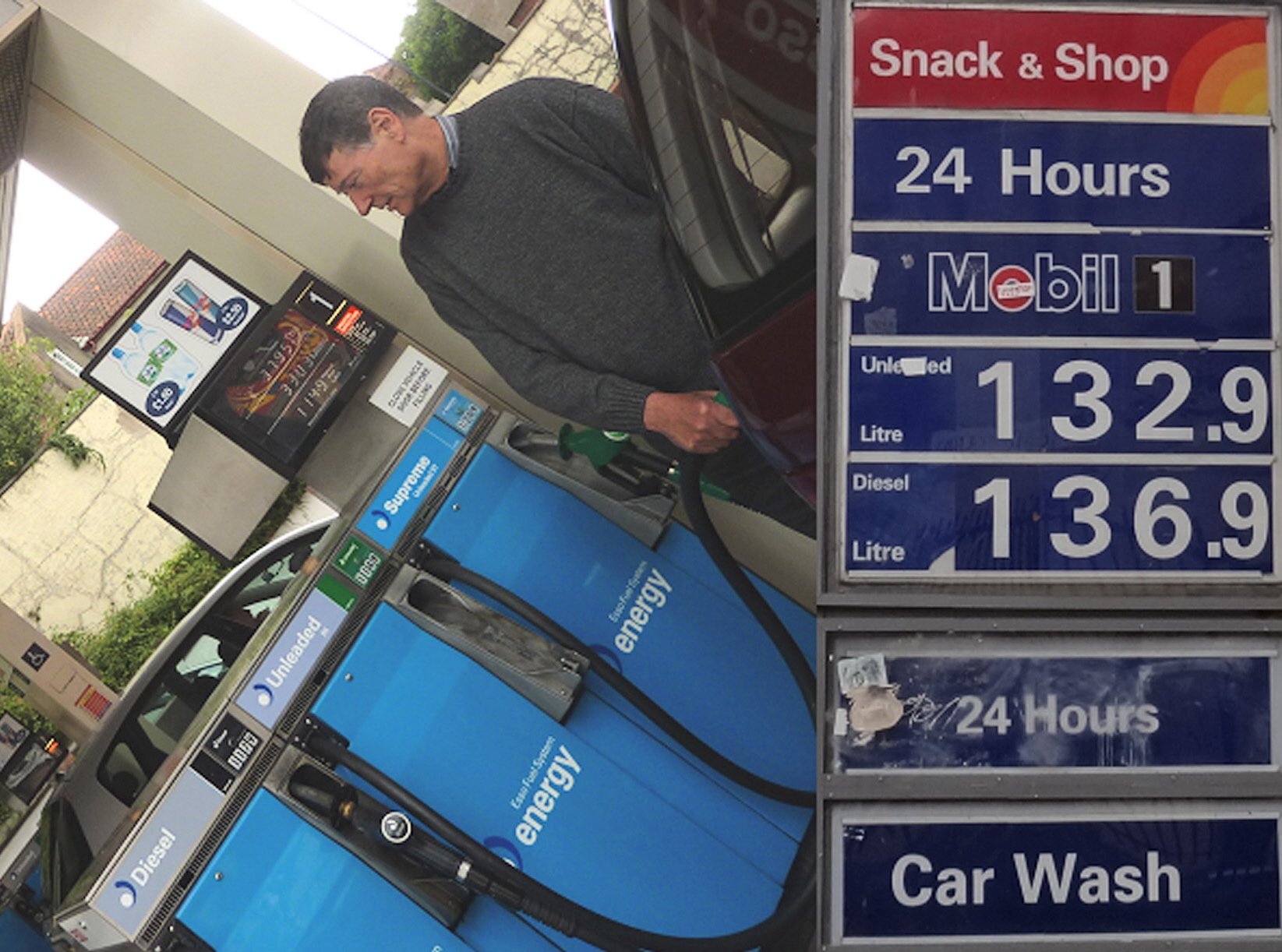
 One problem for motorists at the moment is the cost of petrol, where prices have reached over 1.37p on average, as we considered in the blog It’s fuelling anger. However, another problem could soon materialise and that is no petrol. Back in 2000, there was massive disruption to the public with a fuel blockade and a similar thing could occur, following the ‘yes’ vote by fuel tank drivers in favour of strike action.
Over the past few years, strikes have occurred across a variety of industries and if this one did happen with no contingency plan in place, disruption would be significant to both private individuals and companies. Drivers from Unite (the trade union) supply over 90% of fuel to UK garages and so any strike could lead to the closure of up to 7,900 stations.
However, the government has begun to consider the worst case scenario, if talks do not work with plans to begin training army drivers. There are concerns that without these plans in place, disruption across the country may occur with supermarkets, garages and airports all facing fuel shortages. Those who have a job that relies on travel, or even those who simply use their cars or buses to get to work will also feel the effects. Other problems within the emergency services could also emerge, but the government has assured the public that their fuel would be prioritised. The following articles consider this issue.
Fuel strike drivers vote yes in row over conditions BBC News (26/3/12)
Plan for fuel strike, says Downing Street Financial Times, George Parker (27/3/12)
Talks urged to avert fuel tanker strike Independent, Andrew Woodcock and David Mercer (27/3/12)
Ed Miliband: Fuel strike must be avoided at all costs Telegraph, James Hall (27/3/12)
All striking tanker drivers want is responsible minimum standards Guardian, Len McCluskey (27/3/12)
Questions
- If a trade union bargains for higher wages, what is the likely effect on employment and unemployment?
- How might strike action by tankers affect businesses?
- Are there likely to be any adverse long term effects if strike action does occur over Easter?
- How could strike action affect a firm’s costs of production? Think in particular about those who rely on travel as part of the business.
- What other options are there to trade unions, besides striking? Assess the effectiveness of each of the options.
- If a shortage of petrol emerged, what would you expect to happen to its market price?
 Unemployment is a term that economists and non-economists are familiar with, even if the non-economists perhaps have a less stringent definition of what we term unemployment. Typically, we say you are unemployed if you are of working age and available for work at the current wage rate, but are not in work. Another important and related concept is that of underemployment, which according to the ONS, is a growing problem in the economy.
 Although many people are happy with their part-time jobs and hence would not see themselves as underemployed, for those who are underemployed, the fact that they cannot find sufficient hours seems to indicate an inefficiency within the economy, especially if long-term unemployment or underemployment emerges. This problem is particularly relevant amongst the young and those in low-skilled jobs. However, it is also an increasing problem amongst the self-employed.