 Between December 2007 and March 2009, the Bank of England reduced Bank Rate on several occasions in order to stimulate the economy and combat recession. By March 2009, the rate stood at a record low of 0.5%. Each month the Monetary Policy Committee meets to decide on interest rates and since March 2009, the members’ decision has consistently been that Bank Rate needs to remain at 0.5%.
Although the UK economy has been making tentative steps towards recovery, it is still in a very vulnerable state. Last month, the Bank of England extended its programme of quantitative easing to a total £325bn stimulus. This, together with the decision to keep interest rates down and with the shock fall in manufacturing output contributing towards first quarter growth of just 0.1%, is a key indication that the UK economy is still struggling, even though the central bank thinks it unlikely that the UK will re-enter recession this year.
Monetary policy in the UK has been very much geared towards stimulating economic growth, despite interest rates typically being the main tool to keep inflation on target at 2%. The problem facing the central bank is that economic growth and inflation are in something of a conflict. Low interest rates to stimulate economic growth also create a higher inflation environment and that is the trade-off the economy has faced. Inflation has been well above its target for some months (a high of 5.2% in September 2011), and the low interest rate environment has done little to deflate the figure. After all, low interest rates are a monetary instrument that can be used to boost aggregate demand, which can then create demand-pull inflation. However, inflation is now slowly beginning to fall, but this downward trend could be reversed with the sky high oil prices we are recently experiencing. If inflation does begin to creep back up, the Monetary Policy Committee will once again face a decision: keep Bank Rate low and continue with quantitative easing to stimulate the economy or increase Bank Rate to counter the higher rate of inflation.
The data over recent months has been truly inconsistent. Some indicators suggest improvements in the economy and the financial environment, whereas others indicate an economic situation that is moving very quickly in the wrong direction. A key factor is that the direction the UK economy takes is very much dependent on the world economy and, in particular, on how events in the eurozone unfold. The following articles consider some of the latest economic developments.
UK economy grew 0.1% to avoid recession, says NIESR Guardian, Katie Allen (5/4/12)
UK interest rates held at 0.5% BBC News (5/4/12)
UK just about avoided recession in Q1, NIESR says Telegraph, Angela Monaghan (5/4/12)
Bank of England keeps interest rates on hold at 0.5pc Telegraph (5/4/12)
UK economy ‘weak but showing signs of improvement’ BBC News (3/4/12)
Bank of England holds on quantitative easing and interest rates Guardian, Katie Allen (5/4/12)
Faith on Tories on economy hits new low Financial Times, Helen Warrell (6/4/12)
Questions
- Which factors will the Monetary Policy Committee consider when setting interest rates?
- Using a diagram to help your answer, illustrate and explain the trade-off that the MPC faces when choosing to keep interest rates low or raise them.
- What is quantitative easing? How is it expected to boost economic growth in the UK?
- Which factors are likely to have contributed towards the low growth rate the UK economy experienced in the first quarter of 2012?
- Explain the trends that we have seen in UK inflation over the past year. What factors have caused the figure to increase to a high in September and then fall back down?
- What do you expect to happen to inflation over the next few months? To what extent is your answer dependent on the MPC’s interest rate decisions?
- Although the official figures suggest that the UK avoided a double-dip recession, do you agree with this assessment? Explain your answer.
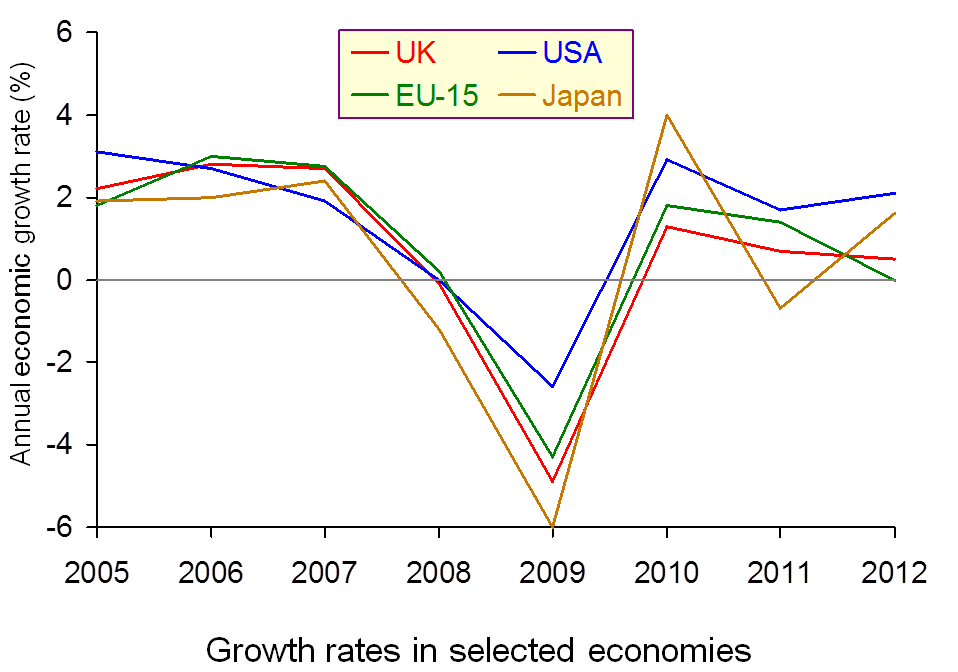 Here’s an excellent article (the first link below) for giving an overview of macroeconomic thinking and policy since the start of the financial crisis in 2007. It looks at how a Keynesian consensus emerged in 2008–9, culminating in policies of fiscal and monetary stimulus being adopted in most major economies.
It also looks at how this consensus broke down from 2010 with the subsequent problem of rising public-sector deficits and debt, and was replaced by a new, although less widespread, consensus of fiscal restraint.
The article is not just about economic theory and policy, but also about the process and politics of how consensus and ‘dissensus’ emerge. It looks at the spread of ideas as a process of ‘contagion’ and how dissent may reflect the view of different defined groups, such as political parties or schools of economic thought.
Consensus, Dissensus and Economic Ideas: The Rise and Fall of Keynesianism During the Economic Crisis, Henry Farrell (George Washington University) and John Quiggin (University of Queensland) (9/3/12)
Keynesianism in the Great Recession Out of the Crooked Timber, Henry Farrell (9/3/12)
Economics in the Crisis (see also) The Conscience of a Liberal, Paul Krugman (5/3/12)
Questions
- What were the features of the Keynesian consensus in 2008–9?
- To what extent can the consensus of that period be described as the result of ‘contagion’?
- Why did consensus break down in 2010?
- How do economic experts play a political role in economic crises?
- To what extent does a lack of consensus benefit politicians?
- Why may the appearance of a consensus be more important in driving policy than actual consensus?
 In December 2011, the ECB provided some €489bn to banks in the form of three-year loans at low interest rates (1%) through open-market operations (see Will new ECB repo operations support the eurozone bond market?).
These ‘Longer-term refinancing operations’ or ‘LTROs’ are designed to ease the burden on European banks which have been struggling to persuade markets that they are dealing with their large amounts of toxic debt, some of which is sovereign debt. Indeed, some of the ECB loans have been used to purchase Italian and Spanish bonds, thereby reducing the likelihood that these countries will default on their debts – at least for the timebeing.
On 29 February 2012, the ECB offered another round of LTROs. Some 800 banks borrowed €530bn under the scheme, bringing the total to a little over €1tr. Initially, much of the money has been put back on overnight deposit with the ECB. The hope, however, is that the loans will be used to support increased credit throughout the eurozone and to fund further purchases of sovereign debt.
But will the increased narrow money supply in the eurozone through these open-market operations result in increased broad money and increased spending and growth? The answer to that depends a great deal on confidence: confidence of banks to lend to firms and consumers; confidence of firms and consumers to borrow. The hope is that the extra money supply will not simply see a corresponding reduction in the velocity of circulation.
The following articles consider the likely effects of these longer-term repos on the real economy.
Articles
ECB hands €529bn in emergency loans to European banks Guardian, Heather Stewart (29/2/12)
Q&A: The ECB’s bank funding programme The Telegraph, Angela Monaghan (29/2/12)
Fighting Debt with Debt Forbes, Bob McTeer (5/3/12)
Is ECB’s €1trn cash boost just the tip of the iceberg? Investment Week, Kyle Caldwell, Dan Jones (5/3/12)
Banks deposit record €821bn at ECB Financial Times, Mary Watkins (5/3/12)
Europe economy may see slim gain from supersize funding: poll Reuters, Sumanta Dey (5/3/12)
Who is the ECB helping? BBC News, Stephanie Flanders (29/2/12)
ECB information on OMOs
Open Market Operations ECB
Questions
- Explain how longer-term refinancing operations work.
- What will determine how much of these ECB loans will be lent to companies?
- Explain what is meant by (a) the velocity of circulation; (b) the money multiplier. Why will the size of these two determine the likely success of the ECB’s LTRO programme?
- Why may the ECB’s actions boost market sentiment? Why might they have the opposite effect?
- Explain what is meant by the “continued de-leveraging by banks”. How does this impact on the money multiplier?
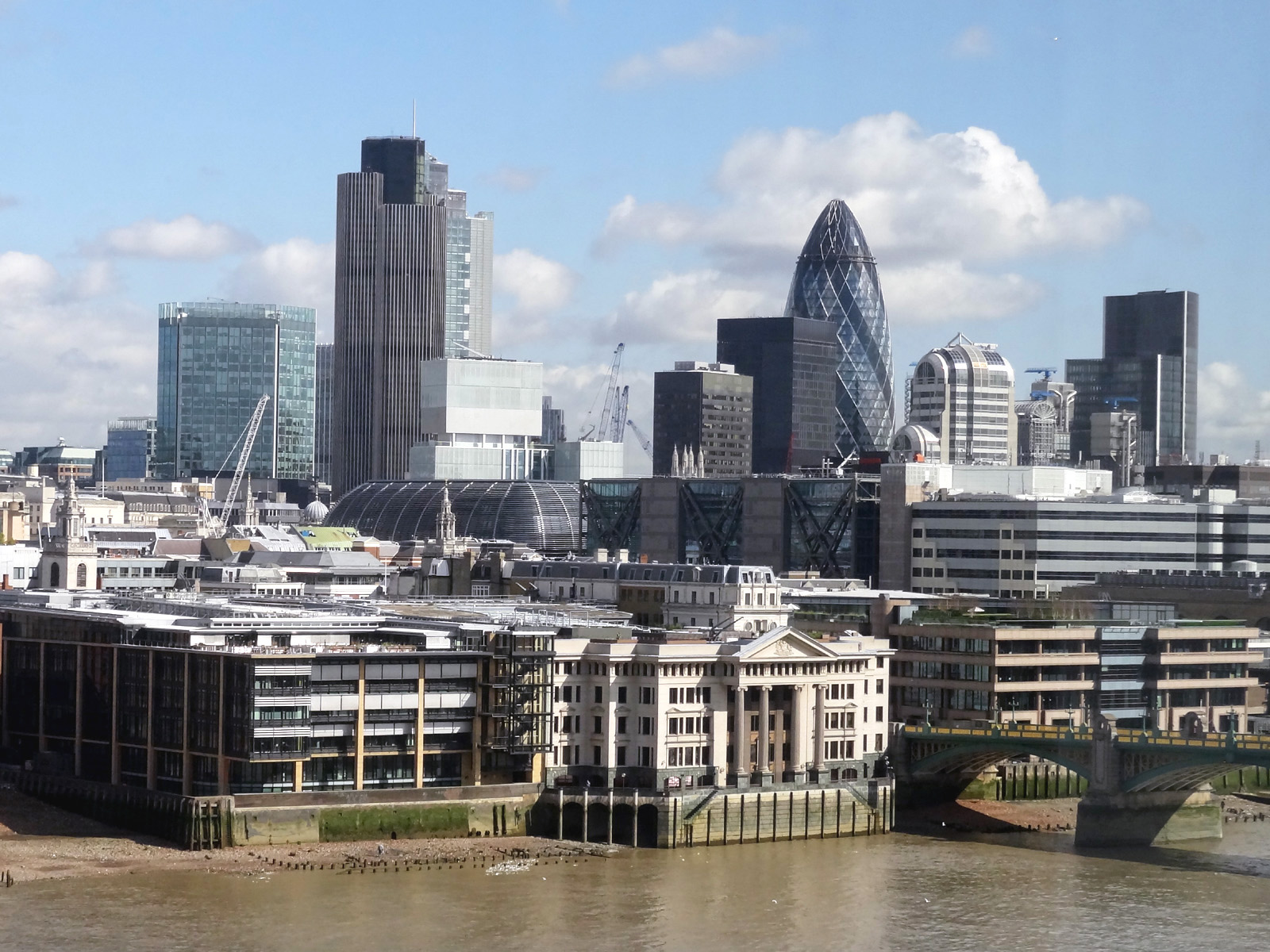 In the third quarter of 2011, the UK economy grew by 0.6% – nothing to shout about, but at least it was positive. Since then there has been growing concern about the state of the recovery with many commentators widely expecting to see much lower growth in the final quarter of last year.
Today, those commentators were proved right, as official figures released show the UK economy shrank by 0.2%. It doesn’t mean we’re in a recession (that requires 2 successive quarters of negative growth), but if growth doesn’t pick up in quarter 1 of 2012, then ‘Double-Dip Recession’ headlines will fill the front page.
Despite the disappointment that the UK economy has shrunk, the figures were not wholly unexpected, especially given the data released a week or so before, which showed unemployment had risen. Furthermore, with the crisis in the eurozone and many other countries still struggling to mount an economic recovery, there have been few external stimuli for the UK.
Although the fall in growth was larger than expected (0.2% as opposed to the predicted 0.1%), the UK economy is expected to grow throughout 2012. However, the IMF has reduced its forecast annual growth rate from 1.6% to 0.6%. The economic climate for 2012 remains uncertain and much will depend on developments in the eurozone. Further problems could spell trouble, but if there is an improvement in the fortunes of Europe, confidence could return to the markets and economic recovery could be faster. Ian McCafferty, the Chief Economic Adviser of the CBI said:
While the acute fears seen at the end of last year over global demand may be subsiding, 2012 will prove to be a difficult year for UK manufacturing, as the crisis in the eurozone – our biggest export market – has yet to reach any definitive resolution.
Whether or not we do move into a double-dip recession is uncertain and following this latest data, many commentators say it is a 50:50 change; and even then it hinges on many factors. However, even if quarter 1 of 2012 sees negative growth and hence a return to recession for the UK, Chris Williamson from Markit said that ‘there are growing indications that any downturn is likely to be ‘mild and short-lived’. The following articles consider the state of the UK economy.
Unemployment to soar as UK heads back into recession The Telegraph, Philip Aldrick (25/1/12)
UK economy shrinks by 0.2% in last 3 months of 2011 BBC News (25/1/12)
UK GDP: what the economists say Guardian (25/1/12)
UK recession threat: can we dodge the double dip? Citywire, Chris Marshall (25/1/12)
Double-dip recession fears as UK economy shrinks 0.2 percent Independent, Peter Cripps (25/1/12)
PM says ‘no complacency’ on economy Financial Times, Norma Cohen and Elizabeth Rigby (25/1/12)
The UK economy is shrinking. Time to listen to gloom-mongers? Guardian, Phillip Inman (25/1/12)
UK economy shrinks in Q4, raising recession fears The Associated Press (25/1/12)
FTSE CLOSE: Stocks slide as 0.2% GDP fall sparks recession fears; banks among the biggest fallers This is Money (25/1/12)
Sorrell: ‘UK will avoid double-dip recession’ Sky News, Tom Rayner (25/1/12)
Recovery in rehab BBC News, Stephanie Flanders (25/1/12)
Questions
- How is a recession defined? What are the typical characteristics of a recession? (Think about the macroeconomic objectives).
- Which particular sectors of the UK economy were the most severely affected in Q4 of 2011?
- Examine the main causes of the UK’s decline in national output.
- Which of the causes identified in question 3 do you think is the key factor keeping UK national output from growing? Explain your answer.
- Why is there a growing presence of companies from emerging markets in the top 100?
- Why are many commentators suggesting that even if the UK goes into a recession, it is likely to be ‘mild and short-lived’?
- What has happened to stock markets following the release of this latest economic data?
- Evaluate the options open to the Coalition government in stimulating the UK economy. To what extent would your policy solution damage the Coalition’s aim of cutting the UK’s structural budget deficit?
There has been much talk of a double-dip recession, with many suggesting that the UK economy is already in a recession. However, according to the British Chambers of Commerce (BCC), a recession is not inevitable. Although the businesses surveyed showed that the economy had significantly weakened, John Longworth the Director General of the BCC said that a ‘new recession is not a foregone conclusion’.
Even though many of the figures showed a continued weakening of the economy, the results are still not as bad as they were back in 2008. The concern is that if the weakness continues, as it is predicted to do in the first quarter of 2012, confidence will remain low and then the economy may stagnate and a recession becomes a more likely scenario. Action is needed to prevent this from happening, especially with the eurozone crisis still causing concern. As John Longworth said:
The UK does have the potential to recover and make its way in the world. We have the talent, the energy and the enterprise. All we need is an environment that puts business first.
At the beginning of December 2011, many analysts thought retail sales would remain low, as they had been throughout 2011. However, British consumers came through in the second half of December and retail sales were up by 4.1% compared with a year ago. According to the British Retail Consortium, this Christmas rush should not be seen as a fundamental change in the direction of the economy and will have done little to boost the overall annual sales of most retailers.
Recession ‘not foregone conclusion’ Guardian (10/1/12)
UK economy likely to shrink amid eurozone crisis, says BCC The Telegraph, Angela Monaghan (10/1/12)
UK recession is not yet inevitable, survey says BBC News (10/1/12)
UK risks recession and lengthy stagnation – BCC Reuters, David Milliken (10/1/12)
U.K recession fears build Wall Street Journal, Ilona Billington (10/1/12)
BoE stimulus expansion may not be enough for recovery, BCC says (quick ad before article appears) Business Week, Scott Hamilton (10/1/12)
Questions
- How is a recession defined?
- What data has the BCC used to come to the conclusion that a recession is not inevitable?
- What action is needed by the government to tackle ‘short term stagnation and a lack of business confidence’?
- What could explain the 4.1% increase in sales in December compared with the previous year? Why is this data not thought to represent a ‘fundamental change in the circumstances of UK consumers’?
- What is expected to happen to UK inflation and employment during the first quarter of 2012?
- Why does the eurozone crisis present a problem for confidence and British exporters?
 Between December 2007 and March 2009, the Bank of England reduced Bank Rate on several occasions in order to stimulate the economy and combat recession. By March 2009, the rate stood at a record low of 0.5%. Each month the Monetary Policy Committee meets to decide on interest rates and since March 2009, the members’ decision has consistently been that Bank Rate needs to remain at 0.5%.