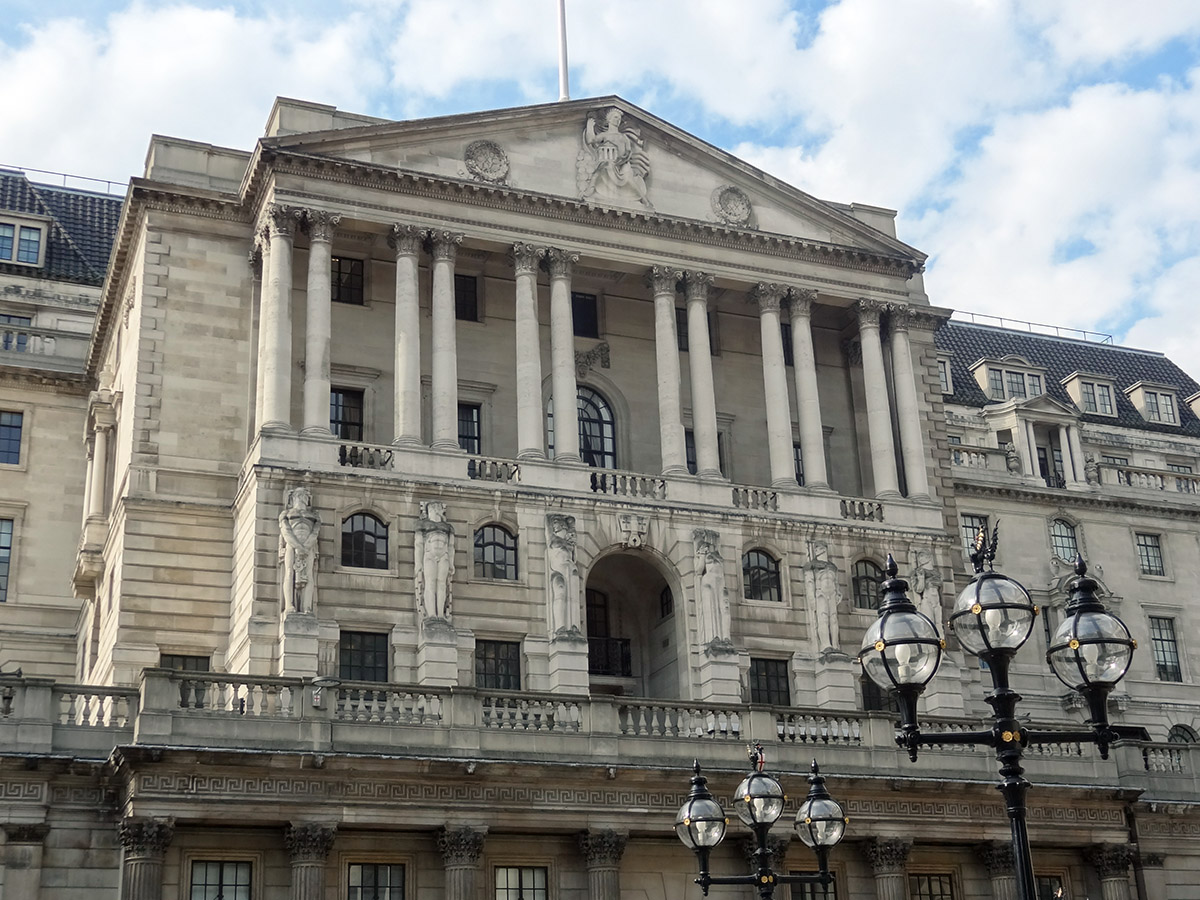
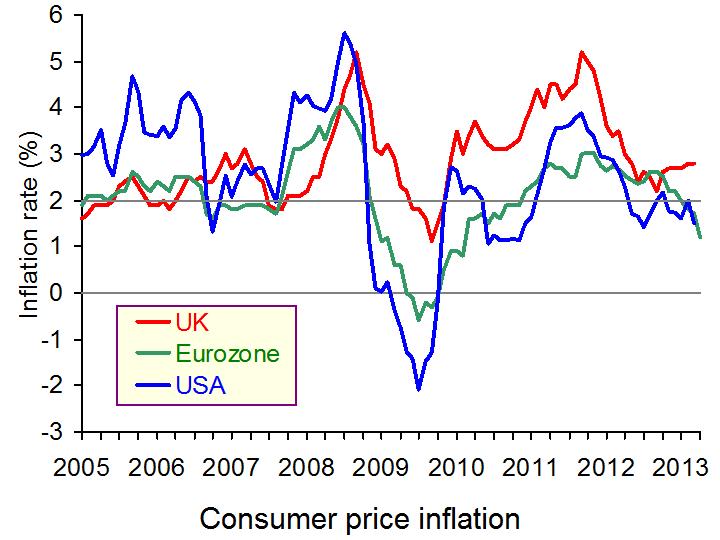
 A recession is typically characterised by high unemployment, low or negative growth and low inflation, due to a lack of aggregate demand. However, since 2009, inflation levels in the UK have only added to the pressures facing the government and the Bank of England. Not only had there been a problem of lack of demand, but the inflation target was no longer being met.
Inflation had increased to above 5% – a figure we had not been accustomed to for many years. With interest rates at record lows with the aim of boosting aggregate demand, demand-pull inflation only added to cost-push pressures. However, data released by the ONS shows that inflation, as measured by the CPI, has now fallen back to its 2% target. Having been at 2.1% in November 2013, the figure for December 2013 fell by 0.1 percentage points.
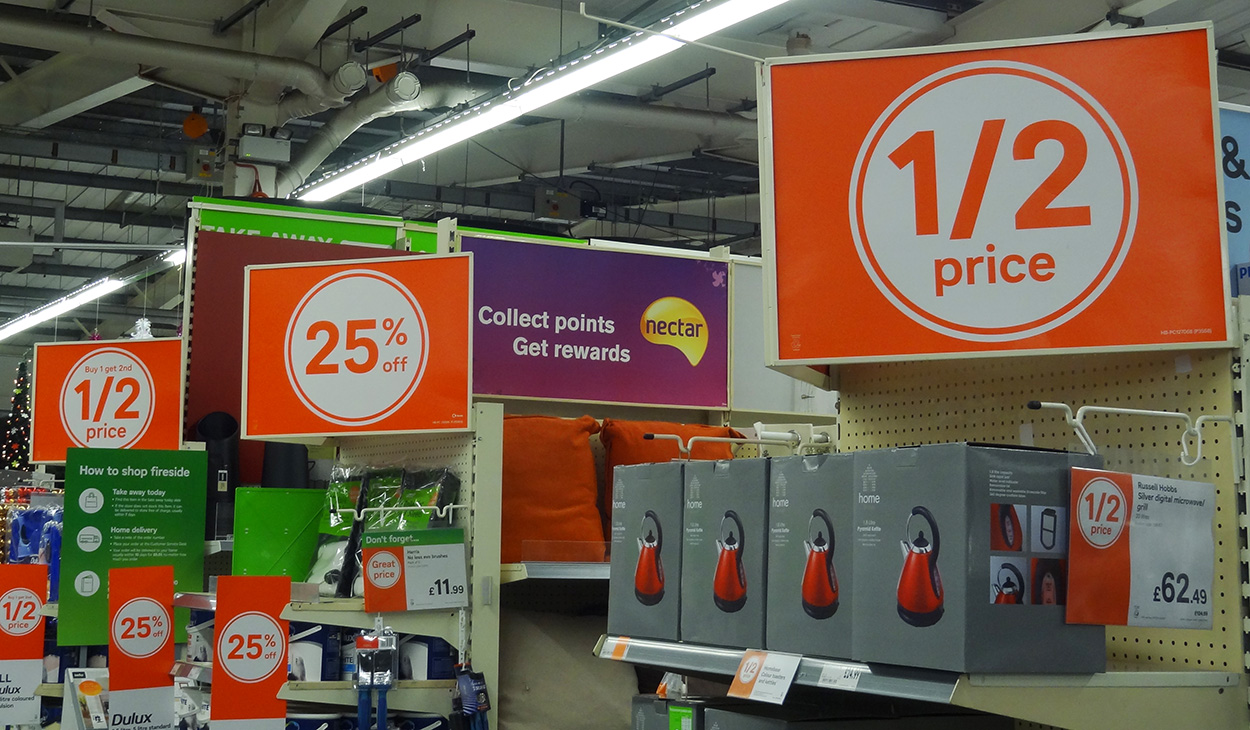
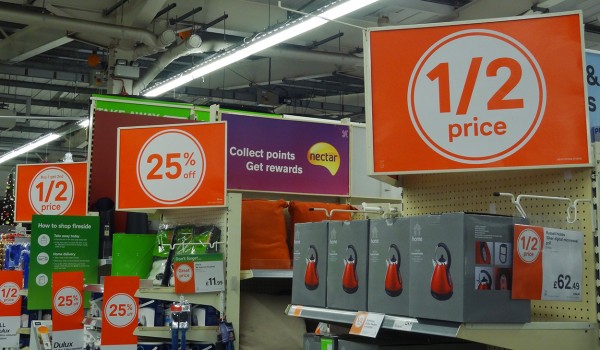 The data for December include some of the energy price rises from the big six, but do not include the full extent of price decreases and discounting initiated by retailers in the lead up to Christmas. The key factors that have helped to keep prices down include some of the discounting throughout December and falling food prices, in particular bananas, grapes and meat.
With inflation back on target, pressures have been removed from the Bank of England to push up interest rates. Mark Carney has said that interest rates will remain at 0.5% until unemployment falls to 7%. 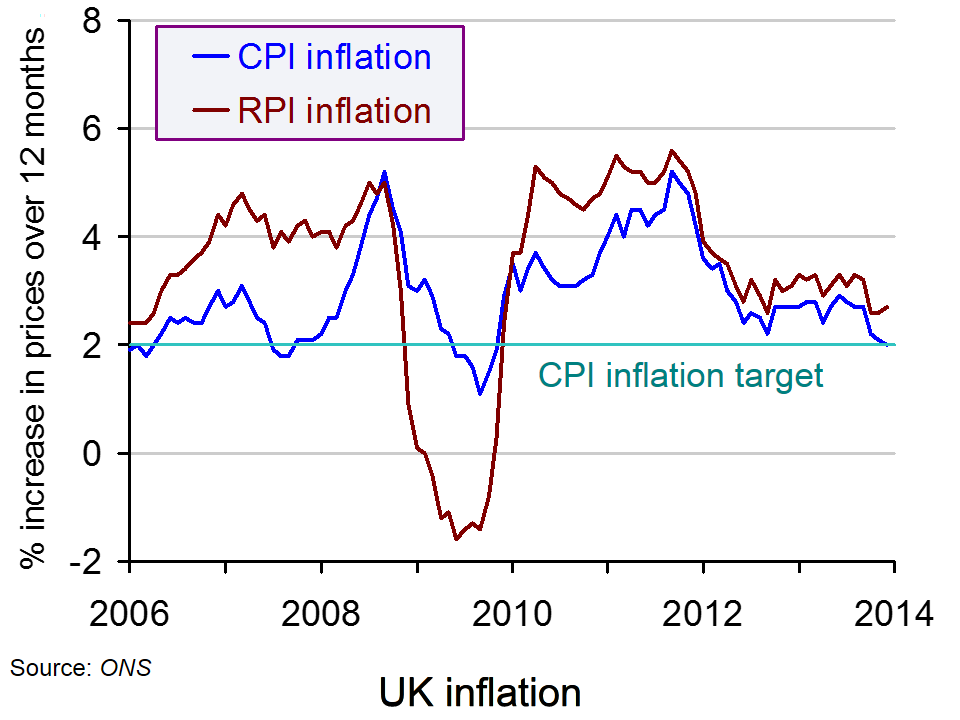 With unemployment fast approaching this target, there has been speculation that interest rates would rise, but with inflation falling back on target, these pressures have been reduced. (Click here for a PowerPoint of the chart.) Referring to this, Jeremy Cook, the chief economist at World First said:
The lack of inflation will help stay their hand especially if the pace of job creation seen in the second half of last year also shows.
These thoughts were echoed by Rob Wood, the chief UK economist at Berenberg Bank:
Inflation is the BoE’s ‘get out of jail free’ card for this year … The lack of inflation pressure gives them room to delay a first hike until next year.
Many economists now believe that the CPI rate of inflation is likely to remain at or below the target, in particular if productivity growth improves. This belief is further enhanced by the fact that tax rates are stable, the pound is relatively strong and the previous upward pressure on commodity prices from China is now declining. Some economists believe that CPI inflation could fall to 1.5% this year and the Treasury has said that it is ‘another sign that the Government’s long-term economic plan is working’. The following articles consider this latest macroeconomic data.
UK inflation falls to Bank of England’s 2pc target in December The Telegraph, Szu Ping Chan (14/1/14)
UK inflation falls to 2% target rate in December BBC News (14/1/14)
Carney’s lucky streak continues as UK inflation slows to 2% Financial Times, Claire Jones (14/1/14)
UK inflation fall gives Bank of England a lift Wall Street Journal, Richard Barley(14/1/14)
Inflation falls to Bank of England target Reuters, William Schomberg and Ana Nicolaci da Costa (14/1/14)
Inflation hits Bank of England’s target of 2% in December Independent, John Paul Ford Rojas (14/1/14)
Questions
- What is the relationship between interest rates and aggregate demand?
- Which factors have led to the reduction in the rate of inflation?
- Why have the latest data on inflation rates reduced the pressure on the Bank of England to increase interest rates?
- Why do stable tax rates, a strong pound and reduced pressure from China on commodity prices suggest that the CPI measures of inflation is likely to remain at similarly low levels?
- Why has the RPI increased while the CPI has fallen?
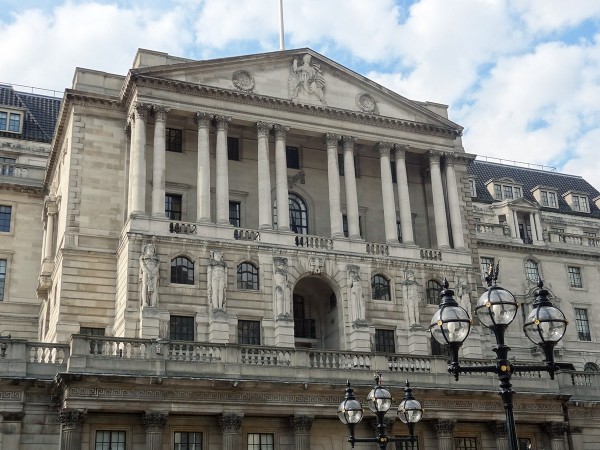 The Consumer Prices index (CPI) measures the rate of inflation and in October, this rate fell to 2.2%, bringing inflation to its lowest level since September 2012. For many, this drop in inflation came as a surprise, but it brings the rate much closer to the Bank of England’s target and thus reduces the pressure on changing interest rates.
The CPI is calculated by calculating the weighted average price of a basket of goods and comparing how this price level changes from one month to the next. Between September and October prices across a range of markets fell, thus bringing inflation to its lowest level in many months. Transport prices fell by their largest amount since mid-2009, in part driven by fuel price cuts at the big supermarkets and this was also accompanied by falls in education costs and food. The Mail Online article linked below gives a breakdown of the sectors where the largest price falls have taken place. One thing that has not yet been included in the data is the impact of the price rises by the energy companies. The impact of his will obviously be to raise energy costs and hence we can expect to see an impact on the CPI in the coming months, once the price rises take effect.
 With inflation coming back on target, pressures on the Bank of England to raise interest rates have been reduced. When inflation was above the target rate, there were concerns that the Bank of England would need to raise interest rates to cut aggregate demand and thus bring inflation down.
However, the adverse effect of this would be a potential decline in growth. With inflation falling to 2.2%, this pressure has been removed and hence interest rates can continue to remain at the record low, with the objective of stimulating the economy. Chris Williamson from Markit said:
The easing in the rate of inflation and underlying price pressures will provide greater scope for monetary policy to be kept looser for longer and thereby helping ensure a sustainable upturn in the economy … Lower inflation reduces the risk of the Bank of England having to hike rates earlier than it may otherwise prefer to, allowing policy to focus on stimulating growth rather than warding off rising inflationary pressures.
The lower rate of inflation also has good news for consumers and businesses. Wages remain flat and thus the reduction in the CPI is crucial for consumers, as it improves their purchasing power. As for businesses, a low inflation environment creates more certainty, as inflation tends to be more stable. Businesses are more able to invest with confidence, again benefiting the economy. Any further falls in the CPI would bring inflation back to its target level of 2% and then undoubtedly concerns will turn back to the spectre of deflation, though with the recent announcements in energy price rises, perhaps we’re getting a little ahead of ourselves! Though we only need to look to countries such as Spain and Sweden where prices are falling to realise that it is certainly a possibility. The following articles consider the data and the impact.
UK inflation falls in October: what the economists say The Guardian, Katie Allen (12/11/13)
British inflation hits 13-month low, easing pressure on central bank Reuters, David Milliken and William Schomberg (12/11/13)
UK inflation falls to 2.2% in October BBC News (1211/13)
UK inflation falls to 13-month low: reaction The Telegraph (12/11/13)
Fall in inflation to 2.2% welcome by government The Guardian, Katie Allen (12/11/13)
Inflation falls to lowest level for a year as supermarket petrol price war helps ease the squeeze on family finances Mail Online, Matt Chorley (12/11/13)
Inflation falls to its lowest level for more than a year as consumers benefit from petrol pump price war Independent, John-Paul Ford Rojas (12/11/13)
UK inflation slows to 2.2%, lowest level in a year Bloomberg, Scott Hamilton and Jennifer Ryan (12/11/13)
Are we facing deflation? Let’s not get carried away The Telegraph, Jeremy Warner (12/11/13)
Questions
- How is the CPI calculated?
- Use an AD/AS diagram to illustrate how prices have been brought back down. Is the reduction in inflation due to demand-side or supply-side factors?
- What are the benefits of low inflation?
- The Telegraph article mentions the possibility of deflation. What is deflation and why does it cause such concern?
- Explain why a fall in the rate of inflation eases pressure on the Bank of England.
- How does the rate of inflation affect the cost of living?
- Is a target rate of inflation a good idea?
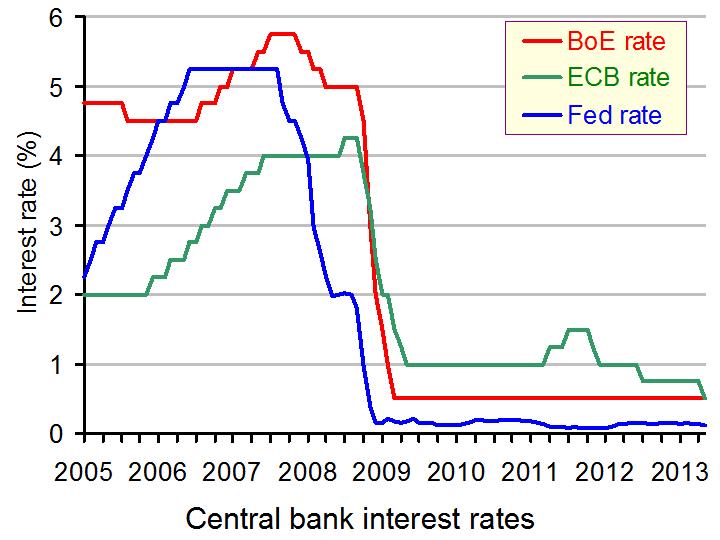 Interest rates have, for some years, been the main tool of monetary policy and of steering the macroeconomy. Across the world interest rates were lowered, in many cases to record lows, as a means of stimulating economic growth. Interest rates in the UK have been at 0.5% since March 2009 and on 2nd May 2013, the ECB matched this low rate, having cut its main interest rate from 0.75%. (Click here for a PowerPoint of the chart.)
Low interest rates reduce the cost of borrowing for both firms and consumers and this in turn encourages investment and can boost consumer expenditure. After all, when you borrow money, you do it to spend! Lower interest rates will also reduce the return on savings, again encouraging spending and for those on variable rate mortgages, mortgage payments will fall, increasing disposable income. However, these above effects are dependent on the banks passing the ECB’s main interest rate on its customers and this is by no means guaranteed.
Following the cut in interest rates, the euro exchange rate fell almost 2 cents against the dollar.
Interest rates in the eurozone have been at 0.75%, but a 0.25 point cut was widely expected, with the ongoing debt crisis in the Eurozone continuing to adversely affect growth and confidence. A lack of trust between banks has also contributed to a lack of lending, especially to small and medium sized enterprises. The ECB has injected money into financial institutions with the aim of stimulating lending, but in many cases, banks have simply placed this extra money back with the ECB, rather than lending it to other banks or customers. The fear is that those they lend to will be unable to repay the money. In response to this, there have been suggestions of interest rates becoming negative – that is, if banks want to hold their money with the ECB they will be charged to do it. Again, the idea is to encourage banks to lend their money instead.
Small and medium sized businesses have been described as the engine of growth, but it is these businesses who have been the least able to obtain finance. Without it, they have been unable to grow and this has held back the economic recovery. Indeed, GDP in the Eurozone has now fallen for five consecutive quarters, thus prompting the latest interest rate cut. A key question, however, will be how effective this quarter of a percent cut will be. If banks were unwilling to lend and firms unwilling to invest at 0.75%, will they be more inclined at 0.5%? The change is small and many suggest that it is not enough to make much of a difference. David Brown of New View Economics said:
The ECB rate cut is no surprise as it was well flagged by Draghi at last month’s meeting. Is it enough? No. The marginal effect of the cut is very limited, but at least it should have some symbolic rallying effect on economic confidence.
This was supported by Howard Archer at HIS Global Insight, who added:
Admittedly, it is unlikely that the trimming of interest rates from 0.75% to 0.5% will have a major growth impact, especially given fragmented credit markets, but any potential help to the eurozone economy in its current state is worthwhile.
 Inflation in the eurozone is only at 1.2%, which is significantly below the ceiling of 2%, so this did give the ECB scope for the rate to be cut. (Click here for a PowerPoint of the chart.) After all, when interest rates fall, the idea is to boost aggregate demand, but with this, inflation can emerge. Mr Draghi said ‘we will monitor very closely all incoming information, and assess any impact on the outlook for price stability’. The primary objective of the ECB is the control of inflation and so had inflation been somewhat higher, we may have seen a different decision by the ECB. However, even then, 5 consecutive quarters of negative growth is hard to ignore.
So, if these lower interest rates have little effect on stimulating an economic recovery, what about a movement away from austerity? Many have been calling for stimulus in the economy, arguing that the continuing austerity measures are stifling growth. The European Council President urged governments to promote growth and job creation. Referring to this, he said:
Taking these measures is more urgent than anything … After three years of firefights, patience with austerity is wearing understandably thin.
However, Mr. Draghi urged for policymakers to stick with austerity and continue to focus on bringing debt levels down, while finding other ways to stimulate growth, including structural reform. The impact of this latest rate cut will certainly take time to filter through the economy and will very much depend on whether the 0.5% interest rate is passed on to customers, especially small businesses. Confidence and trust within the financial sector is therefore key and it might be that until this emerges, the eurozone itself is unlikely to emerge from its recession.
ECB ready to enter unchartered waters as bank cuts interest rate to fresh low of 0.5pc The Telegraph, Szu Ping Chan (2/5/13)
Draghi urges Eurozone governments to stay the course on austerity Financial Times, Michael Steen (2/5/13)
Eurozone interest rates cut to a record low of 0.5% The Guardian, Heather Stewart (2/5/13)
ECB’s Draghi ‘ready to act if needed’ BBC News (2/5/13)
Eurozone interest rates cut again as ECB matches Bank of England Independent, Russell Lynch (3/5/13)
Margio Draghi urges no let-up in austerity reforms after Eurozone rate cut – as it happened The Guardian, Graeme Wearden (2/5/13)
ECB cuts interest rate to record-low 0.5% in desperate measure to drag Eurozone out of recession Mail Online, Simon Tomlinson and Hugo Duncan (2/5/13)
ECB cuts interest rates, open to further action Reuters, Michael Shields (2/5/13)
Eurozone loosens up austerity, slowly Wall Street Journal (2/5/13)
ECB cuts interest rate, not enough to pull the region out of recession The Economic Times of India (2/5/13)
Euro steady ahead of ECB interest rate announcement Wall Street Journal, Clare Connaghan (2/5/13)
 European Central Bank (ECB) cuts interest rates BBC News (2/5/13)
All eyes on ECB as markets expect rate cut Financial Times, Michael Steen (2/5/13)
Questions
- How is a recession defined?
- Using an aggregate demand/aggregate supply diagram, illustrate and explain the impact that this cut in interest rates should have.
- On which factors will the effectiveness of the cut in interest rates depend?
- Using the interest rate and exchange rate transmission mechanisms to help you, show the impact of interest rates on the various components of aggregate demand and thus on national output.
- What would be the potential impact of a negative interest rate?
- Why did the low inflation rate give the ECB scope to cut interest rates?
- What are the arguments for and against austerity measures in the Eurozone, given the 5 consecutive quarters of negative growth?
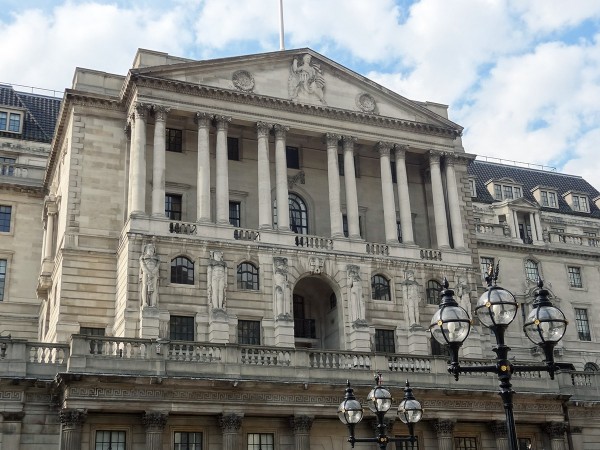 At present, the Bank of England has an inflation target of 2% CPI at a 24-month time horizon. Most, other central banks also have simple Inflation targets. But central bankers’ opinions seem to be changing.
Consider four facts.
1. Many central banks around the world have had record low interest rates for nearly four years, backed up in some cases by programmes of quantitative easing, officially in pursuit of an inflation target.
2. The world is mired in recession or sluggish growth, on which monetary policy seems to have had only a modest effect.
3. Inflation seems to be poorly related to aggregate demand, at least within an economy. Instead, inflation in recent years seems to be particularly affected by commodity prices.
4. Success in meeting an inflation target could mean failure in terms of an economy achieving an actual growth rate equal to its potential rate.
It’s not surprising that there have been calls for rethinking monetary policy targets.
 There have recently been two interesting developments: one is a speech by Mark Carney, Governor designate of the Bank of England; the other is a decision on targets by the Fed, reported at a press conference by Ben Bernanke, Chairman of the Federal Reserve.
Mark Carney proposes the possible replacement of an inflation target with a target for nominal GDP (NGDP). This could be, say, 5%. What is more, it should be an annual average over a number of years. Thus if the target is missed in one year, it can be made up in subsequent years. For example, if this year the actual rate of nominal GDP growth is 4%, then by achieving 6% next year, the economy would keep to the average 5% target. As Stephanie Flanders points out:
Moving to nominal GDP targets would send a signal that the Bank was determined to get back the nominal growth in the economy that has been lost, even if it is at the cost of pushing inflation above 2% for a sustained period of time.
In the USA, Ben Bernanke announced that the Fed would target unemployment by keeping interest rates at their current record lows until unemployment falls below a threshold of 6.5%.
Until recently, the Fed has been more flexible than most other central banks by considering not only inflation but also real GDP when setting interest rates. This has been close to following a Taylor rule, which involves targeting a weighted averaged of inflation and real GDP. However, in January 2012, the Fed announced that it would adopt a 2% long-run inflation target. So the move to targeting unemployment represents a rapid change in policy
So have simple inflation targets run their course? Should they be replaced by other targets or should targeting itself be abandoned? The following articles examine the issues.
Articles
UK
Mark Carney hints at need for radical action to boost ailing economies The Telegraph, Philip Aldrick (11/12/12)
George Osborne welcomes inflation target review The Telegraph, Philip Aldrick and James Kirkup (13/12/12)
Monetary policy: Straight talk The Economist, R.A. (12/12/12)
New Bank of England governor Mark Carney mulls end of inflation targets The Guardian, Larry Elliott (12/12/12/)
Carney’s trail of carnage Independent, Ben Chu (12/12/12)
Mark Carney suggests targeting economic output BBC News (12/12/12)
A new target for the Bank of England? BBC News, Stephanie Flanders (14/12/12)
Should the UK really ditch inflation target? Investment Week, Katie Holliday (14/12/12)
BoE economist Spencer Dale warns on Mark Carney’s ideas The Telegraph, Philip Aldrick (12/12/12)
USA
Ben Bernanke Outlines Fed Policy for 2013 IVN, Alex Gauthier (14/12/12)
Fed gives itself a new target BBC News, Stephanie Flanders (13/12/12)
Fed to Keep Easing, Sets Target for Rates CNBC, Jeff Cox (12/12/12)
Bernanke calls high unemployment rate ‘an enormous waste’ Los Angeles Times, Jim Puzzanghera (12/12/12)
Think the Fed has been too timid? Check out Britain and Japan. Washington Post, Brad Plumer (13/12/12)
Inflation Targeting is Dead, Long Live Inflation! The Market Oracle, Adrian Ash (14/12/12)
Speech and press conference
Guidance Bank of Canada, Mark Carney (11/12/12)
Transcript of Chairman Bernanke’s Press Conference Federal Reserve Bank, Ben Bernanke (12/12/12)
Questions
- Which of the following would meet an NGDP target of 5%: (a) 5% real growth and 0% inflation; (b) 5% real growth and 5% inflation; (c) 5% inflation and 0% growth?
- What are the main arguments in favour of an NGDP target?
- What factors would need to be taken into account in deciding the target rate of NGDP?
- What are the main arguments against an NGDP target?
- Is it possible to target two indicators with one policy instrument (interest rates)? Explain.
- Explain what is meant by Taylor rule?
- Is having an unemployment target a type of Taylor rule?
- Why may the rate of inflation (whether current or forecast) be a poor indicator of the state of the real economy?
Since March 2009, the Bank of England has engaged in a process of quantitative easing (QE). Over the period to January 2010 the Bank of England injected £200 billion of new money into the economy by purchasing assets from the private sector, mainly government bonds. The assets were purchased with new money, which enters the economy as credits to the accounts of those selling the assets to the Bank of England. This increase in narrow money (the monetary base) is then able to form the basis of credit creation, allowing broad money (M4) to increase by a multiple of the increased monetary base. In other words, injecting £200 billion allows M4 to increase by considerably more.
But just how much more will M4 rise? How big is the money multiplier? This depends on the demand for loans from banks, which in turn depends on the confidence of business and households. With the recovery only just beginning, demand is still very dampened. Credit creation also depends on the willingess of banks to lend. But this too has been dampened by banks’ desire to increase liquidity and expand their capital base in the wake of the credit crunch.
Not surprisingly, the growth in M4 has been sluggish. Between March and Decmber 2009, narrow money (notes, coin and banks’ reserve balances in the Bank of England) grew from £91bn to £203bn (an increase of 123%). M4, however, grew from £2011bn to £2048bn: an increase of only 1.8%. In fact, in December it fell back from £2069bn in November.
Despite the continued sluggishness of the economy, at its February meeting the Bank of England announced an end to further quantitiative easing – at least for the time being. Although Bank Rate would be kept on hold at 0.5%, there would be no further injections of money. Part of the reason for this is that there is still considerable scope for a growth in broad money on the basis of the narrow money already created. If QE were to continue, there could be excessive broad money in a few months’ time and that could push inflation well above target. As it is, rising costs have already pushed inflation above the 2% target (see Too much of a push from costs but no pull from demand).
So will this be an end to quantitative easing? The following articles explore the question.
Bank of England halts quantitative easing Guardian, Ashley Seager (4/2/10)
Bank calls time on quantitative easing (including video) Telegraph, Edmund Conway (5/2/10)
Bank of England’s time-out for quantitative easing plan BBC News (4/2/10)
Shifting goalposts keep final score in question Financial Times, Chris Giles and Jessica Winch (5/2/10)
Bank halts QE at £200bn despite ‘sluggish’ recovery Independent, Sean O’Grady (5/2/10)
Easy does it: No further QE BBC News blogs, Stephanomics, Stephanie Flanders (4/2/10)
Leading article: Easing off – but only for now Independent (5/2/10)
Not easy Times Online (5/2/10)
Quantitative easing: What the economists say Guardian (4/2/10)
Questions
- Explain how quantitative easing works?
- What determines the rate of growth of M4?
- Why has the Bank of England decided to call a halt to quantiative easing – at least for the time being?
- What is the transmission mechanism whereby an increase in the monetary base affects real GDP?
- What role does the exchange rate play in the transmission mechanism?
- Why is it difficult to predict the effect of an increase in the monetary base on real GDP?
- What will determine whether or not the Bank of England will raise interest rates in a few months’ time?
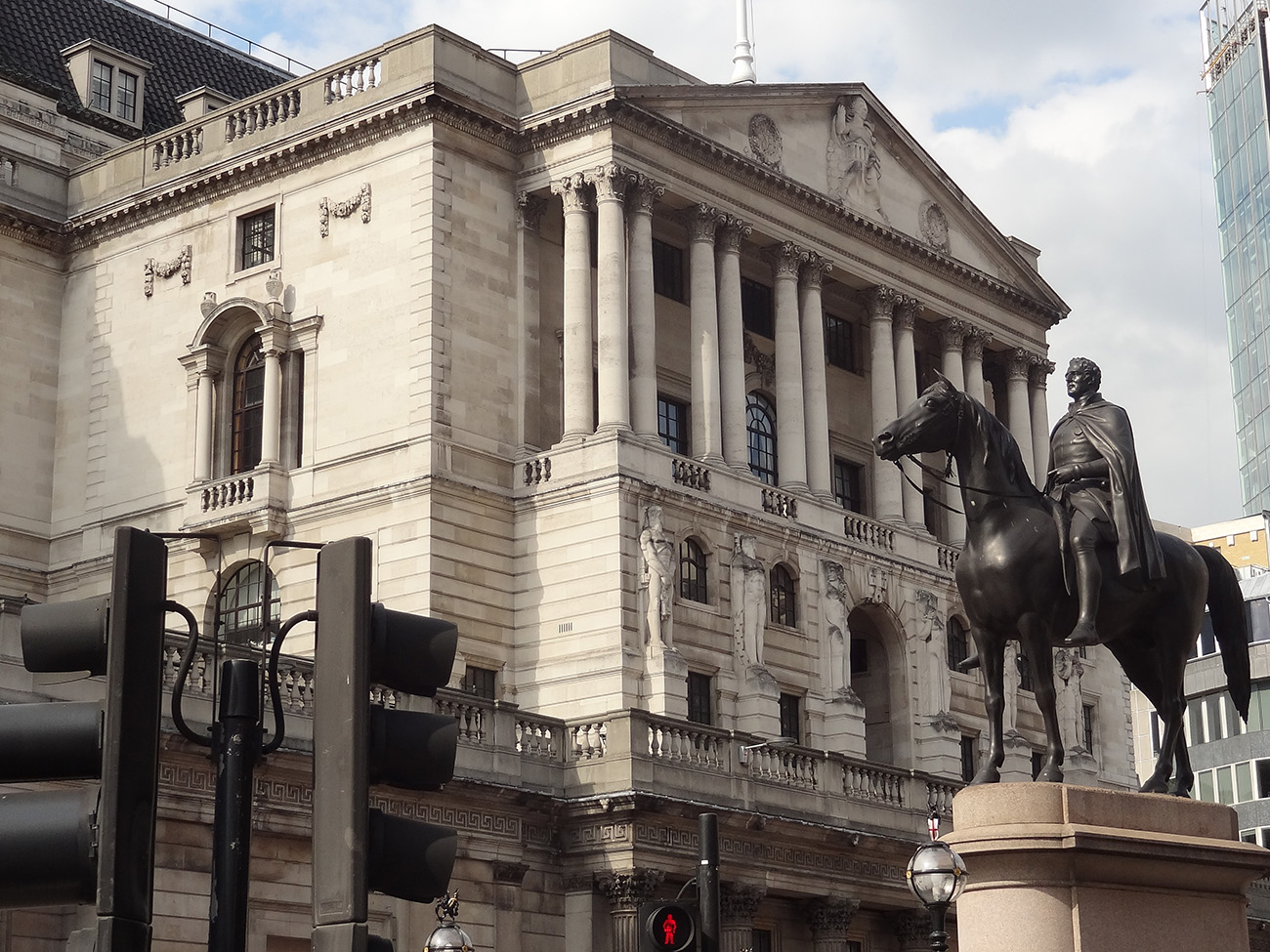 A recession is typically characterised by high unemployment, low or negative growth and low inflation, due to a lack of aggregate demand. However, since 2009, inflation levels in the UK have only added to the pressures facing the government and the Bank of England. Not only had there been a problem of lack of demand, but the inflation target was no longer being met.
 The data for December include some of the energy price rises from the big six, but do not include the full extent of price decreases and discounting initiated by retailers in the lead up to Christmas. The key factors that have helped to keep prices down include some of the discounting throughout December and falling food prices, in particular bananas, grapes and meat.