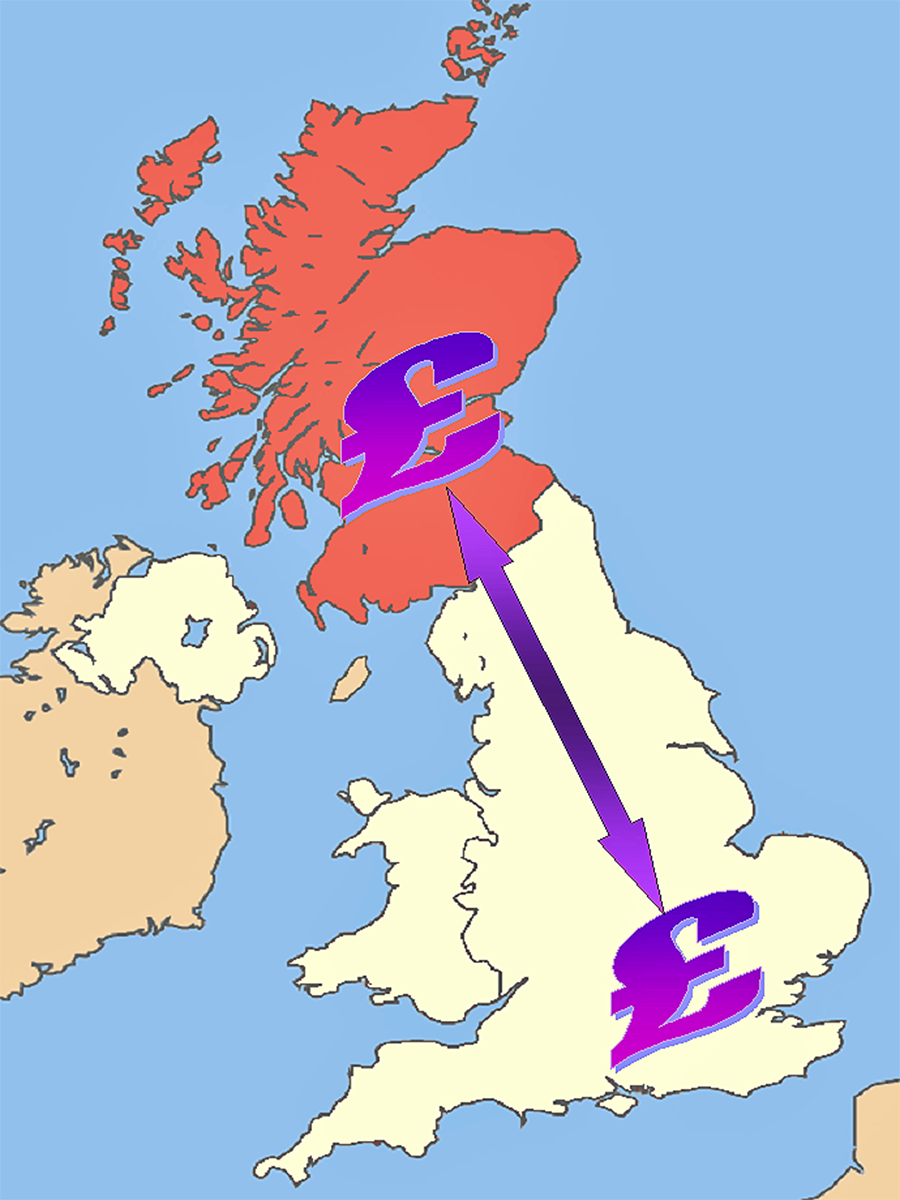
 In a speech in Edinburgh, Mark Carney, Governor of the Bank of England, considered the implications of Scotland retaining the pound if the Scottish people vote yes for independence. His speech was intended to be non-political. Rather he focused on two main questions: first whether a currency union of Scotland and the rest of the UK (RUK) would be an optimal currency area; second how much economic sovereignty would need to be shared with RUK as a consequence of Scotland keeping the pound.
On the first question, Mark Carney argued that the current UK is close to an optimal currency area as there is a high degree of economic integration and factor mobility. Sharing a currency eliminates exchange costs, improves pricing transparency and hence encourages competition, promotes cross-border investment, improves the flow of technology and ideas, and increases the mobility of labour and capital.
But sharing a currency involves sharing a monetary policy. This would still be determined by the Bank of England and would have to geared to the overall economic situation of the union, not the specific needs of Scotland.
There would also need to be a banking union, whereby banks in difficulties would receive support from the whole currency area. In Scotland’s case, banking accounts for a very large proportion of the  economy (12.5% compared with 4.3% for RUK) and could potentially place disproportionate demands on the currency union’s finances.
And then there is the question of fiscal policy. A shared currency also means pooling a considerable amount of sovereignty over taxation, government spending and government debt. This could be a serious problem in the event of asymmetric shocks to Scotland and RUK. For example, if oil prices fell substantially, Scotland may want to pursue a more expansionary fiscal policy just at a time when its tax revenues were falling. This could put a strain on Scotland’s finances. This might then require RUK to provide support from a common pool of funds, such as a ‘regional fund’.
Being in a currency union can amplify fiscal stress, and increase both the risks and consequences of financial instability. In the situation just described [a fall in demand for exports], fiscal policy would ideally help smooth adjustment to the external shock. But its ability to do so could be limited by the budgetary impact of the falls in output, prices and wages. To maintain credibility, fiscal policy may even become pro-cyclical, with the resulting austerity exacerbating the initial fall in demand. In the extreme, adverse fiscal dynamics could call into question a country’s membership of the union, creating the possibility of self-fulfilling ‘runs’ on bank and sovereign debt absent central bank support.6 Such adverse feedback loops turned recessions into depressions in several European countries in recent years.
A separate Scottish currency, by contrast, would, according to Carney, be a valuable shock absorber if domestic wages and prices were sticky.
For example, suppose demand for a country’s exports falls. All else equal, its output will fall, unemployment increase and current account deteriorate. With an independent currency, exchange rate depreciation can dampen these effects by improving competitiveness, and monetary policy can become more accommodative, supporting demand and employment. However, if the country were part of a currency area with its foreign market, its exchange rate would by definition not change, putting the full weight of adjustment on wages and unemployment – a significantly more protracted and painful process. In addition, the responsiveness of monetary policy to weak demand in that country would be diluted by the needs of the broader membership.
But despite the problems of ceding a degree of monetary and fiscal sovereignty, Scotland and RUK are well placed to continue with a successful currency union if Scotland becomes independent. Economic conditions are very similar, as are language, culture and institutions, and there is an effective banking union – assuming such a banking union were to continue post independence.
The existing banking union between Scotland and the rest of the United Kingdom has proved durable and efficient. Its foundations include a single prudential supervisor maintaining consistent standards of resilience, a single deposit guarantee scheme backed by the central government, and a common central bank, able to act as Lender of Last Resort across the union, and also backed by the central government. These arrangements help ensure that Scotland can sustain a banking system whose collective balance sheet is substantially larger than its GDP.
The desirability of Scottish independence is a normative question for the Scottish electorate to decide. Nevertheless, economists have an important part to play in informing the debate. Mark Carney’s economic analysis of currency union if the Scottish electorate votes yes is a good example of this.
Video of speech
 Speech at lunch hosted by the Scottish Council for Development & Industry, Edinburgh Bank of England, Mark Carney (29/1/14)
Text of speech
The economics of currency unions Bank of England, Mark Carney (29/1/14)
Articles, podcasts and webcasts
Independent Scotland would be forced to cede some sovereignty if it keeps pound, says Carney The Telegraph, Szu Ping Chan (29/1/14)
Scottish independence: Currency debate explained BBC News, Andrew Black (29/1/14)
Scottish independence: Key extracts from Mark Carney speech BBC News (29/1/14)
Scottish independence: Carney says Scots currency plan may lead to power loss BBC News (29/1/14)
The sterling price of Scottish independence BBC News, Robert Peston (29/1/14)
Independent Scotland ‘needs to cede sovereignty’ for currency union with UK The Guardian, Severin Carrell (29/1/14)
Mark Carney warns Scotland over currency union hopes Financial Times, Mure Dickie and Sarah O’Connor (29/1/14)
How independent would Scotland really be? Channel 4 News (29/1/14)
BoE’s Mark Carney in currency sovereignty warning The Scotsman, Tom Peterkin (30/1/14)
Carney Says Scotland Must Heed Euro Crisis in Pound Debate Bloomberg, Emma Charlton and Jennifer Ryan (29/1/14)
Independent Scotland ‘meets criteria’ for currency union BBC Today Programme, Gordon MacIntyre-Kemp and Iain Gray (29/1/14)
Scotland must play a high-stakes poker game with Westminster over the pound The Guardian Larry Elliott (12/2/14)
Questions
- What are the conditions necessary for a successful currency union?
- To what extent do Scotland and RUK meet these conditions?
- What are meant by asymmetric shocks? Give some examples of asymmetric shocks that could affect a Scotland–RUK currency union.
- Why is there a potential moral hazard in a whole currency union providing fiscal support to members in difficulties?
- Why is banking union such an important part of a successful currency union? What lessons can be learned here from the eurozone currency union?
- What constraints would currency union impose on Scottish fiscal policy? Would such constraints exist in an optimal currency area?
 It is one year since the election of Shinzo Abe in Japan. He immediately embarked on a radical economic policy to stimulate the Japanese economy, which had suffered from years of stagnation. There have been three parts (or three arrows) to his policy: fiscal policy and monetary policy to stimulate aggregate demand and supply-side policy to increase productivity.
As the previous post explains:
 “The first arrow is monetary policy. The Bank of Japan has engaged in extensive quantitative easing through bond purchases in order to drive down the exchange rate (see A J-curve for Japan?), stimulate expenditure and increase the rate of inflation. A target inflation rate of 2% has been set by the Bank of Japan. Part of the problem for the Japanese economy over the years has been stagnant or falling prices. Japanese consumers have got used to waiting to spend in the hope of being able to buy at lower prices. Similarly, Japanese businesses have often delayed stock purchase. By committing to bond purchases of whatever amount is necessary to achieve the 2% inflation target, the central bank hopes to break this cycle and encourage people to buy now rather than later.
 The second arrow is fiscal policy. Despite having the highest debt to GDP ratio in the developed world, Japan is embarking on a large-scale programme of infrastructure investment and other public works. The package is worth over $100bn. The expansionary fiscal policy is accompanied by a longer-term plan for fiscal consolidation as economic growth picks up. In the short term, Japan should have no difficulty in financing the higher deficit, given that most of the borrowing is internal and denominated in yen.
 The third arrow is supply-side policy. On 5 June, Shinzo Abe unveiled a series of goals his government would like to achieve in order to boost capacity and productivity. These include increasing private-sector investment (both domestic and inward), infrastructure expenditure (both private and public), increasing farmland, encouraging more women to work by improving day-care facilities for children, and deregulation of both goods, capital and labour markets. The prime minister, however, did not give details of the measures that would be introduced to achieve these objectives. More details will be announced in mid-June.”
In the webcast and article below, Linda Yueh, the BBC’s Chief Business Correspondent, considers how effective the policies are proving and the challenges that remain.
Webcast
Has Abenomics fixed Japan’s economic fortunes? BBC News, Linda Yueh (16/12/13)
Articles
Why Abenomics holds lessons for the West BBC News, Linda Yueh (13/12/13)
Japanese business confidence hits six-year high, Tankan survey shows The Guardian (16/12/13)
Data
World Economic Outlook Database IMF (Oct 2013)
Bank of Japan Statistics Bank of Japan
Economic Outlook Annex Tables OECD
Country statistical profile: Japan 2013 OECD (15/11/13)
Questions
- Demonstrate on (a) an aggregate demand and supply diagram and (b) a Keynesian 45° line diagram the effects of the three arrows (assuming they are successful) in meeting their objectives.
- Why has Japan found it so hard to achieve economic growth over the past 20 years?
- How has the Japanese economy performed over the past 12 months?
- What lessons can be learnt by the UK and eurozone countries from Japan’s three arrows?
- Why is the second arrow problematic, given the size of Japan’s general government debt? Does the proportion of Japanese debt owed overseas affect the argument?
- In what ways do the three arrows (a) support each other; (b) conflict with each other?
- Why is the structure of the labour market in Japan acting as a break on economic growth? What policies are being, or could be, pursued to tackle these structural problems?
 There has been an interesting debate recently about whether the austerity policies being pursued in the UK are the correct ones. What would have happened if the government had pursued a more expansionary policy? Would the increase in borrowing, at least in the short term, have triggered a financial crisis?
Without austerity policies, would the eurozone crisis have led to a collapse in investor confidence in the UK, especially if Greece had been forced out of the euro?
On the one side, Kenneth Rogoff argues that increasing the UK’s budget deficit would have been dangerous and could have led to a flight from the pound. Generally, but with some reservations, he supports the fiscal policies that have been pursued by the Coalition.
I am certainly not arguing that the UK or other advanced countries handled the post-crisis period perfectly. There should have been more infrastructure spending, even more aggressive monetary policy and probably more ruthless bank restructuring. But there has to be a balance between stimulus and stability. To assume we always knew things would calm down, and to retrospectively calibrate policy advice accordingly, is absurd
Paul Krugman and Simon Wren-Lewis challenge Rogoff’s arguments. Paul Krugman uses a version of the IS-LM model to analyse the effect of a loss of international confidence in the UK following problems in the eurozone and worries about excessive UK borrowing.
In the model, the LM curve (labelled MP in Krugman’s diagrams) illustrates the effect of an increase in real GDP on interest rates with a particular monetary policy (e.g. an inflation target or a Taylor rule, 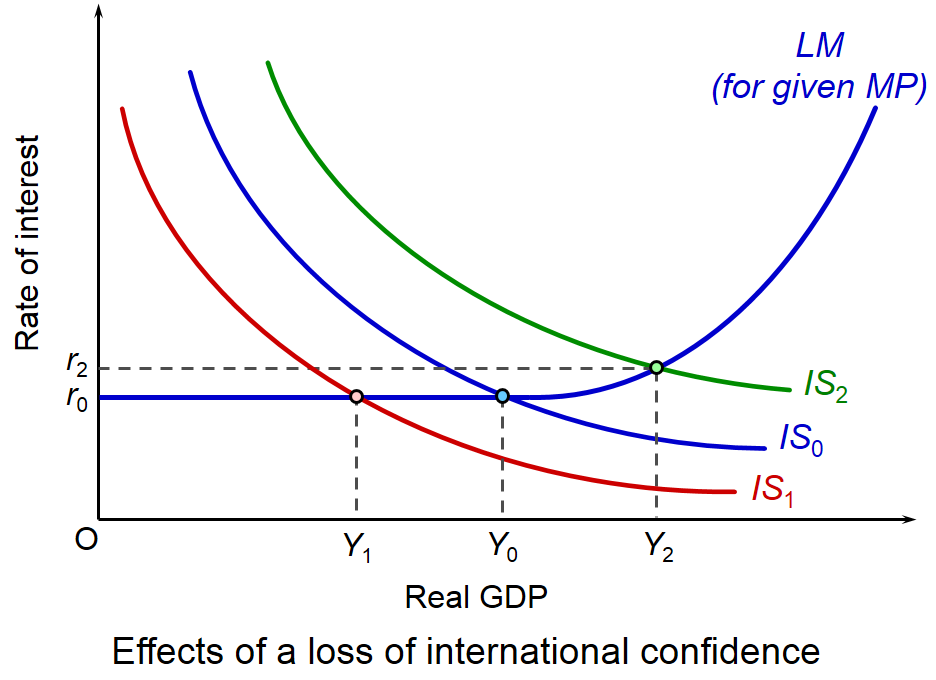 which involves a mix of two policy objectives: an inflation target and real GDP). As GDP rises, putting upward pressure on inflation, so the central bank will raise interest rates. Hence, like the traditional LM curve, the monetary-policy related LM curve will slope upwards, as shown in the diagram.
Initial equilibrium GDP is Y0. The rate of interest is at the minimum level, r0 (i.e. the rate of 0.5% that the Monetary Policy Committee has set since January 2009). This, in the model, is the liquidity trap, where any increase in money supply (a rightward shift in the LM curve) will have no effect on interest rates or GDP.
In Rogoff’s analysis of a crisis triggered by excessive borrowing and problems in the eurozone, the IS curve will shift to the left (as illustrated by curve IS1) as capital flows from the UK and confidence collapses. Real GDP will fall to Y1. This will be the outcome of fiscal expansion in the world of the early 2010s.
 Krugman argues that the opposite will occur. The outflow of capital will drive down the exchange rate. This will lead to an increase in exports and a decrease in imports. Aggregate demand thus rises and the IS curve will shift to the right (e.g. to IS2 in the diagram. Real GDP will rise (e.g. to Y2 in the diagram). If the rise in aggregate demand is sufficient, the economy will rise out of the liquidity trap and interest rates will rise (e.g. to r2 in the diagram).
Not surprisingly, Rogoff challenges this analysis, as you will see if you read his second paper below. He doesn’t criticise the model per se, but challenges Krugman’s assumptions. For example, a depreciation of sterling by some 20% since 2008 doesn’t seem to have had a major effect in stimulating exports (see the chart in the news item, A balancing act). And exports could well have declined if the eurozone economy had collapsed, given that exports to the eurozone account for around 44% of total UK exports.
Rogoff’s assumptions in turn can be challenged. Simon Wren-Lewis argues that, provided a credible long-term plan for deficit reduction is in place, maintaining a fiscal stimulus in the short run, to keep the recovery going that was beginning to emerge in 2010, would help to increase investor confidence, not undermine it. And, with a policy of quantitative easing, which involves the Bank of England buying central government debt, there is no problem of a lack of demand for UK gilts by the private sector.
What is clear from this debate is the willingness of both sides to accept points made by the other. It is an extremely civilised debate. In fact, it could be seen as a model of how academic debate should be conducted. There is none of the ‘shouting’ that has charaterised much of the pro- and anti-austerity lobbying since the financial crisis burst onto the world stage.
Britain should not take its credit status for granted Scholars at Harvard from Financial Times, Kenneth Rogoff (3/10/13)
Ken Rogoff on UK austerity mainly macro, Simon Wren-Lewis (3/10/13)
Phantom Crises (Wonkish) The Conscience of a Liberal, Paul Krugman (3/10/13)
Three Wrongs do not make a Right Scholars at Harvard from Financial Times, Kenneth Rogoff (7/10/13)
Is George Osborne really a hero of global finance? The Guardian, Robert Skidelsky (24/10/13)
Questions
- Explain how the policy-dependent LM curve illustrated in the diagram is derived.
- What would cause the policy-dependent LM curve to shift?
- Explain what is meant by the ‘liquidity trap’. Why does being in a liquidity trap make monetary policy ineffective?
- How would you determine whether or not the UK is currently in a liquidity trap?
- How is the level of (a) public-sector debt and (b) private sector debt owed overseas likely to affect the confidence of investors concerning the effects of an expansionary fiscal policy?
- Compare the UK’s total external debt with that of other countries (see the following tables from Principal Global Indicators, hosted by the IMF: External debt and Short-term external debt).
- What insurance policy (if any) does the UK have to protect against market panic about the viability of UK debt?
- What areas of agreement are there between Rogoff on the one side and Krugman and Wren-Lewis on the other?
 You may have been following the posts on the US debt ceiling and budget crisis: Over the cliff and Over the cliff: an update. Well, after considerable brinkmanship over the past couple of weeks, and with the government in partial shutdown since 1 October thanks to no budget being passed, a deal was finally agreed by both Houses of Congress, less than 12 hours before the deadline of 17 October. This is the date when the USA would have bumped up against the debt ceiling of $16.699 trillion and would be in default – unable to borrow sufficient funds to pay its bills, including maturing debt.
But the deal only delays the problem of a deeply divided Congress, with the Republican majority on the House of Representatives only willing to make a long-term agreement in exchange for concessions by President Obama and the Democrats on the healthcare reform legislation. All that has been agreed is to suspend the debt ceiling until 7 February 2014 and fund government until 15 January 2014.
A more permanent solution is clearly needed: not just one that raises the debt ceiling before the next deadline, but one which avoids such problems in the future. Such concerns were echoed by Christine Lagarde, Managing Director of the International Monetary Fund (IMF), who issued the following statement:
The U.S. Congress has taken an important and necessary step by ending the partial shutdown of the federal government and lifting the debt ceiling, which enables the government to continue its operations without disruption for the next few months while budget negotiations continue to unfold.
It will be essential to reduce uncertainty surrounding the conduct of fiscal policy by raising the debt limit in a more durable manner. We also continue to encourage the U.S. to approve a budget for 2014 and replace the sequester with gradually phased-in measures that would not harm the recovery, and to adopt a balanced and comprehensive medium-term fiscal plan.
US default: Congress votes to end shutdown crisis The Telegraph, Raf Sanchez (17/10/13)
US shutdown: Christine Lagarde calls for stability after debt crisis is averted The Guardian,
James Meikle, Paul Lewis and Dan Roberts (17/10/13)
America’s economy: Meh ceiling? The Economist (15/10/13)
Relief as US approves debt deal BBC News (17/10/13)
Shares in Europe dip after US debt deal BBC News (17/10/13)
Dollar slides as relief at U.S. debt deal fades Reuters, Richard Hubbard (17/10/13)
US debt deal: Analysts relieved rather than celebrating Financial Times, John Aglionby and Josh Noble (17/10/13)
Greenspan fears US government set for more debt stalemate BBC News (21/10/13)
Questions
- Explain what is meant by default and how the concept applies to the USA if it had not suspended or raised its budget ceiling.
- Is the agreement of October 16 likely to ‘reassure markets’? Explain your reasoning.
- What is likely to happen to long-term interest rates as a result of the agreement?
- Will the imposition of a new debt ceiling by February 2014 remove the possibility of using fiscal policy to stimulate aggregate demand and speed up the recovery?
- What is meant by ‘buy the rumour, sell the news’ in the context of stock markets? How was this relevant to the agreement on the US debt ceiling and budget?
 For the second time in nine months, the USA has approached a fiscal cliff. This is where the federal government is forced to make government expenditure cuts and/or impose tax rises. There are two types of cliff face. The first is a legal limit on the size of the federal government debt and hence deficit. The second is failure to agree on a budget.
On January 1st this year, a fiscal cliff was narrowly averted by a last-minute agreement to raise the size of the permitted debt. On the 1st October (the beginning of the financial year), however, the US economy ‘fell over the cliff’. This time is was a failure by Congress to reach agreement over the federal budget. The sticking point was an unwillingness of the Republican majority in the House of Representatives to agree to a budget without the government making concessions on its healthcare reform. The government was unwilling to do that and so no budget was passed.
With no budget, much of government has to shut down! In practice, this means that all non-essential workers will cease to be paid. That includes workers in housing, parts of healthcare, the civil law part of the justice system, immigration, regulatory agencies, the passport service, parks and museums. Even workers in essential areas, such as civilian workers in the military, police and social services, are likely to see their pay delayed until the problem is resolved. The articles below look at some of the implications of this partial shut-down.
It is hoped that, within a few days, agreement on a budget will be reached. But that will not be the end of the story because a second fiscal cliff looms. And that is of the first type. There is currently a legal limit to Federal Government debt of $16.699 trillion. Because that limit was reached earlier this year, from May 18 the government has been able to use various ‘extraordinary measures‘ to carry on borrowing. These measures will run out, however, around 17 October. From then, if a new higher debt ceiling has not been agreed by Congress, the government will be unable to pay some of its bills. For example, on 1 November it will get a bill of $67billion for social security, medicare and veterans benefits. As the second Independent article below explains:
In a government shutdown, the federal government is not allowed to make any new spending commitments. By contrast, if we hit the debt-ceiling then the Treasury Department won’t be able to borrow money to pay for spending that Congress has already approved. In that case, either Congress will have to lift the debt ceiling or the federal government will have to default on some of its bills, possibly including payments to bondholders or Social Security payouts. That could trigger big disruptions in the financial markets — or a long-term rise in borrowing costs.
Not surprisingly, financial markets are nervous. Although the direct effect of lost output will be relatively small, provided agreements on the budget and the debt are reached fairly soon, the impact on confidence in the US system of government could be more damaging. Not only could this curb recovery in the USA, it could have a significant effect on global recovery, given the size and importance of the US economy to the rest of the world.
Webcasts
What does the shutdown mean for normal Americans? BBC News, Keith Doyle (1/10/13)
How the government shut down is being reported in the US BBC News (1/10/13)
Shutdown could slam frail U.S. economy Reuters, Bobbi Rebell (1/10/13)
Shutdown Will Cost U.S. Economy $300 Million a Day, IHS Says Bloomberg, Jeanna Smialek & Ian Katz (1/10/13)
How will the US government shutdown affect the global economy? The Guardian, Larry Elliott and Guy Grandjean (1/10/13)
How would a government shutdown affect the rebounding economy? Aljazeera, Duarte Geraldino (30/9/13)
How will the US government shutdown affect the economy? BBC News, Richard Lister (1/10/13)
Shutdown continues as Obama and Republicans fail to agree BBC News, Rajini Vaidynathan (2/10/13)
Former US Secretary of Labor Robert Reich on shutdown BBC News, Robert Reich (2/10/13)
Government shutdown: What’s the cost? CBS News, Rebecca Kaplan (1/10/13)
US shutdown will have ‘minimal impact’ on global economy One News (New Zealand), Dan Zirker (2/10/13)
What is the US debt ceiling? BBC News, Hugh Pym (14/10/13)
Articles
US wakes up to government shutdown as Congress fails to strike budget deal Independent, Nikhil Kumar (1/10/13)
US begins government shutdown as budget deadline passes BBC News (1/10/13)
David Cameron warns on world growth as US government shuts down The Telegraph, Damien McElroy (1/10/13)
Shutdown showdown: A glossary Aljazeera, Ben Piven (30/9/13)
Everything you need to know about how the partial shutdown will work in US Independent, Brad Plumer (1/10/13)
What’s the economic impact of a US government shutdown? BBC News, Kim Gittleson (1/10/13) (follow links at top of screen for further articles)
US government shutdown isn’t the worst of it BBC News, Linda Yueh (30/9/13)
Onset of the storm BBC News, Robert Peston (1/10/13)
The gathering storm? BBC News, Robert Peston (30/9/13)
Government shutdown: what’s really going on – and who’s to blame? The Guardian, Dan Roberts (30/9/13)
Government shutdown threat is getting very old, very fast CNN, Julian Zelizer (30/9/13)
US fiscal cliff fears rattle the markets The Australian, Adam Creighton (1/10/13)
U.S. Government Shutdown Sinks Dollar Forbes, Dean Popplewell (1/10/13)
US Government Shutdown: European Markets Not Fretting Over Temporary Closure International Business Times, Ishaq Siddiqi (1/10/13)
The States to plunge into abyss of debt, off fiscal cliff Pravda, Irina Sabinina (1/10/13)
Shutting down the United States government nothing new The Vancouver Sun, Andrew Coyne (1/10/13)
Christine Lagarde urges US that debt crisis threatens world economy The Guardian, Larry Elliott (3/10/13)
U.S. failure to lift debt ceiling could damage world – IMF Reuters (3/10/13)
Data
US government shutdown: in numbers The Guardian (see also)
US Budget: Historical Tables White House Office of Management and Budget (includes estimates to 2018 as well as historical data)
Questions
- If a debt ceiling is reached, what does this imply for the budget deficit?
- How serious are the two current fiscal cliffs?
- How would a continuation of the partial government shut-down impact on the US private sector?
- What multiplier effects on the rest of the world are likely to arise from a cut in US government expenditure or a rise in taxes? What determines the size of these multiplier effects?
- Explain the likely effect of the current crisis on the exchange rate of the dollar into other currencies.
- Why might the looming problem of reaching the debt ceiling drive up long-term interest rates in the USA and beyond?
 economy (12.5% compared with 4.3% for RUK) and could potentially place disproportionate demands on the currency union’s finances.