 The Preliminary Estimate of the UK Q2 GDP figures by the Office for National Statistics show that the UK economy grew by 0.6% in the second quarter of 2013: double the growth rate of the first quarter and almost back to the long-run average growth rate prior to 2008.
At first sight, this would seem to be good news – certainly from the government’s point of view. What is more, unlike the previous quarter, growth is spread relatively evenly across the three main sectors: the production (manufacturing, mining, water supply, etc.) and services sectors both grew by 0.6% and the construction sector by 0.9% (this sector fell by 1.8% in the previous quarter). (Click here for a PowerPoint of the chart below.)
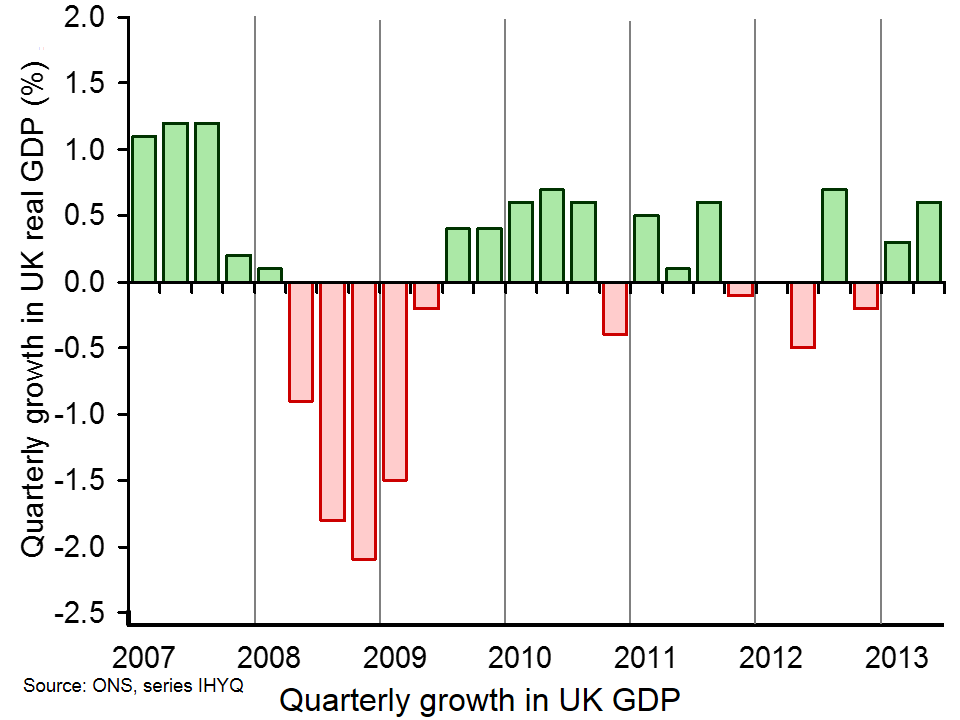 But while growth in the latest quarter may be balanced between the broad sectors, the rise in aggregate demand is not balanced between its components. As an earlier news item (A balancing act) showed, the rise in aggregate demand has been driven largely by a rise in consumption, and a corresponding fall in saving. Exports are rising only slowly and investment is some 25% lower than in the boom years prior to 2008.
So will the latest growth be sustainable? Will investment now begin to pick up and what constraints are there on investment? The following articles consider some of the issues.
Articles
Economy firing on all cylinders as growth hits 0.6pc The Telegraph, Philip Aldrick (25/7/13)
The good, the bad or the ugly? How the UK economy stands up. The Telegraph, Philip Aldrick (25/7/13)
George Osborne’s 0.6% growth is good but unspectacular The Guardian, Larry Elliott (25/7/13)
The (not-so) green shoots of recovery The Economist, John Van Reenen (23/7/13)
Economic recovery slow to take root for some in UK Reuters, William Schomberg and Max De Haldevang (25/7/13)
 GDP figures offer hard evidence for political narrative BBC News, Paul Mason (25/7/13)
Ignore the hype: Britain’s ‘recovery’ is a fantasy that hides our weakness The Observer, Will Hutton (21/7/13)
UK economy: Half-speed ahead BBC News, Stephanie Flanders (25/7/13)
BoE guidance can help sustain the UK recovery The Economist, Kevin Daly (22/7/13)
George Osborne’s description of the economy is near-Orwellian The Guardian, Ha-Joon Chang (26/7/13)
Economic growth: more must be done to encourage investment The Guardian, Phillip Inman (1/8/13)
Data
Gross Domestic Product: Preliminary Estimate, Q2 2013 ONS (25/7/13)
Questions
- Compare the macroeconomic situation today with that prior to the financial crisis of 2007/8 and subsequent recession.
- What factors will determine the sustainability of the UK economic recovery?
- What is meant by the ‘accelerator’ and what will determine the size of any accelerator effect from the latest rise in UK GDP?
- What supply-side constraints are likely to limit the rate and extent of recovery?
- Why do economies that are in recession ‘naturally bounce back’ without any government intervention? Have the macroeconomic policies of the UK government helped or hindered this bounce back? Explain.
- What monetary measures by the Bank of England are most appropriate in the current circumstances?
 Tight fiscal policies are being pursued in many countries to deal with high public-sector deficits that resulted from the deep recession of 2008/9. This has put the main onus on monetary policy as the means of stimulating recovery. As a result we have seen record low interest rates around the world, set at only slightly above zero in the main industrialised countries for the past 4½ years. In addition, there have been large increases in narrow money as a result of massive programmes of quantitative easing.
Yet recovery remains fragile in many countries, including the UK and much of the rest of Europe. And a new problem has been worries by potential investors that loose monetary policy may be soon coming to an end. As the June blog The difficult exit from cheap money pointed out:
The US economy has been showing stronger growth in recent months and, as a result, the Fed has indicated that it may soon have to begin tightening monetary policy. It is not doing so yet, nor are other central banks, but the concern that this may happen in the medium term has been enough to persuade many investors that stock markets are likely to fall as money eventually becomes tighter. Given the high degree of speculation on stock markets, this has led to a large-scale selling of shares as investors try to ‘get ahead of the curve’.
Central banks have responded with a new approach to monetary policy. This is known as ‘forward guidance’. The idea is to manage expectations by saying what the central bank will do over the coming months.
The USA was the first to pursue this approach. In September 2012 the Fed committed to bond purchase of $40bn per month (increased to $85bn per month in January 2013) for the foreseeable future; and record low interest rates of between 0% and 0.25% would continue. Indeed, as pointed out above, it was the ‘guidance’ last month that such a policy would be tapered off at some point, that sent stock markets falling in June.
The Fed has since revised its guidance. On 10 July, Ben Bernanke, the Fed Chairman said that monetary policy would not be tightened for the foreseeable future. With fiscal policy having been tightened, QE would continue and interest rates would not be raised until unemployment had fallen to 6.5%.
Japan has been issuing forward guidance since last December. Its declared aim has been to lower the exchange rate and raise inflation. It would take whatever fiscal and monetary policies were deemed necessary to achieve this (see A J-curve for Japan? and Japan’s three arrows).
Then on 4 July both the Bank of England and the ECB adopted forward guidance too. Worried that growth in the US economy would lead to an end to loose monetary policy before too long and that this would drive up interest rates worldwide, both central banks committed to keeping interest rates low for an extended period of time. Indeed, the ECB declared that the next movement in interest rates would more likely be down than up. Mario Draghi, the ECB president said that the ending of loose monetary policy is ‘very distant’.
The effect of this forward guidance has been to boost stock markets again. The hope is that by managing expectations in this way, the real economy will be affected too, with increased confidence leading to higher investment and faster economic growth.
Articles
Q&A: What is ‘forward guidance’ BBC News, Laurence Knight (4/7/13)
Forward guidance crosses the Atlantic The Economist, P.W. (4/7/13)
ECB has no plans to exit loose policies, says Benoit Coeure The Telegraph, Szu Ping Chan (25/6/13)
ECB issues unprecedented forward guidance The Telegraph, Denise Roland (4/7/13)
Independence day for central banks BBC News, Stephanie Flanders (4/7/13)
The Monetary Policy Committee’s search for guidance BBC News, Stephanie Flanders (16/7/13)
The Monetary Policy Committee’s search for guidance (II) BBC News, Stephanie Flanders (17/7/13)
Bank of England surprise statement sends markets up and sterling tumbling The Guardian, Jill Treanor and Angela Monaghan (4/7/13)
Forward guidance only works if you do it right Financial Times, Wolfgang Münchau (7/7/13)
Fed’s Forward Guidance Failing to Deliver Wall Street Journal, Nick Hastings (15/7/13)
Talking Point: Thoughts on ECB forward guidance Financial Times, Dave Shellock (11/7/13)
Forward guidance in the UK is likely to fail as the Fed taper approaches City A.M., Peter Warburton (12/7/13)
Forward guidance more than passing fashion for central banks Reuters, Sakari Suoninen (11/7/13)
Markets await Mark Carney’s ‘forward guidance’ The Guardian, Heather Stewart (17/7/13)
Beware Guidance The Economist, George Buckley (25/7/13)
UK interest rates held until unemployment falls BBC News (7/8/13)
Central Bank Statements
How does forward guidance about the Federal Reserve’s target for the federal funds rate support the economic recovery? Federal Reserve (19/6/13)
Remit for the Monetary Policy Committee HM Treasury (20/3/13)
Bank of England maintains Bank Rate at 0.5% and the size of the Asset Purchase Programme at £375 billion Bank of England (4/7/13)
Monthly Bulletin ECB (see Box 1) (July 2013)
Inflation Report Press Conference: Opening remarks by the Governor Bank of England (7/8/13)
MPC document on Monetary policy trade-offs and forward guidance Bank of England (7/8/13)
Interest rates to be held until unemployment drops to 7% BBC News, Statement by Mark Carney, Governor of the Band of England (7/8/13)
Questions
- Is forward guidance a ‘rules-based’ or ‘discretion-based’ approach to monetary policy?
- Is it possible to provide forward guidance while at the same time pursuing an inflation target?
- If people know that central banks are trying to manage expectations, will this help or hinder central banks?
- Does the adoption of forward guidance by the Bank of England and ECB make them more or less dependent on the Fed’s policy?
- Why may forward guidance be a more effective means of controlling interest rates on long-term bonds (and other long-term rates too) than the traditional policy of setting the repo rate on a month-by-month basis?
- What will determine the likely success of forward guidance in determining long-term bond rates?
- Is forward guidance likely to make stock market speculation less destabilising?
 In the blogs The capital adequacy of UK banks and A co-operative or a plc? we focus on how British banks continue to look to repair their balance sheets. To do so, banks need to ‘re-balance’ their balance sheets. This may involve them holding more reserves and equity capital and/or a less risky and more liquid profile of assets. The objective is to make banks more resilient to shocks and less susceptible to financial distress.
This will take time and even then the behaviour of banks ought to look like quite different from that before the financial crisis. All of this means that we will need to learn to live with new banking norms which could have fundamental consequences for economic behaviour and activity.
The increasing importance of financial institutions to economic activity is known as financialisation. It is not perhaps the nicest word, but, in one way or another, we all experience it. I am writing this blog in a coffee shop in Leicester having paid for my coffee and croissant by a debit card. I take it for granted that I can use electronic money in this way. Later I am going shopping and I will perhaps use my credit card. I take this short term credit for granted too. On walking down from Leicester railway station to the coffee shop I walked past several estate agents advertising properties for sale. The potential buyers are likely to need a mortgage. In town, there are several construction sites as Leicester’s regeneration continues. These projects need financing and such projects often depend on loans secured from financial institutions.
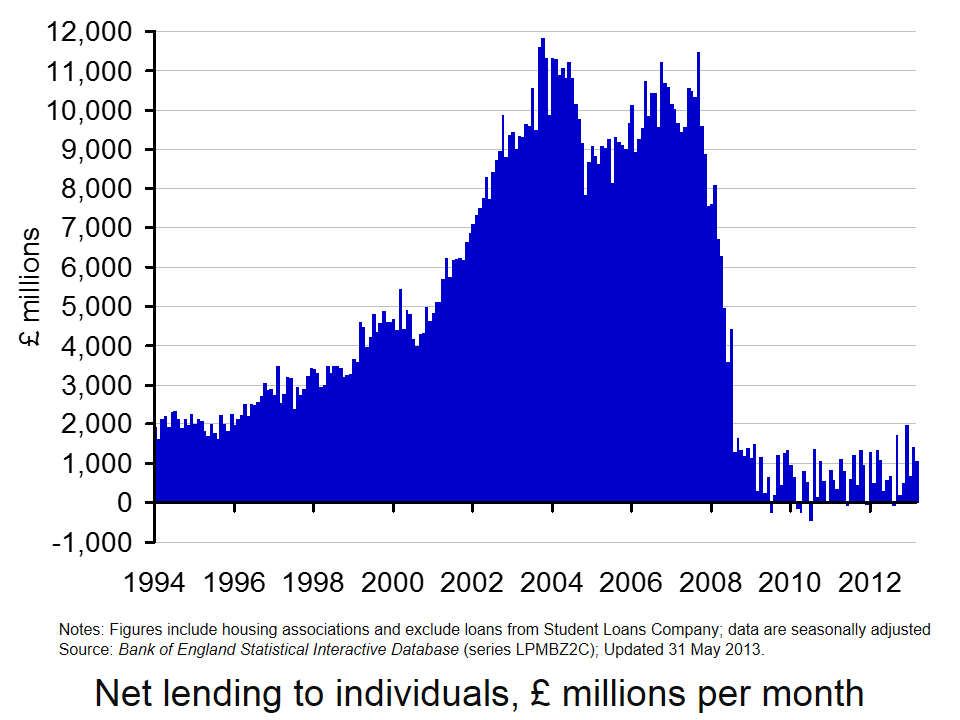 We should not perhaps expect economic relationships to look as they did before the financial crisis. The chart shows how levels of net lending by financial institutions to households have dramatically fallen since the financial crisis. (Click here for PowerPoint of chart.)
Net lending measures the amount of lending by financial institutions after deducting repayments. These dramatically smaller flows of credit do matter for the economy and they do affect important macroeconomic relationships.
Consider the consumption function. The consumption function is a model of the determinants of consumer spending. It is conventional wisdom that if we measure the growth of consumer spending over any reasonably long period of time it will basically reflect the growth in disposable income. This is less true in the short run and this is largely because of the financial system. We use the financial system to borrow and to save. It allow us to smooth our consumption profile making spending rather less variable. We can save during periods when income growth is strong and borrow when income growth is weak or income levels are actually falling. All of this means that in the short term consumption is less sensitive to changes in disposable income that it would otherwise be.
 The financial crisis means new norms for the banking system and, hence, for the economy. One manifestation of this is that credit is much harder to come by. In terms of our consumption function this might mean consumption being more sensitive to income changes that it would otherwise be. In other words, consumption is potentially more volatile as a result of the financial crisis. But, the point is more general. All spending activity, whether by households or firms, is likely to be more sensitive to economic and financial conditions than before. For example, firms’ capital spending will be more sensitive to their current financial health and crucially to their flows of profits.
We can expect particular markets and sectors to be especially affected by new financial norms. An obvious example is the housing market which is very closely tied to the mortgage market. But, any market or sector that traditionally is dependent on financial institutions for finance will be affected. This may include, for example, small and medium-sized enterprises or perhaps organsiations that invest heavily in R&D. It is my view that economists are still struggling to understand what the financial crisis means for the economy, for particular sectors of the economy and for the determination of key economic relationships, such as consumer spending and capital spending. What is for sure, is that these are incredibly exciting times to study economics and to be an economist.
Data
Statistical Interactive Database Bank of England
Articles
Cut in net lending to non-financial firms raises credit worries Herald Scotland, Mark Williamson (25/5/13)
Loans to business continue to shrink despite Funding for Lending Scheme Wales Online, Chris Kelsey (3/6/13)
Factbox – Capital shortfalls for five UK banks, mutuals Standard Chartered News (20/6/13)
UK banks ordered to plug £27.1bn capital shortfall The Guardian, Jill Treanor (20/6/13)
Barclays, Co-op, Nationwide, RBS and Lloyds responsible for higher-than-expected capital shortfall of £27.1bn The Telegraph, Harry Wilson (20/6/13)
UK banks need to plug £27bn capital hole, says PRA BBC News (20/6/13)
Barclays and Nationwide forced to strengthen BBC News, Robert Peston (20/6/13)
Five Banks Must Raise $21 Billion in Fresh Capital: BOE Bloomberg, Ben Moshinsky (20/6/13)
Co-operative Bank to list on stock market in rescue deal The Guardian, Jill Treanor (17/6/13)
Troubled Co-operative Bank unveils rescue plan to plug £1.5bn hole in balance sheet Independent, Nick Goodway (17/6/13)
Co-op Bank announces plan to plug £1.5bn hole Which?(17/6/13)
The Co-operative Bank and the challenge of finding co-op capital The Guardian, Andrew Bibby (13/6/13)
Co-op Bank seeks to fill £1.5bn capital hole Sky News (17/6/13)
Central banks told to head for exit Financial Times, Claire Jones (23/6/13)
Stimulating growth threatens stability, central banks warn The Guardian (23/6/13)
BIS Press Release and Report
Making the most of borrowed time: repair and reform the only way to growth, says BIS in 83rd Annual Report BIS Press Release (23/6/13)
83rd BIS Annual Report 2012/2013 Bank for International Settlements (23/6/13)
Questions
- What is meant by equity capital?
- How can banks increase the liquidity of their assets?
- Explain how Basel III is intended to increase the financial resilence of banks.
- What do you understand by the term ‘financialisation’? Use examples to illustrate this concept.
- How might we expect the financial crisis to affect the detemination of spending by economic agents?
- Using an appropriate diagram, explain how a reduction in capital spending could affect economic activity? Would this be just a short-term effect?
- What does it mean if we describe households as consumption-smoothers? How can households smooth their spending?
 Over the past few years, the term ‘bail-out’ has been a common phrase. But, what about the term ‘bail-in’? The latest bank to face financial ruin is the Co-operative Bank, but instead of turning to the tax-payer for a rescue, £1.5 billion will come from bond holders being offered shares in the bank. This will mean that the bank will become listed on the stock market.
Back in 2009, the Co-operative Bank bought Britannia Building Society and it seems that this was the start of its downfall. It took over many bad mortgage loans and loans to companies, and these played a large part in its current financial difficulties.
In order to rescue the bank and raise the capital needed to absorb current and future losses, without turning to the tax-payer, bond-holders of £1.3 billion of loans to the bank will be asked to swap them for shares and bonds, thus leading to significant losses for them. These bond-holders include 7000 private investors.
Since the financial crisis five years ago, the conventional banking model has seen much criticism and many suggested that the mutual structure of the Co-operative provided a better model, creating trust, due to its many stakeholders, who are not as focused on profitability and returns as those shareholders of a listed bank. However, the problems of the Co-operative seem to have put paid to that idea. The bail-in will mean that the bank is now listed on the stock market and thus will have shareholders expecting returns and profitability. This will undoubtedly change the focus of the bank. Euan Sutherland, the new Chief Executive said:
We are very clear that the bank will remain true to responsible and community-based banking and retain its ethical investment stance … Clearly there are lessons to learn and clearly there will be a time to look back and do that but, to be honest, in the last six weeks, where I have been involved with the Co-operative group, we have focused on driving a very solid future for this bank.
The good news is that the savings of those in the Co-operative are safe and taxpayers will not have to fork out any more money.
Yet, the co-operative structure of the bank has long been praised by customers and government alike. But is it perhaps this structure, which has led to its collapse? Furthermore, will the change in structure that will see it listed on the stock market, lead to a change in its approach to banking? The following articles consider the latest bank to run into difficulties.
Webcast
Co-op Bank unveils rescue plan to tackle the £1.5bn hole BBC News (17/6/13)
Articles
Co-op Bank travails show weakness of mutual model Financial Times, Sarah Gordon (21/6/13)
Co-operative Bank to list on stock market in rescue deal The Guardian, Jill Treanor (17/6/13)
Troubled Co-operative Bank unveils rescue plan to plug £1.5bn hole in balance sheet Independent, Nick Goodway (17/6/13)
Co-op Bank announces plan to plug £1.5bn hole Which? (17/6/13)
The Co-operative Bank and the challenge of finding co-op capital The Guardian, Andrew Bibby (13/6/13)
Co-op Bank seeks to fill £1.5bn capital hole Sky News (17/6/13)
Does Co-op Group deserve to keep control of Co-op Bank? BBC News, Robert Peston (9/7/13)
Questions
- Why did the Co-operative Bank move into financial trouble?
- What are the key characteristics of a Mutual? Are they disadvantages or advantages?
- What is a ‘bail-in’? Who will gain and who will lose?
- The Co-operative Bank will now be listed on the stock market. What does this mean?
- What are the advantages and disadvantages of floating a company on the stock market?
- Why are all banks required to hold capital to absorb losses?
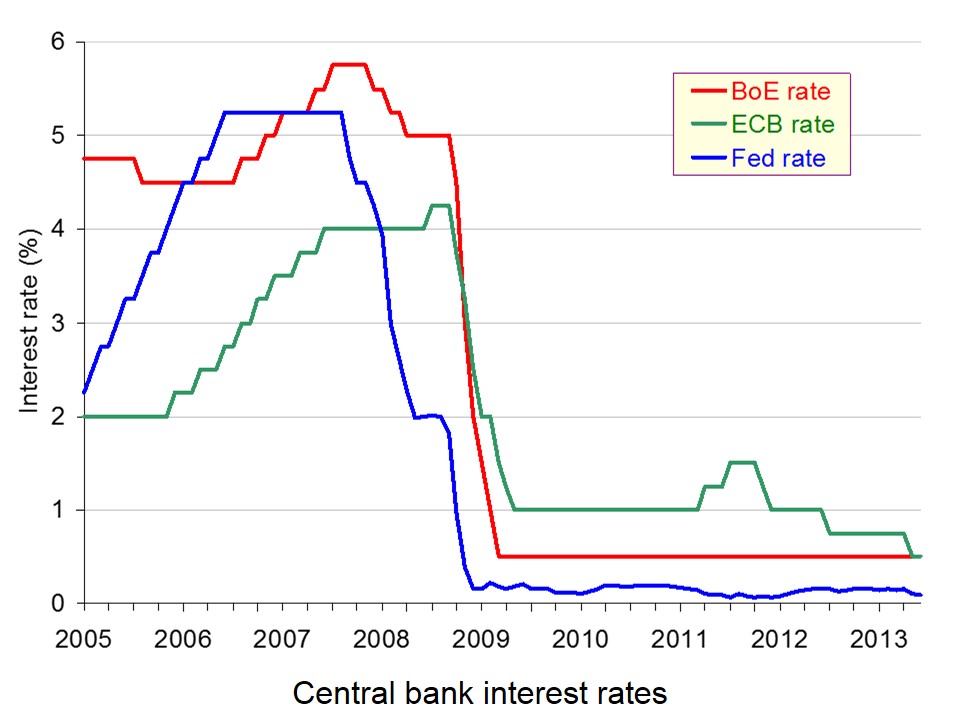 Since the beginning of 2009, central banks around the world have operated an extremely loose monetary policy. Their interest rates have been close to zero (click here for a PowerPoint of the chart) and more than $20 trillion of extra money has been injected into the world economy through various programmes of quantitative easing.
The most recent example of loose monetary policy has been in Japan, where substantial quantitative easing has been the first of Japan’s three arrows to revive the economy (the other two being fiscal policy and supply-side policy).
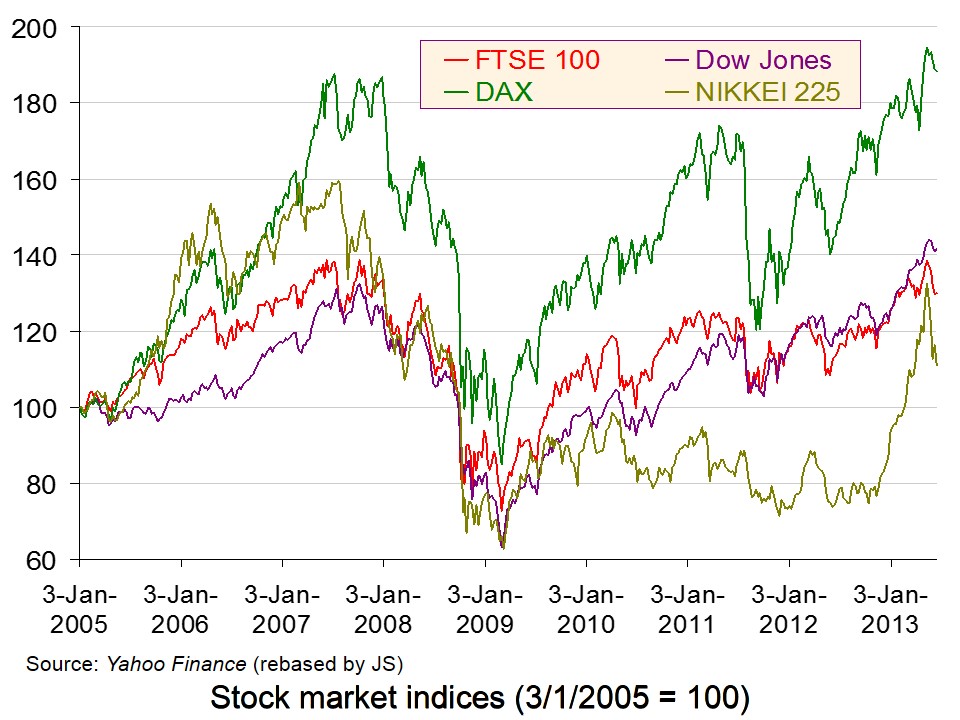 One consequence of a rise in money supply has been the purchase of a range of financial assets, including shares, bonds and commodities. As a result, despite the sluggish or negative growth in most developed countries, stock markets have soared (see chart). From March 2009 to May 2013, the FTSE 100 rose by 91% and both the USA’s Dow Jones Industrial average and Germany’s DAX rose by 129%. Japan’s NIKKEI 225, while changing little from 2009 to 2012, rose by 78% from November 2012 to May 2013 (click here for a PowerPoint of the chart).
The US economy has been showing stronger growth in recent months and, as a result, the Fed has indicated that it may soon have to begin tightening monetary policy. It is not doing so yet, nor are other central banks, but the concern that this may happen in the medium term has been enough to persuade many investors that stock markets are likely to fall as money eventually becomes tighter. Given the high degree of speculation on stock markets, this has led to a large-scale selling of shares as investors try to ‘get ahead of the curve’.
From mid-May to mid-June, the FTSE 100 fell by 6.2%, the Dow Jones by 2.6%, the DAX by 4.5% and the NIKKEI by 15%. In some developing countries, the falls have been steeper as the cheap money that entered their economies in search of higher returns has been leaving. The falls in their stock markets have been accompanied by falls in their exchange rates.
 The core of the problem is that most of the extra money that was created by central banks has been used for asset purchase, rather than in financing extra consumer expenditure or capital investment. If money is tightened, it is possible that not only will stock and bond markets fall, but the fragile recovery may be stifled. In other words, tighter money and higher interest rates may indeed affect the real economy, even though loose monetary policy and record low interest rates had only a very modest effect on the real economy.
This poses a very difficult question for central banks. If even the possibility of monetary tightening some time in the future has spooked markets and may rebound on the real economy, does that compel central banks to maintain their loose policy? If it does, will this create an even bigger adjustment problem in the future? Or could there be a ‘soft landing’, whereby real growth absorbs the extra money and gradually eases the inflationary pressure on asset markets?
Articles
How the Fed bosses all BBC News, Robert Peston (12/6/13)
The great reversal? Is the era of cheap money ending? BBC News, Linda Yueh (12/6/13)
The Great Reversal: Part II (volatility and the real economy) BBC News, Linda Yueh (14/6/13)
The end of the affair The Economist (15/6/13)
Out of favour The Economist, Buttonwood (8/6/13)
The Federal Reserve: Clearer, but less cuddly The Economist (22/6/13)
Global financial markets anxious to avoid many pitfalls of ‘political risk’ The Guardian, Heather Stewart (13/6/13)
Dow Falls Below 15,000; Retailers Add to Slump New York Times, (12/6/13)
Global market sell-off over stimulus fears The Telegraph, Rachel Cooper (13/6/13)
Nikkei sinks over 800 points, falls into bear market Globe and Mail (Canada), Lisa Twaronite (13/6/13)
Global shares drop, dollar slumps as rout gathers pace Reuters, Marc Jones (13/6/13)
The G8, the bond bubble and emerging threats BBC News, Stephanie Flanders (17/6/13)
Global monetary policy and the Fed: vive la difference BBC News, Stephanie Flanders (20/6/13)
The Federal Reserve’s dysfunctional relationship with the markets The Guardian, Heidi Moore (19/6/13)
Global stock markets in steep falls after Fed comment BBC News (20/6/13)
Federal Reserve’s QE withdrawal could signal real trouble ahead The Guardian, Nils Pratley (20/6/13)
Central banks told to head for exit Financial Times, Claire Jones (23/6/13)
Stimulating growth threatens stability, central banks warn The Guardian (23/6/13)
BIS Press Release and Report
Making the most of borrowed time: repair and reform the only way to growth, says BIS in 83rd Annual Report BIS Press Release (23/6/13)
83rd BIS Annual Report 2012/2013 Bank for International Settlements (23/6/13)
Data
Yahoo! Finance: see links for FTSE 100, DAX, Dow Jones, NIKKEI 225
Link to central bank websites Bank for International Settlements
Statistical Interactive Database – Interest & exchange rates data Bank of England
Questions
- Why have stock markets soared in recent years despite the lack of economic growth?
- What is meant by ‘overshooting’? Has overshooting taken place in stock markets (a) up to mid-May this year; (b) since mid-May? How would you establish whether overshooting has taken place?
- What role is speculation currently playing in stock markets? Would you describe this speculation as destabilising?
- What has been the impact of quantitative easing on (a) bond prices; (b) bond yields?
- Argue the case for and against central banks continuing with the policy of quantitative easing for the time being.
- Find out how much the Indian rupee and the Brazilian real have fallen in recent weeks. Explain your findings.
 The Preliminary Estimate of the UK Q2 GDP figures by the Office for National Statistics show that the UK economy grew by 0.6% in the second quarter of 2013: double the growth rate of the first quarter and almost back to the long-run average growth rate prior to 2008.