 In three interesting articles, linked below, the authors consider the state of economies since the financial crisis of 2007–8 and whether governments have the right tools to tackle future economic shocks.
There have been some successes over the past 10 years, in particular keeping inflation close to central bank targets despite considerable shocks (see the Vox article). Also unemployment has fallen in most countries and to very low levels in some, including the UK.
But economic growth has generally remained well below the levels prior to the financial crisis, with low productivity growth being the main culprit. Indeed, many people have seen no growth at all in their real incomes over the past 10 years, with low unemployment being bought at the cost of a growth in zero-hour contracts and work in the gig economy. And what economic growth we have seen has been largely the result of taking up slack through unprecedentedly loose monetary policy.
Fiscal policy, except in the period directly following the financial crisis, has generally been tight as governments have sought to reduce their deficits and slow down the growth in their debt.
But what will happen if economies once more slow? Or, worse still, what will happen if there is another global recession? Do countries have the policies to tackle the problem this time round?
 Quantitative easing could be used again, but many economists believe that it will have more limited scope if confined to the purchase of assets in the secondary market. Also, there is little scope for reducing interest rates, which, despite some modest rises in the USA, remain at close to zero in most developed countries.
One possibility is a combination of monetary and fiscal policy, where new money is used to finance government expenditure on infrastructure, such as road and rail, broadband, green energy, hospitals and schools and colleges. This would avoid the need for governments to borrow on open markets as the spending would be financed by new government securities purchased directly by the central bank.
An objection to such ‘people’s quantitative easing‘, as it has been dubbed, is that it would effectively end the independence of central banks. This independence has been credited by many with giving central banks credibility in controlling inflation. Would inflationary expectations rise with people’s quantitative easing and, with it, actual inflation? A lot would depend on the extent to which this QE could still be conducted within a framework of targeting inflation and whether people’s expectations of inflation could be managed jointly by the government and central bank.
Articles
How should recessions be fought when interest rates are low? The Economist. Free exchange (21/10/17)
The economy is failing. We need to think radically about how to fix it The Guardian, Liam Byrne (25/10/17)
Elusive inflation and the Great Recession Vox, David Miles, Ugo Panizza, Ricardo Reis, Ángel Ubide (25/10/17)
Videos
 Economics since the crisis Vox on YouTube. Charles Goodhart (11/10/17)
Is the system broken? Vox on YouTube, Anat Admati (12/10/17)
Signs of a crisis Vox on YouTube, Christian Thimann (19/10/17)
Policy stances since 2007 Vox on YouTube, Paul Krugman (29/10/17)
Did policymakers get it right? Vox on YouTube, Paul Krugman (4/10/17)
Questions
- Why, during the next recession, will the “zero lower bound” (ZLB) on interest rates almost certainly bite again?
- Why would the scope for QE, as conducted up to now, be more limited in the future if a recession were to occur?
- Why have central banks appeared to have been so successful in keeping inflation close to target despite negative and positive demand- and supply-side shocks?
- Why are the pressures on government expenditure likely to increase in the coming years?
- How would a temporary price-level target help to tackle a recession when the economy next bumps into the ZLB? What would limit its success?
- Is it appropriate for central banks to stick to an inflation target in times when there is an adverse supply-side shock resulting in cost-push inflation?
- Why might monetary policy conducted in a framework of inflation targeting tend to lessen the impact of a fiscal stimulus?
- What are the arguments for and against relaxing central bank independence and pursuing a co-ordinated fiscal and monetary policy?
- What are the arguments for and against using helicopter money to boost private expenditure during a future recession where interest rates are already near the ZLB?
- What are the arguments for and against using ‘people’s QE’?
On the 15th June, the Bank of England’s Monetary Policy Committee decided to keep Bank Rate on hold at its record low of 0.25%. This was not a surprise – it was what commentators had expected. What was surprising, however, was the split in the MPC. Three of its current eight members voted to raise the rate.
At first sight, raising the rate might seem the obvious thing to do. CPI inflation is currently 2.9% – up from 2.7% in April and well above the target of 2% – and is forecast to go higher later this year. According to the Bank of England’s own forecasts, even at the 24-month horizon inflation is still likely to be a little above the 2% target.
Those who voted for an increase of 0.25 percentage points to 0.5% saw it as modest, signalling only a very gradual return to more ‘normal’ interest rates. However, the five who voted to keep the rate at 0.25% felt that it could dampen demand too much.
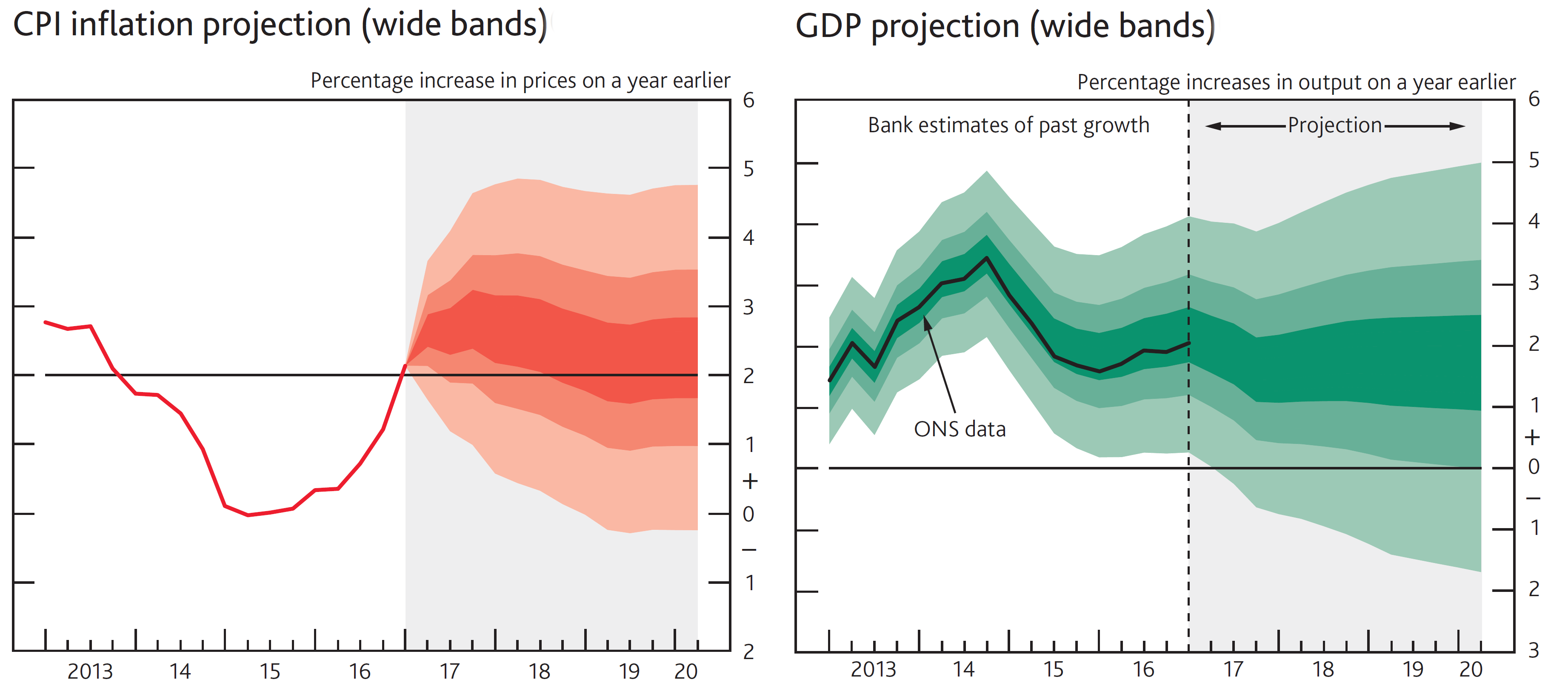
The key argument is that inflation is not of the demand-pull variety. Aggregate demand is subdued. Real wages are falling and hence consumer demand is likely to fall too. Thus many firms are cautious about investing, especially given the considerable uncertainties surrounding the nature of Brexit. The prime cause of the rise in inflation is the fall in sterling since the Brexit vote and the effect of higher import costs feeding through into retail prices. In other words, the inflation is of the cost-push variety. In such cirsumstances dampening demand further by raising interest rates would be seen by most economists as the wrong response. As the minutes of the MPC meeting state:
Attempting to offset fully the effect of weaker sterling on inflation would be achievable only at the cost of higher unemployment and, in all likelihood, even weaker income growth. For this reason, the MPC’s remit specifies that, in such exceptional circumstances, the Committee must balance any trade-off between the speed at which it intends to return inflation sustainably to the target and the support that monetary policy provides to jobs and activity.
The MPC recognises that the outlook is uncertain. It states that it stands ready to respond to circumstances as they change. If demand proves to be more resilient that it currently expects, it will raise Bank Rate. If not, it is likely to keep it on hold to continue providing a modest stimulus to the economy. However, it is unlikely to engage in further quantitative easing unless the economic outlook deteriorates markedly.
Articles
The Bank of England is moving closer to killing the most boring chart in UK finance right now Business Insider, Will Martin (16/6/17)
UK inflation hits four-year high of 2.9% Financial Times, Gavin Jackson and Chloe Cornish (13/6/17)
Surprise for markets as trio of Bank of England gurus call for interest rates to rise The Telegraph, Szu Ping Chan Tim Wallace (15/6/17)
Bank of England rate setters show worries over rising inflation Financial TImes, Chris Giles (15/6/17)
Three Bank of England policymakers in shock vote for interest rate rise Independent, Ben Chu (15/6/17)
Bank of England edges closer to increasing UK interest rates The Guardian, Katie Allen (15/6/17)
Bank of England doves right to thwart hawks seeking interest rate rise The Guardian, Larry Elliott (15/6/17)
Haldane expects to vote for rate rise this year BBC News (21/6/17)
Bank of England documents
Monetary policy summary Bank of England (15/6/17)
Monetary Policy Summary and minutes of the Monetary Policy Committee meeting ending on 14 June 2017 Bank of England (15/6/17)
Inflation Report, May 2017 Bank of England (11/5/16)
Questions
- What is the mechanism whereby a change in Bank Rate affects other interest artes?
- Use an aggregate demand and supply diagram to illustrate the difference between demand-pull and cost-push inflation.
- If the exchange rate remains at around 10–15% below the level before the Brexit vote, will inflation continue to remain above the Bank of England’s target, or will it reach a peak relatively soon and then fall back? Explain.
- For what reason might aggregate demand prove more buoyant that the MPC predicts?
- Would a rise in Bank Rate from 0.25% to 0.5% have a significant effect on aggregate demand? What role could expectations play in determining the nature and size of the effect?
- Why are real wage rates falling at a time when unemployment is historically very low?
- What determines the amount that higher prices paid by importers of products are passed on to consumers?
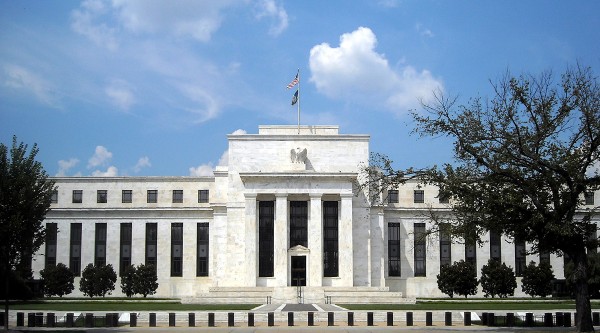 The US Federal Reserve, like many other central banks, engaged in massive quantitative easing in the wake of the financial crisis of 2007/8. Over three rounds, QE1, QE2 and QE3, it accumulated $4.5 trillion of assets – mainly government bonds and mortgage-backed securities (see chart below: click here for a PowerPoint). But, unlike its counterparts in the UK, the eurozone and Japan, it has long ceased its programme of asset purchases.. In October 2014, it announced that QE was at an end. All that would be done in future would be to replace existing holdings of assets as they matured, keeping total holdings roughly constant.
But now this policy is set to change. The Fed is about to embark on a programme of ‘quantitative tightening’, already being dubbed ‘QT’. This involves the Fed reducing its holdings of assets, mainly government bonds and government-backed mortgage-related securities.
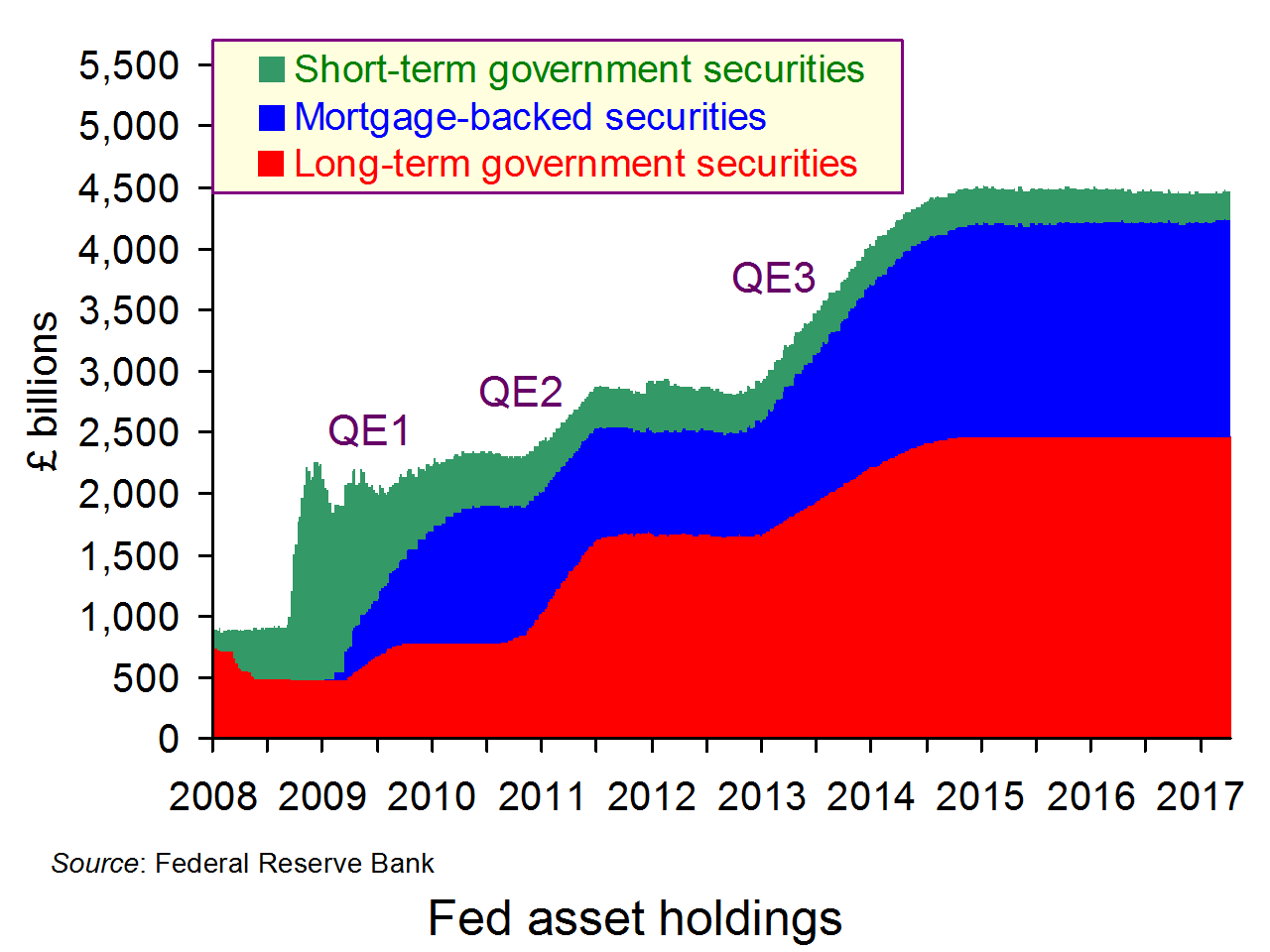 This, however, for the time being will not include selling its holding of bonds or mortgage-backed securities. Rather, it will simply mean not buying new assets to replace ones when they mature, or only replacing part of the them. This was discussed by the 75 participants at the joint meeting of the Federal Open Market Committee (FOMC) and Board of Governors on 14–15 March.
As the minutes put it: “Many participants emphasized that reducing the size of the balance sheet should be conducted in a passive and predictable manner.”
A more active form of QT would involve selling assets before maturity and thus reducing the size of the Fed’s balance sheet more rapidly. But either way, reducing assets would put downward pressure on the money supply and support the higher interest rates planned by the FOMC.
The question is whether there is enough liquidity elsewhere in the system and enough demand for credit, and willingness of the banking system to supply credit, to allow a sufficient growth in broad money – sufficient, that is, to support continued growth in the economy. The answer to that question depends on confidence. The Fed, not surprisingly, is keen not to damage confidence and hence prefers a gradualist approach to reducing its holdings of assets bought during the various rounds of quantitative easing.
Articles
Fed’s asset shift to pose new test of economy’s recovery, resilience Reuters, Howard Schneider and Richard Leong (6/4/17)
Federal Reserve likely to begin cutting back $4.5 trillion balance sheet this year Washington Post, Ana Swanson (5/4/17)
Why the Fed’s debate about shrinking its balance sheet really, really matters Money Observer, Russ Mould (7/4/17)
The Fed and ECB keep a cautious eye on the exit Financial Times (7/4/17)
Get ready for the Fed’s next scary policy change CBS Money Watch, Anthony Mirhaydari (5/4/17)
The Fed wants to start shrinking its $4.5 trillion balance sheet later this year Business Insider, Akin Oyedele (5/4/17)
Inside the Fed’s March Meeting: The Annotated Minutes Bloomberg, Luke Kawa, Matthew Boesler and Alex Harris (5/4/17)
QE was great for asset prices – will ‘QT’ smash them? The Financial Review (Australia), Patrick Commins (7/4/17)
Shrinking the Fed’s balance sheet Brookings, Ben Bernanke (26/1/17)
Data
Selected data Board of Governors of the Federal Reserve System
Questions
- Distinguish between active and passive QT.
- If QE is a form of expansionary monetary policy, is QT a form of contractionary monetary policy?
- Could QT take place alongside an expansion of broad money?
- What dangers lie in the Fed scaling back its holdings of government (Treasury) bonds and mortgage-backed securities?
- Why is it unlikely that the Fed will reduce its holdings of securities to pre-crisis levels?
- Why are the Bank of England, the ECB and the Bank of Japan still pursuing a policy of QE?
- What are the implications for exchange rates of QT in the USA and QE elsewhere?
- Find out data for the monetary base, for narrow money (M1) and broader money (M2) in the USA. Are narrow and/or broad money correlated with Federal Reserve asset holdings?
 Interest rates have been at record lows across the developed world since 2009. Interest rates were reduced to such levels in order to stimulate recovery from the financial crisis of 2007–8 and the resulting recession. The low interest rates were accompanied by extraordinary increases in money supply under various rounds of quantitative easing in the USA, UK, Japan and eventually the eurozone. But have such policies done harm?
This is the contention of Brian Sturgess in a new paper, published by the Centre for Policy Studies. He maintains that the policy has had a number of adverse effects:
|
|
| • |
There will be nothing left in the monetary policy armoury when the next downturn occurs other than even more QE, which will compound the following problems. |
| • |
It has had little effect in stimulating aggregate demand and economic growth. Instead the extra money has been used to repair balance sheets and support unprofitable businesses. |
| • |
It has inflated asset prices, especially shares and property, which has encouraged funds to flow to the secondary market rather than to funding new investment. |
| • |
The inflation of asset prices has benefited the already wealthy. |
| • |
By keeping interest rates down to virtually zero on savings accounts, it has punished small savers. |
| • |
By rewarding the rich and penalising small savers, it has contributed to greater inequality. |
| • |
By keeping interest rates down to borrowers, it has encouraged households to take on excessive amounts of debt, which will be hard to service if interest rates rise. |
| • |
It has lowered the price of risk, thereby encouraging more risky types of investment and the general misallocation of capital. |
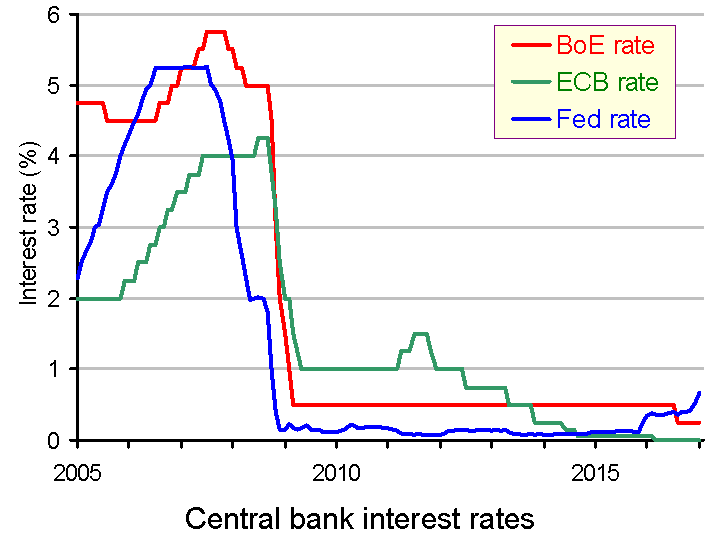 Sturgess argues that it is time to end the policy of low interest rates. Currently, in all the major developed economies, central bank rates are below the rate of inflation, making the real central bank interest rates negative.
He welcomes the two small increases by the Federal Reserve, but this should be followed by further rises, not just by the Fed, but by other central banks too. As Sturgess states in the paper (p.12):
In place of ever more extreme descents into the unknown, central banks should quickly renormalise monetary policy. That would involve ending QE and allowing interest rates to rise steadily so that interest rates can carry out their proper functions. Failure to do so will leave the global financial system vulnerable to potential shocks such as the failure of the euro, or the fiscal stresses in the US resulting from the unfinanced spending plans announced by Donald Trump in his presidential campaign.
Although Sturgess argues that the initial programmes of low interest rates and QE were a useful response to the financial crisis, he argues that they should have only been used as a short-term measure. However, if they were, and if interest rates had gone up within a few months, many argue that the global economy would rapidly have sunk back into recession. This has certainly been the position of central banks. Sturgess disagrees.
Articles
Damaging low interest rates and QE must end now, think thank warns The Telegraph, Julia Bradshaw (23/1/17)
QE has driven pension deficits up, think-tank argues Money Marketing, Justin Cash (23/1/17)
Hold: The ECB keeps interest rates and QE purchases steady as Mario Draghi defends loose policy from hawkish critics City A.M., Jasper Jolly (19/1/17)
Preparing for the Post-QE World Bloomberg, Jean-Michel Paul (12/10/16)
Paper
Stop Depending on the Kindness of Strangers: Low interest rates and the Global Economy Centre for Policy Studies, Brian Sturgess (23/1/17)
Questions
- Find out what the various rounds of quantitative easing have been in the USA, the UK, Japan and the eurozone.
- What are the arguments in favour of quantitative easing as it has been practised?
- How might interest rates close to zero result in the misallocation of capital?
- Sturgess claims that the existence of ‘spillover’ effects has had damaging effects on many emerging economies. What are these spillover effects and what damage have they done to such economies?
- How do low interest rates affect interest rate spreads?
- Have pensioners gained or lost from QE? Explain how the answer may vary between different pensioners.
- What is meant by a ‘natural’ or ‘neutral’ rate of interest (see section 3.2 in the paper)? Why, according to Janet Yellen (currently Federal Reserve Chair, writing in 2005), is this somewhere between 3.5% and 5.5% (in nominal terms)?
- What are the arguments for and against using created money to finance programmes of government infrastructure investment?
- Would helicopter money be more effective than QE via asset purchases in achieving faster economic growth? (See the blog posts: A flawed model of monetary policy and New UK monetary policy measures – somewhat short of the kitchen sink.)
- When QE comes to an end in various countries, what are the arguments for absorbing rather than selling the assets purchased by central banks? (See the Bloomberg article.)
 On 14 December, the US Federal Reserve announced that its 10-person Federal Open Market Committee (FOMC) had unanimously decided to raise the Fed’s benchmark interest rate by 25 basis points to a range of between 0.5% and 0.75%. This is the first rise since this time last year, which was the first rise for nearly 10 years.
The reasons for the rise are two-fold. The first is that the US economy continues to grow quite strongly, with unemployment edging downwards and confidence edging upwards. Although the rate of inflation is currently still below the 2% target, the FOMC expects inflation to rise to the target by 2018, even with the rate rise. As the Fed’s press release states:
Inflation is expected to rise to 2% over the medium term as the transitory effects of past declines in energy and import prices dissipate and the labor market strengthens further.
The second reason for the rate rise is the possible fiscal policy stance of the new Trump administration.  If, as expected, the new president adopts an expansionary fiscal policy, with tax cuts and increased government spending on infrastructure projects, this will stimulate the economy and put upward pressure on inflation. It could also mean that the Fed will raise interest rates again more quickly. Indeed, the FOMC indicated that it expects three rate rises in 2017 rather than the two it predicted in September.
However, just how much and when the Fed will raise interest rates again is highly uncertain. Future monetary policy measures will only become more predictable when Trump’s policies and their likely effects become clearer.
Articles
US Federal Reserve raises interest rates and flags quicker pace of tightening in 2017 Independent, Ben Chu (14/12/16)
US Federal Reserve raises interest rates: what happens next? The Telegraph, Szu Ping Chan (15/12/16)
Holiday traditions: The Fed finally manages to lift rates in 2016 The Economist (14/12/16)
US raises key interest rate by 0.25% on strengthening economy BBC News (14/12/16)
Fed Raises Key Interest Rate, Citing Strengthening Economy The New York Times, Binyamin Appelbaum (14/12/16)
US dollar surges to 14-year high as Fed hints at three rate hikes in 2017 The Guardian, Martin Farrer and agencies (15/12/16)
Questions
- What determines the stance of US monetary policy?
- How does fiscal policy impact on market interest rates and monetary policy?
- What effect does a rise in interest rates have on exchange rates and the various parts of the balance of payments?
- What effect is a rise in US interest rates likely to have on other countries?
- What is meant by ‘forward guidance’ in the context of monetary policy? What are the benefits of providing forward guidance?
- What were the likely effects on the US stock market of the announcement by the FOMC?
- Following the FOMC announcement, two-year US Treasury bond yields rose to 1.231%, the highest since August 2009. Explain why.
- For what reason does the FOMC believe that the US economy is already expanding at roughly the maximum sustainable pace?
 In three interesting articles, linked below, the authors consider the state of economies since the financial crisis of 2007–8 and whether governments have the right tools to tackle future economic shocks.
 Quantitative easing could be used again, but many economists believe that it will have more limited scope if confined to the purchase of assets in the secondary market. Also, there is little scope for reducing interest rates, which, despite some modest rises in the USA, remain at close to zero in most developed countries.