 As we saw in the news item The difficult exit from cheap money, central banks around the world have been operating an extremely loose monetary policy since the beginning of 2009. Their interest rates have been close to zero and trillions of dollars of extra money has been injected into the world economy through various programmes of quantitative easing.
For the past few months the Federal Reserve has been purchasing bonds under its most recent programme dubbed QE3, and thereby increasing narrow money, by $85 billion per month. Since the start of its QE programme in 2009, it has pumped around $2.8 trillion of extra money into the US and world economies. This huge increase in money supply has boosted the demand for assets worldwide and world stock markets have risen. Much of the money has flowed into developing countries, such as India, and has acted as a boost to their economies.
 Once the US economy is growing strongly again, the aim is to taper off, and ultimately end or even reverse, the QE programme. It was expected that the Fed would decide to start this tapering off process at its meeting on 18 September – perhaps reducing bond purchases initially by some $10 billion. (Note that this would still be an increase in money supply, just a slightly smaller one.) Over the past few days, US bond prices have been falling (and yields increasing) in anticipation of such a move.
As it turned out, the Fed decided to delay tapering off. It will continue with its assets purchase programme of $85 billion per month for the time being. The reason given was that the US economy was still too fragile and needed the monthly injections of money to stay at the current level.
Normally it might be expected that the announcement of a more fragile recovery would cause the US stock market, and others worldwide, to fall. In fact the opposite occurred, with investors relieved that the extra money, which allows extra asset purchases, would continue at the same rate.
But this then raises the question of just what will be the effect when tapering off does actually occur. Will stock markets then go into a tailspin? Or will they merely stop rising so fast. That depends very much on the role of speculation.
Webcasts
 Bernanke’s Own Words on Asset Purchases, Economy Bloomberg (18/9/13)
Bernanke: Fed to delay bond tapering PBS Newshour on YouTube (full speech plus questions) (18/9/13)
No tapering announced by Fed CNBC on Yahoo Finance (18/9/113)
The impact of US stimulus moves at home and abroad BBC News, Stephanie Flanders (18/9/13)
Is the upturn reaching Americans? BBC World, Stephanie Flanders (17/9/13)
Shares hit high as Federal Reserve maintains stimulus BBC News, Stephanie Flanders (18/9/13)
US Fed decision to delay tapering was a relief ET Now (India), Bimal Jalan (19/9/13)
Articles
Federal Reserve surprises markets by delaying QE tapering The Telegraph, Katherine Rushton (18/9/13)
Federal Reserve delays QE tapering: the full statement The Telegraph (18/9/13)
Q&A: What is tapering? BBC News (18/9/13)
Fed delay is no reason to celebrate The Guardian, Larry Elliott (19/9/13)
Federal Reserve tapering decision has baffled the markets The Guardian, Larry Elliott (19/9/13)
Taper tiger The Economist (21/9/13)
Everything You Need to Know About the Fed’s Decision Not to Taper QE3 The Atlantic, Matthew O’Brien (18/9/13)
Fed’s dovish turn leaves Wall Street economists mulling taper timing: poll Reuters, Chris Reese (18/9/13)
Good news and bad news from the Fed BBC News, Stephanie Flanders (19/9/13)
Is the Fed frightened of its shadow? BBC News, Robert Peston (19/9/13)
The Federal Reserve and Janet Yellen face a tough task with insufficient tools The Guardian, Mohamed A. El-Erian (14/10/13)
Questions
- Why might a slowing down in the increase in US money supply cause asset prices to fall, rather than merely to rise less quickly?
- Why has the US QE programme led to a rise in asset prices overseas?
- Distinguish between stabilising and destabilising speculation. Which type of speculation has been occurring as a result of the US QE programme?
- How has QE affected unemployment in the UK and USA? How is the participation rate and the flexibility of labour markets relevant to the answer?
- Explain the following two statements by Stephanie Flanders and Robert Peston respectively. “The market conditions argument has a circularity to it: talk of tapering leads to higher market rates, which in turn puts the taper itself on hold.” “The Fed simply hinting that less money would be created, means that there will be no reduction in the amount of money created (for now at least).”
- Why have US long-term interest rates, including mortgage rates, risen since May of this year?
- What impact have higher US long-term interest rates had on economies in the developing world? Explain.
 Tight fiscal policies are being pursued in many countries to deal with high public-sector deficits that resulted from the deep recession of 2008/9. This has put the main onus on monetary policy as the means of stimulating recovery. As a result we have seen record low interest rates around the world, set at only slightly above zero in the main industrialised countries for the past 4½ years. In addition, there have been large increases in narrow money as a result of massive programmes of quantitative easing.
Yet recovery remains fragile in many countries, including the UK and much of the rest of Europe. And a new problem has been worries by potential investors that loose monetary policy may be soon coming to an end. As the June blog The difficult exit from cheap money pointed out:
The US economy has been showing stronger growth in recent months and, as a result, the Fed has indicated that it may soon have to begin tightening monetary policy. It is not doing so yet, nor are other central banks, but the concern that this may happen in the medium term has been enough to persuade many investors that stock markets are likely to fall as money eventually becomes tighter. Given the high degree of speculation on stock markets, this has led to a large-scale selling of shares as investors try to ‘get ahead of the curve’.
Central banks have responded with a new approach to monetary policy. This is known as ‘forward guidance’. The idea is to manage expectations by saying what the central bank will do over the coming months.
The USA was the first to pursue this approach. In September 2012 the Fed committed to bond purchase of $40bn per month (increased to $85bn per month in January 2013) for the foreseeable future; and record low interest rates of between 0% and 0.25% would continue. Indeed, as pointed out above, it was the ‘guidance’ last month that such a policy would be tapered off at some point, that sent stock markets falling in June.
The Fed has since revised its guidance. On 10 July, Ben Bernanke, the Fed Chairman said that monetary policy would not be tightened for the foreseeable future. With fiscal policy having been tightened, QE would continue and interest rates would not be raised until unemployment had fallen to 6.5%.
Japan has been issuing forward guidance since last December. Its declared aim has been to lower the exchange rate and raise inflation. It would take whatever fiscal and monetary policies were deemed necessary to achieve this (see A J-curve for Japan? and Japan’s three arrows).
Then on 4 July both the Bank of England and the ECB adopted forward guidance too. Worried that growth in the US economy would lead to an end to loose monetary policy before too long and that this would drive up interest rates worldwide, both central banks committed to keeping interest rates low for an extended period of time. Indeed, the ECB declared that the next movement in interest rates would more likely be down than up. Mario Draghi, the ECB president said that the ending of loose monetary policy is ‘very distant’.
The effect of this forward guidance has been to boost stock markets again. The hope is that by managing expectations in this way, the real economy will be affected too, with increased confidence leading to higher investment and faster economic growth.
 Update (8/8/13)
With the publication of its August 2013 Inflation Report, the Bank of England clarified its approach to forward guidance. It was announced that Bank Rate would stay at the current historically low level of 0.5% ‘at least until the Labour Force Survey headline measure of unemployment has fallen to a threshold of 7%’. In his Inflation Report Press Conference opening remarks, Mark Carney, Governor of the Bank of England, also stated that:
While the unemployment rate remains above 7%, the MPC stands ready to undertake further asset purchases if further stimulus is warranted. But until the unemployment threshold is reached the MPC intends not to reduce the stock of asset purchases from the current £375 billion.
Nevertheless, the Bank reserved the right to abondon this undertaking under cirtain circumstances. As Mark Carney put it:
The Bank of England’s unwavering commitment to price stability and financial stability is such that this threshold guidance will cease to apply if material risks to either are judged to have arisen. In that event, the unemployment threshold would be ‘knocked out’. The guidance will remain in place only if, in the MPC’s view, CPI inflation 18 to 24 months ahead is more likely than not to be below 2.5%, medium-term inflation expectations remain sufficiently well anchored, and the FPC has not judged that the stance of monetary policy poses a significant threat to financial stability that cannot otherwise be contained through the considerable supervisory and regulatory policy tools of the various authorities. The two inflation knockouts ensure that the guidance remains fully consistent with our primary objective of price stability. The financial stability knockout takes full advantage of the new institutional structure at the Bank of England, ensuring that monetary and macroprudential policies coordinate to support a sustainable recovery. The knock-outs would not necessarily trigger an increase in Bank Rate – they would instead be a prompt for the MPC to reconsider the appropriate stance of policy.
Similarly, it is important to be clear that Bank Rate will not automatically be increased when the unemployment threshold is reached. Nor is 7% a target for unemployment. The rate of unemployment consistent with medium-term price stability – a rate that monetary policy can do little to affect – is likely to be lower than this. So 7% is merely a ‘way station’ at which the MPC will reassess the state of the economy, the progress of the economic recovery, and, in that context, the appropriate stance of monetary policy.
The articles in the updated section below consider the implications of this forward guidance and the caveat that the undertaking might be abondoned in certain circumstances.
Articles
Q&A: What is ‘forward guidance’ BBC News, Laurence Knight (4/7/13)
Forward guidance crosses the Atlantic The Economist, P.W. (4/7/13)
ECB has no plans to exit loose policies, says Benoit Coeure The Telegraph, Szu Ping Chan (25/6/13)
ECB issues unprecedented forward guidance The Telegraph, Denise Roland (4/7/13)
Independence day for central banks BBC News, Stephanie Flanders (4/7/13)
The Monetary Policy Committee’s search for guidance BBC News, Stephanie Flanders (16/7/13)
The Monetary Policy Committee’s search for guidance (II) BBC News, Stephanie Flanders (17/7/13)
Bank of England surprise statement sends markets up and sterling tumbling The Guardian, Jill Treanor and Angela Monaghan (4/7/13)
Forward guidance only works if you do it right Financial Times, Wolfgang Münchau (7/7/13)
Fed’s Forward Guidance Failing to Deliver Wall Street Journal, Nick Hastings (15/7/13)
Talking Point: Thoughts on ECB forward guidance Financial Times, Dave Shellock (11/7/13)
Forward guidance in the UK is likely to fail as the Fed taper approaches City A.M., Peter Warburton (12/7/13)
Forward guidance more than passing fashion for central banks Reuters, Sakari Suoninen (11/7/13)
Markets await Mark Carney’s ‘forward guidance’ The Guardian, Heather Stewart (17/7/13)
Beware Guidance The Economist, George Buckley (25/7/13)
Articles for update
The watered down version of Forward Guidance Reuters, Kathleen Brooks (8/8/13)
Clarity Versus Flexibility at the Bank of England Bloomberg (7/8/13)
Mark Carney’s guidance leaves financial markets feeling lost Independent, Ben Chu (8/8/13)
Bank links interest rates to unemployment target BBC News (7/8/13)
Mark Carney says forward guidance should boost economy BBC News (8/8/13)
The Bank’s new guidance BBC News, Stephanie Flanders (7/8/13)
Uncertainty over BoE guidance lifts sterling to 7-week peak Reuters, Spriha Srivastava (8/8/13)
Bank of England’s guidance is clear, say most economists: Poll The Economic Times (8/8/13)
Britain’s economy: How is it really doing? The Economist (10/8/13)
Markets give thumbs down to Mark Carney’s latest push on forward guidance The Guardian, Larry Elliott (28/8/13)
Carney’s guidance on guidance BBC News, Stephanie Flanders (28/8/13)
Webcasts and podcasts for update
Inflation Report Press Conference Bank of England (7/8/13)
Interest rates to be held until unemployment drops to 7% BBC News, Extracts of Statement by Mark Carney, Governor of the Band of England (7/8/13)
Bank of England links rates to unemployment target BBC News (7/8/13)
Mark Carney: Financial institutions ‘have to change culture’ BBC Today Programme (8/8/13)
Bank of England’s Mark Carney announces rates held BBC News. John Moylan (7/8/13)
Central Bank Statements and Speeches
How does forward guidance about the Federal Reserve’s target for the federal funds rate support the economic recovery? Federal Reserve (19/6/13)
Remit for the Monetary Policy Committee HM Treasury (20/3/13)
Bank of England maintains Bank Rate at 0.5% and the size of the Asset Purchase Programme at £375 billion Bank of England (4/7/13)
Monthly Bulletin ECB (see Box 1) (July 2013)
Inflation Report Press Conference: Opening remarks by the Governor Bank of England (7/8/13)
MPC document on Monetary policy trade-offs and forward guidance Bank of England (7/8/13)
Monetary policy and forward guidance in the UK Bank of England, David Miles (24/9/13)
Monetary strategy and prospects Bank of England, Paul Tucker (24/9/13)
Questions
- Is forward guidance a ‘rules-based’ or ‘discretion-based’ approach to monetary policy?
- Is it possible to provide forward guidance while at the same time pursuing an inflation target?
- If people know that central banks are trying to manage expectations, will this help or hinder central banks?
- Does the adoption of forward guidance by the Bank of England and ECB make them more or less dependent on the Fed’s policy?
- Why may forward guidance be a more effective means of controlling interest rates on long-term bonds (and other long-term rates too) than the traditional policy of setting the repo rate on a month-by-month basis?
- What will determine the likely success of forward guidance in determining long-term bond rates?
- Is forward guidance likely to make stock market speculation less destabilising?
- Is what ways is the ‘threshold guidance’ by the Bank of England likely to make the current expansionary stance of monetary policy more effective?
- Is 7% the ‘natural rate of unemployment’? Explain your reasoning.
 A few weeks ago, Elizabeth wrote a blog on the payday loan industry and its referral by the OFT to the Competition Commission (see A payday inquiry). Now the Archbishop of Canterbury, Justin Welby, has joined the debate. He suggests that the problem of sky-high interest rates charged by payday loan companies would be tackled better by increased competition from elsewhere in the industry than by regulation.
In particular, he proposes an expansion of credit unions. These could provide a much cheaper alternative for people in financial difficulties who are seeking short-term loans. He would like church members with relevant skills to volunteer at credit unions and proposes setting up local credit unions operated from church buildings.
* * * * * * * * * *
In this news item we hand over to ‘Kostas Economides’, an imaginary lecturer in Economics at the imaginary ‘University of the South of England’. Kostas’s blog is written by Guy Judge. Guy recently retired from the University of Portsmouth, where he was Deputy Head of Department, and is now a Visiting Fellow.
 In his blog, Kostas frequently reflects on various economic issues, as well as on life at USE. Here he recounts a conversation with his colleagues about Justin Welby’s proposals. They consider various implications of the proposals from an economist’s point of view.
Kostas’s blog
Pay day loans Guy’s Other Stuff, Guy Judge (30/7/13)
To provide some background to Kostas’s blog, you’ll see below the normal set of links to newspaper articles.
We may well return to Kostas in the near future, as he is planning to look at a number of topical economic issues.
Articles
Why I support Justin Welby’s battle with Wonga The Telegraph, Jacob Rees-Mogg (30/7/13)
Church plans to compete with payday lender Wonga BBC News, Robert Piggott (25/7/13)
Archbishop of Canterbury wants to ‘compete’ Wonga out of existence The Guardian, Miles Brignall (25/7/13)
Let the payday lenders prosper, but not extort Financial Times (30/7/13)
Coalition will support Archbishop of Canterbury Justin Welby’s plan for credit unions, says Vince Cable Independent, Andrew Grice (28/7/13)
Former Archbishop Rowan Williams backs action against payday loan firms Cambridge News, Jennie Baker (30/7/13)
Why Justin Welby’s vision of kumbayah capitalism is wrong The Telegraph, James Quinn (25/7/13)
Wonga V The Church: Comparing Interest Rates Of Payday Loans And Credit Unions The Huffington Post, Tom Moseley (25/7/13)
Wonga Warned Church Of England Could ‘Compete’ It Out Of Existence The Huffington Post, Tom Moseley (25/7/13)
Credit unions thriving even before Archbishop Welby’s attack on Wonga The Guardian, Rupert Jones (29/7/13)
Questions
- Find out the monthly interest rates being charged by various payday loan companies. Take one loan company as an example and calculate what would happen to your debt over the course of a year if you borrowed £100 and paid nothing back each month. What would be the annualised rate of interest?
- What are the arguments for and against banning payday loan companies?
- What are the arguments for and against imposing an interest rate cap on such companies?
- What are the differences between credit unions and banks?
- Should the interest rates charged by credit unions be uncapped?
- Explain what is meant by ‘moral hazard’ and give some examples. What moral hazard would there be in placing a limit on the number of months over which a debt could go on accumulating?
- How would you decide what a ‘normal’ rate of interest should be? Should this vary with the risk of default and, if so, by how much?
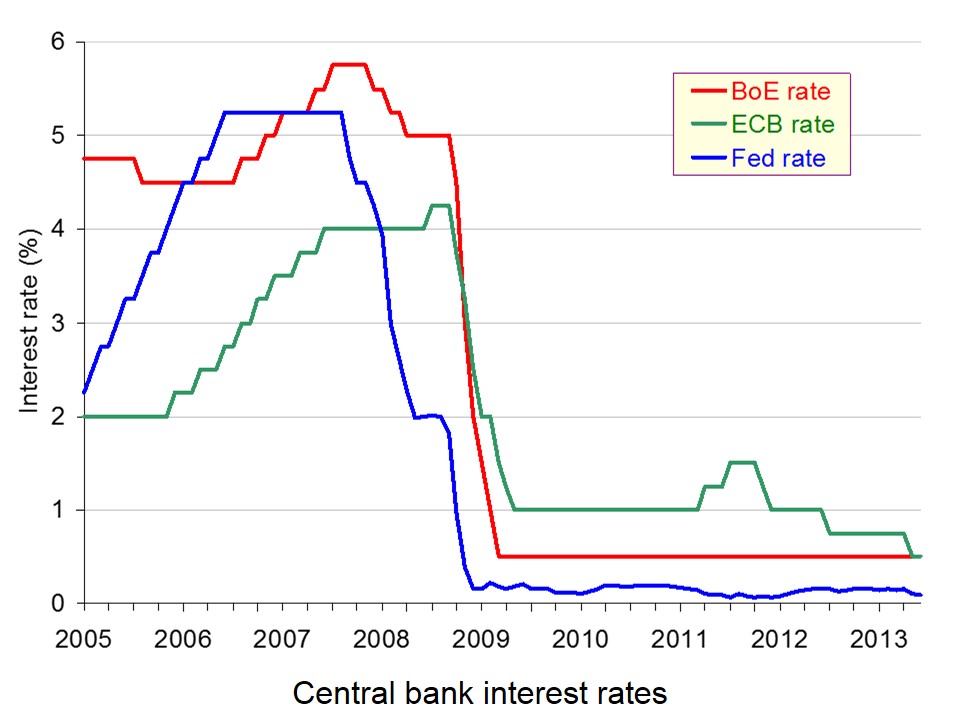 Since the beginning of 2009, central banks around the world have operated an extremely loose monetary policy. Their interest rates have been close to zero (click here for a PowerPoint of the chart) and more than $20 trillion of extra money has been injected into the world economy through various programmes of quantitative easing.
The most recent example of loose monetary policy has been in Japan, where substantial quantitative easing has been the first of Japan’s three arrows to revive the economy (the other two being fiscal policy and supply-side policy).
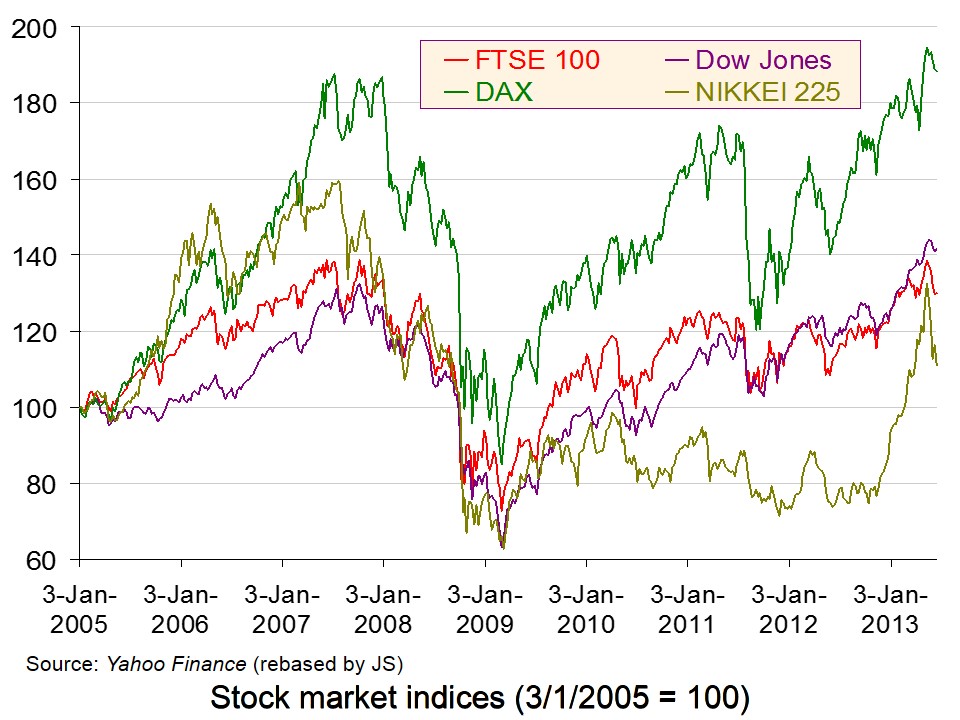 One consequence of a rise in money supply has been the purchase of a range of financial assets, including shares, bonds and commodities. As a result, despite the sluggish or negative growth in most developed countries, stock markets have soared (see chart). From March 2009 to May 2013, the FTSE 100 rose by 91% and both the USA’s Dow Jones Industrial average and Germany’s DAX rose by 129%. Japan’s NIKKEI 225, while changing little from 2009 to 2012, rose by 78% from November 2012 to May 2013 (click here for a PowerPoint of the chart).
The US economy has been showing stronger growth in recent months and, as a result, the Fed has indicated that it may soon have to begin tightening monetary policy. It is not doing so yet, nor are other central banks, but the concern that this may happen in the medium term has been enough to persuade many investors that stock markets are likely to fall as money eventually becomes tighter. Given the high degree of speculation on stock markets, this has led to a large-scale selling of shares as investors try to ‘get ahead of the curve’.
From mid-May to mid-June, the FTSE 100 fell by 6.2%, the Dow Jones by 2.6%, the DAX by 4.5% and the NIKKEI by 15%. In some developing countries, the falls have been steeper as the cheap money that entered their economies in search of higher returns has been leaving. The falls in their stock markets have been accompanied by falls in their exchange rates.
 The core of the problem is that most of the extra money that was created by central banks has been used for asset purchase, rather than in financing extra consumer expenditure or capital investment. If money is tightened, it is possible that not only will stock and bond markets fall, but the fragile recovery may be stifled. In other words, tighter money and higher interest rates may indeed affect the real economy, even though loose monetary policy and record low interest rates had only a very modest effect on the real economy.
This poses a very difficult question for central banks. If even the possibility of monetary tightening some time in the future has spooked markets and may rebound on the real economy, does that compel central banks to maintain their loose policy? If it does, will this create an even bigger adjustment problem in the future? Or could there be a ‘soft landing’, whereby real growth absorbs the extra money and gradually eases the inflationary pressure on asset markets?
Articles
How the Fed bosses all BBC News, Robert Peston (12/6/13)
The great reversal? Is the era of cheap money ending? BBC News, Linda Yueh (12/6/13)
The Great Reversal: Part II (volatility and the real economy) BBC News, Linda Yueh (14/6/13)
The end of the affair The Economist (15/6/13)
Out of favour The Economist, Buttonwood (8/6/13)
The Federal Reserve: Clearer, but less cuddly The Economist (22/6/13)
Global financial markets anxious to avoid many pitfalls of ‘political risk’ The Guardian, Heather Stewart (13/6/13)
Dow Falls Below 15,000; Retailers Add to Slump New York Times, (12/6/13)
Global market sell-off over stimulus fears The Telegraph, Rachel Cooper (13/6/13)
Nikkei sinks over 800 points, falls into bear market Globe and Mail (Canada), Lisa Twaronite (13/6/13)
Global shares drop, dollar slumps as rout gathers pace Reuters, Marc Jones (13/6/13)
The G8, the bond bubble and emerging threats BBC News, Stephanie Flanders (17/6/13)
Global monetary policy and the Fed: vive la difference BBC News, Stephanie Flanders (20/6/13)
The Federal Reserve’s dysfunctional relationship with the markets The Guardian, Heidi Moore (19/6/13)
Global stock markets in steep falls after Fed comment BBC News (20/6/13)
Federal Reserve’s QE withdrawal could signal real trouble ahead The Guardian, Nils Pratley (20/6/13)
Central banks told to head for exit Financial Times, Claire Jones (23/6/13)
Stimulating growth threatens stability, central banks warn The Guardian (23/6/13)
BIS Press Release and Report
Making the most of borrowed time: repair and reform the only way to growth, says BIS in 83rd Annual Report BIS Press Release (23/6/13)
83rd BIS Annual Report 2012/2013 Bank for International Settlements (23/6/13)
Data
Yahoo! Finance: see links for FTSE 100, DAX, Dow Jones, NIKKEI 225
Link to central bank websites Bank for International Settlements
Statistical Interactive Database – Interest & exchange rates data Bank of England
Questions
- Why have stock markets soared in recent years despite the lack of economic growth?
- What is meant by ‘overshooting’? Has overshooting taken place in stock markets (a) up to mid-May this year; (b) since mid-May? How would you establish whether overshooting has taken place?
- What role is speculation currently playing in stock markets? Would you describe this speculation as destabilising?
- What has been the impact of quantitative easing on (a) bond prices; (b) bond yields?
- Argue the case for and against central banks continuing with the policy of quantitative easing for the time being.
- Find out how much the Indian rupee and the Brazilian real have fallen in recent weeks. Explain your findings.
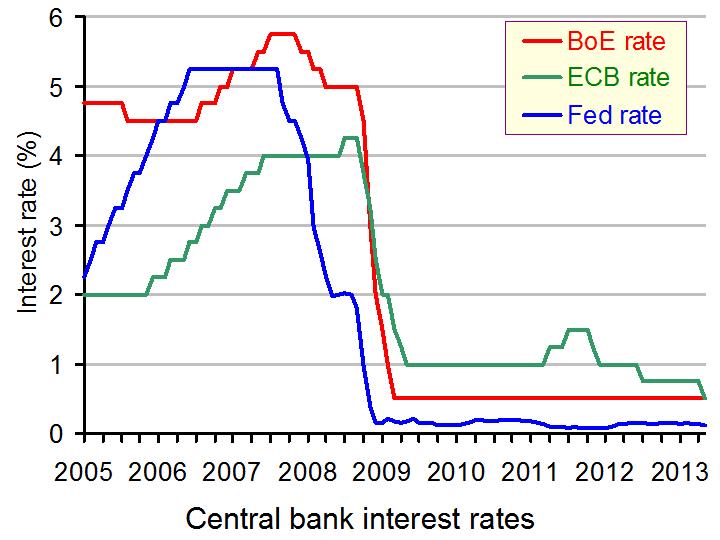 Interest rates have, for some years, been the main tool of monetary policy and of steering the macroeconomy. Across the world interest rates were lowered, in many cases to record lows, as a means of stimulating economic growth. Interest rates in the UK have been at 0.5% since March 2009 and on 2nd May 2013, the ECB matched this low rate, having cut its main interest rate from 0.75%. (Click here for a PowerPoint of the chart.)
Low interest rates reduce the cost of borrowing for both firms and consumers and this in turn encourages investment and can boost consumer expenditure. After all, when you borrow money, you do it to spend! Lower interest rates will also reduce the return on savings, again encouraging spending and for those on variable rate mortgages, mortgage payments will fall, increasing disposable income. However, these above effects are dependent on the banks passing the ECB’s main interest rate on its customers and this is by no means guaranteed.
Following the cut in interest rates, the euro exchange rate fell almost 2 cents against the dollar.
Interest rates in the eurozone have been at 0.75%, but a 0.25 point cut was widely expected, with the ongoing debt crisis in the Eurozone continuing to adversely affect growth and confidence. A lack of trust between banks has also contributed to a lack of lending, especially to small and medium sized enterprises. The ECB has injected money into financial institutions with the aim of stimulating lending, but in many cases, banks have simply placed this extra money back with the ECB, rather than lending it to other banks or customers. The fear is that those they lend to will be unable to repay the money. In response to this, there have been suggestions of interest rates becoming negative – that is, if banks want to hold their money with the ECB they will be charged to do it. Again, the idea is to encourage banks to lend their money instead.
Small and medium sized businesses have been described as the engine of growth, but it is these businesses who have been the least able to obtain finance. Without it, they have been unable to grow and this has held back the economic recovery. Indeed, GDP in the Eurozone has now fallen for five consecutive quarters, thus prompting the latest interest rate cut. A key question, however, will be how effective this quarter of a percent cut will be. If banks were unwilling to lend and firms unwilling to invest at 0.75%, will they be more inclined at 0.5%? The change is small and many suggest that it is not enough to make much of a difference. David Brown of New View Economics said:
The ECB rate cut is no surprise as it was well flagged by Draghi at last month’s meeting. Is it enough? No. The marginal effect of the cut is very limited, but at least it should have some symbolic rallying effect on economic confidence.
This was supported by Howard Archer at HIS Global Insight, who added:
Admittedly, it is unlikely that the trimming of interest rates from 0.75% to 0.5% will have a major growth impact, especially given fragmented credit markets, but any potential help to the eurozone economy in its current state is worthwhile.
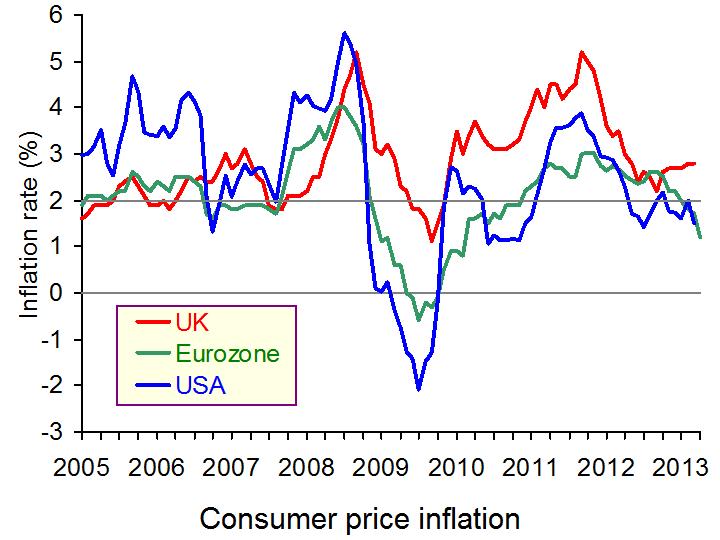 Inflation in the eurozone is only at 1.2%, which is significantly below the ceiling of 2%, so this did give the ECB scope for the rate to be cut. (Click here for a PowerPoint of the chart.) After all, when interest rates fall, the idea is to boost aggregate demand, but with this, inflation can emerge. Mr Draghi said ‘we will monitor very closely all incoming information, and assess any impact on the outlook for price stability’. The primary objective of the ECB is the control of inflation and so had inflation been somewhat higher, we may have seen a different decision by the ECB. However, even then, 5 consecutive quarters of negative growth is hard to ignore.
So, if these lower interest rates have little effect on stimulating an economic recovery, what about a movement away from austerity? Many have been calling for stimulus in the economy, arguing that the continuing austerity measures are stifling growth. The European Council President urged governments to promote growth and job creation. Referring to this, he said:
Taking these measures is more urgent than anything … After three years of firefights, patience with austerity is wearing understandably thin.
However, Mr. Draghi urged for policymakers to stick with austerity and continue to focus on bringing debt levels down, while finding other ways to stimulate growth, including structural reform. The impact of this latest rate cut will certainly take time to filter through the economy and will very much depend on whether the 0.5% interest rate is passed on to customers, especially small businesses. Confidence and trust within the financial sector is therefore key and it might be that until this emerges, the eurozone itself is unlikely to emerge from its recession.
ECB ready to enter unchartered waters as bank cuts interest rate to fresh low of 0.5pc The Telegraph, Szu Ping Chan (2/5/13)
Draghi urges Eurozone governments to stay the course on austerity Financial Times, Michael Steen (2/5/13)
Eurozone interest rates cut to a record low of 0.5% The Guardian, Heather Stewart (2/5/13)
ECB’s Draghi ‘ready to act if needed’ BBC News (2/5/13)
Eurozone interest rates cut again as ECB matches Bank of England Independent, Russell Lynch (3/5/13)
Margio Draghi urges no let-up in austerity reforms after Eurozone rate cut – as it happened The Guardian, Graeme Wearden (2/5/13)
ECB cuts interest rate to record-low 0.5% in desperate measure to drag Eurozone out of recession Mail Online, Simon Tomlinson and Hugo Duncan (2/5/13)
ECB cuts interest rates, open to further action Reuters, Michael Shields (2/5/13)
Eurozone loosens up austerity, slowly Wall Street Journal (2/5/13)
ECB cuts interest rate, not enough to pull the region out of recession The Economic Times of India (2/5/13)
Euro steady ahead of ECB interest rate announcement Wall Street Journal, Clare Connaghan (2/5/13)
European Central Bank (ECB) cuts interest rates BBC News (2/5/13)
All eyes on ECB as markets expect rate cut Financial Times, Michael Steen (2/5/13)
Questions
- How is a recession defined?
- Using an aggregate demand/aggregate supply diagram, illustrate and explain the impact that this cut in interest rates should have.
- On which factors will the effectiveness of the cut in interest rates depend?
- Using the interest rate and exchange rate transmission mechanisms to help you, show the impact of interest rates on the various components of aggregate demand and thus on national output.
- What would be the potential impact of a negative interest rate?
- Why did the low inflation rate give the ECB scope to cut interest rates?
- What are the arguments for and against austerity measures in the Eurozone, given the 5 consecutive quarters of negative growth?
 As we saw in the news item The difficult exit from cheap money, central banks around the world have been operating an extremely loose monetary policy since the beginning of 2009. Their interest rates have been close to zero and trillions of dollars of extra money has been injected into the world economy through various programmes of quantitative easing.